



AML and KYC now cost large financial institutions heavily, yet only 26% of KYC budgets go to technology, leaving manual work at the center of a control system regulators increasingly expect to be evidence-based. Industry compliance-cost research reports that Europe's largest banks spend an average of €14.25 million annually on AML-related expenses, while banks spend about €22,984 per day on KYC programs. KYC represents roughly 40% of AML spending, but technology receives only 26% of KYC budgets.
For mortgage lenders, real-estate operators, and proptech platforms, the practical answer isn't another static onboarding checklist. A defensible compliance AML KYC program connects identity, beneficial ownership, property records, sanctions screening, transaction behavior, and documented risk changes.
- AML is the wider control framework, covering prevention, monitoring, investigation, reporting, and governance.
- KYC identifies and verifies customers, then supplies the evidence needed for customer risk assessment.
- Continuous KYC matters because customer risk changes after onboarding.
- Property and owner data can strengthen risk context, but only when provenance, freshness, matching, and audit trails are controlled.
- Automation reduces manual burden, but it doesn't replace judgment, exception handling, or accountable ownership.
The sections below translate that operating model into controls a real-estate or mortgage team can implement and defend.
Why AML and KYC Matter for Real Estate and Proptech
AML and KYC matter because property transactions can combine valuable assets, complex ownership structures, intermediaries, lenders, escrow accounts, and cross-border funds in one workflow. The compliance question isn't whether a customer uploaded an identity document. It's whether the business understands who owns or controls the customer, why the transaction makes sense, where funds originate, and whether later behavior still fits the original risk profile.
Anti-Money Laundering, or AML, is the broader system used to prevent, detect, investigate, and report suspected financial crime. Know Your Customer, or KYC, is the identification and verification layer within that system. KYC tells the business who the customer is. AML uses that information, combined with ownership, activity, screening, and reporting controls, to determine whether the relationship remains acceptable.
A mortgage operations team may own applicant verification and source-of-funds evidence. A title or escrow workflow may need to understand the parties behind a legal entity. A proptech platform may be responsible for onboarding businesses, property owners, brokers, or service providers before enabling access to financial or property-related features. The regulatory perimeter depends on the product, activity, entity, and jurisdiction, so teams should map obligations before selecting vendors.
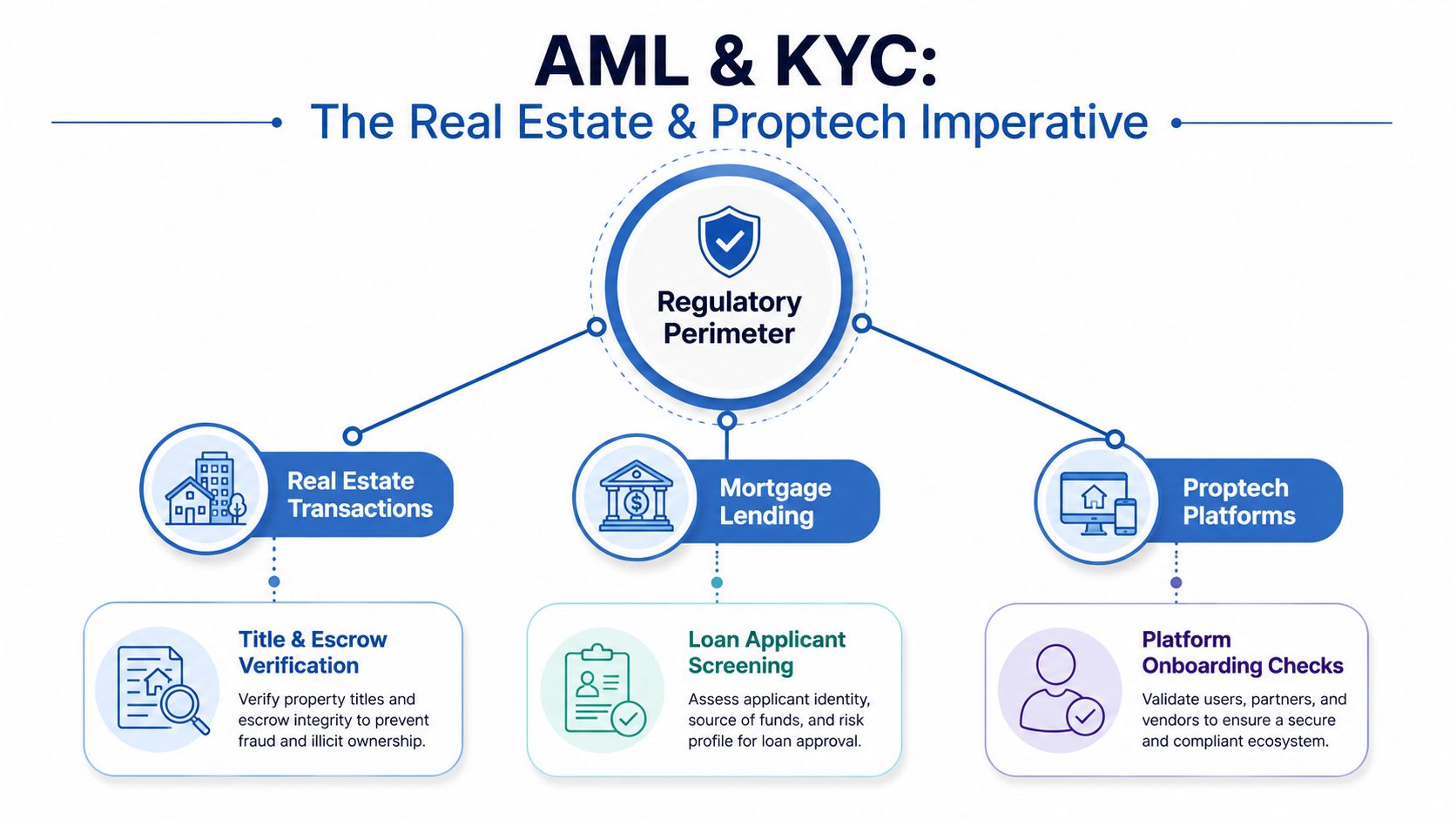
Four anchors, one operating model
The U.S. Bank Secrecy Act provides the core U.S. framework for AML program obligations, reporting, records, and controls. The USA PATRIOT Act strengthened customer identification and financial-crime controls. The FATF Recommendations provide the international risk-based standard that jurisdictions adapt into local rules. The EU AML Regulation, or EU AMLR, creates a more harmonized EU framework and raises expectations around customer due diligence and beneficial ownership.
These aren't four separate programs. A practical risk-based model maps them to one control environment:
| Regulatory anchor | Operational question |
|---|---|
| U.S. Bank Secrecy Act | Can the organization monitor, investigate, report, and retain evidence? |
| USA PATRIOT Act | Can it identify customers and understand account or relationship risk? |
| FATF Recommendations | Can it apply proportionate controls and identify effective control? |
| EU AMLR | Can it apply consistent due diligence and ownership standards where the EU framework applies? |
FATF Recommendation 33 explicitly calls for statistics relevant to the effectiveness and efficiency of AML/CFT systems. FATF's guidance on AML/CFT-related data and statistics therefore matters beyond government reporting. Supervisors increasingly expect firms to show that controls work through measurable indicators, not policies that merely exist in a document repository.
Practical rule: If your team can't explain how a risk rating changed, which data caused the change, who approved the decision, and what happened next, the control isn't operationally mature.
Core Components of a Risk-Based AML KYC Program
A risk-based AML KYC program uses stronger controls where exposure is higher, while preserving a clear baseline for every customer. The framework below focuses on the control evidence a regulator or auditor can inspect.
| Component | Required Control | Common Failure Mode |
|---|---|---|
| Customer due diligence | Verify identity, understand purpose, identify beneficial owners, and assign risk | Treating onboarding as a document-collection exercise |
| Enhanced due diligence | Collect additional evidence for higher-risk relationships and document approval | Escalating informally without a decision record |
| Sanctions screening | Refresh data, tune matching, and document exceptions | Buying a screening tool without testing performance |
| Transaction monitoring | Monitor customer activity and correlate behavior with risk | Using amount-only rules that miss contextual suspicion |
| Suspicious activity reporting | Triage, investigate, escalate, decide, and file within applicable timelines | Allowing alerts to sit without accountable ownership |
| Recordkeeping | Preserve source data, decisions, alerts, approvals, and reports | Keeping final outcomes without the underlying evidence |
| Governance | Appoint a responsible AML officer and test controls | Assuming a vendor owns the regulated firm's obligations |
CDD and EDD
CDD should establish the customer's identity, business purpose, expected activity, ownership structure, and risk factors. For companies, ownership analysis must go beyond the name on an application. FATF guidance requires attention to natural persons exercising effective control, including through layered entities or management rights, and caps the ownership threshold used to identify beneficial owners at a maximum of 25%. FATF beneficial-ownership guidance is a useful reference for that control analysis.
EDD isn't “more documents.” It should answer a defined risk question, such as whether ownership is opaque, the source of funds is difficult to substantiate, or the customer has a relevant public-exposure concern. A politically exposed person, or PEP, is a risk factor requiring proportionate controls, not automatic rejection. For an accessible explanation of the term in an Irish business context, use this PEP definition for Irish companies from Chern & Co.
Screening and monitoring
Sanctions screening requires three controls to operate together: a continuously refreshed database, tuned matching logic, and documented exception handling. The Hong Kong Monetary Authority also expects firms to test whether screening controls continue to perform effectively, making screening a governance and engineering responsibility rather than a one-time vendor configuration. HKMA sanctions-screening guidance supports this control model.
Transaction monitoring should cover all customers and detect unusual activity that may warrant a suspicious-activity report regardless of transaction amount when reasonable grounds for suspicion exist. SFC AML guidance emphasizes the need to connect transaction patterns, behavioral change, and updated customer risk.
Teams building a watchlist architecture can also review global watch-list coverage and screening considerations, then validate that the chosen data and workflow fit the firm's jurisdictions and risk appetite.
How to Operationalize Continuous KYC With Property and Owner Data
Continuous KYC means the firm re-evaluates a relationship when relevant facts change, rather than waiting for a calendar review. In property and mortgage workflows, those facts can include ownership changes, new liens, altered contact details, unusual payment behavior, inconsistent addresses, and a transaction that doesn't fit the customer's stated purpose.
AMLA reported that seven out of ten supervisory filings identified deficiencies in how firms understand and profile client risk, with weaknesses concentrated in outdated onboarding data, weak beneficial-ownership verification, and poor ongoing monitoring. The AMLA risk-profiling discussion shows why a static customer file isn't enough, even in mature markets.
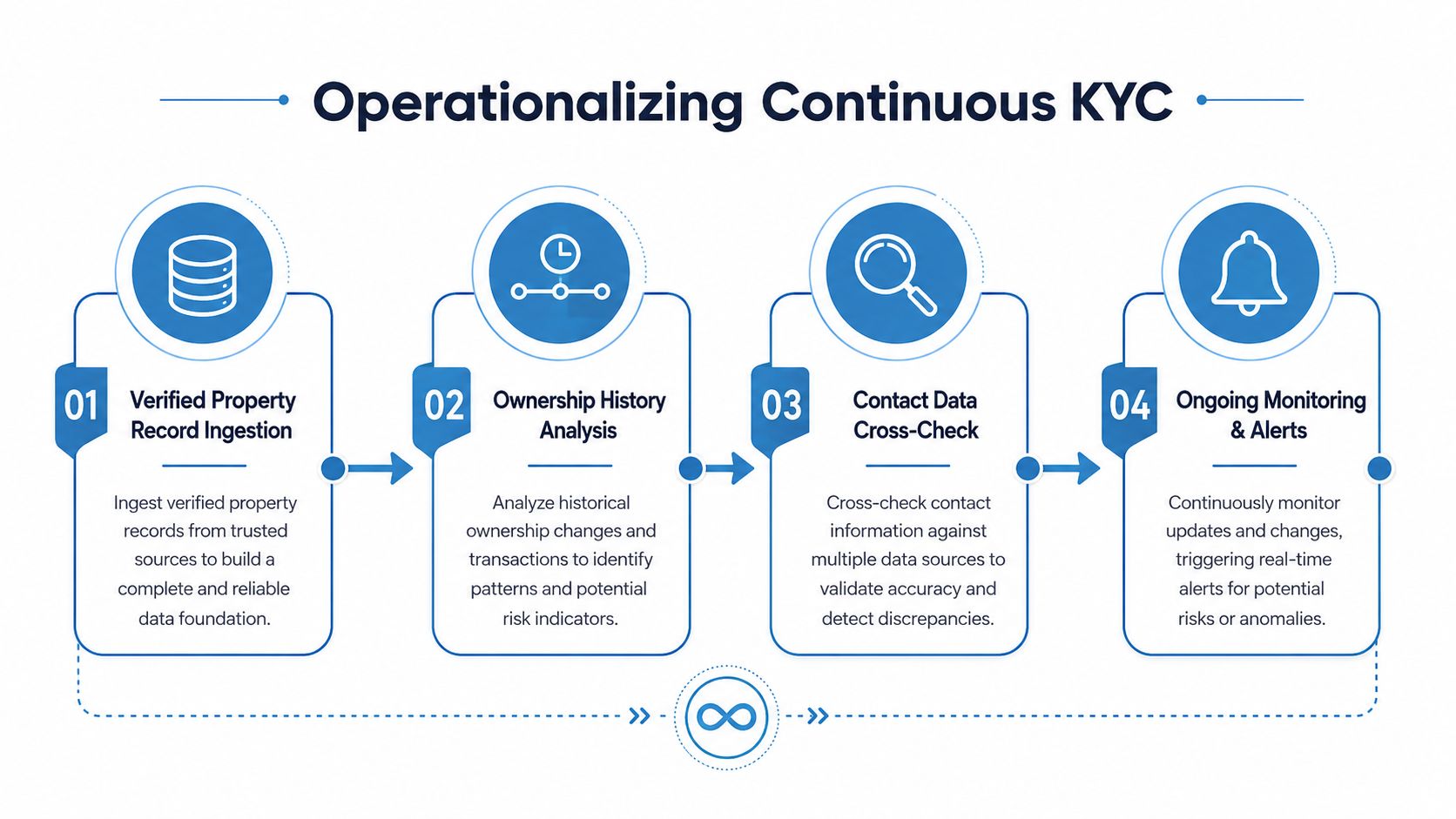
Build the monitoring loop
A workable property-focused loop has four layers:
- Verify the person or business. Capture identity, business purpose, address, ownership, control persons, and expected activity.
- Enrich the risk profile. Connect verified identity data to property records, ownership history, liens, mortgages, contacts, and relevant transaction context.
- Screen refreshed data. Run sanctions and watchlist checks against current names, aliases, owners, controllers, and connected parties. Preserve the screening timestamp, source version, match logic, reviewer, and disposition.
- Re-rate on meaningful change. Trigger a review when ownership changes, contact data conflicts, transaction behavior shifts, or a new risk signal appears.
The API design should reflect the event. Use real-time or low-latency calls when onboarding a customer, opening a transaction, or responding to a trigger event. Use batch delivery for portfolio-wide refreshes, reconciliation, and scheduled re-screening. A practical guide to KYC automation from Zaro provides additional context on turning repetitive verification tasks into managed workflows.
The useful output isn't a data dump. It's a dated, explainable risk decision linked to the evidence that produced it.
The compliance team should define what counts as a material change before engineering builds alerts. Otherwise, every update becomes noise, analysts suppress low-quality signals, and the program loses the ability to distinguish a genuine ownership event from a routine data correction.
An 8-Step Implementation Checklist for Real Estate Teams
A real-estate, mortgage, or proptech team can stand up a practical AML KYC operating model by assigning owners, producing evidence, and setting review cadences from the start.
Scope by product and jurisdiction. Compliance and legal should map the activities, customer types, transaction flows, and jurisdictions covered by the program. Produce a written applicability memo and update it when products or markets change.
Appoint the AML officer. The designated officer needs authority, access to records, escalation rights, and a direct route to senior management. Document responsibilities, deputies, approval rights, and reporting lines.
Map data and systems. Product, engineering, operations, and compliance should inventory application data, identity sources, property records, ownership data, sanctions feeds, case management, and reporting systems. The artifact is a data lineage map showing source, field, refresh method, owner, and retention.
Define the risk matrix. Compliance should set customer, geography, product, ownership, channel, and behavior factors. Keep the rationale visible. A score without an explanation won't help an analyst defend a decision.
Build onboarding controls. Operations should collect and verify identity, business details, beneficial ownership, control persons, purpose, and expected activity. Route exceptions to a documented review queue rather than allowing manual workarounds.
Connect ongoing screening. Engineering and compliance should define screening frequency, matching tolerances, alert ownership, rescreen triggers, and exception outcomes. Test matches with realistic name variation and alias scenarios.
Configure monitoring and escalation. Compliance should translate known risk scenarios into rules or models that consider behavior and profile changes. Every alert needs a priority, owner, deadline, investigation record, and disposition.
Train, test, and audit. Human resources and compliance should train relevant staff, while independent reviewers test design and operating effectiveness. Preserve evidence of training, sample reviews, rule changes, approvals, defects, remediation, and management sign-off.
What the steering group should see
| Owner | Required artifact | Review cadence |
|---|---|---|
| Compliance and legal | Scope memo and risk appetite | On product or jurisdiction change |
| Compliance officer | AML risk assessment and governance record | Scheduled management review |
| Product and engineering | Data lineage and control specifications | At release and material system change |
| Operations | Onboarding and case records | Ongoing quality assurance |
| Independent testing | Findings and remediation tracker | Periodic independent review |
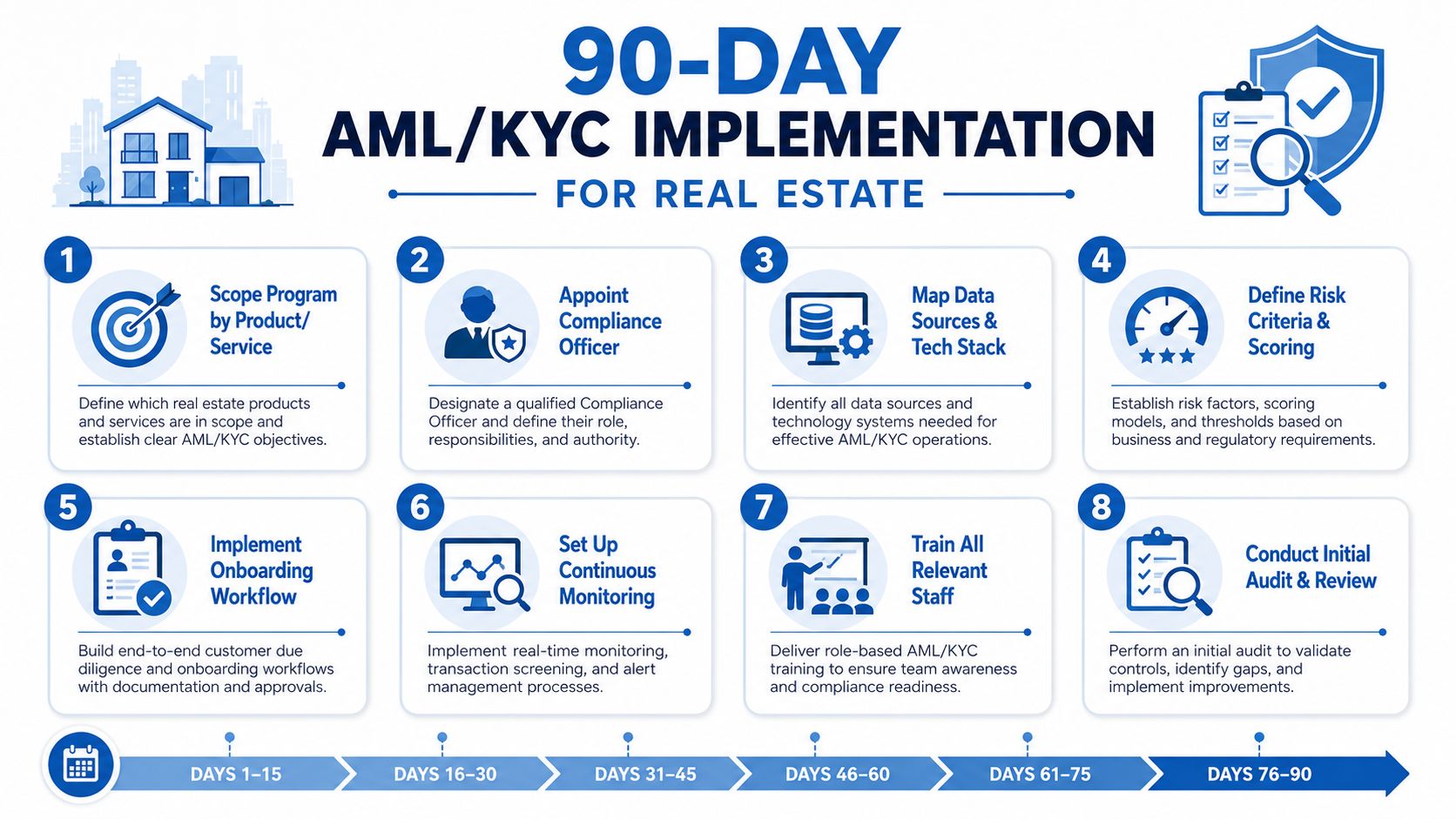
Don't measure the program only by onboarding speed. Track whether analysts receive usable evidence, whether alerts close with consistent reasoning, whether ownership records remain current, and whether management can see unresolved control gaps.
Data, APIs, and Technology Requirements That Survive Audit
Audit-ready technology starts with provenance and freshness, not interface design. A reviewer should be able to identify where a field came from, when it was collected, how it was matched, which transformation occurred, and how the business used it in a decision.
For beneficial ownership, the EU standard is 25% or more of shares, voting rights, or another ownership interest, while the European Commission may lower that threshold to 15% for high-risk categories of corporate entities by 10 July 2029. EU AML package commentary describes that potential change. In the U.S., the Corporate Transparency Act framework identifies a beneficial owner as an individual who owns or controls at least 25% of a reporting company's ownership interests or exercises substantial control, as stated in FinCEN's beneficial ownership fact sheet.
The threshold is only one input. A layered entity can conceal effective control below a simple ownership calculation, so the data model needs ownership chains, control relationships, management rights, and unresolved links.
Choose the delivery pattern by use case
| Use case | Suitable delivery pattern | Audit evidence |
|---|---|---|
| New customer onboarding | API or low-latency request | Request, response, timestamp, match result |
| Ownership or contact trigger | Event-driven API call | Trigger, prior value, new value, review decision |
| Portfolio re-screening | Bulk delivery | File version, population, processing log |
| Data reconciliation | Scheduled batch | Exceptions, corrections, approval history |
A property-data provider should expose coverage, field definitions, update cadence, matching behavior, confidence indicators, security controls, support procedures, and exit options. “Verified” must have a documented meaning. It should identify the source and validation method, not merely describe a marketing category.
BatchData offers 169 million+ U.S. parcels, valuations, and verified owner contacts, with 1,000+ attributes available through APIs and bulk delivery such as S3, Snowflake, or flat files. Its dataset includes ownership history, mortgage and lien details, permits, listings, and pre-foreclosure activity. In a compliance architecture, those fields can supply property and ownership context for onboarding, event-driven review, or portfolio monitoring, subject to the firm's own validation and legal requirements.
Teams should separate identity verification from property enrichment. A property record can support contextual risk analysis, but it doesn't prove that a person is the applicant or that the person controls an entity. For identity architecture, this ID verification API guide helps frame the verification layer separately from broader property intelligence.
Sample Policy Snippets and a SAR Escalation Workflow
The following snippets are starting templates for legal and compliance review, not legal advice.
Risk-based CDD: “The company will identify and verify each customer, understand the purpose and expected activity of the relationship, identify beneficial owners and control persons where applicable, and assign a documented risk rating. The scope of review will reflect the customer, product, geographic, ownership, and behavioral risks identified.”
Ongoing review: “The company will rescreen relevant parties and review customer risk when a material change, new alert, ownership event, contact inconsistency, or unusual activity affects the relationship.”
Recordkeeping: “The company will retain source information, verification results, screening outcomes, alert records, investigation notes, approvals, and reporting decisions for the period required by applicable law and policy.”
A usable escalation workflow assigns ownership at every handoff:
- Alert triage: An analyst validates data quality, removes obvious duplicates, and records the initial rationale.
- Level-one review: The analyst compares activity with the customer profile, ownership, property context, and expected behavior.
- AML officer escalation: Reasonable suspicion or unresolved material risk moves to the designated officer.
- Decision memo: The officer documents facts, analysis, decision, approvals, and any account or transaction restrictions.
- Regulatory filing: If reporting is required, the authorized filer submits the applicable SAR within the governing timeline. SFC guidance supports monitoring that can identify suspicion regardless of transaction amount.
- Feedback: The team updates risk factors, monitoring logic, training, or data requirements when the case reveals a control weakness.
Audit Readiness, Vendor Management, and What Changes Next
Audit readiness means producing the evidence behind the decision, not just the final decision. Examiners commonly need to see the risk assessment, customer files, ownership analysis, screening history, alert investigations, management approvals, training records, quality testing, vendor oversight, and remediation evidence.
Use this review list:
- Ownership evidence: Show the structure reviewed, the natural persons identified, unresolved questions, and approval rationale.
- Screening evidence: Preserve the source version, search parameters, match disposition, reviewer, and retest results.
- Risk-change evidence: Link each rating change to a dated event, data field, analyst assessment, and approval.
- Vendor evidence: Maintain due diligence on coverage, freshness, security, documentation, support, testing, subcontractors, and exit arrangements.
- Control evidence: Reconcile alerts, cases, reports, exceptions, and retained records across systems.
The next risk problem is the connection between AML, KYC, fraud, and payment speed. Synthetic identities and deepfakes can pass an onboarding process that checks only documents and faces. The European Banking Authority has warned that fraud risk in instant-payment environments is ten times higher than in traditional transfer channels, as discussed in 2026 AML risk commentary. Better KYC alone won't solve that exposure. Teams need controls that connect onboarding, transaction monitoring, identity confidence, account behavior, and payment-speed decisions.
The EU ownership framework may also require more granular analysis if the Commission lowers the threshold to 15% for high-risk corporate categories by 10 July 2029, as described earlier. A sound data-compliance framework should therefore govern lawful use, provenance, access, retention, correction, and auditability alongside AML-specific controls.
BatchData provides property records, ownership history, valuations, mortgage and lien details, verified owner contacts, APIs, and bulk delivery that teams can connect to onboarding, due diligence, and portfolio monitoring workflows. Visit BatchData to evaluate the data and integration options for a continuous AML KYC control environment.