
BatchData and Smarty both offer powerful tools for real estate professionals, but they serve different needs. BatchData excels in detailed property data and skip tracing, making it ideal for investors and marketers looking to identify off-market opportunities and contact property owners. Smarty focuses on fast and accurate address validation, ensuring clean, standardized datasets for mailing and analysis.
Key Differences:
- BatchData: Offers 700+ property data points, skip tracing with 76% right-party contact rates, and LLC piercing to uncover ownership details. Pricing starts at $1,000/month for 100K property records.
- Smarty: Excels in address standardization with a 99% USPS match rate and rooftop-level geocoding. Pricing starts at $30/month for 5K address verifications.
Quick Comparison:
| Feature | BatchData | Smarty |
|---|---|---|
| Property Data Points | 700+ (ownership, liens, valuations) | ~350 (structural, financial, locational) |
| Skip Tracing | Yes (76% accuracy) | No |
| Address Validation | Sub-second API response | USPS-certified, 99% match rate |
| Pricing | Starts at $1,000/month | Starts at $30/month |
| Best For | Investors, marketers | Address validation, mailing accuracy |
If you’re managing large-scale property analysis or marketing campaigns, BatchData’s features deliver actionable insights. For clean and verified address data, Smarty is a reliable choice. Decide based on your specific use case and budget.
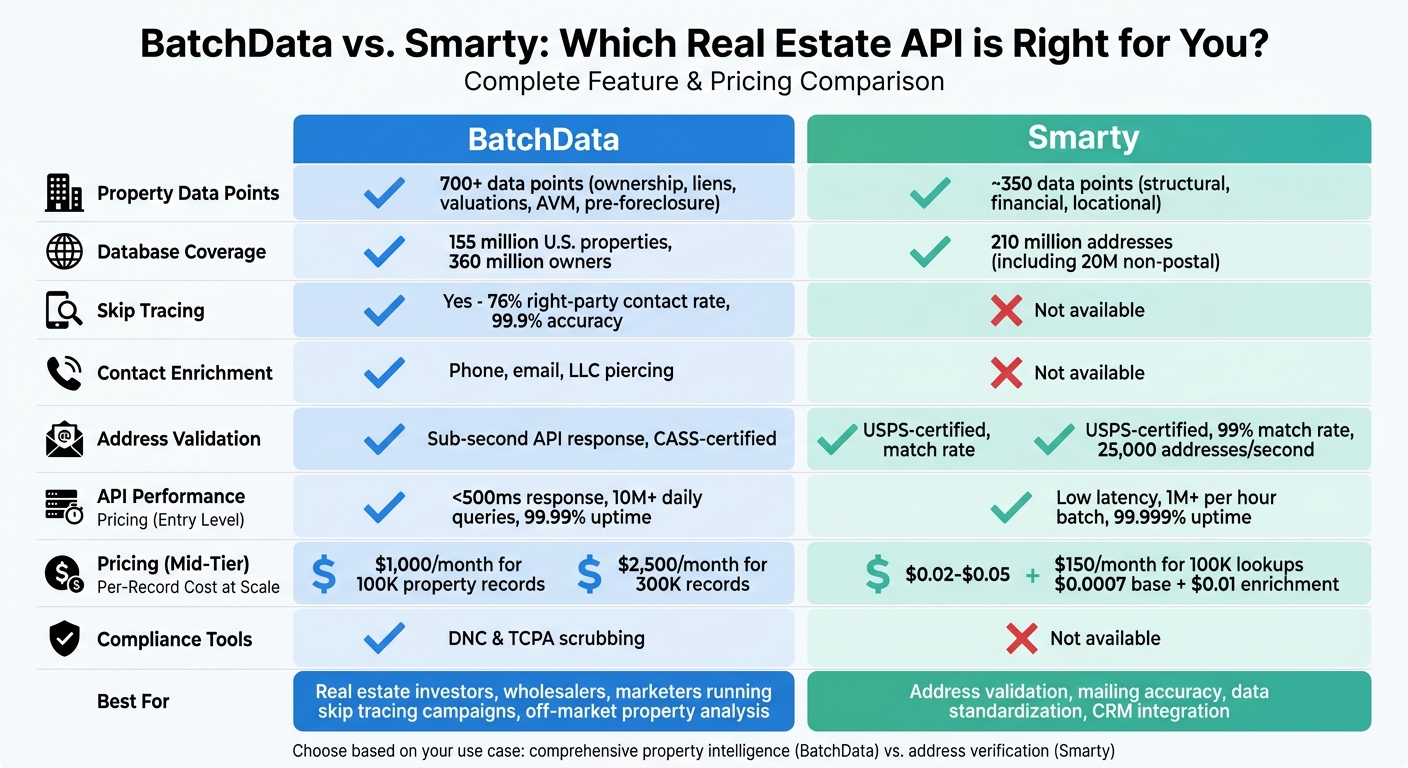
BatchData vs Smarty: Real Estate API Comparison Chart
Property Data for List Building for Motivated Sellers
sbb-itb-8058745
BatchData: Property Data API for Real Estate Professionals
BatchData provides access to a massive database of 155 million U.S. properties, each with over 700 data points, covering 99% of the population. By pulling data from more than 3,200 sources, including county assessors, recorders, mortgage servicers, and MLS feeds, BatchData ensures a steady stream of updates – even during county-level outages.
Features and Capabilities
BatchData’s API offers powerful tools for property data enrichment, delivering details like square footage, year built, tax assessments, open liens, and estimated equity. For skip tracing, it boasts a 76% right-party contact rate, which is about three times the industry average. This is achieved using verified contact information from over 20,000 active feedback sources.
The platform also provides CASS-certified address validation, which cleanses mailing lists by removing duplicates and invalid entries. For bulk operations, BatchData handles millions of records daily, offering delivery via REST API, AWS S3, SFTP, or Snowflake Data Sharing in formats like CSV, JSON, and Parquet.
Real estate wholesalers have reported recovering 30% more contacts from distressed property lists using BatchData’s skip tracing. The platform also includes DNC and TCPA litigator scrubbing, helping users stay compliant and minimize legal risks when running SMS or call campaigns.
These features highlight BatchData’s focus on delivering accurate, actionable data for real estate professionals.
Data Accuracy and Coverage
BatchData ensures 97% overall accuracy through rigorous daily updates and validation processes. Its coverage spans all 50 states and 3,143 counties, with urban areas receiving quarterly refresh rates exceeding 100%. While rural properties make up less than 1% of the database, the platform maintains near-perfect reliability with 99.99% uptime and sub-second response times for real-time queries.
Integration and Developer APIs
The RESTful API, designed for speed and efficiency, supports low-latency GET/POST requests (under 200ms) and uses JSON payloads with OAuth for secure access. Developers can leverage robust SDKs in Python, Node.js, and PHP, along with detailed documentation available through Swagger UI and GitHub.
For high-volume operations, BatchData processes up to 10 million records daily, with enterprise SLAs ensuring consistent performance. Integration with tools like Zapier, N8N, and Make.com simplifies workflows, reducing manual data entry by 80%, which is particularly valuable for agents managing large property portfolios.
With these integration options, BatchData enables real estate professionals to automate tasks and make faster, more informed decisions.
Smarty: Address and Property Data Services
Smarty processes and verifies U.S. addresses against a massive database of over 210 million records, including 20 million non-postal addresses, sourced from more than 10,000 data points. It also provides access to 350+ property attributes spanning structural, financial, and locational details.
Core Features
Smarty excels at standardizing addresses to USPS format, achieving an impressive 99% match rate. Each address is assigned a persistent SmartyKey®, a unique identifier that remains constant even if the address changes. With the ability to process over 25,000 addresses per second, Smarty allows real estate professionals to integrate datasets from multiple sources – like MLS and loan origination systems – without the risk of creating duplicate records.
The property data enrichment service dives deep into property details, offering:
- 150+ structural attributes: Includes square footage, roof material, and foundation type.
- 130+ financial metrics: Covers market value, assessed value, and mortgage loan amounts.
- 60+ locational attributes: Includes structure elevation, zoning details, and parcel boundaries.
Monthly updates ensure the data stays current, reflecting changes like renovations or ownership transfers. For spatial analysis and workflows like risk modeling or property valuation, Smarty also provides rooftop-level geocoding for pinpoint accuracy.
Data Accuracy and Coverage
Smarty’s dataset is updated every month and spans all 50 states, covering both residential and commercial properties. By incorporating 20 million addresses not found in USPS records, Smarty delivers a broader perspective, especially useful for rural or newly developed areas. The SmartyKey ensures that address data remains reliable over time, even as municipal boundaries shift or addresses are reassigned.
Developer Tools and Integration
Smarty makes its platform highly accessible for developers with a range of tools and integrations. These tools are essential for any developer building a real estate API solution. It offers SDKs in nine programming languages (.NET, Go, iOS, Java, JavaScript, PHP, Python, Ruby, Rust) along with no-code solutions like Excel add-ins, Google Sheets add-ons, and a QGIS plugin. Developers can explore functionality using API Playgrounds and detailed Postman documentation.
Additionally, Smarty supports ETag headers, which help reduce costs by returning a 304 status if data hasn’t changed since the last query, ensuring users aren’t charged unnecessarily.
For those interested in trying Smarty, the free trial includes 1,000 lookups with access to all 350+ property attributes. The Professional Plan is available for $350 per year, while custom plans can scale to handle anywhere from 50,000 to over 250 million lookups annually.
Feature Comparison: BatchData vs. Smarty
Property Data and Contact Enrichment
BatchData offers an extensive range of over 700 property data points, including core property details, valuations (AVM), sales history, mortgage specifics, lien balances, and pre-foreclosure data. Its database spans 160 million properties and 360 million property owners. What sets BatchData apart is its proprietary linking logic that reveals the individuals behind LLCs and trusts, a feature essential for real estate investors and commercial teams targeting decision-makers.
For contact enrichment, BatchData delivers verified phone numbers and email addresses with an impressive 99.9% accuracy rate. It also includes daily-updated DNC and TCPA scrubbing, reducing legal risks for marketing teams. Smarty, by contrast, focuses on address standardization and property attributes, offering approximately 350 data points related to structural, financial, and locational information. However, Smarty does not provide skip tracing or contact enrichment services.
Both platforms enhance their data offerings with tools for bulk address verification and delivery, streamlining processes for users.
Address Verification and Bulk Delivery
In addition to its contact enrichment capabilities, BatchData integrates address verification into its broader property intelligence system, maintaining high performance in this area. Users can access data through REST API, Snowflake, S3, or flat file exports. Its pay-as-you-go pricing and custom data extraction options make it a flexible choice for real estate teams handling instant lookups or large-scale market analyses without long-term commitments.
Smarty, on the other hand, excels in fast and accurate address validation that complies with USPS standards. While both platforms provide reliable address processing, BatchData’s broader range of features makes it well-suited for more comprehensive real estate and marketing needs.
Feature Comparison Table
Here’s a quick look at how BatchData and Smarty stack up against each other:
| Feature | BatchData | Smarty |
|---|---|---|
| Property Data Points | 700+ to 1,000+ (including AVM, liens, permits, pre-foreclosure) | ~350 (structural, financial, locational) |
| Contact Enrichment | Database of 360M+ owners with mobile, landline, and email verification at 99.9% accuracy | Not available |
| LLC Piercing | Proprietary linking to identify individuals behind entities | Not available |
| Address Validation Speed | Sub-second API response times | Recognized for fast address validation |
| Compliance Tools | Real-time DNC & TCPA litigator scrubbing | Not available |
| Bulk Delivery Options | REST API, Snowflake, S3, flat file exports | Not specified |
| Skip Tracing Accuracy | 76% right-party contact rate | Not applicable |
Pricing, Scalability, and Integration
Pricing Models and Cost Comparison
BatchData and Smarty take different approaches to pricing, catering to various needs in the real estate and data verification sectors.
BatchData offers monthly subscription plans tailored to record volume, starting at $1,000 per month for 100,000 property records (Growth tier). The costs increase to $2,500 for 300,000 records (Professional tier) and $5,000 for 750,000 records (Scale tier). For businesses with larger requirements, custom Enterprise pricing is available. Skip tracing services are priced higher, beginning at $2,000 per month for 100,000 traces and climbing to $20,000 for the Enterprise plan, which supports up to 3,000,000 traces. Additional features like MLS Data ($600/month), Building Permits ($1,250/month), and Property Valuations ($600/month) are offered as optional add-ons.
Smarty focuses on address verification with tiered pricing. The Starter plan costs $30 per month for up to 5,000 U.S. address verifications, while the Pro plan supports 100,000 lookups for $150 monthly. For property data enrichment, there’s an add-on cost of $0.01 per enrichment, and Enterprise plans start at $2,000 per month for bulk data processing. Smarty also provides pay-per-use credits for low-volume users at $0.0007 per validation.
When comparing costs at scale, BatchData offers better value for high-volume operations, with per-record costs ranging from $0.02 to $0.05. Smarty’s base validation costs approximately $1,000 for 100,000 lookups, but the addition of property data enrichment can increase total costs by 30–50% for comprehensive services. Analysts highlight that BatchData becomes especially economical for large-scale skip tracing, with costs per lead dropping below $0.10 for high-volume usage.
Scalability for High-Volume Operations
Both BatchData and Smarty excel in handling large-scale operations, but their strengths cater to different use cases.
BatchData supports unlimited API calls with a 99.99% uptime guarantee and processes over 10 million queries daily. This makes it a reliable choice for real estate firms managing extensive skip tracing campaigns, with response times consistently under 500 milliseconds. The platform’s tiered pricing ensures smooth scalability, accommodating growth from 100,000 to over 3,000,000 records monthly. For enterprise users, BatchData also offers a self-hosted data infrastructure option known as MCP Server, providing additional control and flexibility.
Smarty, on the other hand, leverages a cloud-based system capable of processing billions of validations annually. Its asynchronous batch processing can handle up to 1 million records per hour, with elastic throughput supported by global content delivery networks. Smarty guarantees 99.999% uptime, ensuring consistent performance. Property investment firms report smooth operations when enriching up to 500,000 leads per month without any noticeable slowdown.
While both platforms deliver enterprise-level scalability, BatchData is particularly well-suited for businesses needing detailed property intelligence at high volumes.
Pricing and Scalability Comparison Table
| Feature | BatchData | Smarty |
|---|---|---|
| Entry-Level Monthly Cost | $1,000 (100K property records) | $30 (5K verifications) |
| Mid-Tier Monthly Cost | $2,500 (300K records) | $150 (100K lookups) |
| Enterprise Monthly Cost | $20,000 (3M skip traces) | $2,000+ (custom volume) |
| Per-Record Cost at Scale | $0.02–$0.05 | $0.0007 base + $0.01 enrichment |
| Maximum Daily Queries | 10M+ | 1M+ per hour batch processing |
| API Response Time | <500ms SLA | Low latency |
| Uptime Guarantee | 99.99% | 99.999% |
| Integration Methods | API, Snowflake, S3, Zapier, Make.com, N8N | API, Zapier, HubSpot, pre-built SDKs |
| Setup Time | ~1 hour for CRM integration | ~15 minutes average |
| Developer Support | Dedicated account manager (Enterprise) | 50+ code examples, 10+ language SDKs |
Real Estate Use Cases: Property Intelligence and Investment Analysis
Real estate investors and marketers can tap into BatchData’s tools to gain deeper insights into properties and enhance their investment strategies.
Property Intelligence and Market Research
BatchData provides data on 155 million U.S. properties, giving investors the ability to track market trends and identify undervalued properties. With access to ownership records, tax assessments, and sales history, users can create heat maps to visualize appreciation rates in specific neighborhoods. For example, investors can analyze bulk parcel data to pinpoint suburban areas showing 15-20% annual value growth based on historical comparisons.
The platform also monitors critical indicators like pre-foreclosure status, Notices of Default, auction dates, and unpaid balances. This helps investors discover off-market opportunities before they hit the open market. Filters such as estimated equity, Loan-to-Value (LTV) ratios, and Automated Valuation Models (AVM) ensure that potential deals offer solid investment margins. Additional insights, like absentee ownership, ownership length exceeding 20 years, and corporate versus individual ownership, help identify sellers who may be open to below-market offers.
Smarty, on the other hand, specializes in USPS-certified address verification with an impressive 99.99% accuracy rate. By appending latitude and longitude coordinates, Smarty enables spatial analysis, allowing real estate analysts to overlay data onto GIS maps. This often reveals trends such as proximity to amenities that can boost property values by 10-15% in urban areas. While Smarty is excellent for address standardization and market scanning, its ownership insights are less detailed compared to BatchData’s extensive property-specific data.
These insights are further enhanced by BatchData’s skip tracing capabilities, which are key for targeted marketing efforts.
Skip Tracing and Marketing Campaigns
BatchData’s skip tracing API takes property intelligence a step further by aggregating verified contact details, including phone numbers, emails, and owner information, from public records. The tool achieves 85-95% contact match rates, making it highly effective for reaching off-market property owners. Investors using this feature for direct mail and SMS campaigns report 25% higher response rates when sourcing wholesale leads. With access to over 200 million owner records and 92% accuracy for contact appends, BatchData is ideal for large-scale campaigns.
Smarty complements these efforts by focusing on address verification, which can reduce undeliverable mail by up to 98%. Its global autocomplete feature also supports targeted digital campaigns. When integrated with CRMs, Smarty validates contacts in real time, leading to a 30% increase in email open rates for real estate outreach. However, Smarty’s primary strength lies in cleansing and verifying contact lists rather than sourcing comprehensive contact details, making it a great tool for ensuring accuracy in marketing databases.
Feedback from real estate professionals highlights the strengths of each platform. Experts on REI BlackBook forums commend BatchData for its "end-to-end property-to-contact workflows", earning it a 4.8 out of 5 rating on G2 for its data depth. Smarty, meanwhile, is praised on Capterra for its speed and reliability, earning a 4.9 out of 5 rating, particularly for its "bulletproof address tools." Investors often choose BatchData for its comprehensive property insights, while marketing teams lean toward Smarty for accurate address validation.
Case Study Examples
Real-world examples illustrate how these tools deliver results.
One investment firm used BatchData’s bulk property API to analyze 10,000 parcels in a target ZIP code. By identifying 500 distressed properties through absentee owner flags and tax delinquencies over 90 days, they secured 15 off-market acquisitions at 20-30% below market value, saving a total of $750,000.
In another instance, a wholesaler processed 5,000 leads using Smarty’s API. They standardized addresses and geocoded them for segmentation before appending contact details via CRM integration. This approach resulted in a 40% contact rate through SMS campaigns, ultimately landing 8 contracts and achieving a 5x ROI on a $2,500 ad spend.
For businesses managing large-scale workflows, combining the strengths of both platforms proves effective. A hybrid approach might involve using BatchData for initial property data and skip tracing, followed by Smarty for address validation before CRM uploads via Zapier. This setup can handle 100,000 records daily, blending BatchData’s enrichment with Smarty’s address accuracy to streamline off-market property searches.
Which Address & Property Data API is Right for Your Business?
Summary of Key Differences
BatchData stands out by offering an extensive range of property insights, with over 1,000 data points covering more than 155 million U.S. properties. These include automated valuation models (AVMs), lien details, pre-foreclosure information, and ownership records, giving users a comprehensive view of property data.
One of its standout features is Contact Append, which enhances skip tracing by turning property addresses into actionable leads. This feature provides verified phone numbers and emails, delivering an impressive 74% Right Party Contact rate. By combining detailed property intelligence with targeted contact enrichment, BatchData offers a cost-effective tool for actionable insights. These attributes make it a strong contender for businesses seeking a reliable property data solution.
Final Recommendation
For real estate professionals who need in-depth property insights – such as equity analysis or pre-foreclosure tracking – BatchData is a top choice. It’s especially useful for wholesalers, fix-and-flip investors, and marketing teams managing large-scale campaigns. Its data enrichment and skip tracing tools can significantly improve return on investment.
Consider testing BatchData with a sample dataset to validate key metrics, like the RPC rate, before fully integrating it into your workflow.
FAQs
Can I use both APIs together in one workflow?
Yes, you can integrate BatchData APIs within a single workflow. The platform allows you to combine various API services, such as property search, contact enrichment, skip tracing, and bulk data delivery. This setup streamlines workflows by merging real-time data access with large-scale datasets, making it easier to handle tasks like property analysis, lead generation, and portfolio management – all within one system.
How do I estimate my monthly cost for my record volume?
To figure out your monthly expenses, start by estimating how many records or API calls you’ll need. Then, multiply that number by the rate for your selected BatchData plan. For instance, the Growth plan is priced at $1,000 per month for 100,000 records, which works out to roughly $0.0066 per record as your volume increases. To get a precise estimate tailored to your requirements, try BatchData’s pricing calculator.
What data should I test first before fully integrating?
To begin, prioritize testing the accuracy and timeliness of property data. Focus on verifying property details and owner contact information using real-time validation methods. This step ensures the data is dependable for activities like skip tracing or property analysis. Also, assess the API’s contact enrichment and skip tracing features, including metrics like the right-party contact (RPC) rate, to determine if it aligns with your outreach and lead generation requirements.