BatchData and REIPro are two real estate platforms that help investors research properties, generate leads, and manage their investing workflows, but they take different approaches. BatchData focuses on property intelligence, contact enrichment, data delivery, and scalable workflows, while REIPro provides a more structured set of tools designed to guide real estate investors through the investing process.
- BatchData: Provides property and contact data, skip tracing, property intelligence, APIs, bulk data delivery, and data enrichment capabilities for investors and businesses that need scalable data workflows.
- REIPro: Offers tools designed to support real estate investors with lead generation, deal analysis, marketing, contracts, and structured investing workflows.
Quick Comparison:
| Feature | BatchData | REIPro |
|---|---|---|
| Primary Focus | Property intelligence, data enrichment, skip tracing, and APIs | Real estate investing workflow and lead management |
| Data & Research | Detailed property and contact data with advanced filtering | Property research and investing-focused data |
| Analytics | Property intelligence and data-driven lead analysis | Deal analysis and investment planning tools |
| Skip Tracing | Available for contact enrichment and owner identification | Available as part of its investing workflow |
| Target Audience | Investors, businesses, and teams needing scalable data solutions | Real estate investors seeking an all-in-one workflow |
| Integrations | APIs and bulk data delivery options | Integrated tools for managing investing activities |
Overall, BatchData is better suited to users who prioritize scalable property data, contact enrichment, automation, and integrations. REIPro may be a better fit for investors who want a more structured platform that brings lead generation, deal analysis, and investing workflows together.
BatchData vs REIPro: Complete Feature and Pricing Comparison for Real Estate Investors
Property Data and Intelligence
Data Coverage and Accuracy
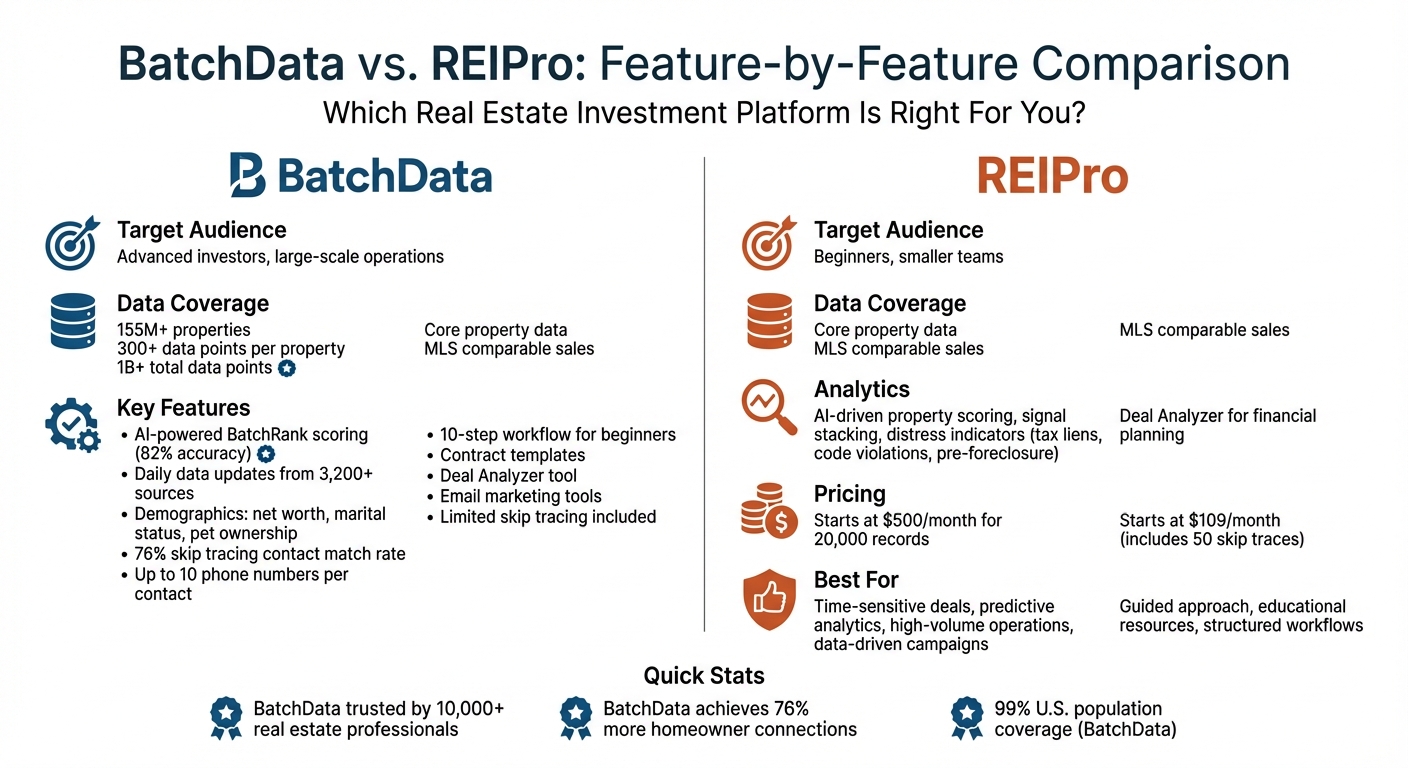
BatchData covers an impressive 155 million properties, reaching 99% of the U.S. population. Its data is refreshed daily from over 3,200 sources and validated through a real-time feedback loop involving more than 20,000 active users. Each property record contains anywhere from 300 to over 1,000 data points, including details like net worth, marital status, and even pet ownership.
On the other hand, REIPro focuses on core property data – such as mortgage information, property values, and basic features – along with MLS comparable sales data. It also provides educational tools like a 10-step workflow and contract templates aimed at helping new investors. While REIPro offers a solid foundation, BatchData’s broader scope and fast updates are ideal for investors working on time-sensitive deals.
The importance of up-to-date information cannot be overstated. As Ivo Draginov, President of BatchData, puts it:
“Data freshness means daily updates and real-time checks for content accuracy. It is what separates productive deal-making from wasted effort.”
This commitment to accuracy and frequent updates lays the foundation for advanced analytics.
Analytics and Scoring Tools
BatchData leverages machine learning through its BatchRank AI to predict which properties are most likely to sell. During tests conducted from August to early October 2025, it achieved an 82% accuracy rate in forecasting property sales. This tool enables users to sift through thousands of leads and focus on the top 50 properties most likely to sell in a specific area. The platform also supports signal stacking, allowing users to combine distress indicators – like tax liens and code violations – to zero in on motivated sellers.
In comparison, REIPro offers a “Deal Analyzer” tool that focuses on financial scenario planning rather than predictive analytics. While this helps users assess potential returns, it doesn’t provide insights into seller motivation or market timing. BatchData, however, monitors both financial indicators (pre-foreclosures, tax liens, bankruptcies, probate) and physical signals (code violations, abandoned properties, deferred maintenance) to identify distressed properties. Pre-foreclosure filings, for instance, are typically added to the system within 24 to 48 hours of being recorded. Users can even set up automated alerts to stay informed when properties meeting their criteria hit the market.
This combination of predictive analytics and distress tracking gives investors a powerful edge in identifying lucrative opportunities quickly.
Skip Tracing and Contact Enrichment
Skip Tracing Accuracy
BatchData provides skip tracing and contact enrichment designed to help users identify and reach property owners more efficiently. The platform uses multiple data sources and validation processes to improve the quality and reliability of phone, email, and mailing-address information.
Contact data can vary by individual record, location, and the availability of current information. For this reason, skip tracing results should be treated as data intelligence rather than a guarantee of successful contact. Users can use available contact and confidence information to prioritize records and focus their outreach efforts.
BatchData supports both bulk and automated workflows, allowing users to process large property or lead lists and integrate enriched contact data into their existing systems. This makes skip tracing useful for real estate teams that need to identify property owners at scale without manually researching each record.
Contact Enrichment Features
BatchData doesn’t stop at accurate skip tracing – it goes further by offering robust contact enrichment features. Users gain access to multiple phone numbers (up to 10 in advanced configurations) and at least two verified email addresses for each property owner. To help prioritize outreach, each contact method is scored based on recency, validity, and reachability. Additionally, the platform identifies whether numbers are mobile or landline, complete with carrier details, which is essential for maintaining TCPA compliance when using automated calls or texts.
One standout feature is the ability to “See Behind LLCs” and trusts. Using proprietary linking logic, BatchData identifies the actual decision-makers behind corporate-owned properties. This feature allows users to map relationships by connecting individuals to all their properties nationwide.
Compliance is built into the system. Tools like automated Do Not Call (DNC) registry checks and TCPA litigator flagging are updated every 24 hours to keep users protected. For seamless workflows, BatchData supports real-time API integration, enabling “enrich on ingest” functionality. This means leads can be automatically skip-traced as they’re added to a CRM.
Chris Finck, Director of Product Management, captures the platform’s efficiency perfectly:
What used to take 30 minutes now takes 30 seconds. BatchData makes our platform superhuman.
Lead Generation and List Building
BatchData simplifies lead generation by combining detailed property intelligence with accurate contact data, making it easier to run data-driven campaigns.
List Stacking and Filtering Options
With BatchData’s extensive property dataset, enterprise users can filter leads based on highly specific criteria. For instance, users can refine searches by pet ownership, smoker status, discretionary income, or even permit types like solar, roof, HVAC, or pool installations.
Features like the “Deal Analyzer” and “Smart Search” tools help identify shared distress factors across lists, making it easier to detect patterns and prioritize leads with the highest potential. BatchRank AI further enhances this process by scoring homeowners based on their likelihood to sell, helping investors zero in on the most promising opportunities. This level of precision allows for hyper-targeted campaigns that lead to quicker and more efficient deal-making. To help ensure compliance, the platform includes built-in DNC registry checks and litigator flagging, providing an extra layer of protection during list building.
BatchData also offers demographic filtering options, including insights into owner age, marital status, and net worth – data that’s often missing from simpler platforms. This added detail enables investors to craft campaigns aimed at specific groups, such as pre-foreclosure properties, absentee owners, or high-equity homeowners within particular income brackets. Once these precise lists are created, BatchData ensures the information integrates smoothly into your existing workflows.
Exporting and Bulk Data Delivery
Once your lists are ready, BatchData provides options for exporting, delivering, and integrating property and contact data into existing workflows. Businesses can use bulk data delivery and API-based solutions to move enriched data into their internal systems, databases, and applications.
For larger operations, BatchData can support automated data delivery and integrations based on the customer’s requirements. Available delivery methods and integration options may vary depending on the dataset, workflow, volume, and technical requirements.
Developers can use BatchData’s APIs for property and contact data lookups and automated workflows, while businesses with larger data requirements can explore custom delivery options. BatchData can also help enrich or enhance existing datasets, allowing teams to work with their current lead databases rather than rebuilding their lists from scratch.
For current export capabilities, delivery methods, integrations, and availability, users should contact BatchData to discuss their specific data requirements.
APIs, Integrations, and Professional Services
BatchData provides developers and enterprise teams with tools like APIs, cloud integrations, and managed services to support faster, smarter real estate decisions.
Developer APIs
BatchData offers a real-time REST API that’s easy to integrate into custom applications, with SDKs available for Python and Node.js. This API provides access to over 700 property data points, such as valuations, tax records, and sales history. A highlight is its ability to handle compound queries, allowing users to retrieve multiple datasets in a single request, which minimizes delays. Interactive documentation is available, letting developers test API calls and see live responses. Standard plans come with rate limits designed for most use cases, while enterprise plans cater to high-volume operations with dedicated infrastructure and increased throughput.
Third-Party Integrations
For teams relying on modern data warehouses, BatchData simplifies the process by delivering standardized datasets directly into platforms like Snowflake, BigQuery, and Databricks, eliminating the need for complex ETL workflows. Additionally, data can be delivered as Parquet files to storage solutions such as Amazon S3 and Google Drive. Within its ecosystem, BatchData integrates seamlessly with BatchDialer for predictive dialing and BatchLeads for lead generation, enabling a streamlined workflow that combines property insights, contact enrichment, and outreach. For teams with specialized needs, BatchData also develops tailored data workflows.
Custom Data Solutions
BatchData’s Data Concierge service is designed for enterprise clients needing custom data pipelines, workflow integrations, or system evaluations. Services include custom development, data normalization, and enrichment to create dependable data platforms aligned with specific business goals. For companies transitioning from older systems, BatchData offers white-glove support for data matching and migration. The platform’s delivery options are flexible – on-demand, self-serve, or fully managed concierge services – with custom datasets and schedules. These solutions are built to handle the scale and complexity of advanced real estate operations.
Pricing and Scalability
BatchData’s pricing structure is designed to accommodate a wide range of real estate data needs, ensuring flexibility and scalability for businesses of all sizes.
Pricing Models and Flexibility
BatchData offers flexible options designed to support different property data, contact enrichment, skip tracing, API, and bulk data delivery requirements. Pricing can vary based on the products selected, data volume, usage, integrations, and specific business needs.
Businesses with larger or specialized requirements can explore custom solutions, including tailored data delivery, API integrations, and managed services. For teams with specific skip tracing requirements, available options may vary depending on the volume and type of data being processed.
Because pricing, plans, and product availability may change over time, businesses should contact BatchData directly for current pricing, available options, and volume-based commercial terms.
These flexible options allow businesses to select solutions based on their data requirements and scale their usage as their workflows grow.
Pricing and Scalability
BatchData’s pricing is designed to support different data volumes, workflows, and business requirements. Available pricing can vary based on the products selected, data volume, API usage, skip tracing requirements, integrations, and other business needs.
Pricing Models and Flexibility
BatchData offers flexible options for accessing property and contact data, including API-based solutions, bulk data delivery, skip tracing, and custom enterprise services. Businesses with larger or specialized requirements can work with BatchData on custom data solutions, integrations, and delivery schedules.
For teams with occasional skip tracing needs, pay-as-you-go options may also be available, depending on the selected service and current commercial terms.
Because pricing and product availability can change, businesses should contact BatchData directly for current pricing, volume options, and plan details.
Scalability for Different Business Sizes
BatchData supports workflows ranging from smaller data projects to large-scale enterprise operations. Teams can use property data, contact enrichment, skip tracing, APIs, and bulk data delivery according to their specific requirements.
Enterprise customers can also request customized solutions, including data integrations, automated delivery, custom datasets, and managed services. This allows organizations to scale their data workflows without relying on a fixed plan structure.
The best option depends on factors such as record volume, data fields required, frequency of updates, API usage, skip tracing needs, and integration requirements. For the most accurate and up-to-date information, review BatchData’s current offerings or contact the BatchData sales team.
Conclusion
BatchData and REIPro take different approaches to real estate investing. BatchData is built around property intelligence, contact enrichment, predictive analytics, and scalable data workflows, while REIPro focuses more on guided investing workflows and tools for beginners.
For investors who need detailed property data, advanced filtering, skip tracing, APIs, and automation, BatchData offers a more data-driven approach. REIPro may be a better fit for investors who prefer a structured platform with built-in workflows and educational resources.
The right choice ultimately depends on your investing strategy, team size, and data requirements. If your priority is building scalable, data-driven lead generation and integrating property intelligence into existing workflows, BatchData provides the flexibility to support those needs.
Before choosing a platform, compare the features, data coverage, integrations, and current pricing that matter most to your business.
FAQs
How do I choose between BatchData and REIPro for my investing goals?
When deciding between BatchData and REIPro, it comes down to what you need most.
BatchData is tailored for those who want scalable real estate data and advanced tools. It offers features like skip tracing, property analytics, and APIs, making it a great choice if you’re looking for automation and seamless integration.
On the other hand, REIPro is designed with newer investors in mind. It provides lead generation tools, distressed property lists, and educational resources to help you get started in real estate.
Your choice depends on whether you prioritize high-level data solutions or tools and support geared toward beginners.
What data sources power BatchData, and how is accuracy verified?
BatchData combines property, ownership, contact, and public-record data from multiple sources and applies validation processes to improve data quality. Contact information can be cross-checked using multiple data signals, while property records are regularly updated to help keep information current.
Because data availability and accuracy can vary by record and location, no data provider can guarantee that every record will be completely accurate. Users should verify important information before making business or outreach decisions.
Can BatchData connect to my CRM or data warehouse automatically?
BatchData integrates seamlessly with your CRM or data warehouse using its API connections. It works with platforms like Salesforce and HubSpot, offering real-time data enrichment and automated triggers to simplify and optimize your workflows.