Building a custom real estate CRM can be expensive, especially when API integrations are involved. These integrations can connect your CRM to systems such as MLS databases, payment processors, and mapping tools. Key cost factors include development, ongoing maintenance, third-party service fees, and integration complexity. Here’s a quick summary:
- MLS API Integrations: Costs vary depending on the provider, data access requirements, and integration complexity.
- CRM/ERP Sync: Costs vary based on the systems being connected, implementation requirements, and ongoing maintenance.
- Payment Gateways: Costs vary by provider and may include setup, transaction, or processing fees.
- Mapping APIs: Costs vary based on the provider, usage volume, and features required.
- BatchData APIs: Contact BatchData for current pricing based on your data requirements, usage, and integration needs.
Recurring costs can include maintenance, hosting, third-party services, and API usage. When evaluating an integration, consider both implementation costs and ongoing operational requirements. Security is also an important consideration when connecting external APIs and handling sensitive data.
Balancing implementation requirements, ongoing costs, and business needs is key to building a successful CRM.
Recurring costs often exceed initial development expenses, with maintenance alone making up over 50% of the total cost. However, these integrations can save time, reduce errors, and improve efficiency, often delivering ROI within 6–18 months. Security is also critical, as API-related attacks have surged by 400% since 2023. Balancing costs and benefits is key to building a successful CRM.
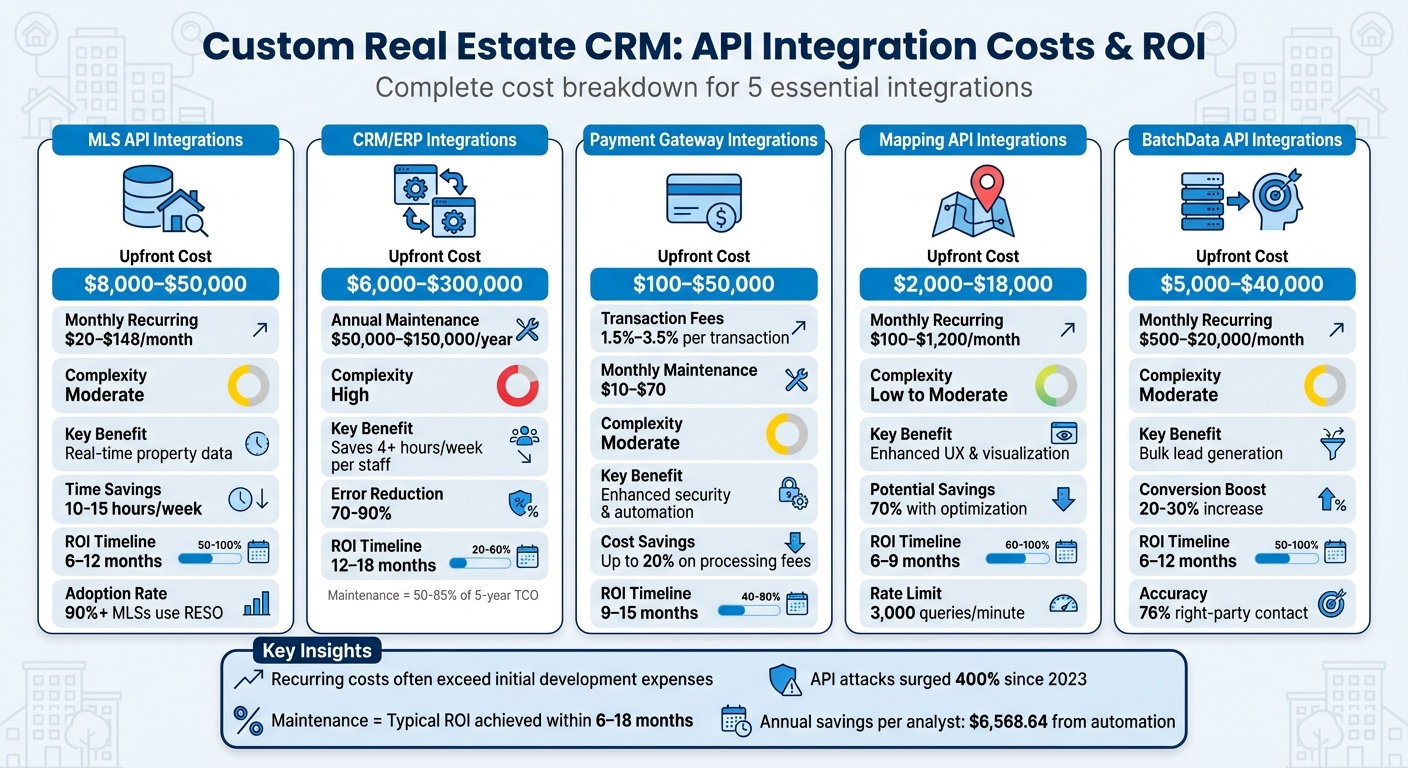
Custom Real Estate CRM API Integration Costs and ROI Comparison
1. MLS API Integrations
Development Cost
The cost of integrating an MLS feed varies depending on the number of MLS systems involved, data requirements, normalization needs, and integration complexity. Basic integrations may require less development effort, while multi-MLS enterprise systems can require additional work for data normalization, display rules, security, testing, and ongoing maintenance.
The RESO Web API is an industry-standard approach for accessing real estate data and has largely replaced the older RETS system. Integration timelines and requirements vary depending on the MLS providers and systems involved.
Recurring Fees
Ongoing costs for MLS integrations vary by MLS, access agreement, data provider, and connection type. Some providers may charge recurring access or service fees, while third-party API services may offer different pricing models.
Always confirm current pricing and access requirements directly with the relevant MLS or API provider.
Integration Complexity
MLS API integration comes with technical considerations such as authentication, access controls, data normalization, OData queries, changing MLS requirements, payload changes, and rate limits. Developers should design integrations to handle provider-specific restrictions and API changes reliably.
For larger datasets, efficient pagination, caching, asynchronous processing, and appropriate rate-limit handling can help maintain reliable API performance.
Real Estate ROI Impact
MLS-fed systems can help real estate professionals automate data workflows, reduce manual processing, and keep property information synchronized across applications. The potential return on investment depends on the organization’s data volume, workflow requirements, and level of automation.
When integrating MLS data with additional property or contact data services, evaluate the capabilities, technical requirements, and current pricing of each API provider before implementation.
sbb-itb-8058745
CRM – API Integrations
2. CRM/ERP Integrations
Integrating CRM or ERP systems with a custom real estate CRM can require significant upfront development and ongoing maintenance. Costs and implementation requirements depend on the systems involved, integration architecture, data volume, and level of automation.
Development Cost
Connecting a custom CRM to existing CRM or ERP platforms can require substantial development effort. Costs vary based on integration complexity, number of systems, data synchronization requirements, and whether custom middleware is needed.
The complexity of the integration plays a major role in determining development and maintenance requirements. Legacy ERP systems that rely on SOAP/XML protocols may require additional custom adapters compared with modern REST/JSON-based services.
Organizations can choose between custom development and Integration Platform as a Service (iPaaS) solutions such as Zapier or Make. Custom development provides greater control and flexibility, while iPaaS solutions can simplify implementation and ongoing integration management.
Recurring Fees
Ongoing costs can include software licensing, API access, hosting, monitoring, maintenance, and engineering support. The total cost depends on the integration architecture and the systems being connected.
Organizations should evaluate total cost of ownership, including both initial implementation and ongoing operational requirements, when planning CRM/ERP integrations.
Integration Complexity
Advanced features such as bidirectional synchronization, conflict resolution, and source-of-truth logic require additional engineering compared with simpler one-way data transfers. Large data volumes may also require queuing, batching, retry and backoff logic, pagination, and efficient API processing.
Security is another major consideration for systems handling sensitive data. Integrations should use appropriate access controls, secure data transmission and storage, audit logging, and security practices aligned with organizational and regulatory requirements.
The appropriate architecture depends on the systems being integrated, data requirements, security requirements, expected volume, and operational needs.
Real Estate ROI Impact
Despite the high costs, CRM/ERP integrations often pay off quickly by improving efficiency and reducing errors. Custom API-driven integrations typically deliver ROI within 6 to 12 months. Automating manual data entry can save around 40 hours of labor per week, translating to annual savings of approximately $78,000 based on a $37.50 hourly rate. Most businesses recover their investment within 18 to 36 months through better lead conversion and reduced administrative work.
Additionally, these integrations can lower data error rates by 70% to 90%, cutting down on costly manual reconciliations and preventing revenue loss from billing errors. Moving from manual processes to real-time synchronization reduces data delays from days to seconds, enabling faster, more informed decisions on pricing and inventory.
3. Payment Gateway Integrations
Payment gateway integrations link your CRM to payment processors for handling rent, security deposits, and commission payments. Depending on the approach – either hosted solutions that redirect users or API-based solutions that embed payment forms – the costs and complexity can vary widely.
Development Cost
The cost of integrating a payment gateway varies depending on the provider, integration method, customization requirements, and complexity of the existing CRM or application.
Hosted payment gateways are generally simpler to implement, while API-based integrations may require additional development for custom workflows, payment processing, webhooks, reconciliation, and integration with existing systems.
Development timelines also vary based on the scope of the project. More complex implementations involving multiple systems, custom workflows, or advanced security requirements typically require additional development and testing.
These upfront costs are only part of the equation, as ongoing expenses also influence the total cost of ownership.
Recurring Fees
Payment gateways may include transaction fees, recurring service fees, chargeback fees, and additional costs for fraud prevention or other services. Pricing varies by provider, payment method, transaction volume, and geographic region.
Payment integrations also require ongoing engineering maintenance, including testing, API updates, security patches, monitoring, and support as payment providers evolve.
“Engineering maintenance compounds over time. APIs change, security patches roll out, and new payment methods launch. Every gateway integration requires ongoing testing, updates, and monitoring, and that labor cost never shows up in a standard gateway fee comparison.”
– Nick Daley, Writer, Spreedly
These ongoing costs should be considered when evaluating the total cost of ownership of a payment integration.
Integration Complexity
The complexity of a payment gateway integration depends on the required payment methods, checkout experience, data synchronization, security requirements, and existing system architecture.
Hosted gateways can simplify implementation because the payment provider handles much of the checkout and payment-processing infrastructure. API-based integrations provide greater control over the user experience but require additional development and security considerations.
Two-way synchronization can require additional logic for payment statuses, refunds, failures, reconciliation, and webhook processing. Integrations should also include appropriate monitoring, error handling, logging, and retry mechanisms.
Real Estate ROI Impact
Payment gateway integrations can reduce manual payment processing and reconciliation while improving the overall payment workflow.
The potential ROI depends on transaction volume, payment methods, processing costs, automation opportunities, and the organization’s operational requirements. Businesses should evaluate both implementation costs and ongoing processing and maintenance expenses when determining whether an integration is cost-effective.
4. Mapping API Integrations
After payment gateways, mapping integrations can further enhance your CRM by improving search and navigation features. These integrations can support features such as visual property searches, neighborhood overlays, geocoding, and route planning. While these features can improve the user experience, they also introduce development, usage, and maintenance considerations.
Development Cost
Integrating mapping APIs involves more than configuring an API key. Depending on the application, developers may need to implement custom map styling, geofencing, caching, address search, route calculations, and usage monitoring.
Real estate CRMs may incur additional usage costs when implementing features such as Street View, dynamic maps, geocoding, and interactive overlays. To control unexpected usage, configure appropriate quotas and usage limits through the selected mapping provider.
Separating staging and production environments with distinct API credentials can also help prevent testing activity from affecting production usage and costs.
Recurring Fees
Mapping API providers generally use usage-based or subscription-based pricing. Costs can vary by API, feature, request volume, geographic coverage, and provider.
Common billable services may include dynamic maps, static maps, geocoding, places/search, routing, and Street View. Review the current pricing and usage limits directly with the mapping provider before implementation, as pricing structures and free usage allowances can change.
Caching frequently requested data where permitted by the provider can help reduce redundant API requests and improve application performance. Usage monitoring and appropriate refresh intervals can also help control recurring API costs.
“Plenty of teams hit a hidden spike when clients scroll endlessly. Every scroll triggers fresh tile pulls. A lazy-load script that pauses after two screens cut our total Dynamic Maps charge by 22 percent.” – Yara Al-Mansour, Pricing Analyst, CartoFlow
Integration Complexity
Mapping integrations require expertise across the tech stack. Front-end developers handle map displays and user interactions, while back-end developers manage secure API keys and data processing. For example, the Maps JavaScript API typically enforces rate limits of 3,000 queries per minute.
Maintenance is just as critical as initial setup. Developers need to monitor for version updates and deprecations to prevent malfunctions. In May 2024, a real estate website in its staging phase racked up over $400 in unexpected monthly fees due to higher-than-anticipated API calls during testing. Using field masks in Place Details requests can help reduce costs by requesting only the necessary data.
Strategic planning and ongoing cost management are key to balancing the benefits and expenses of mapping features in your CRM.
Real Estate ROI Impact
When implemented effectively, mapping integrations can improve the efficiency and usability of real estate CRMs. Businesses can reduce unnecessary API usage by selecting appropriate mapping services for each feature, caching data where permitted, and optimizing how frequently location-based requests are made.
Using static maps for non-interactive features can help reduce API usage compared with dynamic mapping features. Session-based search and appropriate request handling can also help minimize redundant API calls.
Setting up budget alerts, usage monitoring, and daily quotas can help identify unexpected traffic spikes and prevent uncontrolled API usage.
The overall ROI of a mapping integration depends on factors such as usage volume, selected mapping services, application requirements, and the amount of manual work or operational overhead reduced through automation.
5. BatchData API Integrations
BatchData APIs go beyond mapping and payment tools by offering advanced features like property search, skip tracing, phone verification, and data enrichment. These capabilities can be directly integrated into your platform, providing a robust solution for real estate data needs. While the setup process involves some complexity, the pricing model is straightforward.
Development Cost
The initial development cost for integrating BatchData APIs varies depending on the integration scope, data requirements, system architecture, and level of customization.
Development work may include API authentication, endpoint integration, data mapping and normalization, error handling, testing, and quality assurance. More complex implementations may require additional backend development, asynchronous processing, monitoring, and integration with existing CRM or ERP systems.
For organizations with limited development resources, professional implementation or support services may be available depending on the requirements. Contact BatchData to discuss integration needs and available services.
Recurring Fees
BatchData pricing varies based on the products, data requirements, usage volume, and customer needs. Pricing and available plans may change over time.
For current pricing, plans, and volume-based rates, contact BatchData sales for a quote based on your specific requirements. Do not rely on pricing figures published in older articles.
Additional BatchData products and services may be available depending on the use case and data requirements. Contact BatchData for current availability and pricing.
Integration Complexity
Integrating BatchData APIs requires consideration of authentication, endpoint selection, data mapping, rate limits, error handling, and API response processing. The overall development effort depends on the systems being integrated and the complexity of the required workflows.
BatchData APIs can be integrated into existing applications and CRM workflows to support property and contact data use cases. Development teams can handle API requests, rate-limit management, data processing, and error handling on the backend, while front-end teams can focus on displaying the returned data.
Teams should use the current BatchData API documentation when implementing integrations to ensure that authentication methods, endpoints, request formats, and supported fields are accurate and up to date.
Real Estate ROI Impact
Integrating BatchData significantly enhances CRM performance, increasing lead conversion rates by 20–30% through accurate skip tracing and enriched contact data. This allows for more targeted outreach and faster deal closures. For CRMs with total investments between $40,000 and $100,000, the payback period typically falls within 6–12 months. With a 76% right-party contact accuracy – three times the industry average – teams can spend less time on data research and more time closing deals.
“What used to take 30 minutes now takes 30 seconds. BatchData makes our platform superhuman.” – Chris Finck, Director of Product Management
Over a three-year period, the total cost of ownership for a BatchData integration depends on the initial development effort, ongoing API usage, maintenance, and the products and data services required.
To manage expenses, firms can evaluate which BatchData products and data attributes are necessary for specific workflows rather than applying additional services universally. Reviewing usage requirements and current pricing with BatchData can help organizations estimate ongoing costs and select an appropriate solution.
Pros and Cons
When it comes to custom real estate CRM development, finding the right balance between integration costs and operational benefits is crucial. Let’s break down the key points for each API integration type and how they influence your CRM’s total cost of ownership (TCO).
MLS APIs are indispensable for providing real-time property data, which can automate lead generation and improve efficiency. However, handling large data volumes and managing tiered licensing fees can stretch your budget.
CRM/ERP integrations can save each staff member around 4 hours a week by eliminating repetitive data entry across disconnected systems. That said, integrating older legacy systems can increase development costs by 30% to 50% – a significant consideration for budgeting.
Payment gateway integrations simplify transactions while boosting security. These integrations typically start with an upfront cost of $10,000 to $25,000. However, compliance with PCI DSS standards and ongoing transaction fees (2.9% + $0.30 per transaction) can add layers of complexity.
Mapping APIs enhance user experience by adding geolocation and visual search capabilities. While less technically challenging than some other integrations, their usage-based pricing model can lead to fluctuating monthly costs as your platform grows.
BatchData API integrations can support bulk lead generation and data enrichment workflows. The overall cost depends on the products used, data requirements, usage volume, and integration complexity.
Here’s a quick comparison of the initial costs, complexity, benefits, drawbacks, and ROI considerations for each type:
| Integration Type | Initial Cost | Complexity | Primary Benefit | Primary Drawback |
|---|---|---|---|---|
| MLS API | Varies by provider and scope | Moderate | Real-time property data | Managing provider-specific requirements and data volumes |
| CRM/ERP | Varies by systems and integration scope | High | Automated data synchronization | Legacy system compatibility |
| Payment Gateway | Varies by provider and implementation | Moderate | Automated payment processing | Security, compliance, and transaction requirements |
| Mapping API | Varies by provider and usage | Low/Moderate | Enhanced UX and visualization | Usage-based costs |
| BatchData API | Varies by requirements | Moderate | Property and contact data enrichment | API usage and integration requirements |
Advanced security, monitoring, and data-processing requirements can increase development and maintenance effort. Organizations should also consider the operational costs associated with managing multiple non-integrated systems.
To estimate three-year TCO, consider initial development, ongoing maintenance, vendor fees, API usage, hosting, monitoring, and other infrastructure expenses. This provides a more accurate basis for comparing integration strategies.
Conclusion
Creating a custom real estate CRM with API integrations involves balancing upfront development expenses with the benefits of long-term operational efficiency. Maintenance, infrastructure, vendor services, and API usage should all be considered when evaluating the total cost of ownership.
A hybrid integration strategy can be effective: use native integrations or marketplace applications for standard workflows and custom development where unique business requirements require additional flexibility. Integration platforms such as Zapier or Make can also be considered when they fit the required workflow and systems.
Selecting the right data provider is another important factor in maximizing a CRM’s capabilities. For real estate data integrations, consider factors such as supported products, API capabilities, scalability, reliability, documentation, support, and pricing.
BatchData pricing varies based on data requirements, products, usage volume, and customer needs. Contact BatchData sales for current pricing and a quote based on your specific requirements. Avoid relying on specific pricing figures published in older content because pricing and available plans may change.
Security measures should be prioritized from the start. API integrations should implement appropriate authentication, input validation, secure credential management, encryption, access controls, monitoring, and error handling based on the requirements of the systems involved.
To determine your three-year total cost of ownership, calculate initial development costs, ongoing maintenance, vendor and API fees, and infrastructure expenses over the expected period. Evaluate these costs against the operational efficiencies and business benefits expected from the integration.
FAQs
What factors determine the cost of API integrations for a custom real estate CRM?
The cost of integrating APIs into a custom real estate CRM hinges on several important factors. These include the complexity of the project, the number and type of integrations needed, and the amount of data the system will handle. Customization requirements and implementing strong security protocols also significantly influence the final price.
Other considerations, like scalability and ongoing maintenance or support, can further affect costs. For instance, adding advanced features such as property search tools, contact data enrichment, or skip tracing often demands specialized expertise and additional resources. Being aware of these elements can help you better gauge the investment required for your customized CRM solution.
How do API integrations in a custom real estate CRM improve efficiency and ROI?
API integrations in a custom real estate CRM can make operations smoother and improve return on investment (ROI) by automating how data flows between systems. This eliminates much of the manual work, cuts down on errors, and keeps property details, customer contacts, and transaction statuses updated in real time. The result? More efficient workflows that free up teams to focus on strategic priorities and make quicker, informed decisions.
Yes, there’s an upfront cost. Development expenses can range from a few thousand dollars for basic integrations to over $30,000 for more complex setups. However, these costs often pay for themselves quickly. Businesses save money by reducing labor, avoiding costly errors, and speeding up processes – many see ROI within 6 to 12 months. Over time, API integrations help build a system that’s not only scalable but also improves data accuracy and keeps customers happier.
What are the key security practices for integrating APIs into a real estate CRM?
When integrating APIs into a real estate CRM, keeping sensitive data secure should be a top priority. Start by using secure authentication methods like OAuth 2.0, API keys, or JSON Web Tokens (JWT). Store these credentials safely – tools like environment variables can help – and make it a habit to rotate them regularly to minimize potential risks.
Set up role-based access controls and stick to the principle of least privilege. This ensures users and systems only have access to the specific functions they need, reducing the chance of unauthorized actions. Always encrypt data – both while it’s being transmitted and when it’s stored – to guard against interception or unauthorized access.
To stay ahead of potential issues, monitor API activity for anything unusual and conduct regular reviews to uncover and address vulnerabilities. By following these practices, you’ll build a strong layer of protection, keeping your CRM integrations secure and your data safe.