



Montgomery County Ohio real estate records are split across three separate county offices, and no single search surface gives you the full picture. A complete ownership and title history means checking the Auditor, Recorder, and Treasurer in sequence, because each office holds a different slice of the record stack.
That matters in a county with roughly 191,417 residential properties and a mature parcel universe for analysis (county data). It matters even more now that market activity, reappraisal questions, and tax changes have made record lookups more operational than theoretical (market metrics, 2026 Property Reappraisal context).
- Ownership and value live in the Auditor system.
- Deeds and recorded instruments live in the Recorder system.
- Tax status and delinquency live in the Treasurer system.
- Chain of title usually needs all three, not one.
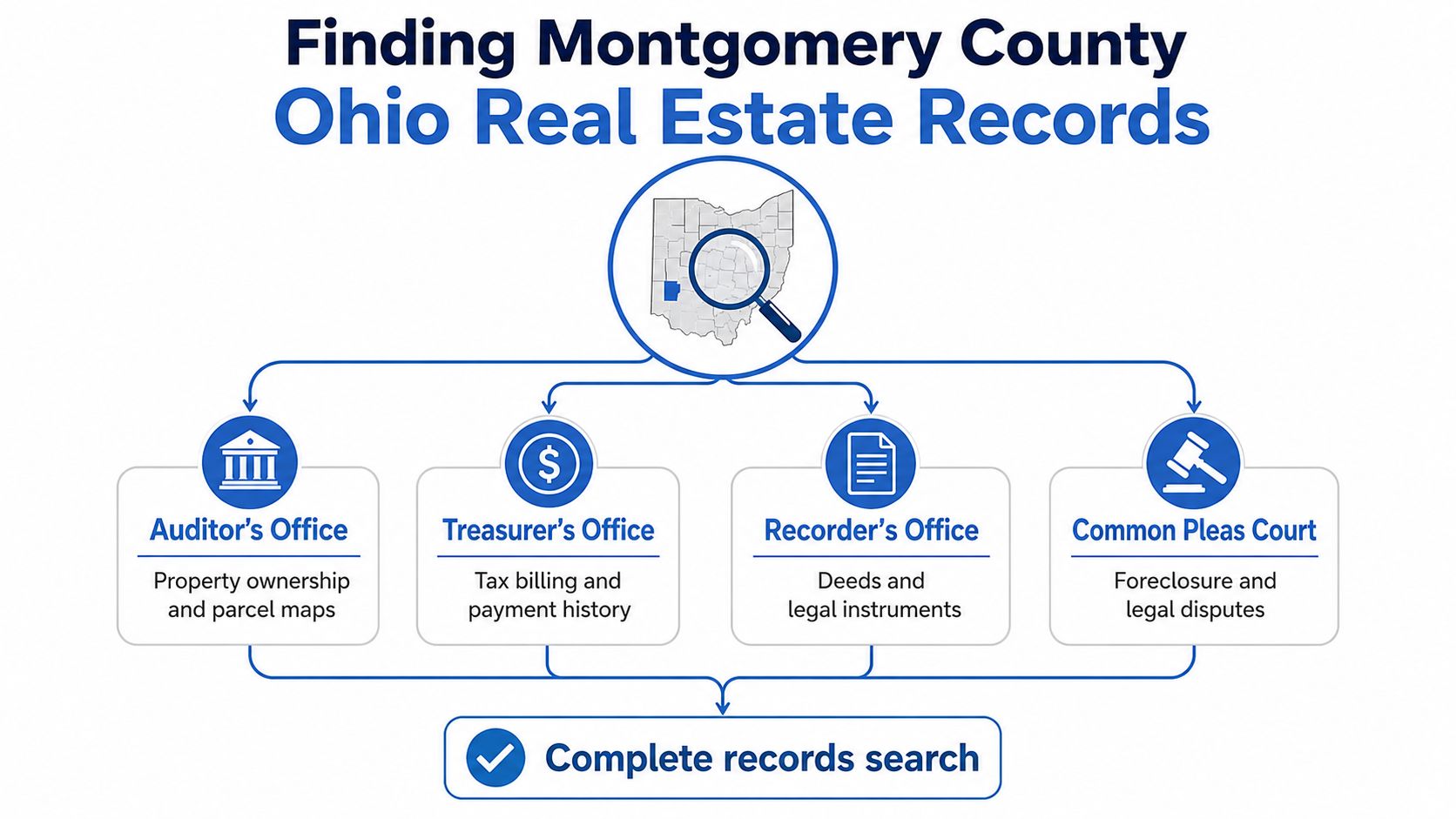
If you treat Montgomery County as one database, you'll waste time and miss document history. The county's own research workflow is more useful than any third-party shortcut, because it shows how the public record system works, not how people wish it worked (Home & Property Research Guide).
Finding Montgomery County Ohio Real Estate Records
The county's real estate records are split by function, so the fastest search depends on what you already know. The Auditor handles property and value data, the Recorder handles deeds and other recorded instruments, and the Treasurer handles tax records and payment status (Real Estate, Treasurer search, Recorder search). If you start in the wrong place, you'll still get data, but not the data you needed.
Match the office to the question
Use the Auditor's MCRealEstate portal when you need parcel-level ownership, assessed value, homestead, CAUV, deed transfer fields, or map-linked property details (MCRealEstate portal, Real Estate). Use the Recorder's Information Search System when you need the deed sequence, legal descriptions, or recorded documents. Use the Treasurer's tax search when the question is about payment history, delinquency, billing address, or tax liens.
Practical rule: start with the parcel or address in the Auditor system, then verify the conveyance path in the Recorder, then check the Treasurer if tax status matters.
The county's broader Home & Property Research Guide is worth keeping open because it ties those systems together in the way researchers need them. It also reinforces a key point that most casual users miss, ownership chains can be reconstructed through the Recorder's deed indexes, the Tract Index, or the Auditor search tool, but not by assuming one search surface is enough (Home & Property Research Guide).
Search discipline matters. The county recommends one search method at a time, and parcel IDs should be entered exactly as formatted, including the leading capital letter (Home & Property Research Guide). That small detail saves a lot of dead ends when you're dealing with large parcels, LLC ownership, or a record that was indexed differently from the way it was spoken in conversation.
Use an address-to-county workflow when the jurisdiction is unclear
Searching Property Records by Parcel or Owner
The fastest first pass is an address or parcel lookup in the Auditor system. That gets you to the property identity, ownership snapshot, and valuation context before you waste time chasing deed language that may not even match the current parcel record (MCRealEstate portal, Real Estate). After that, use the Recorder to verify the conveyance sequence and document references.
Use the right search path
If you have a parcel ID, enter it exactly as formatted. The county's guidance is explicit about the leading capital letter, and that is the kind of small indexing rule that breaks automated and manual searches alike (Home & Property Research Guide). If you have an owner name, search the Auditor first, then pivot to the Recorder if you need the actual deed chain.
Owner-name searches work best when you're cautious with spelling. The county recommends partial or wildcard-style searching when the exact spelling is uncertain, especially for LLCs, trusts, and business owners (Home & Property Research Guide). That advice is not optional in practice, because legal ownership names are often longer, more formal, and less intuitive than the name a caller gives you.
| Montgomery County Property Record Search Systems | |||
|---|---|---|---|
| Office | Record Type | Search Fields | Portal |
| Auditor | Property ownership, value, parcel and GIS fields | Address, parcel ID, owner | MCRealEstate |
| Treasurer | Tax records, payment status, delinquency, tax liens | Parcel ID, property lookup | Tax Search |
| Recorder | Deeds, mortgages, easements, leases, recorded instruments | Name, parcel number, legal description | Recorder Search |
A clean workflow looks like this:
- Start in the Auditor with the parcel or address.
- Confirm the owner name and parcel formatting.
- Search the Recorder for the deed sequence and document references.
- Check the Treasurer if you need tax-year status, delinquency, or lien context.
Use ownership-history research when you need to verify prior transfers
Pulling Deeds and Recorded Documents
The Recorder is where you verify what got recorded, and it's a separate workflow from parcel lookup. You can search by name, parcel number, or legal description, and each method fits a different use case, from quick confirmation to full title reconstruction (Recorder search). If you only use the Auditor, you'll see the parcel picture, but not always the deed text or instrument sequence you need for diligence.
Why the Recorder matters
Recorded documents in Montgomery County include deeds, mortgages, affidavits, agreements, easements, leases, mechanic's liens, and trust documents (Recorder search). That breadth matters because a parcel can look clean in one system and still carry a recorded instrument that changes your risk picture.
A title review that ignores the Recorder is incomplete, even if the parcel lookup looks tidy.
The fee structure also affects workflow design. Montgomery County publishes $34 for the first two pages, $8 for each additional page, and a $20 surcharge for documents that do not meet Ohio format rules (Recorder search). If you're pulling multiple instruments per parcel, those fees add up fast, and format compliance becomes a real cost control issue.
That's where document preparation matters. The Recorder's own guidance includes preparation rules, and non-compliant filings create a hidden drag on bulk retrieval projects because they can trigger extra charges or slow review. For researchers and proptech teams, the lesson is simple, verify the deed chain first, then decide whether the instrument set is worth expanding.
The most efficient order is still Auditor first, Recorder second. The Auditor gives you the parcel identity and valuation frame, and the Recorder gives you the legal paper trail that proves how the current owner got there.
Looking Up Tax and Valuation Data
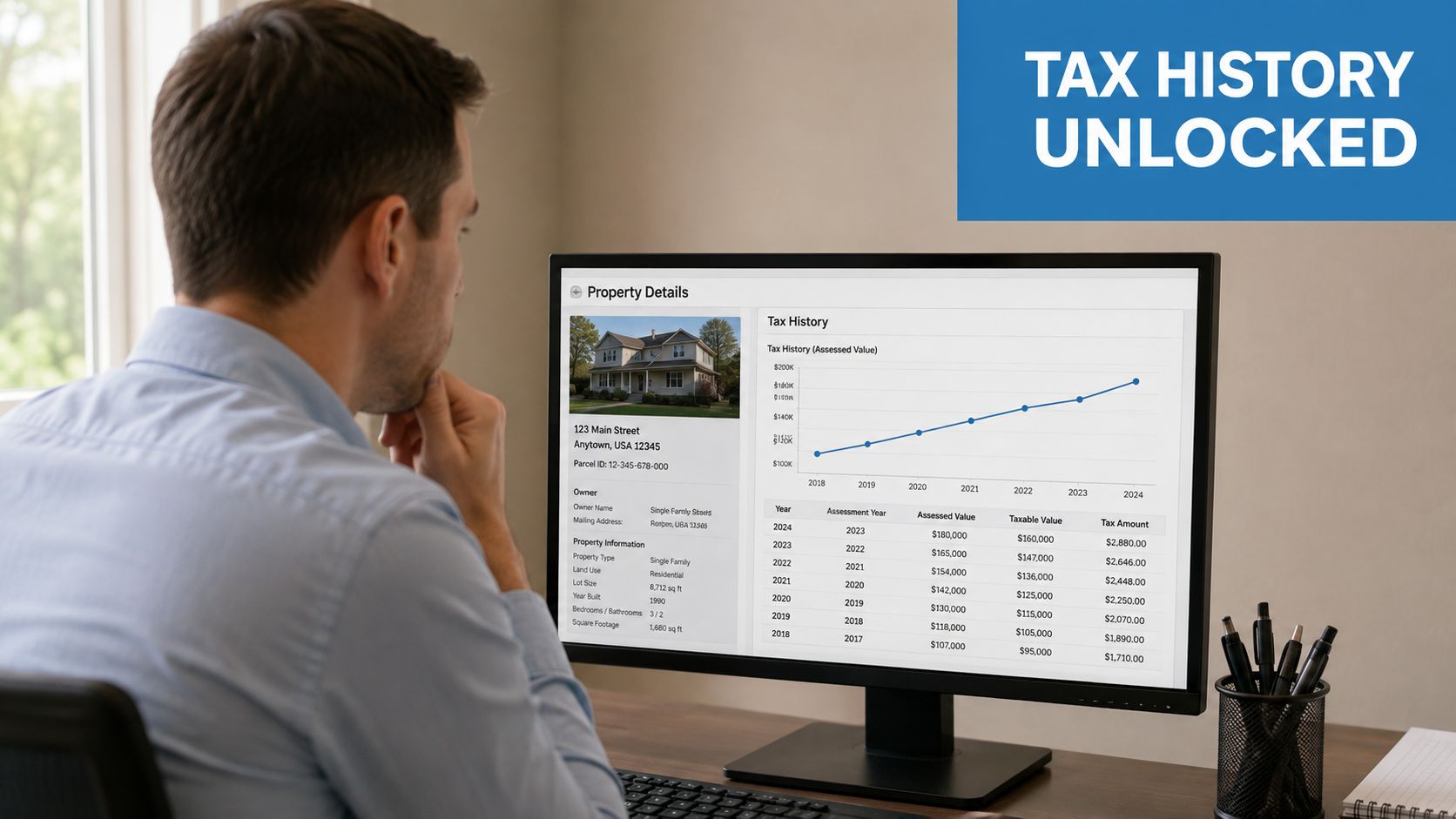
A property lookup doesn't end when you find the owner, it ends when you know whether the tax and valuation signal changed. The Treasurer's Real Estate Tax Information System Online Record Search is where you move from general property identity to year-specific payment and delinquency data, and the county says the results appear in the lower part of the screen before you click the Parcel ID to open the record (Treasurer search). The office is listed at 451 W. Third Street, Dayton, OH 45422, with hours Monday through Friday, 8 a.m. to 4 p.m., phone (937) 225-4010 (Treasurer search).
Why value changes matter now
Montgomery County's site now highlights a 2026 Property Reappraisal, and local reporting noted that county property values surged and taxes were expected to increase (2026 Property Reappraisal context). That makes value-change questions more urgent than the usual ownership lookup, because a higher assessment can reflect market movement, reassessment timing, or a data problem in the parcel record.
The practical question is not just who owns it. It is whether a value change is operationally meaningful for lending, insurance, or lead targeting. If the number changed, you still need to ask whether the shift came from the appraisal cycle, a transfer event, or a record discrepancy.
For teams working quickly, the Treasurer is the place to confirm the tax-side consequence. The Treasurer's data is not interchangeable with the Recorder's instruments, and the distinction matters when the goal is to understand current exposure instead of historical conveyance. If the issue is delinquency, payment timing, or lien context, the tax system is the one that answers it.
Understanding Fees Turnaround Times and Privacy Rules
Montgomery County's record stack is cheap to start but expensive to do badly. The Auditor, Treasurer, and Recorder each serve different functions, and a clean title or lien review requires cross-checking all three (Real Estate, Treasurer search, Recorder search). If you blur tax records and recorded instruments together, you'll miss problems that only show up when you compare systems.
| Montgomery County Record Office Fee Comparison | |||
|---|---|---|---|
| Office | Function | Fee Structure | Turnaround |
| Auditor | Property records, value, assessment, ownership fields | Public search access through the portal | Immediate read-only lookup |
| Treasurer | Tax records, payment status, delinquency, tax liens | Public search access through the portal | Immediate parcel-level lookup |
| Recorder | Deeds and recorded instruments | $34 first two pages, $8 each additional page, $20 noncompliant surcharge | Immediate indexing search, document pull depends on record type |
The county also recommends collecting owner, former owner, parcel ID, sale date, and deed-reference information before you search (Real Estate). That prep step cuts false positives in chain-of-title work because the record indexes are strong, but only if you give them enough context.
Privacy is straightforward in one sense and restrictive in another. The public can search assessment, tax, and recorded-document indexes, but that does not mean bulk extraction or resale is frictionless. Teams building internal tools should treat the county portals as public-record interfaces, not as free bulk data feeds.
Workflow rule: if you need one parcel, search the county. If you need a portfolio, design for structured data from the start.
The office addresses also tell you how the system is organized. The Auditor real-estate function lists 451 West Third St., P.O. Box 972, Dayton, Ohio 45422, hours 8:00 a.m. to 5:00 p.m. Monday-Friday, phone (937) 225-4326 (MCRealEstate portal). The Recorder lists 451 W Third Street, Dayton, OH 45422, phone (937) 225-4275 (Recorder search). That physical proximity does not mean the data is unified, it just means the county keeps the workflows close.
Building Pro Workflows with Batch Data Alternatives
For one-off due diligence, the county portals are enough. For portfolio monitoring, lead generation, underwriting, or product integration, piecemeal county searches break down fast because you need structured records, not one parcel at a time. BatchData is one option for that layer, with 169M+ U.S. property records, 1,000+ attributes, low-latency APIs, and bulk delivery through S3, Snowflake, or flat files.
Where scale changes the answer
The useful comparison is not county versus platform, it is manual verification versus repeatable data operations. BatchData covers core characteristics, ownership history, AVMs and equity, mortgage and lien details, listings, permits, and pre-foreclosure activity, and it also supports contact enrichment, skip tracing, phone verification, Smart Property Search, Portfolio Monitoring APIs, and BatchRank propensity modeling.
That matters for workflows like:
- Underwriting: combine parcel, ownership, and lien signals without rebuilding the chain manually.
- Portfolio monitoring: detect property changes across large holdings.
- Lead generation: target properties with cleaner owner and contact data.
- Skip tracing: enrich reachability before outreach.
- Servicing and risk: keep ownership and collateral signals current.
Read more about licensing and bulk real-estate data workflows
The county systems still have a job. They're the right source for legal verification, local document review, and parcel-level confirmation. A structured platform like BatchData is the better fit when the problem is scale, not curiosity, and when your team needs a repeatable feed instead of a one-off lookup.
If you need accurate Montgomery County property context without manually bouncing between three county systems, BatchData gives teams a structured way to work with property, ownership, and contact data at scale. Visit BatchData to see how its property data and portfolio tools fit into underwriting, monitoring, and due diligence workflows.