Bulk real estate data licensing provides platforms access to large-scale, structured property datasets via tools like APIs, S3 buckets, and Snowflake. This enables platforms to process millions of records, including tax assessments, deed history, ownership contacts, and more, for advanced analytics and operational workflows.
Key Takeaways:
- Why it matters in 2026: Platforms need actionable data for lead generation, identifying motivated sellers, automating outreach, and seizing real-time opportunities. Over 90% of real estate investment decisions now rely on data.
- Core data types: Assessor data (APNs, square footage, etc.), financial data (loan balances, liens), distress indicators (pre-foreclosure alerts), and verified contact details (phone numbers, emails).
- Delivery methods: Cloud-native solutions like Snowflake for real-time updates and S3 for bulk historical data. Property enrichment APIs ensure sub-second response times for real-time data updates.
- Compliance: Built-in safeguards like DNC registry scrubbing and litigator filtering help platforms avoid legal risks, such as TCPA violations.
BatchData, a leading provider, offers daily-updated data on over 155 million U.S. properties, with 700+ attributes per record. Their tools support SaaS redistribution, predictive scoring, and AI integration through the Model Context Protocol (MCP), ensuring platforms stay competitive and efficient.
Core Components of Actionable Real Estate Data
Property Data Fields Platforms Must Have
The backbone of any real estate platform lies in its data. At its core, platforms need assessor data – details like Assessor Parcel Numbers (APNs), FIPS codes, legal descriptions, and standardized property addresses – to uniquely identify each property. These identifiers form the foundation for understanding the asset.
Key physical details such as square footage, number of bedrooms and bathrooms, year built, lot size, and construction type provide critical context for evaluating a property’s potential.
On the financial side, fields like deed history, sale prices, loan amounts, open liens, and tax delinquency records reveal a property’s fiscal health. For example, BatchData tracks over 155 million U.S. properties, offering more than 700 attributes per record. This data is sourced from over 3,200 channels, ensuring reliability even when some county-level sources are unavailable.
| Data Category | Key Fields | Platform Use Case |
|---|---|---|
| Assessor | APN, sq ft, year built, land value | Property identification and physical baseline |
| Ownership | Owner name, mailing address, trust/LLC flags | Direct-to-owner outreach and entity resolution |
| Financial | Loan balance, interest rate, open liens | Equity analysis and financial motivation scoring |
| Distress | Notice of default, auction date, lis pendens | Identifying motivated sellers |
However, property data alone isn’t enough. To act on these insights, accurate contact information is crucial.
Verified Contact Data for Outreach and Skip Tracing
Having property data is one thing, but reaching the right person is another. For platforms focused on lead generation or direct-to-owner outreach, verified contact data – such as mobile numbers, emails, and mailing addresses – is a must. Without this, users risk wasting time and resources on undeliverable mailers or disconnected phone numbers.
BatchData’s contact database includes over 600 million records and boasts a 76% right-party contact accuracy rate. That’s three times higher than the industry standard. A standout feature here is entity resolution, which identifies the actual individual owner behind an LLC or trust. This is critical for connecting with the true decision-maker.
Once reliable contact data is secured, enrichment data takes property insights to the next level.
Enrichment Data for Investment and Analytics
Enrichment data turns raw property information into actionable strategies. Beyond the basics, this data supports lead scoring, deal matching, and portfolio tracking. For instance, attributes like estimated equity positions, pre-foreclosure indicators (e.g., notices of default, lis pendens filings, and auction dates), and absentee ownership flags help identify motivated sellers before their properties hit the market.
Predictive scoring models, such as BatchData’s BatchRank, evaluate hundreds of data points to determine a property’s likelihood of selling. With daily data updates, platforms can track key events like new liens or ownership changes almost in real time, enabling users to manage risks and seize opportunities proactively.
Modern Delivery Models for Bulk Data
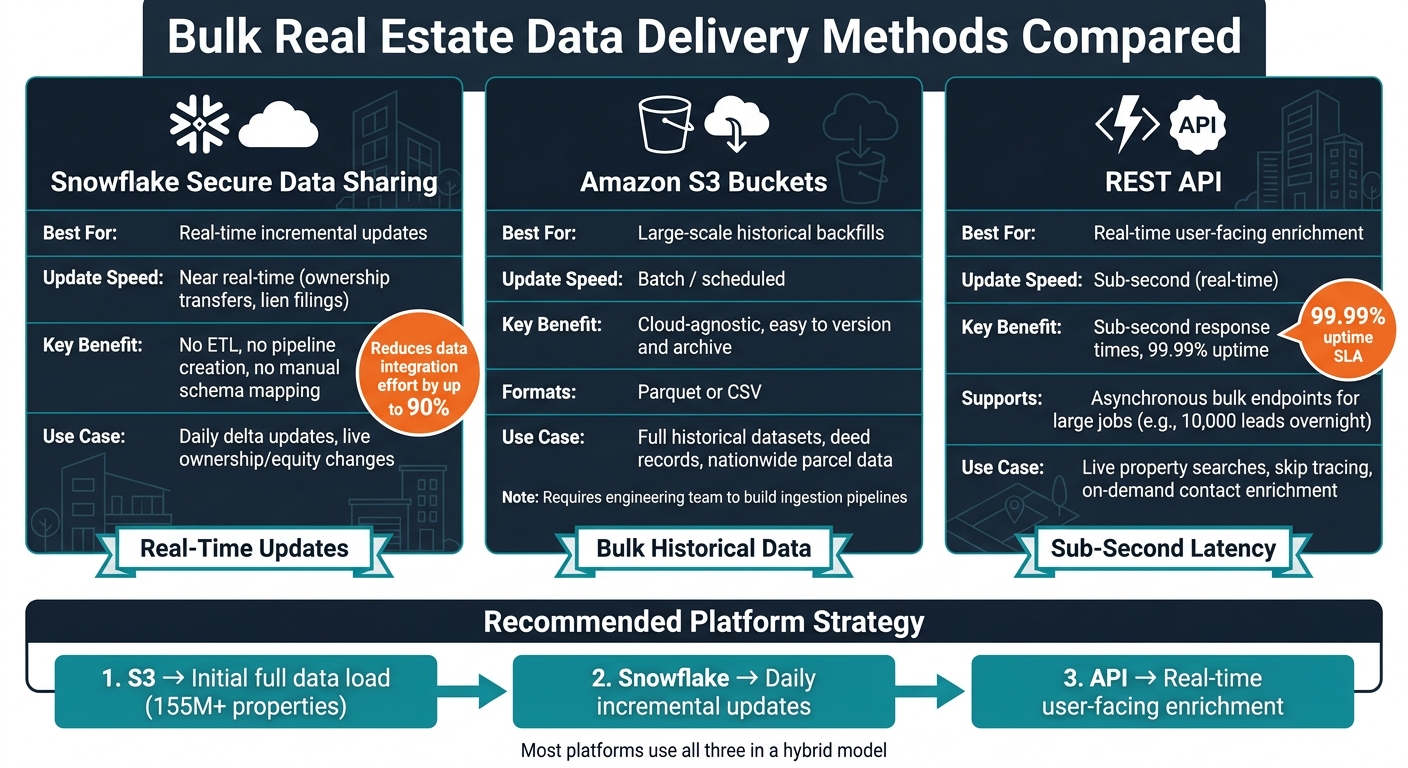
Bulk Real Estate Data Delivery Methods: Snowflake vs S3 vs API
Quarterly FTP flat-file drops are a thing of the past. By 2026, platforms will demand real-time, scalable data delivery to keep up with modern expectations.
Cloud-Native Delivery for Scale
Handling nationwide property datasets – covering over 155 million U.S. properties with hundreds of attributes – requires not just robust data but also efficient delivery methods. Two key approaches dominate today: Snowflake Secure Data Sharing and Amazon S3 buckets. Each serves a distinct yet complementary role.
Snowflake Secure Data Sharing allows data to flow directly into a platform’s Snowflake environment without the need for copying or ETL processes. Snowflake claims this method can reduce traditional data integration efforts by up to 90%, as there’s no need for pipeline creation or manual schema mapping. Updates from the provider appear almost instantly, so changes like ownership transfers or new lien filings are reflected in near real time.
On the other hand, S3-based delivery is ideal for large-scale backfills. When platforms need full historical datasets – like years of deed records or nationwide parcel data – S3 provides a practical solution. Using formats like Parquet or CSV, this method is cloud-agnostic, easy to integrate into any data warehouse, and simple to version or archive. However, it does require engineering teams to build and maintain ingestion pipelines.
Most platforms combine these methods: S3 for the initial full data load and Snowflake shares or APIs for daily incremental updates. This hybrid strategy ensures foundational datasets remain comprehensive while keeping user-facing information – like ownership changes, equity updates, and contact details – current.
While cloud-native delivery handles massive datasets effectively, real-time APIs take it a step further by delivering data directly to users in real time.
High-Throughput APIs for Real-Time Enrichment
Cloud delivery handles bulk data, but APIs power the real-time interactions users expect. Whether it’s property searches or skip traces, platforms need sub-second response times, while bulk processes run seamlessly in the background.
BatchData’s REST API delivers on this need with sub-second response times and a 99.99% uptime SLA. For larger tasks – like enriching a list of 10,000 leads overnight – asynchronous bulk endpoints get the job done. These endpoints process data in the background and deliver results via webhooks or retrieval, ensuring the platform stays responsive even during heavy workloads.
A well-designed platform separates low-latency API requests from bulk processing, keeping user-facing features fast while allowing background enrichment to scale without slowing things down.
These high-performance APIs set the stage for integrating more advanced, AI-driven data tools.
AI Support and Model Context Protocol (MCP) Compatibility
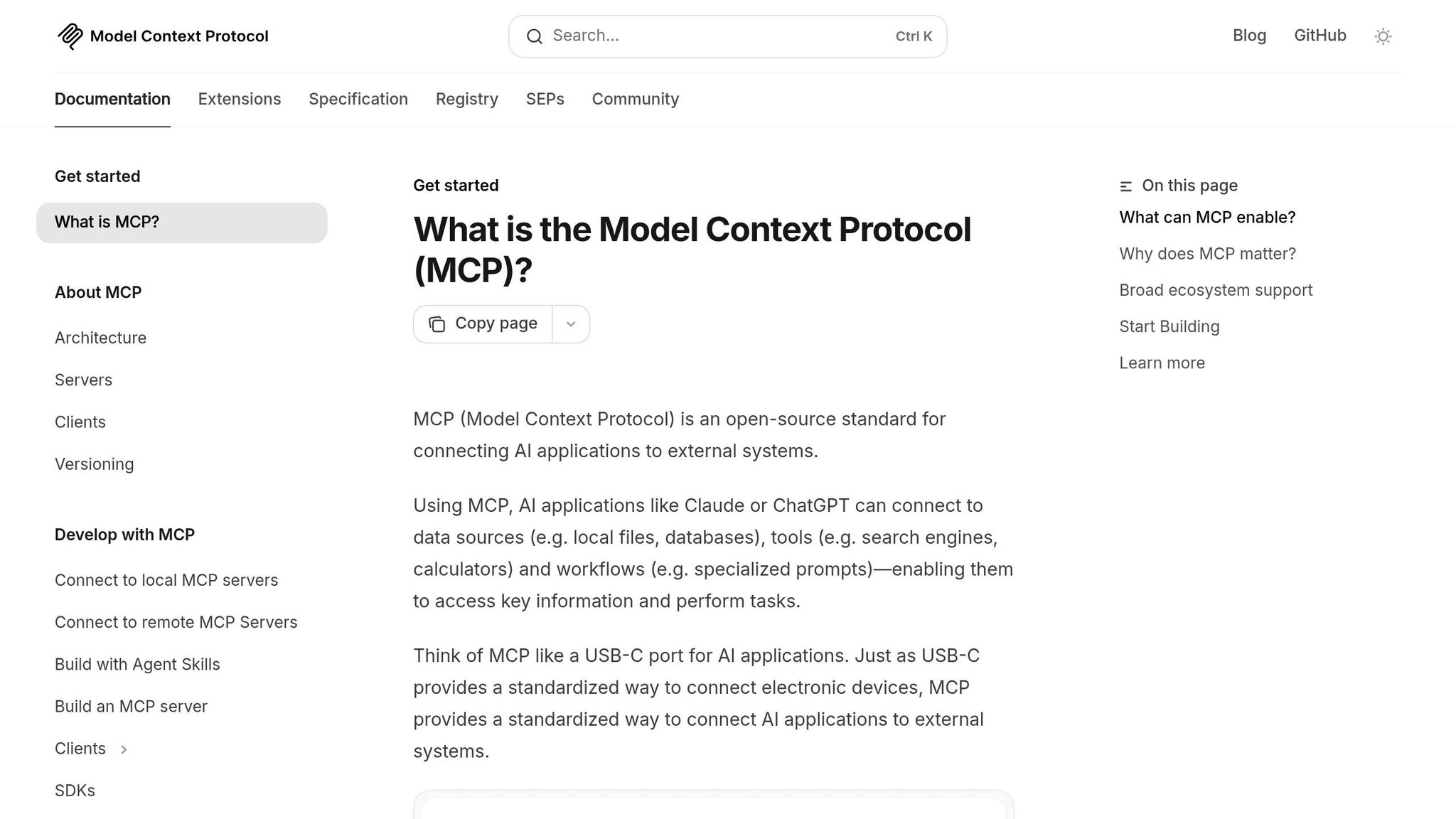
Once fast data delivery and real-time enrichment are in place, the next step is enabling AI to dynamically query data for instant, context-specific insights. The Model Context Protocol (MCP) is an emerging standard that allows AI agents to interact with external data tools in a structured, flexible way – no need for custom integrations for every new AI model or workflow.
BatchData provides an MCP Server that connects AI-driven platforms to its property and contact datasets. For example, an AI agent in a real estate platform can instantly fetch lien history, estimated equity, pre-foreclosure status, or owner contact details right when it’s needed. This ensures recommendations or automated decisions are based on the most relevant, up-to-date data.
This functionality becomes even more powerful when paired with predictive scoring models like BatchRank. BatchRank evaluates hundreds of property attributes to identify motivated sellers. An MCP-enabled AI agent can pull BatchRank scores in real time, seamlessly integrating property intelligence into workflows like lead routing, deal matching, or underwriting. Tasks that once required manual effort or rigid pre-built logic can now be automated with precision and speed.
Compliance and Risk Mitigation in Data Licensing
Ensuring that data delivery adheres to strict compliance standards is critical. Platforms that utilize actionable intelligence must prioritize robust compliance measures to safeguard their operations and protect end-users.
Built-In Compliance Features
Handling bulk contact data comes with significant legal risks. Violations of the Telephone Consumer Protection Act (TCPA) can result in steep penalties – $500 per negligent call or text and up to $1,500 for willful violations. These fines can add up quickly, especially in high-volume outreach. A striking example is Dish Network‘s 2017 case, where a federal court imposed a $280 million judgment for millions of calls that violated the TCPA and the Telemarketing Sales Rule. The stakes are undeniably high.
Another layer of complexity is the National Do Not Call (DNC) Registry, which had over 244 million active registrations as of 2023. This means that any bulk contact list is likely to include numbers registered on the DNC list, making automated suppression systems a necessity.
BatchData addresses these challenges by embedding compliance into its bulk licensing process. Their system scrubs datasets against the National DNC Registry and applies a Litigator Scrub, which removes numbers associated with known litigators and trap lines. As BatchData explains:
"Shield yourself and your clients from unreliable phone records with data that’s scrubbed for disconnected numbers, known litigators, and the National Do Not Call Registry."
To ensure ongoing compliance, BatchData provides regular DNC updates through Snowflake shares, refresh files, or API enrichment. Platforms can also integrate compliance metadata – such as DNC status, phone type, and line classification – into their user interfaces and APIs. This allows downstream systems like dialers and CRMs to automatically respect these compliance flags.
Beyond data scrubbing, compliance relies heavily on clear and enforceable licensing terms.
Redistribution Rights and Licensing Terms
Compliance isn’t limited to outreach – it also extends to how data is licensed and redistributed. Many traditional data agreements include "no derivative works" clauses, restrict SaaS redistribution, or impose high fees, which can limit a platform’s ability to create revenue-generating features from licensed data.
BatchData takes a different approach, offering a licensing model that explicitly allows SaaS redistribution. This means platforms can include property and contact records as part of their paid offerings, enabling features like end-user exports, lead scoring, and automated outreach sequences – all within clearly defined terms.
To navigate licensing effectively, contracts should specify whether SaaS redistribution, AI/ML applications, and derivative data creation are permitted. A smart strategy is to start with modular licensing – beginning with right-sized data solutions that include only the fields your product requires and expanding as your compliance systems become more robust. This phased approach minimizes privacy risks early on while laying a solid foundation for scaling outreach capabilities later.
Implementation Best Practices for Platform Teams
Defining Your Data Requirements
Before diving into integration for real estate investing, it’s crucial to map out three core aspects: the geographic scope, the data layers you need, and how often updates are required.
Decide if you need data for the entire country (covering over 155 million properties) or just specific regions. From there, pinpoint the fields you’ll rely on, such as those from Assessor Data (covering physical property details) and Recorder/Mortgage Data (covering financial history and related documents). If staying up-to-date is critical, ensure daily refreshes to track key updates like ownership changes, sales, or liens. Before signing any licensing agreement, insist on clear fill rate guarantees for important fields (e.g., owner names or prior sale dates) and request data samples to ensure the quality meets your expectations.
Once your requirements are clearly defined, structure your integration process to match these needs seamlessly.
Integration Patterns for Bulk Data
After finalizing your data requirements, focus on building an integration system that handles data ingestion and updates efficiently. A hybrid approach is often the most effective. Start by using bulk files – accessible via platforms like S3, Snowflake, or SFTP – to create your internal database. Then, use high-throughput APIs for daily updates to keep that database current with transactional changes.
"A property data solution’s core function is to execute a three-step process: ingest raw data, enrich it with computed intelligence, and deliver it through a flexible, usable format." – BatchData
Bulk delivery is ideal for loading historical records, powering machine learning models, and enabling large-scale analytics. Meanwhile, APIs are perfect for real-time needs like live property searches, skip tracing, or on-demand contact enrichment. To ensure smooth operations, evaluate API performance using P95 and P99 latency benchmarks – a slow API can severely impact user experience.
Address standardization is another crucial step. For example, discrepancies like "123 Main St" versus "123 Main Street" can lead to duplicate records and operational errors. Cleaning up these inconsistencies before data enters your system will save you from downstream headaches in analytics and outreach.
Data Governance and Scaling for Growth
Once integration is running smoothly, focus on governance to ensure your data remains secure and scalable. Centralized, OAuth-based access control is a great way to manage permissions efficiently.
Automate monitoring wherever possible. Event-based alerts for critical changes – such as ownership transfers, new liens, or foreclosure filings – can shift your platform from reactive to proactive. This not only improves decision-making but also ensures compliance. Pair automated data quality checks during each ingestion with occasional manual reviews for edge cases to maintain high reliability.
When it comes to scaling, take a modular approach. Start with the data fields and regions your current features demand, then expand as your platform grows. This incremental strategy helps keep costs manageable and limits privacy risks, particularly during the early stages of development.
Why BatchData Is the Right Bulk Licensing Partner for Real Estate Platforms
When it comes to selecting a data partner that can grow alongside your platform, BatchData stands out as a top choice. With daily-updated information on over 155 million U.S. properties, each record boasting 700+ attributes, BatchData offers an impressive depth of data. Additionally, their skip tracing achieves a 76% right-party contact accuracy, which is a game-changer for platforms where outreach drives revenue growth.
BatchData doesn’t just provide data – it delivers it with precision and speed. Platforms can access the full dataset through Snowflake, Amazon S3, or SFTP for bulk analytics. For real-time needs, their real estate APIs, backed by a 99.99% uptime SLA and sub-second response times, ensure seamless enrichment. Features like the Smart Search push architecture notify platforms of qualifying property events instantly via webhooks. Meanwhile, the MCP server enables teams to query property data using natural language, removing the need for complicated coding. This level of technical reliability ensures your platform remains compliant and efficient, even at scale.
Compliance is built into every aspect of BatchData’s services. Bulk licenses come with DNC registry filtering, litigator scrubbing, and real-time phone verification – all standard. Plus, their flexible, usage-based licensing model allows for SaaS redistribution, making it easy to adapt as your platform evolves.
Whether your focus is on data ingestion, enrichment, or governance, BatchData provides the robust infrastructure needed to support your platform’s growth.
FAQs
What data fields should my platform license first?
In 2026, focus on licensing core property details, contact information, and ownership records. Critical fields to include are the APN (Assessor’s Parcel Number), geocodes, property address, year built, lot size, square footage, and construction specifics. Verified mobile numbers, email addresses, and ownership data – such as owner names and mailing addresses – are vital for effective outreach and regulatory compliance. Incorporating financial information like mortgage balances and lien statuses can further improve analytics, risk evaluation, and marketing strategies, creating a strong and actionable platform.
How do I keep nationwide property data updated daily without heavy ETL?
You can keep nationwide property data updated daily without relying on heavy ETL processes by using direct cloud delivery methods. Tools like Snowflake Shares, S3 buckets, or high-throughput APIs allow for real-time or daily refreshed data. These solutions streamline integration and ensure your platform always has the most current information, without the complexity of traditional ETL workflows.
What do I need to do to stay TCPA and DNC compliant when using contact data?
To ensure compliance with TCPA and DNC regulations, it’s important to take a few key steps. First, make sure you’re scrubbing your contact lists in real-time against the National Do Not Call Registry and litigator lists. Automating the removal of opted-out contacts is another crucial step to avoid potential violations. Additionally, verify phone numbers for deliverability to reduce errors.
Leverage built-in tools like DNC filtering and litigator scrubbing, which are supported by regular data updates and detailed audit trails. These practices not only help you stay compliant but also minimize legal risks while keeping your processes efficient.
Related Blog Posts
- Real Estate Data Licensing for Mortgage Analytics: 2026 Guide
- The Complete Guide to Licensing Large Real Estate Datasets for LLMs and PropTech in 2026
- Top-Rated Real Estate Data Licensing for Mortgage Analytics and Portfolio Stress Testing
- The Best Real Estate APIs for Multi-Source Data Quality and Unified Property Intelligence