



A property-data platform can encrypt databases, secure API traffic, and still expose sensitive records through weak keys, unsafe processing, or outdated public-key cryptography. Data encryption standards define how readable information becomes protected ciphertext, how authorized systems recover it, and how teams prove that protection is implemented correctly.
For real-estate, mortgage, insurance, and marketing systems, the practical answer is layered: use AES-GCM for bulk data, TLS for network connections, public-key cryptography for authentication and key establishment, and FIPS-validated modules with disciplined key management. Encryption also has limits. It doesn't automatically protect plaintext inside an application, prevent an authorized user from misusing data, or make an obsolete protocol acceptable.
Core takeaways:
- AES protects large volumes of stored or actively transferred data.
- RSA and ECC support identity, signatures, and key establishment rather than bulk encryption.
- TLS combines asymmetric authentication with symmetric session encryption.
- FIPS 140-3 evaluates cryptographic modules and operational controls, not just algorithm names.
- Post-quantum cryptography is changing how teams should inventory and migrate public-key dependencies.
- OWASP's cryptographic-failures guidance highlights implementation and lifecycle failures as major residual risks, even when AES and TLS are already deployed (OWASP Cryptographic Failures).
The important question isn't just which algorithm a platform uses. It's where the data travels, who controls the keys, how plaintext is processed, and whether the entire design can withstand the next standards transition.
What Data Encryption Standards Actually Do
Data encryption standards specify approved methods for transforming readable data into ciphertext and restoring it only for an authorized party with the correct key. In a real-estate system, that can mean protecting owner contact information, mortgage details, property valuations, lien records, or API credentials while those assets move through storage, services, and analytics pipelines.
Consider a platform that receives property records through an API, stores them in a warehouse, and sends a selected dataset to a lending application. If an attacker steals an unencrypted database, readable owner and mortgage data may be immediately exposed. If the database is encrypted but the API connection is not, an attacker may target the network path. If both are protected but application logs contain plaintext contact data, the security design still has a serious gap.
Standards create a common technical baseline. They support interoperability between vendors, libraries, operating systems, cloud services, and compliance programs. They also provide terminology that auditors and engineering teams can use consistently. They don't decide which employees should access a record, whether a service has excessive privileges, or whether an application accidentally writes decrypted data to a log.
| Technology | Primary role | Practical use |
|---|---|---|
| AES | Symmetric encryption | Bulk protection for databases, files, backups, and application data |
| RSA | Asymmetric cryptography | Legacy key establishment, signatures, and certificate-based identity |
| ECC | Asymmetric cryptography | Modern signatures and key establishment with compact keys |
| TLS | Secure communications protocol | Authenticated, encrypted connections between clients and services |
| FIPS 140-3 | Cryptographic-module validation | Evaluates module security, boundaries, roles, tamper evidence, and key protection |
Practical rule: Treat encryption as a risk-control layer, not as a complete authorization model.
The term standard also needs careful handling. AES is an algorithm standard. TLS is a protocol that negotiates algorithms and authenticates endpoints. FIPS 140-3 validates the module implementing cryptography. These categories work together, but they aren't interchangeable.
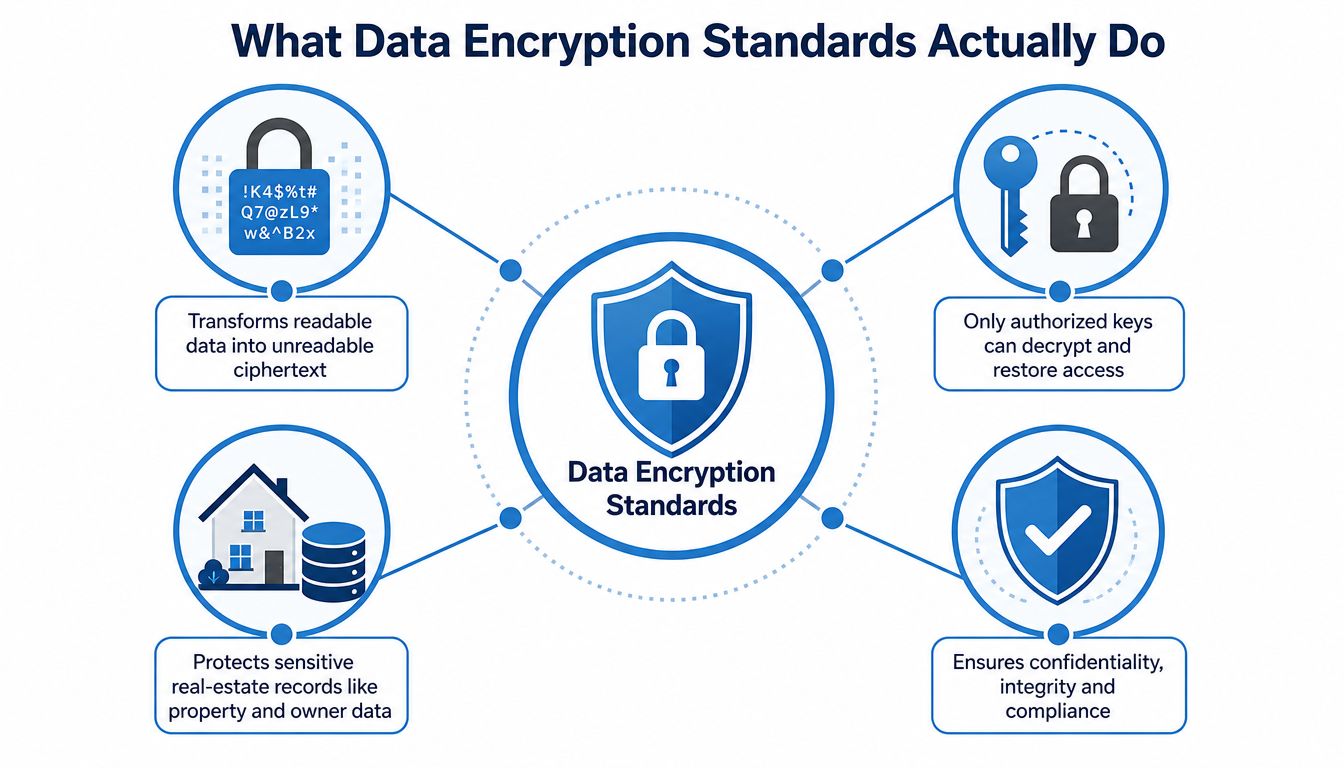
The design becomes clearer once you separate the cryptographic primitives from the protocols and the operational controls that make them trustworthy.
How Modern Encryption Standards Evolved
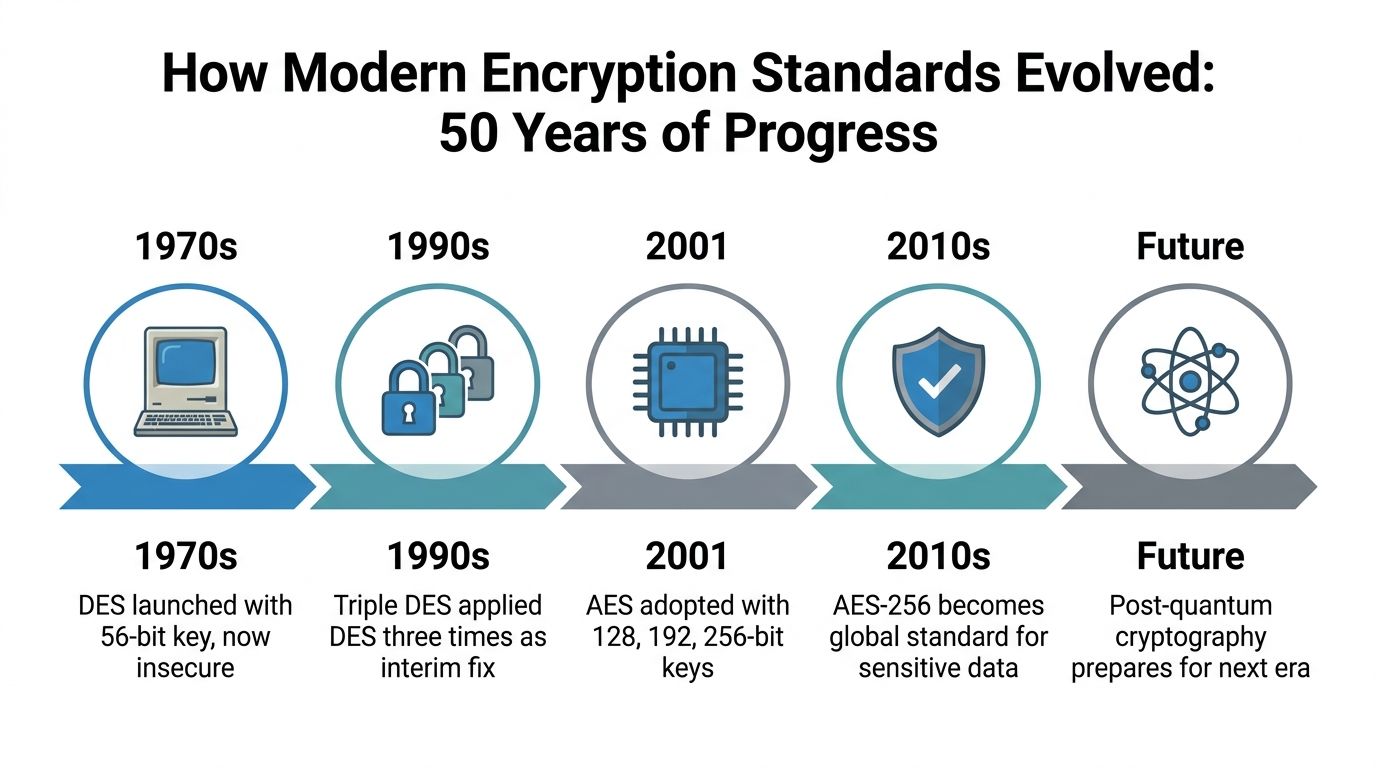
Modern encryption standards evolved because older algorithms eventually stopped providing an acceptable security margin against stronger computers and better attacks. The history begins with a government effort to create a common symmetric-key method that organizations could implement consistently.
In 1973, the U.S. National Bureau of Standards began work on a common symmetric-key standard intended to protect computer data and support large-scale commercial interoperability. The result was the Data Encryption Standard, or DES, a 64-bit block cipher with a 56-bit key. NIST describes DES as the first public encryption algorithm created by the U.S. government (NIST's cryptographic standards history).
DES was published as FIPS 46 in January 1977 and officially issued for federal use on November 23, 1977. NIST reaffirmed it in 1983, again in 1988, and reviewed it again in 1993. Those milestones illustrate an important principle: a standard isn't permanent just because it was once approved.
A cryptographic standard is a living engineering decision. Its security must be reviewed against changing computation, attack methods, and deployment needs.
NIST withdrew DES in 2005 because it no longer provided adequate security for federal information (NIST's cryptographic standards history). The lesson for product teams is direct. “Compliant” or “approved” describes a point in time and a defined implementation context. It doesn't mean a method remains suitable forever.
Symmetric encryption first
Symmetric encryption uses the same secret key to encrypt and decrypt data. That makes it efficient for large property datasets, database pages, backups, and files. The hard operational problem is distributing and protecting the shared secret.
Asymmetric cryptography adds identity
Asymmetric cryptography uses a public key and a private key. The public key can be distributed, while the private key remains controlled by its owner. This model supports digital signatures and helps systems establish shared secrets without placing one reusable secret on every network path.
Hybrid systems combine both
Modern secure connections generally use asymmetric methods for authentication or key establishment, then use symmetric encryption for the actual data stream. That design avoids forcing computationally expensive public-key operations to process every byte of a large dataset.
Core Data Encryption Standards Compared
AES is the usual choice for bulk encryption, while RSA and ECC handle public-key functions, and TLS orchestrates authenticated encrypted communication. Choosing among them isn't a matter of selecting one universal winner. Each solves a different part of the security problem.
NIST specifies AES-GCM with an underlying 128-bit block cipher and requires a key size of at least 128 bits. Approved deployments commonly use 128-, 192-, and 256-bit keys, corresponding to security strengths of 128, 192, and 256 bits (NIST SP 800-38D). Larger keys increase brute-force cost, but key length doesn't compensate for nonce reuse, poor access control, exposed keys, or unsafe implementation.
| Standard | Type and key size | Best for | Tradeoff to know |
|---|---|---|---|
| AES-GCM | Symmetric, commonly 128, 192, or 256-bit keys | Bulk encryption of files, databases, backups, and application payloads | Nonce, authentication-tag, and key-management errors can undermine a strong algorithm |
| RSA | Asymmetric, key sizes vary by deployment | Certificates, signatures, and some key-establishment workflows | Larger public keys and slower operations can create performance and modernization constraints |
| ECC | Asymmetric, curve-based keys | Signatures and efficient key establishment | Correct curve selection, library support, and migration planning matter |
| TLS | Protocol using asymmetric authentication and symmetric session encryption | API calls, service-to-service traffic, and secure bulk delivery | Security depends on protocol version, cipher configuration, certificates, and forward secrecy |
AES-GCM for data volume
AES-GCM provides confidentiality and integrity in one authenticated-encryption construction. That matters for property records because a recipient needs to know not only that the contents are hidden, but also that an attacker hasn't altered the message unnoticed.
NIST emphasizes that the IV or nonce and authentication-tag choices materially affect security. Its 2026 revision process proposes removing tag lengths below 96 bits and recommends a 192-bit default IV length for wGCM, reflecting concerns about nonce misuse and forgery probability (NIST SP 800-38D).
RSA and ECC for public-key tasks
RSA and ECC aren't replacements for AES when a platform must encrypt a large warehouse or file archive. They are better understood as tools for identity, signatures, certificate systems, and establishing session secrets.
ECC often offers a more compact representation for comparable security goals, but the right choice depends on approved curves, library maturity, protocol support, certificate practices, and the organization's migration path. Product teams should select based on the complete protocol and compliance environment, not on a key-size comparison alone.
TLS as the connection layer
TLS protects a connection by authenticating endpoints, negotiating cryptographic parameters, and creating session keys. The bulk traffic then uses efficient symmetric encryption. A TLS configuration can still fail if it permits obsolete protocol versions, accepts weak cipher choices, mishandles certificates, or lacks usable evidence for audit.
The operational decision is therefore straightforward: use AES-GCM for protected content, use approved public-key mechanisms for identity and key establishment, and configure TLS as a managed protocol rather than treating it as a checkbox.
How At Rest and In Transit Encryption Work Together
At-rest encryption protects stored records, in-transit encryption protects network movement, and data-in-use controls address the period when an application has decrypted information for processing. A real-estate data platform needs all three views because records rarely remain in one system.
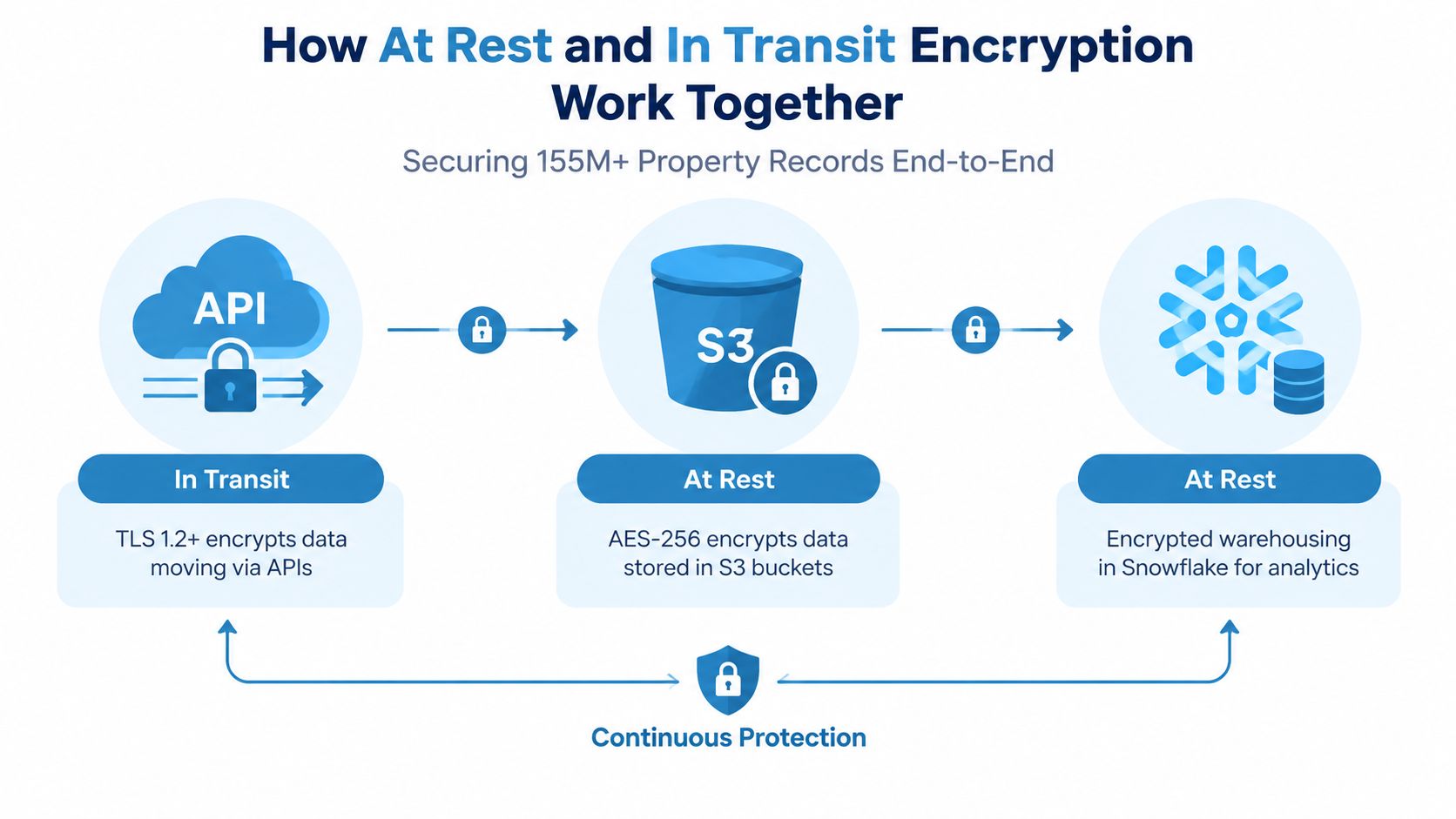
Take a BatchData-style workflow involving 169M+ property records, APIs, S3 delivery, and Snowflake analytics. An API request may carry owner or mortgage information from a service to a customer application. The delivered file may then sit in an S3 bucket, while a selected dataset is loaded into Snowflake for underwriting or portfolio analysis.
At rest, teams can use transparent database encryption, disk encryption, file encryption, or field-level encryption. Field-level protection is useful when only certain values, such as owner contact details or sensitive mortgage attributes, require tighter controls than general property characteristics.
The movement path matters
A useful flow is:
- API request: TLS protects the connection between the client and service.
- Processing layer: The application authorizes the request and decrypts only what it needs.
- Object storage: Encryption protects bulk files stored in S3.
- Analytics warehouse: Snowflake data remains protected at rest under the warehouse's security model.
- Output and logs: Teams prevent sensitive plaintext from appearing in exports, debugging traces, or application logs.
The platform's security documentation states that it uses TLS 1.2 or higher for data in transit and encryption at rest as safeguards. Customers should still verify the exact controls, responsibilities, retention settings, and evidence available for their own integration.
The key residual risk is data in use. An application must usually decrypt a record before it can score a lead, calculate an AVM, display a contact, or join mortgage data to a property identifier. During that window, memory, logs, query results, administrator access, and downstream services become part of the threat model.
Encryption follows the data lifecycle. It doesn't eliminate the moment when authorized software needs to read the data.
For API-specific design pitfalls, teams can review common real-estate API security mistakes. The right response isn't to encrypt every field indiscriminately. Classify data, minimize exposure, restrict privileges, and record which systems can decrypt which fields.
Key Management Best Practices That Make Encryption Work
Key management determines whether encryption reduces risk or merely relocates it. An attacker who obtains both ciphertext and the decryption key doesn't need to defeat AES. Teams need a controlled lifecycle covering creation, use, storage, rotation, revocation, recovery, and destruction.
Start inside a validated boundary
FIPS 140-3 is the current U.S. standard for cryptographic-module validation. It defines four increasing security levels, and evaluates more than algorithm strength. The assessment considers the module boundary, role separation, tamper evidence, and key-protection mechanisms (FIPS 140-3).
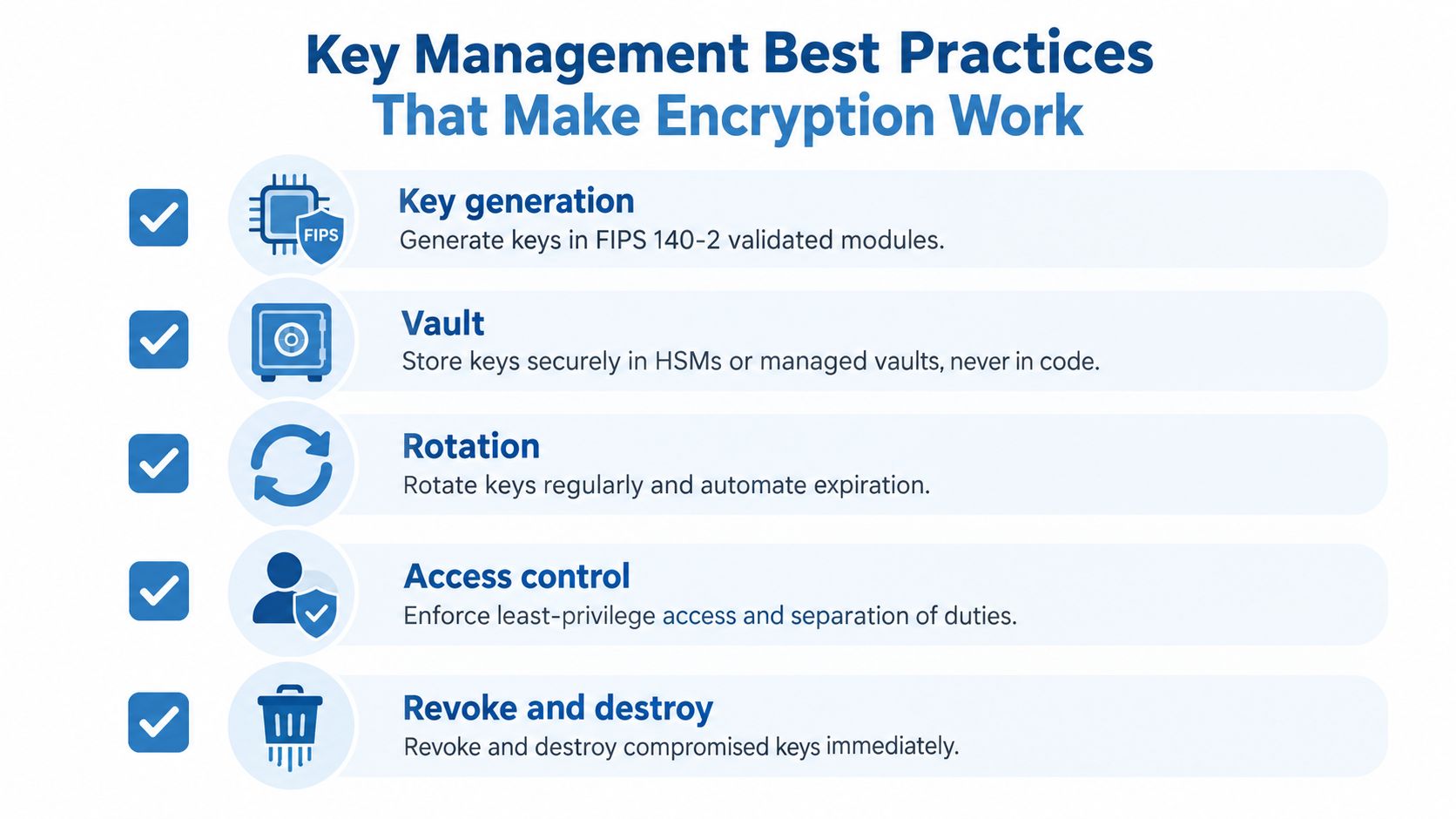
A practical lifecycle checklist looks like this:
- Generate keys: Create keys inside a FIPS-validated cryptographic module or an approved managed key service with a clearly documented boundary.
- Store keys separately: Keep keys in an HSM or managed vault, not in source code, environment files, application logs, or the same storage location as the protected records.
- Control use: Apply least privilege, separate administrative duties, and log every sensitive key operation.
- Rotate deliberately: Define cryptoperiods by data sensitivity, volume, legal obligations, and compromise impact.
- Revoke quickly: Disable a compromised or misused key, then identify affected records, services, backups, and integrations.
- Destroy safely: Remove retired keys according to documented retention and recovery requirements.
NIST key-management guidance recommends cryptoperiod discipline. Encryption keys protecting large volumes may have relatively short originator-usage periods, while recipient use may continue afterward, with some guidance allowing recipient usage for up to three years after the originator period (FIPS 140-3 and NIST key-management guidance). That doesn't mean every organization should use the maximum. It means teams should define and enforce a deliberate period rather than leaving keys active indefinitely.
For a plain-language foundation on key roles and terminology, exploring public private seed keys can help product and data teams distinguish public keys, private keys, and seed material.
Key governance should also cover customer-facing API credentials. A service account that can retrieve owner contacts shouldn't automatically decrypt every historical dataset or administer the vault. The architecture and access policy should express those boundaries directly. Teams handling CRM records can also use this guide to CRM encryption for real-estate data when mapping controls to workflows.
Compliance Considerations for FIPS PCI and HIPAA
Compliance teams need evidence that cryptography is correctly scoped, implemented, and operated, not just a statement that a system uses AES. This distinction matters for proptech platforms, lenders, insurers, healthcare-adjacent services, and marketing systems that process regulated or highly sensitive records.
FIPS 140-3 validates a cryptographic module against defined security requirements. It doesn't certify an entire application, database, vendor, or business process. Auditors may therefore ask which module performs the operation, where its boundary sits, how roles are separated, and how keys are generated, stored, accessed, rotated, revoked, and destroyed.
PCI DSS and HIPAA also require teams to connect encryption with broader safeguards. The applicable control set depends on scope, system role, data type, contractual obligations, and the organization's interpretation of the framework. Encryption alone won't resolve excessive access, weak authentication, poor retention, missing monitoring, or an unmanaged vendor connection.
Evidence auditors can inspect
Prepare artifacts that show actual operation:
- Module evidence: The FIPS validation status and version of the cryptographic module in scope.
- Transport evidence: TLS configuration reports, certificate records, approved protocol settings, and proof that TLS 1.0 and TLS 1.1 aren't being used, where those controls apply (OWASP Cryptographic Failures).
- Key evidence: Key inventories, ownership, rotation records, access logs, revocation procedures, and recovery tests.
- Data-flow evidence: Diagrams showing API calls, bulk delivery, storage, analytics, backups, exports, and deletion paths.
- Vendor evidence: Contracts, security documentation, shared-responsibility boundaries, and incident-notification procedures.
Teams should also plan for hardware retirement, backups, removable media, and data-bearing devices. Practical audit-ready device retirement tips can complement the cryptographic controls by addressing what happens when storage leaves active service.
For real-estate providers, the compliance question often starts with vendor selection but ends with customer configuration. A platform may protect its service while the customer exposes API keys in a repository, grants broad warehouse access, or sends decrypted exports to an unmanaged mailbox. A useful real-estate data privacy and vendor compliance guide helps teams assign those responsibilities before an audit or incident forces the issue.
Post-quantum readiness should appear in the evidence plan as well. NIST's 2024 FIPS 203, 204, and 205 standards are being positioned as a baseline for post-quantum adoption, while industry planning discusses migration windows extending toward 2030 to 2035 (global cryptography regulations and post-quantum planning). Treat those dates as migration planning horizons, not as permission to delay inventory work.
Implementation Recommendations for Real Estate Data Platforms
Start with a cryptographic inventory, then prioritize the systems that expose sensitive records through APIs, bulk transfers, analytics, and public-key dependencies. A real-estate platform doesn't need an exotic design everywhere. It needs clear boundaries, approved primitives, controlled keys, and evidence that matches the actual data flow.
A practical sequence
Map sensitive fields and paths. Identify owner contacts, mortgage and lien details, valuations, identity-related attributes, exports, backups, logs, and machine-learning pipelines. Mark where each item is stored, transmitted, decrypted, copied, and deleted.
Protect bulk data with authenticated encryption. AES-GCM is appropriate for large datasets when nonce generation, authentication tags, key access, and failure handling are implemented correctly. Use a stronger key size when the security policy and data lifetime justify it, but don't confuse AES-256 with a complete architecture.
Harden API and delivery channels. Require modern TLS configurations, certificate validation, forward secrecy where supported, and service-specific credentials. Treat an API key as a privileged secret, not as a harmless identifier.
Use public-key cryptography selectively. ECC may be preferable for modern key establishment and signatures when the approved curve, library, certificate chain, and interoperability requirements support it. RSA may remain necessary for legacy systems, but teams should document its dependency and replacement path.
Choose build versus buy for key control. Build only when the organization can operate cryptographic boundaries, access reviews, recovery, rotation, audit logging, and incident response as a durable capability. Otherwise, use a managed service or HSM-backed provider with verifiable validation and clear responsibility assignments.
Prepare for post-quantum migration. Inventory RSA, ECC, certificates, signing systems, software libraries, embedded devices, and long-lived encrypted archives. Prioritize systems holding data that attackers could collect now and attempt to decrypt later. NIST's post-quantum standards and the evolving migration discussion make dependency discovery the immediate engineering task, not a future research exercise (NIST's cryptographic standards history).
BatchData can fit into this model as a real-estate data provider delivering property records, valuations, and owner-contact data through APIs and bulk options such as S3 and Snowflake. Customers should validate the specific controls, scopes, and evidence required for their architecture rather than treating a vendor's encryption statement as a substitute for their own threat model.
The final review should ask one question for every dataset: who can decrypt it, where can plaintext appear, and what happens when the key or public-key dependency must be replaced? That question connects encryption standards to operational reality.
Use BatchData to evaluate real-estate property, valuation, ownership, mortgage, and verified contact data through developer-focused API and bulk-delivery workflows. Visit BatchData to discuss your data flow, security requirements, and a practical path for protecting sensitive records from ingestion through analytics.