


































Real estate CRMs handle highly sensitive data – like Social Security numbers, bank details, and legal documents – that, if exposed, can cause significant harm to clients and businesses. Encryption is the key to protecting this data from breaches, fraud, and compliance risks.
Here’s why encryption is critical:
- What It Does: Encryption converts data into unreadable code, safeguarding it from unauthorized access.
- Key Types:
- At Rest: Protects stored data using AES-256 encryption.
- In Transit: Secures data during transfer with SSL/TLS protocols.
- Why It’s Needed: Real estate CRMs house financial, legal, and personal data, making them prime targets for cyberattacks like wire fraud and malware.
- Regulatory Requirements: Laws like CCPA, FTC Safeguards Rule, and GLBA mandate encryption for compliance, reducing liability in case of a breach.
- Best Practices: Use AES-256 for storage, TLS 1.3 for communication, and robust key management to ensure data security.
Encryption isn’t just a technical feature – it’s a safeguard for client trust, regulatory compliance, and financial security.
The Threat Landscape for Real Estate CRM Systems
Key Threats Facing Real Estate CRM Systems
Real estate CRM systems hold a treasure trove of sensitive information, making them attractive targets for cybercriminals. These systems often house financial data, personal identification documents, and transaction records – exactly the kind of information attackers seek.
One of the most damaging threats is wire fraud through Business Email Compromise (BEC). In these attacks, cybercriminals gain access to email accounts and replace legitimate wire transfer instructions with fraudulent ones, redirecting funds before anyone notices.
"The most financially damaging cyber risk in US real estate is wire fraud driven by business email compromise." – NewAgeSysIT
Another major threat comes from infostealer malware, which quietly collects credentials and sells them to ransomware operators. This gives attackers quick access to CRM systems. In 2024, infostealer malware exposed an astonishing 3.9 billion credentials across 4.3 million infected devices, with breaches happening just seven days after a personal device was compromised.
Misconfigurations also pose a serious risk. For example, unprotected API endpoints or guest access settings can leave entire databases vulnerable. In April 2026, the ShinyHunters group exploited a Salesforce misconfiguration at McGraw Hill, gaining access to 13.5 million records via unauthenticated "Guest User" access.
These threats aren’t just technical – they carry heavy financial consequences, as discussed in the next section.
The Cost of Unencrypted Data Breaches
The aftermath of a data breach goes far beyond the immediate incident. In the United States, the average cost of a data breach stands at $10.22 million, more than twice the global average of $4.44 million. These costs include regulatory fines, legal expenses, ransom payments, and the erosion of client trust.
Under California’s CCPA/CPRA laws, companies face statutory damages of $100 to $750 per consumer, per incident for unencrypted data breaches. When millions of records are involved, liabilities can reach staggering amounts. For instance, in April 2026, the ShinyHunters group exfiltrated 5.6 million Salesforce records from Canada Life, including names, income details, and birthdates. The attackers issued a "pay-or-leak" threat, knowing the unencrypted data was easily exploitable.
"The ransom threat only works because the data is real… If those same records had been tokenized at the field level before they entered Salesforce, the attacker would not be holding live customer data." – Jim Barkdoll, CEO, DataStealth
Beyond financial losses, breaches erode client trust and strain business relationships, making encryption an essential safeguard.
How Encryption Reduces Security Risks
While encryption can’t stop every attack, it significantly limits the damage when breaches occur. Even if attackers bypass firewalls or steal credentials, encrypted data remains unreadable without the decryption key. This can turn a potentially catastrophic breach into a manageable incident, underscoring the importance of encrypting CRM data.
For wire fraud, using encrypted, authenticated in-platform communication channels eliminates the vulnerabilities associated with email-based financial transactions. Similarly, field-level encryption ensures that even if data is exfiltrated, it cannot be used for extortion or sold on the dark web.
The table below outlines common threats to CRM systems and how encryption can mitigate them:
| Threat | How It Works | Encryption Defense |
|---|---|---|
| Wire Fraud (BEC) | Email compromise; fraudulent wiring instructions | Encrypted in-platform messaging; TLS 1.3 for data in transit |
| Ransomware / Infostealers | Credential theft; direct CRM login | AES-256 encryption at rest; field-level tokenization |
| Misconfiguration / Data Leak | Exposed API endpoints; unauthenticated guest access | Encrypted storage; access controls and audit logs |
| Supply Chain Attack | Vulnerable third-party plugins or APIs | Encrypted API communication; OAuth 2.0; key rotation |
Encryption also acts as a safety net for human errors, which are responsible for 60–95% of all security incidents. Whether it’s a misconfiguration or an accidental data share, encryption ensures that only scrambled, unusable data is exposed – not sensitive client information.
Why Are CRM Customer Data Privacy Issues So Critical? – Sales Saas Breakdown
Encryption Standards and Best Practices for Real Estate CRMs
In the world of real estate CRMs, safeguarding data through reliable encryption and proper key management isn’t just a technical detail – it’s essential for minimizing risks and protecting sensitive information.
Core Encryption Standards to Know
To build a secure CRM, you need to understand the right encryption standards and how to apply them. The focus should be on three key areas: data at rest, data in transit, and user credentials.
- Data at Rest: For stored data like production databases, backups, or cloud storage, AES-256 (Advanced Encryption Standard with 256-bit keys) is the go-to choice. For added protection, sensitive database columns can be encrypted at the field level using AES-256-GCM.
- Data in Transit: Use TLS 1.3 for all communications involving the CRM, APIs, and users. If necessary, TLS 1.2 can serve as a fallback, but older versions like TLS 1.0 and 1.1 should be avoided as they’re no longer secure. Tools like SSL Labs can help verify configurations and flag weak cipher suites such as RC4 or 3DES.
- User Credentials: Passwords should always be stored using secure cryptographic hashing rather than reversible encryption. This ensures that even if a user table is compromised, the credentials cannot be retrieved.
"Encryption at rest protects against physical theft… Encryption in transit protects against network interception. Field-level encryption protects against authorized database users reading data they should not see. You need all three." – Tahar Maqawil, Senior Application Developer, Bioquro
These encryption measures are the foundation of CRM security, but they rely heavily on strong key management practices.
Key Management Best Practices
Encryption is only as secure as the keys used to protect the data. To ensure key safety, follow these best practices:
- Separate Keys from Data: Never store encryption keys in the same location as the data they encrypt.
- Use Key Management Services: Services like AWS KMS, Google Cloud KMS, and Azure Key Vault provide secure ways to manage encryption keys. For organizations with strict compliance needs, a Bring Your Own Key (BYOK) model allows full control over key lifecycles and ensures keys are stored separately from CRM providers.
- Key Rotation: Rotate master keys annually and Data Encryption Keys (DEKs) every 90–180 days. For high-privilege tokens, a more frequent rotation – every 30 days – is recommended.
- Envelope Encryption: This method uses a Key Encryption Key (KEK) stored in a Hardware Security Module to encrypt the DEKs, adding an extra layer of protection.
- Separation of Duties: Application code should never directly access encryption keys. Instead, all cryptographic operations should be handled by secure key management libraries and vaults.
Encryption Use Cases in Real Estate CRM Workflows
When it comes to real estate transactions, sensitive data like Social Security numbers, credit scores, bank details, and legal records must be protected at every step. Here’s how encryption can be applied effectively:
| Data Type | Encryption Standard | Why It Matters |
|---|---|---|
| Stored client records & financial docs | AES-256-GCM | Protects data at rest from database or physical breaches |
| CRM-to-user and API communications | TLS 1.3 | Prevents interception during data transmission |
| Third-party integrations (lenders, titles) | OAuth 2.0 | Secures API endpoints without hardcoding credentials |
| SSNs, credit scores, financial fields | Field-level encryption | Blocks unauthorized access to sensitive fields |
| User passwords | Cryptographic hashing | Ensures credentials remain unrecoverable if the user table is compromised |
For third-party integrations, OAuth 2.0 is a must. API keys should be scoped to specific IP addresses, limited to defined time windows, and rotated frequently to reduce risks. Avoid common pitfalls like hardcoding credentials into source code, which creates vulnerabilities.
When agents access CRM data on mobile devices or brokerage systems, the same encryption and security standards apply. Always use TLS-secured connections and enforce Multi-Factor Authentication (MFA) to keep sensitive data safe in the field.
sbb-itb-8058745
Regulations Driving CRM Encryption in Real Estate
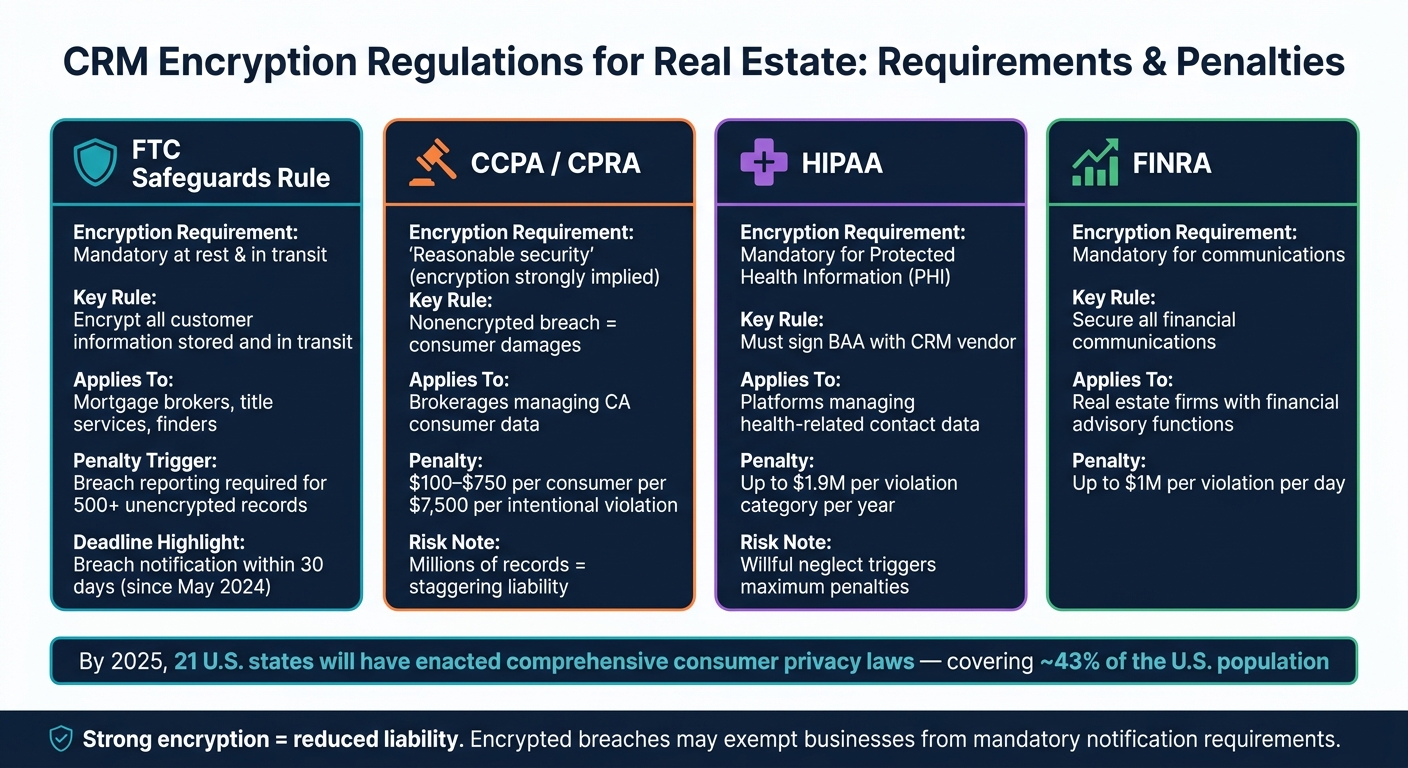
CRM Encryption Regulations: Requirements & Penalties Compared
Regulations That Affect Real Estate CRM Security
Encryption isn’t just a good idea anymore – it’s often legally required. Several U.S. laws directly influence how real estate professionals must secure CRM data.
The FTC Safeguards Rule is one of the most straightforward examples. It specifically mandates businesses to "encrypt customer information on your system and when it’s in transit". This rule applies to companies providing services like mortgage brokering, title services, or acting as a "finder". Starting in May 2024, the rule also requires businesses to notify the FTC within 30 days of discovering certain breaches.
The CCPA/CPRA takes a slightly different angle, requiring "reasonable security procedures." If a breach exposes nonencrypted personal information, consumers can seek damages ranging from $100 to $750 per person per incident. For a brokerage managing thousands of client records, this can quickly snowball into significant financial exposure.
Then there’s GLBA, which focuses on safeguarding sensitive financial data. To compare these regulations:
| Regulation | Encryption Requirement | Penalty Threshold |
|---|---|---|
| FTC Safeguards Rule | Mandatory at rest & in transit | Breach reporting for 500+ records |
| CCPA / CPRA | "Reasonable security" (encryption) | $7,500 per intentional violation |
| HIPAA | Mandatory for PHI | Up to $1.9M per violation category/year |
| FINRA | Mandatory for communications | Up to $1M per violation per day |
These laws don’t just guide security practices – they also set the stakes for what happens when data breaches occur.
How Encryption Reduces Legal Liability
Adhering to encryption requirements can significantly lower legal risks during a breach.
For example, under the FTC Safeguards Rule, a breach becomes a "notification event" only if unencrypted customer information for at least 500 individuals is compromised. Proper encryption, paired with secure key management, can exempt a business from mandatory breach notifications. The FTC clarifies: "A ‘notification event’ involves the unauthorized acquisition of at least 500 consumers’ unencrypted information. Even encrypted data counts if the encryption key is accessed by an unauthorized party."
Similarly, under CCPA/CPRA, strong encryption serves as a key defense against lawsuits. Courts and regulators consider encryption evidence of "reasonable security", which can significantly influence liability assessments. For HIPAA, failing to encrypt health-related contact data isn’t just risky – it’s a direct violation that can trigger maximum penalties for "willful neglect".
Beyond regulatory fines, encryption also helps avoid breach-of-contract claims under Data Processing Agreements (DPAs). If your CRM doesn’t meet encryption standards, institutional partners or lenders might hold you accountable for misrepresenting your security measures.
Evaluating Vendors for Encryption Compliance
Selecting the right CRM vendor is critical for staying compliant. A poor choice could leave your business exposed, even if your internal policies are airtight.
Start by looking at certifications. SOC 2 Type II has become a must-have for platforms working with institutional clients. This certification confirms that a vendor has effective security controls in place. As Vikas Patel of GTC Systems notes: "Security and compliance readiness aren’t features you can add later. They’re built into the platform."
Certifications aside, ensure the vendor offers essential features like role-based access controls (RBAC), immutable audit logs, and automated data deletion workflows. These tools are especially important for handling CCPA "Right to Erasure" requests within the required 45-day timeframe. If the CRM will manage health-related contact data, the vendor must also sign a Business Associate Agreement (BAA) to meet HIPAA requirements. Without this, no feature set can make the platform compliant.
By 2025, 21 U.S. states will have enacted comprehensive consumer privacy laws, covering roughly 43% of the U.S. population. For real estate platforms operating across multiple states, this patchwork of regulations makes it even more critical to align vendor contracts with all applicable standards.
Ultimately, ensuring vendor compliance with these regulations is a cornerstone of protecting CRM data in the real estate industry.
Putting CRM Encryption Into Practice
Common Encryption Gaps in CRM Systems
Spotting encryption gaps is a key step in safeguarding sensitive data within real estate CRMs. These gaps can lead to serious vulnerabilities, and some are easier to miss than you might think.
One major issue is unencrypted communication. When agents send wire transfer details or sensitive documents through regular email or SMS, they open the door to Business Email Compromise (BEC) attacks. Wire fraud in real estate transactions is among the most expensive forms of cybercrime, with losses running into billions of dollars annually.
Another common gap involves improperly secured sensitive fields, like Social Security numbers or bank account details. Using AES-256 encryption for these fields and keeping encryption keys stored separately is critical. Many CRM apps fall short by storing data in application-layer folders on mobile devices instead of leveraging hardware-backed storage like iOS Keychain or Android Keystore. This makes them more susceptible to exploits from rooted or jailbroken devices.
How Encryption Has Reduced Data Exposure in Practice
Addressing these encryption gaps with practical measures can significantly reduce data exposure. Take this example: a brokerage’s cloud backup is accessed by an unauthorized party. If the backup data is encrypted with AES-256 and the keys are stored separately, the stolen data remains unreadable. Without encryption, the breach could require notifying hundreds or even thousands of clients and might trigger regulatory investigations.
Encryption also works well alongside role-based access control (RBAC) to limit insider threats. For instance, if agents can only access their own client data, managers are restricted to team-level information, and executives handle financial records, the damage from compromised credentials is contained. Given that insider threats account for 60% of all data breaches, this layered approach is one of the most effective ways to reduce risks.
"Real estate platforms that route all transaction-related financial communication through authenticated, in-platform systems significantly reduce the attack surface and improve control over transaction integrity." – Giovanni Livia, AI & Software Solutions Consultant, NewAgeSysIT
This highlights how encryption, when implemented thoughtfully, can drastically reduce the risk of data exposure.
Steps to Strengthen Your CRM Encryption
Start by auditing your current encryption practices. Check if your CRM encrypts backups, how mobile data is stored, and whether any unauthorized third-party integrations might bypass your security measures – these integrations are often overlooked. Once you’ve identified vulnerabilities, take these steps:
- Move financial communications in-platform. Replace email and SMS for wire instructions with secure, in-platform channels that use multi-factor authentication (MFA).
- Encrypt sensitive fields. Use tools like PostgreSQL’s
pgcryptoto apply column-level encryption to critical data, such as Social Security numbers and bank account details. - Upgrade to TLS 1.3. If you’re still using TLS 1.2, make the switch to TLS 1.3, which offers stronger data-in-transit security.
- Schedule annual penetration tests. Test for vulnerabilities by simulating wire fraud attack scenarios and ensuring mobile app security features like certificate pinning and root detection are in place.
- Rotate API keys regularly. Set a defined schedule for key rotation to limit exposure if a key is compromised.
- Minimize data collection. Only gather the client information you absolutely need for each service. Storing less data reduces exposure and liability under regulations like the CCPA.
These steps can help close encryption gaps and bolster the overall security of your CRM system.
Conclusion: Protecting Real Estate Data Through Encryption
Real estate CRMs store incredibly sensitive information – everything from Social Security numbers and bank details to wire transfer instructions, property documents, and access codes. This makes encryption an absolute must for safeguarding data.
Beyond the risk of breaches, there are serious regulatory and licensing concerns to consider. Frameworks like GDPR, CCPA, and RESPA emphasize encryption as a key compliance measure. On top of that, many state licensing boards now require documented cybersecurity programs. Falling short of these standards doesn’t just put client data at risk – it could jeopardize your license.
"Proactive CRM security isn’t optional – it’s the foundation of customer trust, regulatory compliance, and sustainable business growth." – David Cockrum, CEO, Vantage Point
To stay secure, implement trusted methods like AES-256 encryption, TLS 1.3, stringent access controls, and secure in-platform communications. Combine these with regular audits and disciplined key management to protect both your clients and your business.
In an industry built on trust, clients expect their sensitive data to be handled with care. Strong encryption practices not only ensure compliance but also strengthen the trust clients place in your firm. By adopting these measures, real estate businesses can safeguard their reputation and maintain client confidence.
FAQs
Does encryption stop wire fraud, or do I still need other controls?
Encryption is a powerful tool for protecting sensitive data, but it’s not a silver bullet against wire fraud. Many wire fraud schemes involve Business Email Compromise (BEC), where cybercriminals gain access to legitimate email accounts to manipulate transactions.
To reduce the risk of wire fraud:
- Enable multi-factor authentication (MFA): Adding an extra layer of security makes it harder for attackers to access email accounts.
- Verify financial details independently: Always confirm payment instructions through a trusted, separate communication channel – like a phone call to a verified number.
- Avoid sharing sensitive information via email: Email alone is too vulnerable. Use secure platforms or encrypted methods when exchanging critical details about financial transactions.
Taking these steps can help safeguard against the tactics fraudsters commonly use.
What should I ask my CRM vendor about key management and BYOK?
When evaluating the security of your CRM vendor, it’s important to dig into their encryption protocols and key management strategies. Start by asking if they offer Bring Your Own Key (BYOK), which allows you to maintain control over your encryption keys. Also, check their key rotation policies – regularly rotating keys is considered a best practice. Lastly, ensure they rely on secure secret management tools rather than embedding credentials directly into application code, which can be a risky practice.
Which CRM fields should be field-level encrypted vs. just encrypted at rest?
All CRM data must be encrypted both at rest and in transit to maintain security. For data at rest, AES-256 encryption is the standard, while data in transit should use TLS 1.2 or higher. For especially sensitive information – like Social Security numbers, financial account details, and other personally identifiable information (PII) – field-level encryption is critical. This method ensures that even authorized users can’t view the most sensitive data unless they have access to specific decryption keys, providing an additional layer of security.