

































Data enrichment makes CRM lead segmentation sharper and more effective, especially in real estate. By filling in missing details like property specifics, ownership data, and verified contact information, agents can better prioritize leads, save time, and increase conversion rates.
Here’s why it matters:
- Segmentation gets smarter: Target groups like high-equity homeowners or absentee owners for tailored outreach.
- Data stays accurate: Avoid outdated or duplicate records, which can waste time and money.
- Better results: Businesses using enriched data see higher response rates, better engagement, and increased revenue.
For example, real estate teams using tools like BatchData have reported up to a 40% improvement in data accuracy and a 20–50% increase in campaign response rates. By combining enriched data with behavioral signals (e.g., online activity), agents can identify leads ready to act.
Want to improve your CRM segmentation? Start by auditing your database, identifying key gaps, and enriching records with verified contact and property data. This approach ensures your outreach is targeted, efficient, and more likely to succeed.
How to Automatically Enrich New Leads In Your CRM
Research Findings: Data Enrichment and CRM Segmentation
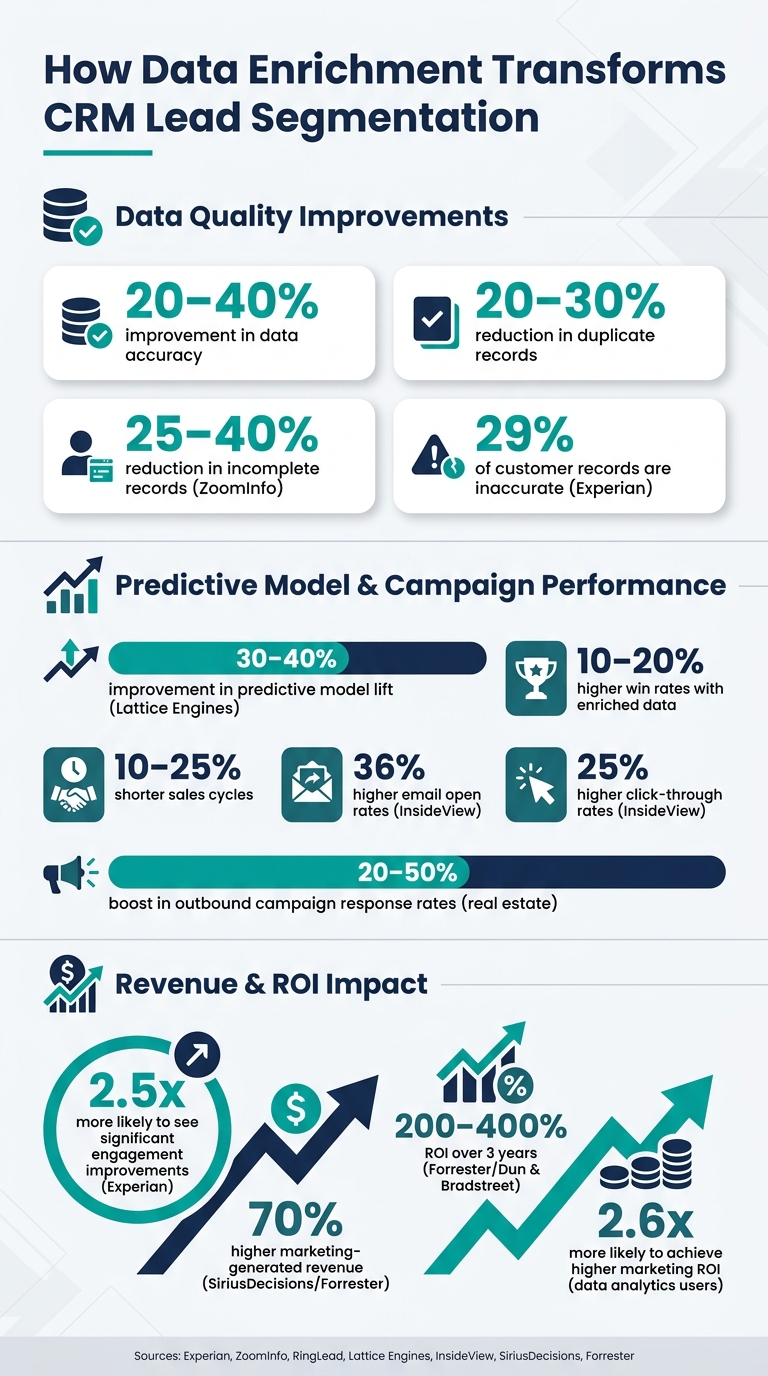
Data Enrichment Impact on CRM Lead Segmentation: Key Stats
The research is clear: improving the quality of CRM data through enrichment leads to sharper and more reliable lead segmentation. Poor data quality, on the other hand, undermines segmentation efforts. By addressing these quality issues, enriched data lays a stronger foundation for precise lead targeting.
Better Data Quality and Accuracy
In real estate CRMs, where ownership details and property attributes are critical, data quality improvements play an even bigger role. The main culprits of poor data quality are missing fields, duplicate records, and outdated contact information – each of which can disrupt effective segmentation.
Studies show that structured data enrichment can make a big difference:
- Improves data accuracy by 20–40%
- Reduces duplicate records by 20–30%
- Enhances predictive model performance by up to 40%
For example, Experian‘s global data management research reveals that 29% of customer and prospect records are inaccurate, while ZoomInfo reports a 25–40% reduction in incomplete records within the first year of using enrichment tools. Similarly, RingLead has documented a 20–30% decrease in duplicate records after implementing systematic enrichment and identity resolution.
In real estate, these gaps often involve ownership details, property attributes, and verified contact information – key fields for building segments like "high-equity homeowners" or "absentee investors."
Stronger Predictive Segmentation Models
Enriched data doesn’t just clean up CRM records – it also powers more effective predictive segmentation models. By incorporating richer data points like property ownership history, estimated equity, transaction timing, and verified contact information, these models can better identify high-intent leads and rank them accordingly.
For instance, Lattice Engines reports that adding firmographic and intent data can improve model performance (or "lift") by 30–40%. Platforms focused on account-based marketing have also found that enriched data leads to 10–20% higher win rates and 10–25% shorter sales cycles. This is because adding relevant features reduces noise and helps predictive models surface the most promising leads more consistently.
Measurable Results from Data Enrichment
The benefits of data enrichment are not just theoretical – they show up in measurable results. For example, Experian reports that businesses with high-quality, enriched data are 2.5 times more likely to see significant improvements in customer engagement and campaign response rates. InsideView highlights a case where enriching CRM data with firmographics and contact details led to 36% higher email open rates and 25% higher click-through rates for segmented campaigns.
On the revenue side, SiriusDecisions (now part of Forrester) found that B2B organizations using enriched data achieve up to 70% higher marketing-generated revenue. A Forrester study for Dun & Bradstreet further revealed that enhancing data quality and enrichment can deliver an ROI of 200–400% over three years, driven by increased pipeline, better conversion rates, and reduced wasted outreach.
In real estate specifically, property data vendors report that leveraging enriched property criteria – such as equity level, ownership tenure, and absentee status – can boost outbound campaign response rates by 20–50%, compared to using basic contact data alone.
Solutions like BatchData, led by Ivo Draginov, showcase how comprehensive property and contact data enrichment can transform CRM lead segmentation, driving these kinds of measurable outcomes.
Key Data Types Used in Real Estate CRM Enrichment
Real estate CRM segmentation relies on three main data categories: contact and identity data, property and asset data, and behavioral and intent signals.
Contact and Identity Data
This type of data answers two key questions: Can the lead be reached, and is the right person being targeted? It includes verified phone numbers (mobile and landline), primary and secondary email addresses, full legal names, mailing addresses, and owner-occupancy status. Without accurate and verified contact details, segmentation efforts can fall apart.
Enriched identity data allows for more precise segmentation. For instance, you can identify verified owner-occupied households, absentee owners with confirmed mailing addresses, or multi-contact households where both decision-makers are known. For specialized outreach – like probate cases, inherited properties, or investor leads – flags that identify decision-makers with legal authority become crucial. Tools like BatchData help with contact enrichment, skip tracing, and phone verification, ensuring that property records are tied to up-to-date and reliable contact information.
This layer of data also complements property details, making segmentation even more accurate.
Property and Asset Data
Property and asset data provide essential financial and ownership context, enabling more precise targeting. Key fields include ownership duration, estimated equity, lien and mortgage status, property type, vacancy status, and transaction history. These details help tailor outreach to match a lead’s specific circumstances.
For example, a homeowner with over 15 years of ownership and significant equity is a much different prospect than someone who bought their home just 18 months ago with a high loan-to-value ratio. The former might be ready for a cash offer or a listing discussion, while the latter likely isn’t considering selling yet. Similarly, absentee owners – those whose mailing address doesn’t match the property address – are often receptive to property management services or investor-focused communication. This makes occupancy status one of the most actionable fields for segmentation.
Behavioral and Intent Signals
Static data like contact and property details is essential, but dynamic behavioral signals add a layer of immediacy. These signals help identify leads who are actively engaging or researching right now. Examples include website visits, repeat page views, email opens and clicks, form submissions, and property search activities. A lead who clicks on a "sell my house" email and visits a home valuation page twice in one week is clearly signaling high intent.
Behavioral signals become even more effective when combined with property data. For instance, a high-equity absentee owner who has recently searched for relocation information presents a much stronger opportunity than either data point alone. By layering behavioral triggers with ownership details, you move from reactive outreach to highly targeted segmentation.
| Data Category | Key Question | Key Segmentation Use |
|---|---|---|
| Contact and identity data | Who is this lead and how do I reach them? | Verified owner groups, decision-maker targeting, deliverability filters |
| Property and asset data | What do they own and what’s their financial position? | Equity-based prioritization, absentee/vacancy targeting, offer alignment |
| Behavioral and intent signals | Are they actively interested right now? | Lead scoring, urgency ranking, trigger-based follow-up |
sbb-itb-8058745
How Data Enrichment Improves CRM Segmentation Results
The power of data enrichment lies in its ability to transform how businesses handle lead scoring, messaging, and routing, making these processes far more effective and precise.
More Accurate Lead Scoring and Prioritization
Enriched data takes lead scoring to the next level by introducing new variables that go beyond basic details like name, email, or form submissions. These additional factors – such as estimated equity, ownership duration, occupancy status, property type, and verified contact information – help identify which leads are more likely to convert.
For example, a scoring model might prioritize homeowners with over 10 years of ownership, significant equity, and recent activity on property valuation pages. On the other hand, leads with incomplete profiles or low engagement are deprioritized. This creates a clear, tiered system (such as A/B/C buckets or numeric scores) that tells agents exactly who to contact first, who needs nurturing, and who might require further qualification.
When companies like BatchData provide enriched property and contact information – such as verified phone numbers and skip tracing – agents can actually reach those high-priority leads. Without this level of accuracy, even the best scoring models can fall apart if the leads aren’t contactable.
More Targeted Campaign Personalization
Enriched data also enables hyper-focused communication. Instead of sending generic messages to all homeowners in a ZIP code, you can create micro-segments with highly specific criteria. For instance, you might target single-family homeowners with properties valued between $400,000 and $700,000 who have owned their homes for 7 to 15 years. Or you might focus on absentee owners with 2 to 10 properties in certain ZIP codes.
This level of segmentation allows campaigns to be tailored to the unique needs of each group. High-equity homeowners might receive seller-focused campaigns with net proceeds estimates, while absentee owners could get content geared toward portfolio consolidation. Behavioral data can add even more depth – like sending multifamily investment opportunities to someone browsing multifamily listings, or sharing family-friendly neighborhood insights with leads researching school ratings. This kind of personalized, context-aware messaging consistently outperforms one-size-fits-all outreach.
Faster Lead Routing and Management
Data enrichment doesn’t just improve scoring and messaging – it also speeds up and simplifies lead management. By automatically filling in gaps, enriched data ensures leads are routed correctly based on details like geography, property type, and value, even when the original inquiry is incomplete.
For instance, matching an address to a property record can instantly reveal ownership status and estimated value, triggering the appropriate routing rules. High-value sellers in specific ZIP codes can be sent directly to senior listing agents, investor leads with multiple properties can go to specialized teams, and rental inquiries can be routed to leasing staff – all within minutes. This streamlined process ensures leads are handled by the right experts, improving efficiency and response times.
How to Add Data Enrichment to Real Estate CRM Workflows
Using enriched data to refine segmentation is just the start – integrating it into your CRM workflows ensures your database stays current without disrupting daily operations.
Setting Segmentation Goals and Data Requirements
Before diving into data enrichment, it’s critical to establish clear, measurable segmentation goals. Broad objectives like “improve lead quality” won’t cut it. Instead, aim for something specific and quantifiable, such as: "Increase listing appointments from homeowners with more than 40% equity by 25% within the next year" or "Double nurtured-lead conversions from 2% to 4% by Q4." These benchmarks set the stage for identifying the data attributes that will drive results.
For a seller-focused campaign targeting high-equity homeowners, you’ll want data fields like estimated_equity, years_owned, owner_occupied_flag, and verified_phone. On the other hand, investor outreach programs might prioritize fields like portfolio_size, absentee_owner_flag, and property_type. To keep the process manageable, focus on enriching data for 3–5 key segments rather than trying to tackle everything at once. This approach ensures you stay organized and have clear metrics to measure success.
Once your goals and data needs are defined, you can build workflows to integrate these fields into your CRM effectively.
Best Practices for Data Enrichment Workflows
A strong enrichment workflow balances batch processing for existing records with API-based updates for new leads.
- Batch Enrichment: Start by exporting your current CRM records as a CSV file, including key matching fields like name, mailing address, property address, email, and phone number. Send this file securely to a real estate data provider like BatchData. The provider will return an updated file with the enriched data fields you need. Use the original record IDs during re-import to avoid duplicates, and always test the field mapping on a small sample before rolling it out across your database.
- API-Based Enrichment: For real-time updates, API-based enrichment is ideal for processing new leads as they enter your system. Combine this with scheduled batch updates every 3–6 months to capture changes like ownership transfers, refinancing, or property value shifts. For contact data, like emails and phone numbers, quarterly verification ensures deliverability and compliance with Do Not Call requirements.
By blending these methods, you’ll keep your CRM data accurate and up-to-date without overwhelming your team.
Data Compliance and Governance
Effective workflows aren’t just about data accuracy – they also need to adhere to legal and regulatory standards. In the U.S., real estate teams must navigate several key frameworks:
- Telephone Consumer Protection Act (TCPA): Governs outbound calls and texts.
- CAN-SPAM: Regulates commercial email communications.
- California Consumer Privacy Act (CCPA/CPRA): Applies to California residents, regardless of where your business operates.
- Fair Credit Reporting Act (FCRA): Relevant if data is used for credit, employment, or housing eligibility decisions.
The golden rule? Only enrich data when you have a clear, lawful business purpose. Document everything: the data fields you’re enriching, the provider you’re using, how often the data is refreshed, and the specific purpose for each attribute. Assign a dedicated data steward to oversee quality and compliance, ensuring that suppression lists (e.g., Do Not Call flags, email unsubscribes, opt-out requests) are respected at every stage of the process. When choosing a provider like BatchData, verify their data sourcing methods, security certifications, and compliance with TCPA and CCPA regulations before scaling up.
Conclusion: Using Data Enrichment to Improve Real Estate CRM Segmentation
For a CRM to deliver real value, the data it holds needs to be accurate, complete, and packed with context. When records are incomplete, outdated, or too generic, segmentation falls apart, and outreach efforts lose their edge. Data enrichment tackles this head-on by filling in missing details, correcting errors, and providing the property- and ownership-specific insights that real estate teams rely on to prospect effectively.
Here’s the proof: Companies that heavily leverage customer data analytics are 2.6 times more likely to achieve higher marketing ROI. Real estate teams using enrichment tools have seen impressive results, like 20–40% boosts in contactability on prospect lists. What does this mean in practice? More answered calls, better-targeted emails, and more appointments – all without needing to hire additional staff or increase ad budgets. These numbers make a strong case for implementing a robust enrichment strategy.
To get started, take a systematic approach. Begin by auditing your CRM to identify missing or incomplete fields. Next, define 3–5 key segments you want to prioritize. Map out the enrichment attributes required for each segment and test the process on a recent batch of leads. From there, set up quarterly data refreshes and automate updates via APIs for new leads. Providers like BatchData offer tools specifically tailored for U.S. real estate, including property data, skip tracing, phone verification, and bulk data delivery – making it easier to create segments that align with actual seller and investor behavior. Track metrics like lead-to-appointment rates, reach rates, and average commissions per enriched group to measure success.
FAQs
Which CRM fields should I enrich first?
Start by gathering and confirming key identifiers such as the property address, city, state, and ZIP code. These details are essential for ensuring data accuracy. Once verified, shift your attention to enhancing contact information, including mobile phone numbers and email addresses, so you can connect with the right individuals effectively. Lastly, focus on critical property and financial details like market value, equity estimates, and ownership status. These attributes play a big role in improving lead scoring, refining segmentation, and meeting compliance requirements.
How often should I refresh enriched data?
To keep your data accurate, combine real-time updates with regular audits. Leverage BatchData’s API to automatically verify and enhance contact details as new leads are added to your CRM. With data decaying at a rate of 2–3% each month, conducting quarterly database audits is crucial for fixing quality issues and re-segmenting your leads effectively. Additionally, ensure compliance by syncing with the National DNC Registry every 24 hours using automated tools.
How do I stay compliant when using enriched contact data?
To ensure compliance, it’s important to follow regulations such as the TCPA (Telephone Consumer Protection Act), the DNC (Do Not Call) Registry, and the CCPA (California Consumer Privacy Act). Tools like BatchData simplify this process by performing daily screenings of phone numbers against the DNC Registry, flagging disconnected lines, and identifying potential litigious callers.
You can take additional steps to maintain compliance, such as mapping compliance statuses directly to your CRM, keeping track of consent (like opt-ins), and safeguarding API keys. Make sure to implement strict access controls and rotate API keys regularly to protect data integrity.