






































SEO Title: Property Profile Reports for API-Driven Real Estate Ops
Meta Description: Learn what property profile reports include, how APIs change the workflow, and how teams use them for underwriting, monitoring, and due diligence.
Meta Keywords: property profile reports, property data API, real estate data, underwriting data, portfolio monitoring, due diligence, proptech APIs, property intelligence
Static property reports create blind spots. Modern providers compile sales, mortgage, and ownership history from hundreds of authoritative sources and return it within seconds in presentation-ready form, which changes how teams handle due diligence and portfolio analysis (DataTrace property profile reports).
The practical shift is simple. A property profile report used to be a document you pulled when someone asked for it. Now it works better as a live property intelligence layer feeding underwriting queues, acquisition models, servicing alerts, and outbound workflows.
Core takeaways:
- Property profile reports are aggregated intelligence: They combine ownership, legal, tax, mortgage, market, and risk data into one usable view.
- Enterprise reports go deep: Modern PPRs can aggregate 1,000+ data attributes for a single property (Fast Title Search guide to free property profile reports).
- APIs beat manual lookup: Programmatic access is what makes these reports operational, not just informative.
- ROI comes from decisions, not documents: Teams use the data to underwrite faster, monitor portfolios continuously, and target opportunities with better precision.
- Coverage quality matters: Rural, underserved, and climate-exposed properties are where weak data strategies break.
For teams tracking market movement and investor sentiment at scale, Investor Pulse reports are a useful example of how report outputs become part of a recurring decision system instead of a one-time file.
Introduction
A static property report is often treated as evidence. In practice, it’s closer to a timestamped snapshot that starts aging the moment it’s generated.
That’s the counterintuitive part. The faster your acquisition, underwriting, or servicing workflow moves, the less useful a one-off PDF becomes. The report still has value, but the advantage comes when the same underlying data can be refreshed, scored, matched, and routed automatically.
What matters in 2026 isn’t whether you can pull a property profile report. It’s whether your systems can consume property intelligence continuously. Teams that still rely on manual county searches, spreadsheet merges, and analyst-by-analyst reconciliation are paying for delay, inconsistency, and missed triggers.
Three practical truths drive the shift:
- Speed matters operationally: Some providers deliver sales, mortgage, and ownership history in seconds, which is a meaningful advantage when teams are handling rapid due diligence or large portfolios.
- Breadth matters analytically: Strong property profile reports pull from many source types, not a single feed.
- Access method matters strategically: A report in a browser helps one analyst. A report available through an API helps an entire business process.
Practical rule: If a property report can’t trigger an action in another system, it’s still being used below its value.
That’s why this topic matters beyond title, brokerage, or lending teams. Proptech platforms, insurers, servicers, and investor portals all need the same thing: a way to turn raw property records into decisions without forcing staff to rebuild the same file over and over.
What Exactly Is a Property Profile Report?
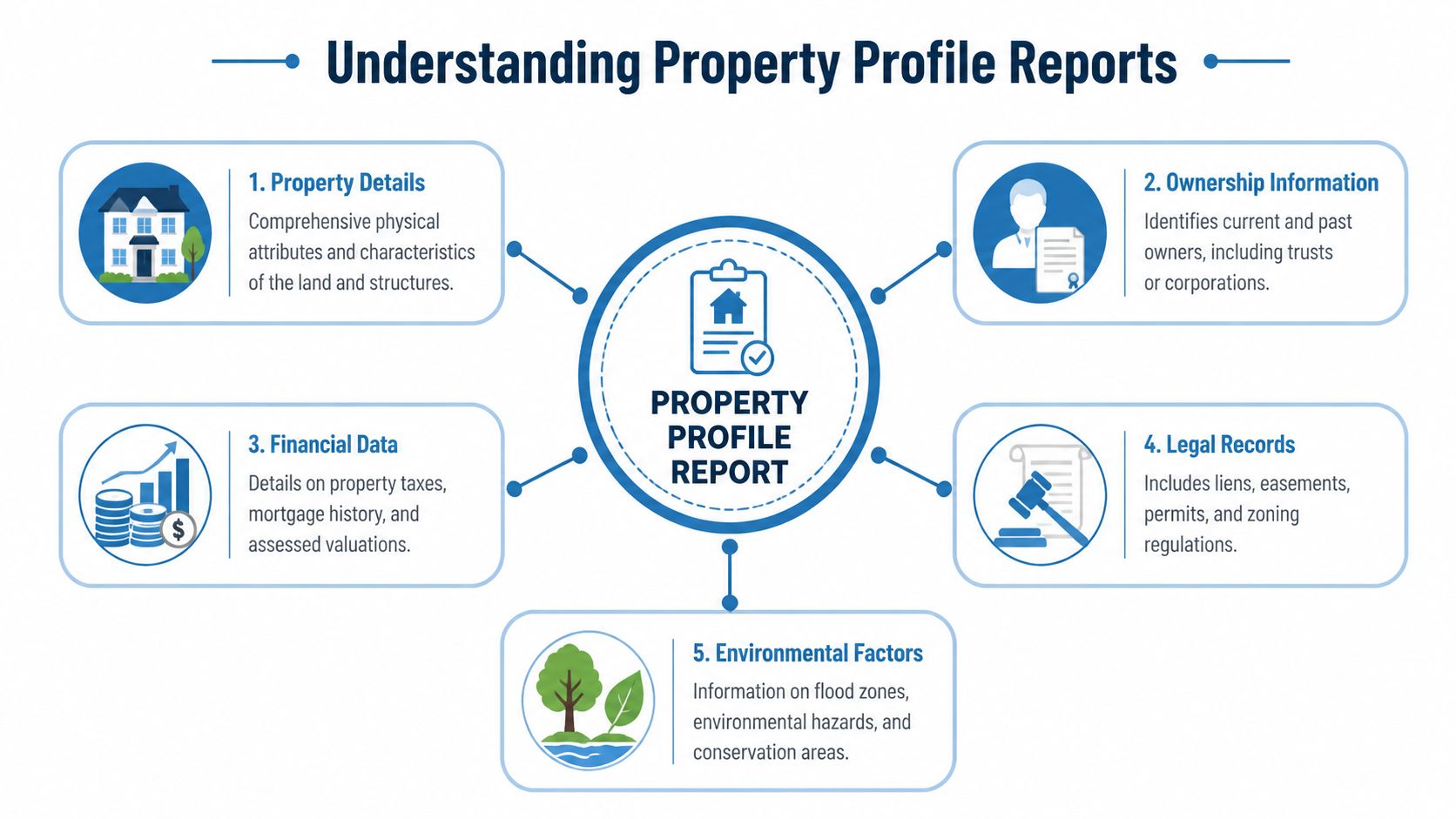
A property profile report is a structured record of a parcel or address that pulls together the data teams usually have to assemble by hand. It typically combines ownership, tax, mortgage, transaction, legal, and physical property data into one usable profile.
For a title analyst or acquisitions associate, that profile may be read as a report. For a proptech platform or servicing operation, it should be treated as an input to a workflow.
Static report versus live feed
The practical difference is timing and usability.
A PDF answers, “what was assembled at the moment this report was generated?” An API-backed property profile answers, “what does the system show now, and can that update trigger the next action?” That matters when a team is monitoring ownership transfers, lien filings, listing changes, vacancy signals, or servicing risk across thousands of records.
In real operations, the API model changes the economics. One analyst pulling one report at a time is fine for exception handling. It breaks down when underwriting queues, lead-routing rules, valuation models, or portfolio monitoring depend on current property data every day.
Where the data comes from
No provider creates this data from scratch. The work is aggregation, normalization, and record matching across fragmented public and commercial sources. A usable property profile report usually pulls from several of these inputs:
- County recorder files
- Tax assessor datasets
- Sales and mortgage history
- Ownership and vesting records
- Legal filings such as liens or lis pendens
- Market and neighborhood indicators
Quality depends on how well those sources are standardized and connected at the property level. The hard part is not displaying fields on a screen. The hard part is resolving parcel IDs, address variants, recording gaps, and filing delays well enough that downstream systems can rely on the result.
Consumer-grade lookup versus enterprise-grade property intelligence
A basic property lookup can be enough for casual research. It might show the owner name, mailing address, square footage, and tax amount. That helps an agent, borrower, or investor check a single property.
Enterprise teams usually need more. They need a property record that can support decisions, scoring, and automation without forcing staff to re-key data into other systems. That means the report has to do more than summarize a property. It has to hold up under underwriting, acquisitions, servicing, compliance review, and outbound operations.
The difference shows up in the questions the data can answer:
- Is the ownership record current enough to trust for outreach or vesting review?
- Are there liens, notice filings, or other title signals that change risk?
- Can the property be matched reliably across CRM, LOS, servicing, and data warehouse records?
- Can the same record be refreshed in bulk through an API, including platforms such as BatchData, instead of being ordered one address at a time?
That is the operational definition that matters. A property profile report is not just a document. It is a standardized property data object that can be queried, refreshed, scored, and routed across systems. Teams that use it that way get faster cycle times and fewer manual touches.
What Key Data Fields Should You Expect?
A usable property profile report should give your team enough structure to match the asset across systems, score risk, and trigger action without manual cleanup. If the record cannot feed underwriting rules, outbound workflows, or portfolio monitoring, it is a lookup result, not an enterprise property profile.
At the top end, property profiles can include more than 1,000 attributes across parcel, ownership, legal, tax, physical, and market datasets. That breadth matters in API workflows because the highest-value fields are rarely the obvious ones. A parcel ID mismatch can break CRM joins. A vesting change can reroute a collections file. A zoning field can change redevelopment assumptions. Teams using platforms such as BatchData usually care less about how the report looks in PDF form and more about whether those fields can be refreshed reliably at scale.
Core components of a Property Profile Report
| Data Category | Key Fields | Primary Source(s) |
|---|---|---|
| Identity and parcel | APN, situs address, legal description, parcel boundaries | County assessor, recorder, parcel datasets |
| Ownership and vesting | Owner name, mailing address, vesting type, ownership history | Recorder filings, deed records, public records |
| Sales and mortgage | Last sale date, transfer history, mortgage history, lender data | Recorder offices, mortgage filings |
| Tax and assessment | Assessed value, tax amount, tax status, exemptions | Tax assessor records |
| Legal and title signals | Liens, lis pendens, judgments, easements, violations | Court filings, recorder data, municipal records |
| Physical characteristics | Year built, lot size, building area, bed/bath count, use type | Assessor data, surveys, field records |
| Zoning and development | Zoning code, land use, FAR, air rights | Planning departments, zoning records |
| Environmental and hazard | FEMA flood zone, toxic site flags, conservation overlays | Environmental datasets, hazard maps |
| Market context | HPA trends, median home value tiers, rental indicators, vacancy context | Market analytics, MLS-derived and housing data sources |
The fields that actually change decisions
Some fields support reference. Others drive workflow.
Ownership and legal signals
Ownership data does more than identify the current titleholder. It affects entity resolution, contact strategy, foreclosure monitoring, vesting review, and exception handling.
Focus on these fields:
- Current owner and vesting: Individual, trust, LLC, and corporate ownership often require different treatment in underwriting, servicing, and outreach.
- Mailing address and owner occupancy: Useful for collections, investor segmentation, and occupancy modeling.
- Ownership history: Helps confirm turnover patterns, deed chronology, and recent transfer activity.
- Liens, lis pendens, judgments, and notice filings: These often determine whether a file stays in an automated path or goes to analyst review.
- Violations and municipal complaints: Relevant for insurance exposure, code enforcement risk, and distressed asset screening.
For lead-gen and servicing teams, legal signal quality usually matters more than one more bedroom count field.
Physical and development attributes
Basic characteristics such as square footage, year built, and use code still matter. The higher ROI fields are the ones tied to redevelopment, valuation edge cases, and location-specific constraints.
Examples include:
- FAR and zoning code: Important for redevelopment screens, density assumptions, and feasibility models.
- Lot size, frontage, and parcel shape constraints: Useful for subdivision analysis and infill filtering.
- Air rights and easements: Material in urban markets and title-sensitive acquisitions.
- Condition and improvement details when available: Helpful in collateral review and appraisal support.
- Boundary and geospatial context: Parcel geometry becomes more useful when paired with geospatial analysis for automated valuation models.
These fields are especially valuable in an API pipeline because they can be queried in bulk, scored automatically, and pushed into pricing or routing logic without another analyst touching the file.
Financial and tax history
This is the category teams spend time reconciling when records are incomplete or spread across systems. A good profile reduces that reconciliation work.
Useful fields include:
- Sales history, because transfer timing and price context help validate current positioning.
- Mortgage history, because refinance patterns, lender presence, and debt recency can signal both opportunity and exposure.
- Tax assessments and exemptions, because tax burden changes hold economics and owner behavior.
- Delinquency and status indicators when available, because they help prioritize review queues.
- Income-property metrics when included, such as NOI or GRM, for faster screening of multifamily and rental assets.
The National Association of Realtors publishes housing research and statistics that reference operating and performance measures such as Net Operating Income, Gross Rent Multiplier, tenant turnover, and average rent per property in real estate analysis (NAR housing statistics and research).
Risk and location context
A property profile should also answer whether the parcel carries location-based risk that changes pricing, insurance assumptions, or hold strategy.
Key fields include:
- Flood zone placement
- Environmental hazard indicators
- School district and neighborhood segmentation
- Rental market context
- Home price appreciation trends across multiple time horizons
If the record identifies the parcel but leaves out surrounding risk context, teams still have to pull separate datasets and reconcile them by hand. That is exactly the manual work modern property data APIs are supposed to remove.
How Do Top Teams Use These Reports for ROI?
Top teams treat property profile reports as production data, not as PDFs sitting in a deal folder. ROI shows up when the record feeds scoring, routing, monitoring, and outreach automatically across thousands of properties.

Underwriting and servicing
Underwriting teams do not win by ordering more reports. They win by turning property signals into early decision rules.
Encumbrances are a good example. Easements, lien stacks, and related title issues can change collateral quality, development assumptions, and the right review path. An industry overview from EzFeasy on property profile reports states that identifying an easement can reduce a lot’s potential yield by 20-40%, that multiple liens can indicate an 18% delinquency spike risk, and that proactive intervention can reduce servicing losses by up to 15%.
That matters because the operational gains are straightforward:
- Collateral reviews start with fewer bad assumptions
- Servicing teams can intervene earlier on higher-risk files
- Exception queues get routed by rule instead of analyst memory
- Analysts spend less time opening files that should have been flagged upstream
The trade-off is implementation work. A team that only pulls one-off reports still leaves analysts to interpret and rekey the same issues manually. A team using API-driven property data can push those fields into underwriting rules, QC checks, and servicing alerts the moment the record updates.
Investment due diligence
Buy-side teams use the same record differently. The objective is not just to describe the property. The objective is to screen faster, reject bad fits earlier, and spend analyst time only where the spread justifies it.
Static reports support one address at a time. Programmatic access supports market-wide screening.
Common ROI use cases include:
- Title complexity screening: Liens, lis pendens, and ownership structure help isolate assets that need legal review before they enter pricing models.
- Development constraint checks: FAR, zoning, and easement data reduce bad assumptions about buildable area and exit value.
- Market context overlays: Price appreciation, rent signals, and neighborhood conditions sharpen buy box filters.
- Off-market targeting: Pre-foreclosure, equity position, and ownership duration become more useful when queried in batches instead of by hand.
Location data also changes valuation quality. Teams building pricing or acquisition models should review how geospatial analysis supports automated valuation models, especially when parcel-level facts need local market context.
Portfolio monitoring and targeted outreach
Portfolio operations and growth teams often start with the same property record and end with different workflows. One team watches for ownership transfers, new liens, or violations across an existing book. Another uses equity, absentee status, or distress indicators to build outreach segments.
The report stops being a document at that point. It becomes infrastructure for change detection.
A practical setup looks like this. A proptech platform ingests refreshed property records through an API such as BatchData’s, scores changes against business rules, and writes the result into servicing queues, CRM audiences, or retention campaigns. That is a very different operating model from emailing around a report and asking an analyst to review it later.
A short walkthrough helps clarify how teams put these fields to work:
Good teams route the same property data into more decisions.
Teams that treat property profile reports as one-time analyst artifacts create backlog. Teams that feed the same records into automated workflows get faster decisions, tighter targeting, and lower manual cost per property.
How Do You Generate Property Reports with an API?
You generate property reports with an API by sending a property identifier such as an address or APN to an endpoint, authenticating the request, and receiving structured data that your systems can store, score, and trigger against.
That’s the simple version. The useful version is more specific: your implementation has to solve for identity resolution, refresh cadence, response normalization, and downstream actioning.

Start with the property identifier
Most APIs will let you query a property by one of these:
- Full address
- APN
- Latitude and longitude
- Owner plus location constraints
- Portfolio file for batch matching
If you have strong internal IDs, use them only after you’ve built reliable crosswalks to the provider’s identifiers. If you don’t, address plus postal normalization is usually the cleanest entry point.
A practical request flow looks like this:
-
Normalize the input
Clean directional fields, unit numbers, ZIP formatting, and state abbreviations. -
Run match logic
Resolve the submitted record against the provider’s parcel and property graph. -
Request the profile
Pull the attributes your product or workflow needs. -
Store both data and metadata
Save not just field values, but also timestamps, confidence indicators, and match status. -
Trigger next actions
Push the record into underwriting, CRM enrichment, monitoring, or analytics.
Example request and response shape
The exact endpoint will vary by provider, but the structure usually looks something like this:
Example request payload
{
  "query": {
    "address": {
      "street": "123 Main St",
      "city": "Austin",
      "state": "TX",
      "zip": "78701"
    }
  },
  "include": [
    "ownership",
    "sales_history",
    "mortgage_history",
    "tax_assessment",
    "liens",
    "zoning",
    "flood_zone",
    "market_indicators"
  ]
}
Example response payload
{
  "match_status": "matched",
  "property_id": "provider_internal_id",
  "parcel": {
    "apn": "example_apn",
    "address": "123 Main St, Austin, TX 78701"
  },
  "ownership": {
    "owner_name": "Example Owner LLC",
    "mailing_address": "PO Box 100, Austin, TX 78702",
    "vesting_type": "llc"
  },
  "physical": {
    "property_type": "single_family",
    "lot_size_sqft": 7405,
    "building_area_sqft": 2140,
    "year_built": 1988
  },
  "financial": {
    "assessed_value": null,
    "tax_status": "current"
  },
  "legal": {
    "liens": [],
    "lis_pendens": [],
    "easements": ["utility_easement"]
  },
  "risk": {
    "flood_zone": "outside_special_hazard_area"
  },
  "market": {
    "hpa_trend_available": true,
    "rental_indicators_available": true
  },
  "metadata": {
    "as_of_date": "2026-01-15",
    "match_confidence": "high"
  }
}
The example is illustrative, but the implementation lesson is real. Your internal systems shouldn’t depend on a browser-ready PDF if what you need is machine-readable data.
What teams usually get wrong
The first mistake is over-requesting fields. Pulling every available attribute sounds efficient, but it creates storage bloat, noisy models, and integration friction.
The second mistake is ignoring match quality. A property report generated from a weak address match is worse than no report because it creates false confidence.
The third mistake is forgetting refresh logic. Ownership, listing, lien, permit, and distress fields do not all change on the same cadence. Treating them as if they do creates stale decisions.
Operational advice: Build your schema around decision use cases, not around the provider’s full attribute catalog.
API access versus file delivery
Not every use case belongs on a synchronous API call. If you’re handling portfolios, model training sets, historical backfills, or nightly monitoring jobs, bulk delivery often makes more sense than request-by-request lookup.
A simple comparison helps:
| Delivery mode | Best for | Trade-off |
|---|---|---|
| Real-time API | Instant lookups, user-facing products, transaction workflows | More request orchestration required |
| Batch file delivery | Portfolio review, nightly scoring, warehouse ingest | Less immediate than direct lookup |
| Warehouse delivery | Analytics teams, BI tools, model development | Requires stronger data engineering discipline |
Some enterprise platforms support bulk delivery through storage and warehouse workflows such as S3 and Snowflake, which is often the right path for large-scale internal analysis rather than repeated front-end calls.
Where a provider fits
If your team needs a live property data layer instead of ad hoc reports, one option is BatchData, which provides low-latency APIs and bulk delivery across property characteristics, ownership history, valuations, mortgage and lien details, listings, permits, and pre-foreclosure activity. The practical value isn’t branding. It’s having one system where product teams, analysts, and operations teams can hit the same property backbone instead of stitching together separate tax, market, and contact workflows.
What good implementation looks like
The strongest setups share a few traits:
- Clear matching rules: Address normalization, parcel-level resolution, and duplicate handling are explicit.
- Field-level ownership: Product, data, and risk teams know which fields are authoritative for which decisions.
- Confidence-aware workflows: Low-confidence matches get routed for review instead of entering production logic.
- Separate refresh tiers: Distress, legal, and market-sensitive fields refresh more aggressively than static parcel data.
- Warehouse-ready modeling: Responses are structured so data science and BI teams can reuse them without custom cleanup every week.
When those pieces are in place, property profile reports stop being reports in the old sense. They become reusable data products.
What Are the Best Practices for Accuracy and Compliance?
Accuracy problems in property data rarely start with a bad report. They start with teams treating a compiled record like a final fact set, then pushing it into underwriting, outreach, servicing, or pricing logic without enough controls.
The fix is operational discipline. A property profile report should function as a monitored data input with source history, timestamps, confidence thresholds, and review rules. Teams that still pass around PDFs or CSV exports usually find issues late, after a mailing drops, a loan file gets challenged, or a model starts drifting.
Validate fields at the decision level
Different fields carry different risk. A site address or APN may be stable for long periods. Permit activity, legal filings, occupancy indicators, listing status, and hazard attributes can change quickly or arrive with uneven county coverage.
Set rules at the field level:
- Track source lineage: Record whether the value came from assessor, recorder, court, MLS-derived, geospatial, or modeled enrichment data.
- Store field timestamps: An overall record refresh date is not enough if the lien data updated last week and the ownership data is months older.
- Define source precedence: Decide which source wins before records conflict.
- Score match confidence: Low-confidence joins should pause downstream automation.
- Keep prior values: Audit trails matter when analysts, risk teams, or regulators ask what was known at the time of a decision.
That is the difference between a useful property data system and a report archive.
Handle rural and underserved properties as a separate data quality problem
Rural collateral breaks assumptions that work in dense metro counties. Parcel boundaries can be harder to resolve. Land use can be mixed. Mailing address, situs address, and legal description may not line up cleanly.
The CFPB maintains a rural and underserved counties tool for regulatory purposes under 12 CFR 1026.35. The existence of that separate determination framework is a good reminder that teams should not assume standard metro-oriented matching and geography logic will transfer cleanly to rural compliance workflows. In practice, that means adding extra validation around tract assignment, boundary resolution, and land-use classification before using the data in credit or underwriting decisions.
For market context, teams handling dispersed portfolios should also compare their internal coverage against broader regional trends, such as those highlighted in BatchData’s Investor Pulse reports.
Separate operational use from regulated use
One record can support several workflows, but the controls should change by use case.
A skip-tracing or lead-prioritization workflow can tolerate more ambiguity than a consumer-facing credit decision. Internal portfolio segmentation has a different risk profile than pricing, insurance, or adverse-action-related processes. Teams get into trouble when the same property profile payload moves across departments with no change in validation rules.
A workable policy usually includes these controls:
- Name the decision type. Lead routing, collateral review, servicing, compliance review, and consumer-facing decisions should not share the same assumptions.
- Limit which fields can drive action. Some inputs are fine for prioritization but need secondary verification before they influence a regulated outcome.
- Log what was used. Store the exact version, timestamp, and source path behind the record used in the workflow.
- Create manual review triggers. Edge cases should route to analysts instead of forcing a clean yes or no from incomplete data.
Design for climate and hazard updates now
Hazard data is changing faster than many legacy report formats were built to handle. Historical flood, fire, or storm fields are still useful, but static labels are weak inputs for current underwriting and insurance workflows if they cannot absorb newer geospatial or property-condition signals.
The practical issue is architecture. Teams need a data model that can accept refreshed hazard layers, permit activity, and property condition inputs without rebuilding the workflow every quarter. API-based delivery is better suited to that than one-off report pulls, because the underlying property record can refresh as new risk data arrives.
Good compliance starts with good data plumbing. If the pipeline cannot show where a field came from, how old it is, and whether it was reliable enough for the decision, the report is not ready for production use.
Frequently Asked Questions About Property Profile Reports
Are property profile reports the same as AVMs?
No. A property profile report is a broad data record about the asset, ownership, legal status, taxes, mortgages, and related context. An AVM is a valuation model that estimates market value using selected inputs. In practice, AVMs often depend on data that comes from a property profile workflow, but they aren’t the same product.
Do teams usually buy reports one at a time or through subscriptions?
Both models exist. Smaller teams often start with one-off report access. Larger platforms and enterprise operators usually need API or bulk-delivery pricing because they aren’t buying a document. They’re buying recurring access to the data layer behind the report.
What should you do when fields conflict?
Use a precedence policy. Decide which source wins for ownership, tax, legal, market, and geospatial fields before conflicts appear. Store the losing value when needed for audit purposes, but don’t let analysts improvise source priority record by record.
How should climate risk fit into property profile reports?
It should be layered in, not bolted on at the end. One unresolved industry problem is how to integrate AI-driven climate risk scoring when recent extreme weather conditions aren’t reflected in standard historical report formats. Emerging approaches combine geospatial AI and permit history to connect property data with climate exposure for insurance and underwriting use (Nearmap property assessment solutions).
Where can you watch broader market-level property trends alongside property reporting workflows?
A market-level report can complement property-level intelligence, especially for strategy and acquisition planning. For example, BatchData’s Investor Pulse reports shows how recurring market reporting can sit alongside parcel-level decision systems.
If your team is still treating property profile reports as static files, it’s worth looking at BatchData. The platform provides programmatic access to large-scale U.S. property, valuation, ownership, lien, permit, and pre-foreclosure data through APIs and bulk delivery, which is the setup most enterprise real estate workflows need.