

































Fake users and invalid phone numbers can cost businesses billions annually. Here’s why it matters and how to fix it:
- Fake accounts inflate costs, skew analytics, and expose platforms to fraud. SaaS companies alone lose $1.2 billion annually from trial abuse.
- Invalid phone numbers waste time and money. Sales teams lose 40% of call time dialing bad numbers, while marketing teams waste $262.50 for every 10,000 SMS messages sent to invalid contacts.
- Legal risks arise from contacting reassigned numbers, with TCPA fines ranging from $500 to $1,500 per violation.
The solution? Real-time phone verification. BatchData’s API identifies invalid, disconnected, or fraudulent numbers instantly, preventing fake signups, reducing wasted resources, and improving data accuracy by 99.9%. It’s fast, easy to integrate, and ensures your platform only interacts with real users.
Key Benefits:
- Blocks up to 95% of fraudulent registrations.
- Boosts right-party contact rates to 76% (vs. 25% industry average).
- Saves time, reduces costs, and protects against compliance risks.
Bad data hurts your business. Clean it up with phone verification and focus on growth.
How Bad Phone Data Corrupts Analytics and Decision-Making
Corrupted Data Insights
The impact of fake users and invalid phone data goes far beyond just inflated numbers – it wreaks havoc on analytics. Even the most precise analytics tools can’t deliver accurate insights when the underlying data is flawed. Metrics based on invalid phone numbers become unreliable, leading businesses astray.
Bad data costs U.S. businesses a staggering $3.1 trillion every year. It starts with the basics: fraudulent accounts inflate your user base, creating the illusion of growth, while real conversion rates quietly decline. Your performance charts may look promising, but they’re telling a story that doesn’t exist.
The ripple effects of bad data touch every corner of decision-making. Sales teams waste an average of 550 hours and $32,000 annually chasing leads based on inaccurate information. Forecasting models, trained on this flawed data, predict growth that never happens. The result? Biased projections and decisions that crumble under scrutiny.
Impact on Marketing and User Engagement
Corrupt data doesn’t just distort metrics – it also undermines marketing efforts. When marketing teams spend 34% of their time chasing invalid leads, customer acquisition costs skyrocket, while their ability to reach real prospects diminishes.
Take the case of Michael Chen, VP of Marketing at MarketPro, in January 2025. His team was sending out 2.5 million SMS messages every month, but many were landing on invalid numbers. After implementing a phone validation system, MarketPro slashed their SMS marketing costs by 40% and saw a 280% boost in ROI.
"When CRM records are incomplete, outdated, or just plain wrong, sales and marketing teams are left flying blind." – Validity, The State of CRM Data Management Report
Invalid numbers don’t just waste resources – they also harm your campaigns. High bounce rates from these numbers can trigger carrier spam filters, leading to legitimate campaigns being blocked entirely. This not only disrupts delivery but also tarnishes your sender reputation, making future campaigns even harder to execute successfully.
Why Mobile Operators Hold The Keys To Fraud-Proof Sign‑Ins
The Phone Verification API Solution
BatchData’s Phone Verification API helps stop bad data in its tracks by instantly checking phone numbers during sign-ups, subscriptions, or checkouts. With just one API call, you’ll know if a number is valid, active, its type (mobile, landline, or VoIP), the carrier, and its Do Not Call (DNC) status.
This system taps into trusted data sources and real-time risk indicators to flag disconnected, temporary, or fraudulent numbers. It provides the insights you need to stay compliant, block risky virtual numbers, and ensure legitimate users can proceed smoothly.
Real-Time Verification in Milliseconds
When users are filling out forms or making purchases, speed is everything. BatchData’s API delivers results in milliseconds, verifying phone numbers right when they’re entered – whether during registrations, newsletter sign-ups, or payment processes.
Between 2023 and 2024, Intuit rolled out real-time phone verification across more than 200 countries to authenticate new users, achieving a 94% deliverability rate for one-time password messages in just three months. Similarly, Stripe used the API to secure millions of user logins in the United States, boosting login success rates by 6 points, with 70% of verifications handled seamlessly through the API.
"By verifying information at the source, prospects and customers will receive the follow-up they expect and your internal teams won’t waste time trying to connect with invalid contacts." – Validity BriteVerify
This fast and accurate verification process is designed to integrate effortlessly, keeping your system efficient and user-friendly.
Easy Integration for Any Platform
Built on standard REST architecture with JSON data exchange, the API works with nearly any modern platform. Developers can quickly integrate it into web forms or mobile apps using detailed documentation and libraries available for Node.js, Python, and Java.
"What used to take 30 minutes now takes 30 seconds. BatchData makes our platform superhuman." – Chris Finck, Director of Product Management
Whether you’re verifying numbers at your API gateway or directly in web forms, the integration ensures invalid data doesn’t clog up your systems. Plus, with flexible Pay-As-You-Go pricing, you only pay for what you use – no long-term contracts required.
Real Estate Use Cases for Phone Verification
Better User Onboarding
Real estate platforms often struggle with fake accounts, which can mess up their data and make CRM systems less reliable. By using phone verification during sign-up, platforms can prevent invalid numbers from sneaking into their systems.
The Phone Verification API cross-checks phone numbers against a database of 356 million records. It even flags numbers tied to TCPA litigators and Do Not Call (DNC) lists, helping reduce the risk of legal issues tied to TCPA and DNC violations. With data updated every 24 hours and validation sourced from over 50 providers, the system achieves a 99.9% accuracy rate. It also boasts a 76% right-party contact accuracy – three times better than the industry norm.
Cleaner sign-ups mean more reliable data, which translates into sharper marketing strategies.
Higher Quality Marketing Leads
Bad contact data doesn’t just create headaches – it wastes time. Studies show that up to 27% of a sales rep’s time can be lost due to poor data, and 62% of organizations admit that 20–40% of their records are incomplete or inaccurate. For real estate agents trying to connect with property owners or serious buyers, invalid numbers mean hours of frustration.
Real-time phone verification solves this by removing invalid contacts, instantly improving lead quality. Agents working with verified data see contact rates improve by 10–20%. Plus, verification helps pre-qualify leads: prospects who complete two-factor authentication during sign-up are 400% more likely to respond if contacted within the first five minutes. This ensures your team spends time on leads that are ready to engage.
But phone verification doesn’t just stop at better leads – it also plays a key role in securing transactions.
Safer Transactions
With better onboarding and higher-quality leads in place, phone verification adds an extra layer of security to real estate transactions. By validating over 80% of prospects and flagging potential risks like criminal records, bankruptcies, liens, or foreclosures, it helps ensure that sellers are authorized to transfer property titles and that buyers making payments are legitimate.
Additionally, the process creates an auditable trail, proving due diligence in case fraud occurs. For high-risk deals, verifying identities upfront can stop impersonation scams before any money changes hands. This not only protects your business but also builds trust with clients during critical financial exchanges.
sbb-itb-8058745
Benefits of Phone Verification: Cleaner Data and Higher ROI
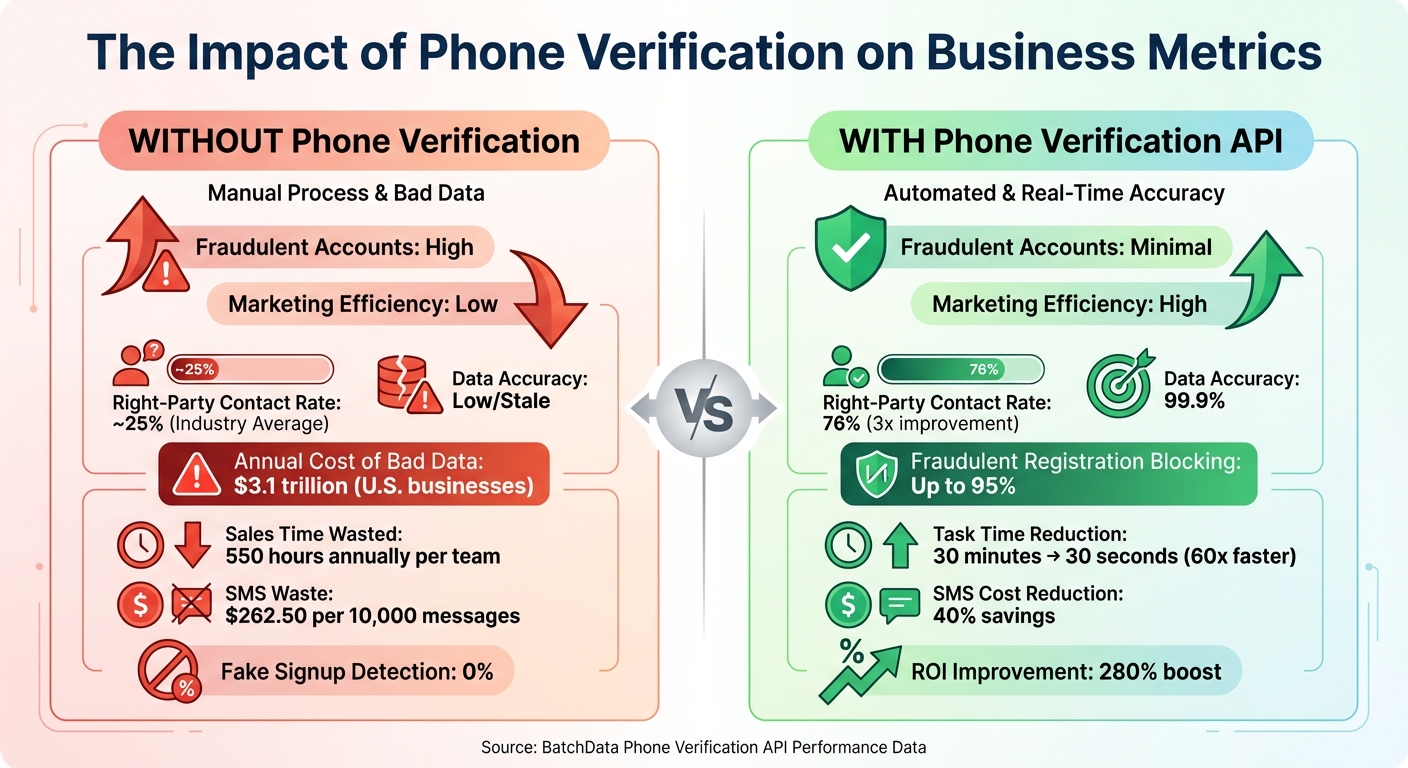
Phone Verification Impact: Before vs After Implementation Statistics
Before and After: The Impact of Verification
Unverified phone data can lead to fake signups and wasted marketing dollars. But with the Phone Verification API, the results speak for themselves. Right-party contact rates can jump from the industry average of about 25% to an impressive 76%. On top of that, phone validation alone can catch around 60% of fake signups. Combine it with other verification layers, and you can block up to 95% of fraudulent registrations. This kind of transformation is crucial, especially when small and medium-sized businesses lose an estimated $2.7 billion annually to fake signups.
| Metric | Without Verification | With Phone Verification API |
|---|---|---|
| Fraudulent Accounts | High | Minimal |
| Marketing Efficiency | Low | High |
| Right-Party Contact Rate | ~25% (Industry Average) | 76% |
| Data Accuracy | Low/Stale | 99.9% |
These improvements don’t just clean up your data – they deliver measurable operational benefits.
Improved Operational Efficiency
Phone verification automation replaces the tedious tasks of dialing disconnected numbers or chasing outdated contacts. This frees your team to focus on leads that matter. What’s more, automated verification slashes task times from 30 minutes to just 30 seconds – a staggering 60x speed boost. With real-time validation, you can handle higher volumes seamlessly, eliminating bottlenecks and keeping your operations running smoothly.
Getting Started: Easy Integration and Flexible Pricing
Simple Developer Integration
The Phone Verification API is designed for quick and straightforward integration, using RESTful JSON over HTTPS. You can get it up and running in less than 30 minutes. Start by signing up for a free API key, which gives you access to the developer portal. Here, you can test live responses and explore various endpoints before committing to full implementation.
The platform supports SDKs for popular programming languages like Python, Node.js, PHP, Java, and C++. The API provides structured JSON responses, including carrier details, line type (mobile or landline), and validity status, making it easy for your systems to process the data. Authentication is handled through API keys, and the service offers a 99.99% uptime SLA for reliability.
For added security, it’s recommended to store your API credentials in environment variables. The developer portal also features an interactive interface that allows you to test queries and ensure accurate data mapping. Whether you’re verifying phone numbers during user sign-ups or cleaning up CRM data in bulk, the integration process is simple and well-documented.
This streamlined setup ensures your system is ready for scalable, usage-based pricing.
Pay-As-You-Go Pricing
The pricing model is designed to grow with your business while keeping things transparent. With a pay-as-you-go plan, you only pay for the data you use or matches you receive – no mandatory monthly fees or hidden costs. This flexibility makes it ideal for startups experimenting with their first verification workflows, as well as established businesses handling millions of requests.
For those with consistent monthly needs, subscription plans offer even more value. Options include:
- Lite: $500/month for 20,000 records
- Growth: $1,000/month for 100,000 records
- Professional: $2,500/month for 300,000 records
- Scale: $5,000/month for 750,000 records
Enterprise customers with higher volume requirements can request custom pricing and dedicated infrastructure. Bulk data extracts and large-scale processing come with volume discounts.
You can choose between two delivery options: the Real-Time API for instant lookups or Cloud Delivery via platforms like Snowflake, S3, or Google Drive for large-scale analytics. Both options include compliance features, such as DNC scrubbing and TCPA litigator identification, at no additional cost. This pricing model eliminates the need for complex, expensive annual contracts often associated with older data providers.
Conclusion: Clean Data Drives Business Growth
Bad data doesn’t just skew your analytics – it leads to poor decisions, wasted budgets, and even security vulnerabilities. When fake users and invalid phone numbers flood your database, the consequences stack up quickly. You could end up spending marketing dollars on contacts you can’t reach, exposing your platform to fraud, and grappling with inefficiencies that grow over time.
The Phone Verification API addresses these issues head-on. By validating phone numbers in real time, it stops bots, reduces wasted SMS costs, prevents promo abuse, and ensures that OTPs and 2FA codes reach actual users.
These technical improvements deliver real, measurable results. For instance, companies using verification systems have reported right-party contact rates nearly three times the industry average. Between June 2022 and May 2025, businesses saved an estimated $82 million by blocking fraudulent verification attempts. Financial platforms like Bitso achieved a 99% success rate in user account verifications, while Intuit reached 94% deliverability across more than 200 countries in just three months.
Clean data isn’t just about accuracy – it’s about creating operational efficiency and unlocking growth potential. With validation handled in milliseconds, your team can focus on engaging real customers and closing deals, while developers can concentrate on building standout products instead of managing complex in-house verification systems. And you won’t be stuck with rigid contracts – flexible pay-as-you-go pricing ensures phone verification scales with your needs, transforming it from an expense into a strategic advantage.
FAQs
How does phone verification help prevent TCPA violations?
Phone verification serves multiple purposes: it confirms that a phone number is active, verifies its ownership, and ensures consent has been granted. This process helps businesses avoid reaching out to the wrong people or numbers that are part of Do-Not-Call lists. By confirming prior express consent, as mandated by the TCPA, companies can minimize the chances of facing hefty legal fines and stay aligned with telemarketing rules.
How does real-time phone verification improve the success of marketing campaigns?
Real-time phone verification guarantees your marketing messages are reaching genuine users, not inactive or fake numbers. It works by instantly checking the validity of phone numbers, helping you avoid bounced SMS, cut down on wasted marketing dollars, and maintain clean, accurate contact lists.
This efficient approach also speeds up follow-ups, improves lead quality, and increases conversion rates – all while saving valuable time and resources. By concentrating your efforts on verified contacts, you can drive better outcomes and get the most out of your campaigns.
How does phone verification enhance the quality of sales and marketing data?
Phone verification ensures your contact lists are both correct and dependable by flagging invalid or incorrectly entered phone numbers. It also offers useful insights, such as carrier details and line type, allowing your sales and marketing teams to work with accurate, actionable data. This minimizes wasted time and boosts the success of your campaigns.