



More than 52,000 consumers complained about caller ID spoofing to the FCC in 2018 alone, and one investigated telemarketing operation placed 2,341,125 unlawful spoofed calls between July 26, 2016 and September 25, 2017, according to the Government Accountability Office's report on illegal robocalls. For real estate, mortgage, and lead-generation teams, a caller identification API is no longer just a name lookup. It's an identity, authentication, and reputation layer for voice workflows.
The practical distinction matters. A production system must determine who appears to be calling, whether the number is authorized and authenticated, and whether recipients have reported behavior associated with spam. It also needs to handle incomplete carrier coverage, stale records, false positives, non-IP call paths, and privacy obligations without blocking legitimate prospects.
Core takeaways:
- Spoofing is an enforcement problem, not merely a user-experience issue.
- Modern caller identification APIs combine multiple signals, including carrier verdicts, CNAM data, reputation, and STIR/SHAKEN status.
- CNAM alone cannot authenticate a call or establish that it's wanted.
- Coverage quality is the overlooked buying question, especially across countries, mobile numbers, landlines, and other line types.
- Real estate integrations need resilient enrichment, caching, fallbacks, auditability, and context-aware screening.
Why Caller Identification APIs Matter Now
Caller identification became infrastructure once spoofing reached a scale regulators could measure and enforce. The FCC recorded more than 52,000 consumer complaints about caller ID spoofing in 2018, while a separate investigation found that one telemarketing operation made 2,341,125 unlawful spoofed calls over 14 months, from July 26, 2016 through September 25, 2017. The figures show why a displayed number cannot be treated as reliable identity evidence.
A spoofed number can make an unwanted caller appear to be a local agent, lender, property owner, or familiar business. In a real-estate workflow, that misattribution can corrupt lead attribution, expose agents to avoidable complaints, and make a legitimate company's number appear suspicious. The operational question is therefore broader than whether a caller's name can be displayed. Teams need to assess identity signals, authentication, reputation, and the quality of the underlying coverage.
The policy response pushed caller identity beyond basic number display. The FCC, FTC, and Department of Justice had identified 62 enforcement cases involving spoofing since 2006. The FCC later described STIR/SHAKEN as the framework used to verify the identity of calling numbers, as documented in the GAO report on spoofing enforcement. FTC enforcement has also covered Do Not Call violations, robocalls, spoofed caller ID, and assistance with those violations.
Why real estate feels the risk
Real-estate and mortgage teams often operate across several voice channels:
- Inbound lead handling, where caller signals affect routing and agent preparation.
- Outbound prospecting, where the displayed number influences trust and answer behavior.
- Mortgage intake, where identity data supports fraud and compliance controls.
- Campaign attribution, where the originating number must connect to a source and interaction history.
A caller identification API lets a CRM, dialer, contact center, or lead router process a phone event as structured data rather than an isolated ring. Rules can then account for authentication status, reputation, line type, and missing or conflicting records before an agent engages.
The response remains a decision input, not proof that a person is honest, interested, or legally callable. Treating it as a definitive verdict creates false positives while leaving advanced abuse undetected. Coverage quality also matters: results can vary across mobile numbers, landlines, carriers, countries, and call paths, so buyers should test those conditions before relying on the API in production.
What a Caller Identification API Does
A caller identification API accepts a telephone number and returns structured metadata about its apparent identity, network status, and reputation. In a typical real-estate workflow, the application normalizes the raw number to E.164 format, sends it to an enrichment service, and applies the response before, during, or after the call.
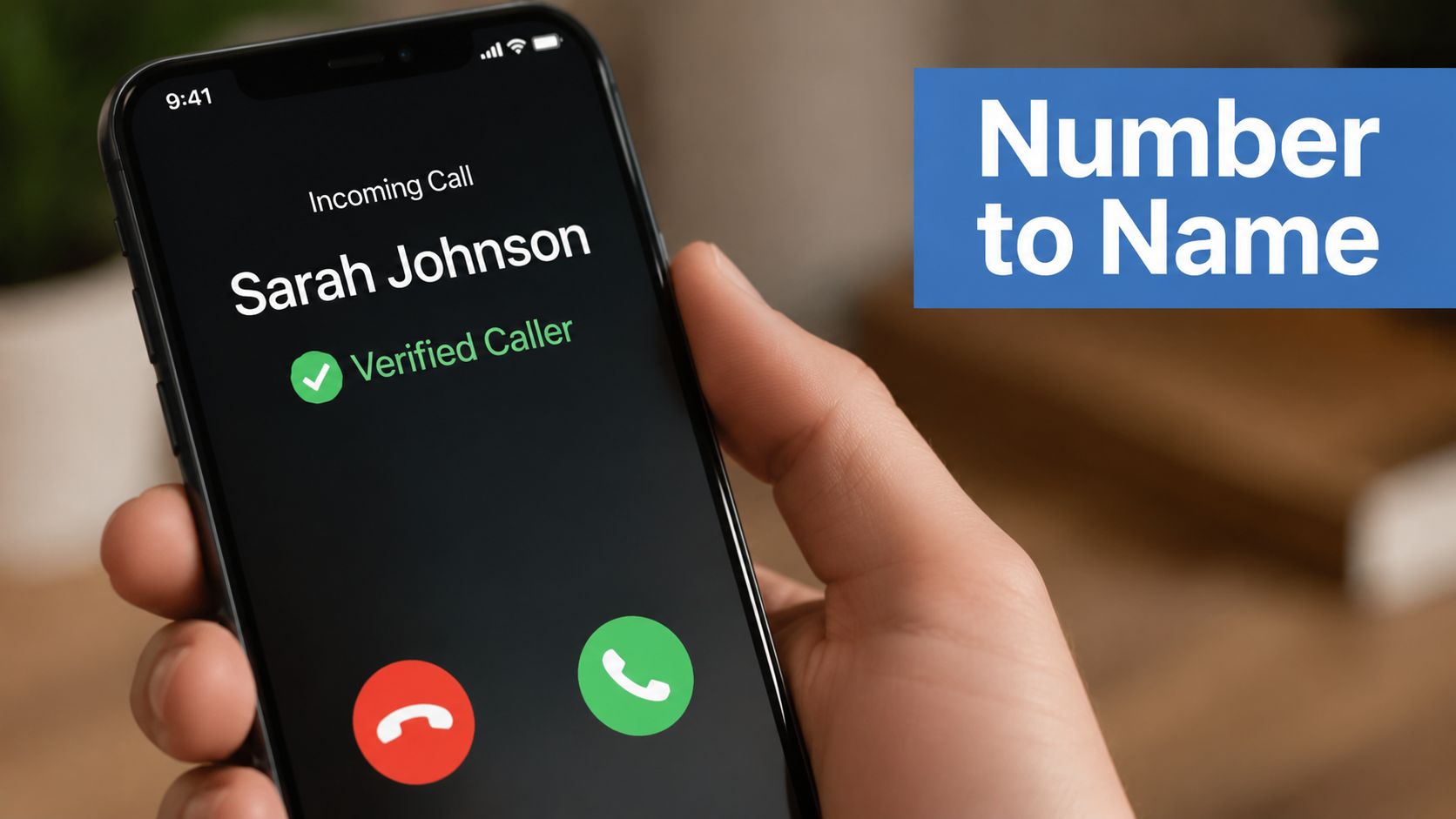
The request is simple. The response contract determines whether it works in production. A useful response can contain:
- Carrier and line data, including carrier verdicts and line-type metadata.
- Name and business identity, often drawn from CNAM or business records.
- Authentication information, including STIR/SHAKEN status where available.
- Behavioral reputation, such as spam scores, complaint history, or recipient labels.
These fields answer separate questions: Who is associated with the number? Is the call likely to be unwanted? Does the network authenticate the calling identity? A match does not prove that the caller is trustworthy, that the lead is interested, or that an outbound call is legally permitted.
Android shows how platform-level call screening is evolving. On Android 11 and later, applications can access carrier verdict data and STIR/SHAKEN verification status through getCallerNumberVerificationStatus(). That data can support spam labeling before a user answers, as described in Android's caller spoofing prevention documentation.
Practical rule: Store identity, authentication, and reputation as separate fields in your internal schema. Do not reduce them to one
is_verifiedboolean.
Keep provenance with each result. If a mortgage intake workflow flags a number, engineers and compliance teams need to know whether the decision came from carrier authentication, a reputation database, complaint activity, or an inferred business match. Without that context, teams cannot explain blocked calls or adjust thresholds safely.
A caller identification API is an enrichment layer, not a definitive identity service. Its production value depends on signal quality, freshness, carrier and geographic coverage, and how the application handles missing or conflicting data.
Data Sources and Matching Techniques
Caller-ID accuracy depends on the upstream signals behind each field. An API can return a clean response while carrier data, ownership records, reputation history, and business directories each follow different update schedules and confidence rules. Treat those fields as separate evidence, especially when the number belongs to a real-estate agent, lender, brokerage, or prospect.
| Source Type | Update Cadence | Reliability Tier | Best Used For |
|---|---|---|---|
| Carrier verdict and attestation | During call setup or network handling | High for network authentication | Confirming the originating number's network-level status |
| Government and telecom registries | Periodic reporting and administrative updates | Useful for formal ownership, weaker for freshness | Supporting ownership and regulatory records |
| Behavioral reputation databases | Ongoing aggregation from labels and complaints | Valuable but context-sensitive | Detecting patterns associated with unwanted calls |
| Business identity and directory records | Varies by provider and record owner | Helpful for matching, not authentication | Displaying a company or professional identity |
Carrier information has the clearest connection to network authentication, but it cannot show whether a recipient wants the call. A number may pass an authorization check and still be used for an intrusive outreach campaign. Reputation databases add that behavioral context, yet legitimate numbers can receive negative signals after aggressive calling, reassignment, or a limited cluster of complaints.
The caller ID API documentation illustrates the response structure engineers may encounter, including spam scoring, business identity, carrier details, and reputation or complaint history. It also uses discrete states such as flagged, mixed_high, mixed_low, and unflagged. These states preserve uncertainty better than a single binary spam value, which is especially useful when deciding whether to route a lead, display a warning, or request manual review.
Matching should preserve uncertainty
A production matching pipeline should:
- Normalize first, so formatting differences do not create duplicate identities.
- Separate exact matches from inferred matches, particularly for business names and contact records.
- Record freshness, because number ownership and calling behavior can change.
- Apply complaint recency thresholds, rather than treating every complaint as permanent evidence.
- Retain the raw provider response, allowing later audits of routing and compliance decisions.
The FCC triennial report on STIR/SHAKEN describes network upgrades that support authentication. Authentication, registry data, and behavioral reputation each address different failure modes. Combining them improves the decision record, but it does not remove the need to calibrate thresholds against local carrier coverage, number reassignment, and the actual quality of real-estate leads.
Caller ID API vs CNAM Lookup and Traditional Verification
A CNAM lookup returns the name associated with a telephone number. A caller identification API can combine that name with authentication, carrier verdicts, line type, and behavioral reputation. These services answer different questions and should not be treated as interchangeable.
| Capability | CNAM Lookup | Caller Identification API |
|---|---|---|
| Registered name display | Yes, where data exists | Usually included where available |
| Carrier and line metadata | Limited or absent | Commonly supported |
| STIR/SHAKEN status | No | May be included where carrier data is available |
| Spam and complaint signals | No | Commonly included |
| Authentication decision | No | Supports a broader trust decision |
| Regulatory workflow support | Narrow | More suitable as one component of compliance controls |
CNAM works well for display. It can help an agent recognize a brokerage or contact record, but it does not prove that the caller is authorized to use the number or that the recipient wants the call. The returned name may be stale, incomplete, or missing even when the number remains active.
Caller identification adds signals that support a decision rather than a simple label. Android 11 and later expose carrier verdict data and STIR/SHAKEN verification status through getCallerNumberVerificationStatus(). As noted earlier, that platform behavior reflects the operational requirement to evaluate identity and trust together.
The distinction matters in real-estate software. A CRM can show a brokerage or contact name to an agent, then use authentication and reputation fields to decide whether to route the call immediately, send it for review, or display a caution label. A mortgage system can retain those fields for investigation without automatically denying the interaction. That separation reduces the risk of treating an incomplete identity record as proof of fraud.
Coverage quality remains a buyer-level concern. One provider may return a useful name but weak carrier data for a given region, while another may provide authentication signals without a reliable contact match. Test the provider against the markets, carriers, mobile numbers, and business lines your real-estate workflows receive.
A reverse phone lookup API focuses on associating a number with person or contact records. It can support enrichment, but it does not replace carrier authentication or behavioral screening. A practical architecture may use both services, assigning each a separate responsibility: lookup for record association, and caller identification for trust and routing decisions.
Integration Patterns and Performance Considerations
A production integration should treat caller identification as an enrichment pipeline rather than a blocking request in the user interface. Normalize the number, check a cache, request provider data when needed, merge it with call context, and retain a safe fallback if the provider is unavailable.
A practical workflow is:
- Normalize the input to E.164 before matching or caching.
- Check a short-lived cache using the normalized number and relevant region.
- Request live enrichment when the cached record is missing or stale.
- Merge context, including inbound or outbound direction, originating DID, campaign, agent, and timestamp.
- Apply separate policies for authentication, reputation, and identity confidence.
- Log the decision, not only the provider response.
Latency matters when the result affects pre-answer behavior. A delayed lookup can postpone ringing, disrupt routing, or show an agent the caller's identity after it is useful. Post-call enrichment can follow a separate path because attribution and CRM updates do not need to interrupt the conversation.
Caching requires signal-specific freshness. Static identity and carrier fields can often remain cached longer than reputation fields. Complaint-driven classifications should refresh more frequently. Set the policy according to call volume, number churn, and risk tolerance. One global time-to-live is simple, but it rarely fits every signal.
Error handling must distinguish causes
A carrier timeout differs from a nonexistent number, and neither proves malicious intent. Define separate outcomes for:
- Transient provider or carrier failure, which should trigger retry or fallback.
- Permanent non-existence, which can support list hygiene.
- Missing identity data, which should remain an unknown state.
- Attestation failure or low attestation, which should affect trust handling.
- Mixed reputation, which should prompt caution rather than automatic blocking.
The reputation categories described in the earlier caller ID API test documentation provide a useful model. Preserve intermediate states such as mixed_high and mixed_low instead of forcing every response into “safe” or “spam.” This distinction matters in real-estate systems, where an uncertain caller may still be a legitimate prospect, borrower, agent, or referral partner.
Engineering rule: Unknown is a valid result. Do not convert missing data into a negative identity decision.
Monitor cache-hit behavior, provider error classes, incomplete responses, and disagreements between identity and reputation fields. These metrics expose coverage gaps that a basic success-rate dashboard will miss. A provider that answers reliably but returns weak data for the carriers and business numbers in your target markets can still degrade routing and agent trust.
Privacy, Regulation, and Compliance Risks
Regulation is often the silent bottleneck in caller-ID architecture. The FTC's Do Not Call enforcement records list 151 enforcement actions involving companies and telemarketers accused of Do Not Call violations, robocalls, spoofed caller ID, or assisting and facilitating violations.
The financial consequences also show why a low-cost lookup can be a false economy. The GAO reported that FTC officials had obtained about $363 million in monetary judgments across 31 spoofing cases, while spoofing complaints represented about 14% of FCC unwanted-call complaints in 2018 and about 1% of FTC unwanted-call complaints, according to the GAO report on unwanted calls.
A caller identification API doesn't make an outreach program compliant by itself. It can provide evidence and decision signals, but the organization still needs lawful calling practices, consent controls where applicable, suppression processes, governance, and an audit trail.
STIR/SHAKEN has a defined boundary
The FCC defines STIR/SHAKEN as technical standards and protocols that authenticate and verify caller ID information for IP-based voice calls. Providers were required to implement the framework in the IP portions of their voice networks by June 30, 2021, according to the FCC's call authentication guidance.
That requirement doesn't cover every segment of every call path. The FCC says STIR/SHAKEN covers the IP portions of call paths, leaving a gap where non-IP segments may still exist. A 2025 compliance update on proposed non-IP authentication requirements describes proposed use of In-Band Authentication, ATIS-1000095.v002, or Out-of-Band Multiple STI-CPS Authentication, ATIS-1000096, with certification in robocall-mitigation filings.
For buyers, the checklist should include retention, access controls, deletion workflows, vendor subprocessors, and field-level provenance. Telephone numbers can connect to identifiable people, owners, applicants, and customers. Store only what the workflow needs, restrict access by role, and document why the system processes each field.
Teams should also separate screening from automated adverse action. A suspicious reputation result can route a call for review or show a warning. It shouldn't automatically deny a borrower, reject a property owner, or suppress a legitimate prospect without a defined review path. For additional operational context, see this guide to TCPA compliance for automated outreach.
Real Estate, Mortgage, and Marketing Use Cases
Real-estate systems get the most value when caller identity is joined to the surrounding record, not displayed as an isolated label. The same number may connect to a property owner, borrower, investor, listing lead, or prior campaign interaction. Context determines what the application should do next.
Mortgage intake
A lender can use caller identification during intake to compare the incoming number with applicant and household records, inspect carrier and line metadata, and record available authentication signals. That supports a broader identity review before a file advances, but it shouldn't replace formal borrower verification or underwriting controls.
The useful output is an evidence bundle:
- Identity association, showing the person or organization linked to the number.
- Line information, indicating available carrier and line-type details.
- Authentication status, where network data is present.
- Reputation context, useful when an application number has suspicious history.
- Audit metadata, recording when the lookup occurred and what decision followed.
Investor and skip-tracing workflows
Investors often begin with property records and need a reachable owner or decision-maker. A phone enrichment service can help associate a number with contact records, validate whether the number is usable, and keep disconnected or questionable records out of an outreach queue. Guidance on locating phone numbers for real-estate workflows is relevant to this part of the process.
That doesn't mean every matched number should enter a dialer. Consent, suppression status, campaign purpose, and reputation policy still control whether outreach is permitted.
Marketing attribution
Marketing teams can use caller identity to connect calls to campaigns, landing pages, listings, and agent assignments. Pre-answer enrichment can route a caller to the correct team, while post-call enrichment can reconcile the interaction with a lead record. The advantage is better event context than a last-click model provides, not a guarantee of attribution accuracy.
BatchData's real-estate data platform combines property, ownership, and contact enrichment workflows, including phone verification and related contact fields. Used carefully, that kind of property-to-person linkage can give a CRM a more complete record, provided the organization keeps identity matching separate from permission to contact.
Evaluating and Selecting a Caller ID API Provider
The hardest vendor question isn't whether an API can identify a number. It's where the result is reliable, which line types it covers, and whether the displayed identity is verified or inferred.
A provider may advertise broad geographic coverage while disclosing little about country-level precision, mobile-versus-landline performance, or the distribution of attestation results. Buyers should demand test results for their actual traffic, including the states, markets, carriers, and line types that matter to their operation.
| Evaluation Dimension | Minimum Acceptable Threshold | Red Flag Signal | Verification Method |
|---|---|---|---|
| Market and line-type coverage | Documented performance for target markets and number types | Global claims without regional or line-type detail | Test a representative, labeled sample |
| Authentication coverage | Clear explanation of STIR/SHAKEN fields and unknown states | Treating name matching as authentication | Inspect raw response fields and provenance |
| Reputation quality | Intermediate states, complaint context, and freshness indicators | Binary spam or safe output with no explanation | Compare results against reviewed call outcomes |
| Integration behavior | Documented limits, error classes, retry guidance, and stable schemas | Undocumented throttling or opaque failures | Run failure, timeout, and malformed-input tests |
| Compliance posture | Retention, access, deletion, and audit documentation | No clear data-processing responsibilities | Review contract, security materials, and logs |
| Total cost | Pricing that reflects cache strategy and enrichment volume | Cost model penalizes necessary rechecks | Model live, cached, failed, and batch requests |
Request mobile and landline splits, regional results, and attestation-level distributions before signing. Test numbers with known business identities, recently changed ownership, mixed reputation, and no available identity. Then compare the API's answer with the decision your agents or compliance team would make.
The right provider won't eliminate uncertainty. It will expose uncertainty in a form your software can handle. That means documented provenance, stable response fields, useful unknown states, and enough operational visibility to explain why a call was routed, warned, or held for review.
For a real-estate team, selection should finish with a controlled pilot. Measure coverage and decision quality on your own traffic, validate the provider's privacy terms, and confirm that the integration can fail safely before expanding it into every campaign and contact center.
BatchData provides real-estate data services that connect property, ownership, and verified contact records through APIs and bulk delivery, including phone verification and contact enrichment for workflows that need more than a basic caller-name lookup. Visit BatchData to evaluate its real-estate data platform for identity-aware prospecting, mortgage operations, marketing attribution, and portfolio workflows.