



A deposit isn't one thing, it's a family of money arrangements that do different jobs in banking, renting, and real estate. If you've ever wondered why one deposit is refundable, another becomes part of a home purchase, and another just sits in a bank account, that confusion is normal. The clean definition is simple, though, a deposit is money paid in advance or held as security for a future obligation, and major dictionaries keep both meanings alive in the same word Cambridge Dictionary's definition of deposit.
At a practical level, that means the word can describe a bank deposit, earnest money, a security deposit, an escrow hold, or a down payment. Those are related, but they're not interchangeable. The differences matter because they decide who holds the money, when it's refundable, and whether it turns into purchase price or remains protected collateral.
- Bank deposits hold cash in an account and create a claim against the institution.
- Earnest money shows commitment in a purchase contract.
- Security deposits protect a landlord against damage or unpaid rent.
- Escrow deposits sit with a neutral third party until conditions are met.
- Down payments reduce the amount borrowed at closing.
Practical rule: If the money is sitting in a bank account, it's a deposit. If it's there to prove intent or cover risk, it's also a deposit, but the legal treatment changes fast.
What Does Deposit Mean in Plain English
A deposit is money paid ahead of time or held back as security for something that still has to happen. That's the plain-English answer, and it's why the same word shows up in banking, rentals, car deals, and home purchases Cambridge Dictionary's deposit entry.
The easiest way to think about it is this, a deposit is a promise in dollar form. Sometimes the promise says, “I'm saving this money with you for safekeeping.” Other times it says, “I'm serious about this transaction, and if I walk away or cause damage, you may have a claim on the funds.”
That dual meaning is the source of most confusion. In a lease, the deposit may be there to cover damage. In a purchase, it may show commitment. In a bank account, it's money the institution owes you under the account terms.
The five versions that cause the most confusion are:
- Bank deposits, where money sits in an account.
- Earnest money, where the buyer signals good faith.
- Security deposits, where a landlord holds protection against loss.
- Escrow deposits, where a third party keeps funds until closing or another contract event.
- Down payments, where money becomes part of the buyer's equity at purchase.
That list is the fastest way to stop mixing up the word. The core idea stays the same, money is being set aside for a future obligation, but the legal meaning changes based on the contract and the context.
A helpful outside primer on the bookkeeping side is understand prepayments for small business, because deposits often sit near prepayments and retainers in real-world accounting.
What Are the Five Deposit Types at a Glance
All five deposit types are about commitment, risk control, or funding, but they land in very different places. A bank deposit funds an account. Earnest money supports a purchase offer. A security deposit protects a landlord. Escrow holds money neutrally. A down payment reduces the loan balance at closing.
| Deposit Type | Primary Purpose | Who Holds It | Refundable | Typical Size |
|---|---|---|---|---|
| Bank deposit | Safekeeping and account funding | Bank or financial institution | Usually available according to account terms | Varies by account activity |
| Earnest money | Show purchase intent | Escrow agent, title company, broker, or other neutral holder | Sometimes, based on contract contingencies | Contract-specific |
| Security deposit | Protect against damage or unpaid obligations | Landlord or property manager | Often refundable minus lawful deductions | Contract-specific |
| Escrow deposit | Hold funds until conditions are met | Neutral third party | Depends on the underlying contract | Contract-specific |
| Down payment | Reduce mortgage principal and build equity | Usually transferred at closing | Not a refund, it's part of the purchase price | Contract-specific |
A useful way to read the table is to ask three questions every time money changes hands. Who holds it? What does it protect? When does it move? Those three answers usually tell you which deposit bucket you're looking at.
The fastest way to avoid category errors is to separate payment timing from ownership of the funds. A deposit can be part of a purchase, a placeholder against future performance, or a protected balance held in trust. Those are different accounting and legal outcomes even when the word is the same.
If you work around invoicing, retainers, or prepayments, the accounting logic looks similar. For a practical finance lens, the concept lines up well with understanding mortgage deposit requirements, because mortgage deals often bundle several deposit-related obligations into one transaction.
How Do Bank Deposits Work and Why Do They Matter?
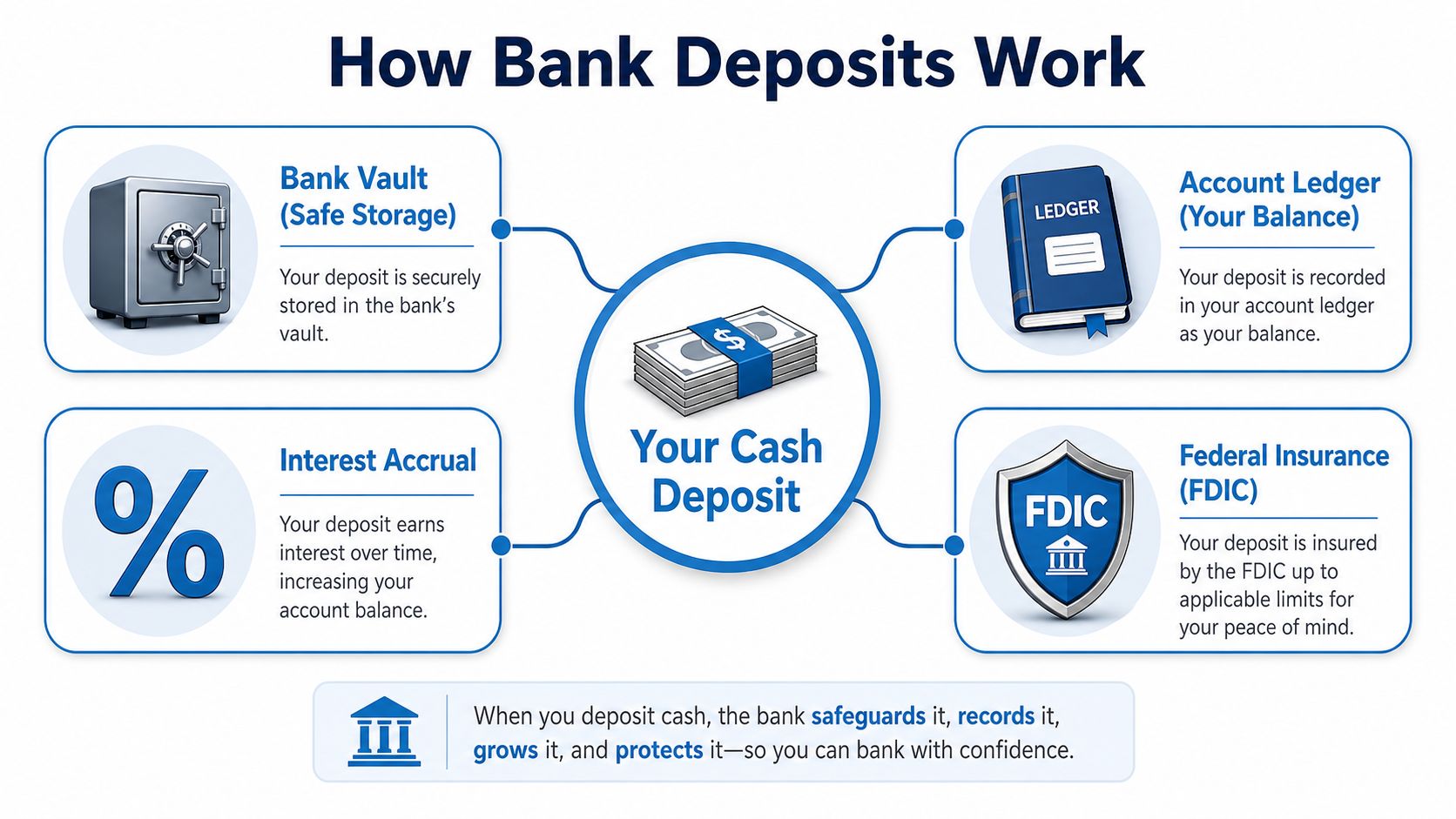
Why does a bank treat your deposit as money you still own, yet also as money it must account for? The short answer is that a deposit creates two views at once. For the bank, it is a liability. For you, it is an asset because the institution owes you repayment under the account terms StocksMantra on deposits.
That split is where the confusion usually starts. The bank does not own your deposit the way it owns its office furniture or computers. It records an obligation to return the funds, and that obligation affects liquidity, lending capacity, and rate sensitivity. Time deposits keep money locked for a set period and usually pay interest in exchange for reduced access, while deposits that can be withdrawn on demand give the customer more flexibility and the bank less funding certainty.
Demand deposits versus time deposits
Demand deposits are the checking-account style version. You can withdraw them whenever you need to, so the bank has to be ready for that cash to leave at any time. Time deposits, like certificates of deposit, keep money tied up for a fixed term, which gives the bank more stable funding and usually justifies interest to the depositor Wikipedia's deposit overview).
That stability matters because deposits are a core funding base for banks. The more predictable and longer-dated the deposit mix, the more room a bank has to make loans and absorb stress without scrambling for cash.
A simple way to read the difference is this. Faster access for the customer usually means more uncertainty for the bank.
The scale is enormous, which is why deposits sit at the center of everyday banking and credit creation. FDIC-insured institutions reported about $18.3 trillion in total deposits in 2024, showing how much of the financial system runs on deposit funding Wikipedia's deposit overview.
For real estate investors, bank deposits matter because they show up in the financing background of a deal. Stable deposit funding can influence rate offers, underwriting appetite, and closing timing. If you want a broader systems view of how finance data gets organized, first steps in buying your first home is a useful place to see how deposit-related information connects to the rest of the transaction flow.
How Do Earnest Money, Escrow, and Down Payment Fit in a Real Estate Deal?
Earnest money, escrow, and down payment are three different stops in the same home-buying pipeline. A buyer sends earnest money first to prove serious intent, the funds sit in escrow while the contract runs, and then some or all of that money can be credited toward the down payment at closing.
Take a $400,000 home with a 30-day close. The buyer agrees to wire $10,000 in earnest money within three days after contract acceptance. That money goes to a neutral holder, not directly to the seller, because the point is to protect both sides while contingencies are still open Cambridge Dictionary on deposit as collateral or earnest money.
The money's path through the deal
- Earnest money deposit. The buyer shows commitment.
- Escrow hold. A third party keeps the funds until the contract conditions are met.
- Closing credit. The earnest money is applied to the buyer's equity contribution if the sale closes.
That sequence matters because the same dollars can change legal character without physically moving very far. The buyer's earnest money is not the same thing as the full down payment, but it can become part of it at closing. The lender then funds the rest of the price according to the mortgage terms.
The reason sellers care about earnest money is simple. It creates a financial consequence if the buyer cancels outside the contract rules or misses deadlines. That's why the deposit is often treated as a commitment device, not just an advance payment.
If you're mapping the first steps of a purchase, first steps in buying your first home is a useful companion because it helps place deposit timing next to financing and contract milestones.
How Do Security Deposits Work in Rentals and Commercial Leases?
A security deposit is a tenant's upfront cash pledge that protects the landlord if the lease goes sideways. It's usually refundable at move-out, but only after lawful deductions for documented damage, unpaid rent, or other lease breaches.
The clean mental model is a damage reserve. A landlord is not taking the money as free rent, and the tenant isn't making a purchase. The funds sit as protection against risk during occupancy, then get reconciled when the unit is turned back over.
What tenants usually dispute
The disputes are predictable:
- Normal wear and tear. Tenants often argue that ordinary aging isn't damage.
- Cleaning charges. Landlords may withhold funds if the property isn't returned in agreed condition.
- Missing documentation. Without photos, move-in checklists, or itemized deductions, disputes get harder to resolve.
In many markets, deposit terms are influenced by local law, lease language, and the condition of the property. Commercial leases can be stricter, and they sometimes use larger cash holds or even letters of credit instead of a simple consumer-style security deposit.
The contract language controls more than the label does.
That's the rule worth remembering. A landlord can call something a deposit, but the lease still decides whether it's refundable, how deductions are handled, and what evidence is needed at move-out.
For commercial tenants, the question is usually not just “Can I get this back?” but also “What replaces this cash if the lease changes?” That's where negotiated guarantees, collateral substitutes, and deposit escrows come into play.
How Does Deposit Data Show Up in Property Records?
Deposit-related information shows up in property records as mortgage balances, lien amounts, ownership history, escrow fields, and equity signals. That matters because investors and lenders don't just care that a deposit happened, they care whether the resulting ownership position and debt stack make sense.
A lender looking at a file wants to know whether the borrower has real skin in the game. An investor wants to know whether liens are clearing and whether equity is building. A servicer wants to know whether escrow and payment history line up with the property's recorded state.
The fields that matter most
- Mortgage balance. Shows how much debt is still outstanding.
- Lien amount. Shows claims against the property.
- Owner equity. Indicates how much value is left after debt.
- Ownership history. Helps confirm whether the purchase trail makes sense.
- AVM inputs and outputs. Help estimate whether the price and equity story are coherent.
That's where property data platforms become useful. Batch-level records can expose mortgage, lien, AVM, and ownership attributes, which means deposit-related assumptions can be checked against real property facts instead of guesswork. In practice, that helps teams verify whether a down payment likely supported a healthy loan-to-value profile and whether the property's current debt position still matches the deal story.

If you need a process for checking the trail behind a property, how to research property history is the practical next stop, because deposit questions usually sit inside broader title, lien, and ownership verification.
What Are the Most Common Deposit Confusions Worth Clearing Up?
The first mistake is treating every deposit like a down payment. A deposit can be part of the purchase price, but it can also stay separate, remain refundable, or serve as collateral, depending on the contract.
Misconception one, deposit means down payment
A down payment is the buyer's equity contribution at closing. A deposit can be an earlier payment that is later credited, held, or refunded based on the deal terms.
That difference matters in real estate because the same word can show up in several places. A bank deposit sits in an account, earnest money sits inside a purchase contract, a security deposit belongs to a lease, escrow holds funds for a neutral release, and a down payment reduces the amount borrowed at closing.
Misconception two, all deposits are refundable
Refundability depends on the document, the contingency language, and whether the buyer or tenant followed the required deadlines and conditions. The word itself does not decide the outcome.
A deposit works more like a rule-bound bucket than free cash. Some money moves back if the contract allows it, some money gets applied to the sale, and some money stays locked until specific conditions are met. If the papers are unclear, the refund answer is usually in the contract language, not in the label on the payment.
Misconception three, earnest money and security deposit are the same thing
They are used for different purposes. Earnest money belongs to a purchase contract and shows good-faith intent. Security deposit belongs to a lease and protects against property damage or unpaid obligations.
A simple rule helps here.
If the money is tied to buying, think earnest money or down payment. If it is tied to occupying, think security deposit. If it is held by a neutral party, think escrow.
That distinction matters because deposit language is easy to skim and easy to misread. The same word can point to very different legal and accounting treatment, and the contract is where the meaning lives.
What Are the Best Practices for Handling and Recording Deposits?
The best way to handle a deposit is to treat it like a controlled obligation, not casual cash flow. Write down who holds it, why it exists, when it can move, and what happens if the deal changes.
Quick-reference deposit rules
| Deposit Type | What to Check First | What Usually Controls It |
|---|---|---|
| Bank deposit | Account access and availability | Deposit agreement and bank policy |
| Earnest money | Contingencies and deadlines | Purchase contract |
| Security deposit | Damage, deductions, and move-out records | Lease and local law |
| Escrow deposit | Neutral holder and release terms | Escrow instructions |
| Down payment | Closing statement and loan terms | Purchase contract and mortgage documents |
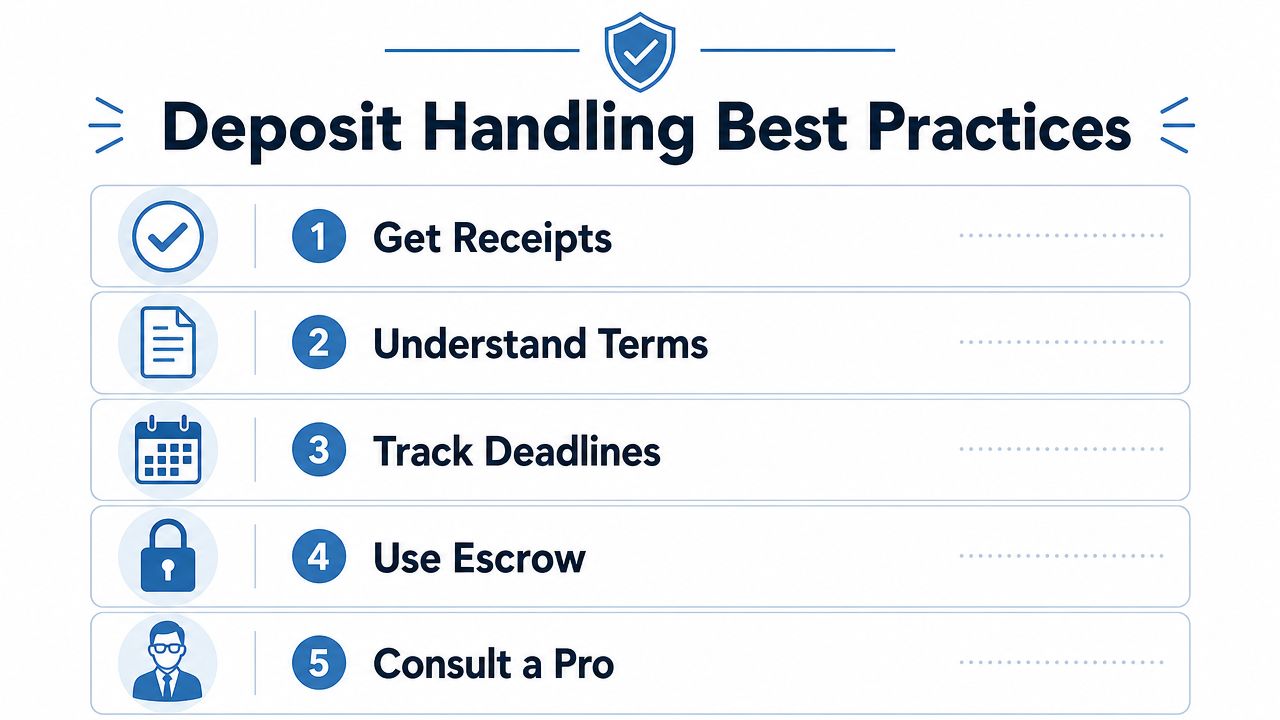
Five habits that prevent errors
- Get Receipts. Keep proof of every transfer and acknowledgment.
- Understand Terms. Read the refund and release conditions before money moves.
- Track Deadlines. Missing a contract date can change the deposit outcome.
- Use Escrow. Neutral holding reduces conflict in purchase transactions.
- Consult a Pro. Real estate agents, attorneys, and accountants catch different risks.
Recording matters just as much as holding. A deposit without a paper trail turns into a dispute fast, especially when multiple parties touch the funds. That's why ledger entries, escrow confirmations, and closing statements should line up with the deal terms.
For teams that need to verify mortgage balances, liens, equity, and ownership data at scale, property records make the deposit story auditable instead of assumptive. That's the difference between guessing a file is clean and proving it.
If you're evaluating property, financing, or portfolio risk, use BatchData to cross-check the mortgage, lien, equity, and ownership fields behind the deal, then make your next deposit decision with facts instead of assumptions.