



The affordable housing market has expanded quickly, but headline market size is a poor proxy for investability. A large addressable market does not by itself produce financeable deals. In affordable housing, viability depends on whether restricted rents, operating costs, public incentives, and required debt service can coexist in the same pro forma.
That is the first distinction experienced investors need to make. Affordable housing is not a simplified version of multifamily. It is a policy-linked operating business with real estate wrapped around it. Revenue is capped by design, expense ratios are often tighter than market-rate investors expect, and deal feasibility often turns on the structure of the capital stack rather than on exit cap rate assumptions.
Three factors determine outcomes: capital stack design, constraint-based underwriting, and asset-level market selection. Weakness in any one of the three can impair returns before stabilization, even when demand is obvious and occupancy is strong.
Core takeaways
- Policy mechanics shape returns: Public support is not peripheral to the investment thesis. It often supplies the gap financing that allows restricted rents to support institutional capital.
- The capital stack requires close examination: Viable projects commonly combine debt, tax credits, soft loans, grants, and local incentives. Each layer changes cash flow priority, compliance obligations, and refinance flexibility.
- Underwriting starts with limits, not upside: Investors need to model rent caps, income restrictions, subsidy renewal terms, reserves, and lender covenants before they make any assumption about growth.
- Operations create risks generic guides miss: Neighborhood concentration, compliance failure, deferred maintenance, and political scrutiny can weaken portfolio performance even when tenant demand remains high.
- Data improves sourcing and screening: The best pipeline often comes from fragmented owners, expiring affordability periods, and submarkets where supply constraints are measurable. Investors using sharper local data on real estate market trends can screen for those conditions earlier.
Investors that perform well in this segment usually treat affordable housing as a capital markets and operations discipline first, and an impact label second. That shift in framing changes how they price risk, how they diligence sponsors, and how they decide whether a deal is financeable.
Introduction
Roughly one-fifth of the global population lacks access to affordable housing. That scale helps explain why affordable housing now sits inside mainstream real estate allocation discussions rather than only public policy debates. The investment case starts with a structural supply gap, but it becomes credible only when a deal can convert that unmet demand into durable, compliant cash flow.
Institutional capital has moved in for a reason. Affordable housing can produce steadier occupancy and lower cyclicality than market-rate multifamily, but those benefits do not come from demand alone. They come from a financing model built around rent limits, subsidy support, and long-term operating discipline. Investors who treat the sector as a simple yield story usually miss the mechanics that determine whether returns are resilient or merely subsidized on paper.
That distinction matters.
A viable affordable housing deal is usually assembled, not acquired directly. Revenue is often capped by design. Expenses are often higher than first-pass underwriting suggests because compliance, resident services, reporting, and capital needs are real operating line items. The resulting gap between restricted income and total development cost is what creates the need for a layered capital stack, which is the part generic overviews tend to skip.
The better question is not whether demand exists. It is whether the stack is financeable, the restrictions are durable, and the sponsor can operate the asset through a full compliance cycle without eroding margins or optionality. That is why experienced investors pair local supply-demand work with sharper screening of subsidy structures, sponsor capability, and neighborhood concentration risk. Good sourcing often starts with submarkets where constraints are measurable in local real estate market trend data, then moves quickly into document-level diligence.
For investors allocating through nonprofit operators or mission-driven partnerships, back-office controls matter more than many acquisition teams assume. Reporting, reserve tracking, and covenant compliance can affect both lender confidence and execution speed, which is why operational infrastructure such as fund accounting for MA housing organizations belongs in diligence, not as an afterthought.
The core analytical mistake is using market-rate multifamily logic on an asset class where policy design, capital structure, and operations jointly shape returns. Affordable housing rewards investors who underwrite constraints first, then determine whether the remaining cash flow, tax benefits, and downside protection justify the basis.
What Exactly Is Affordable Housing Investment
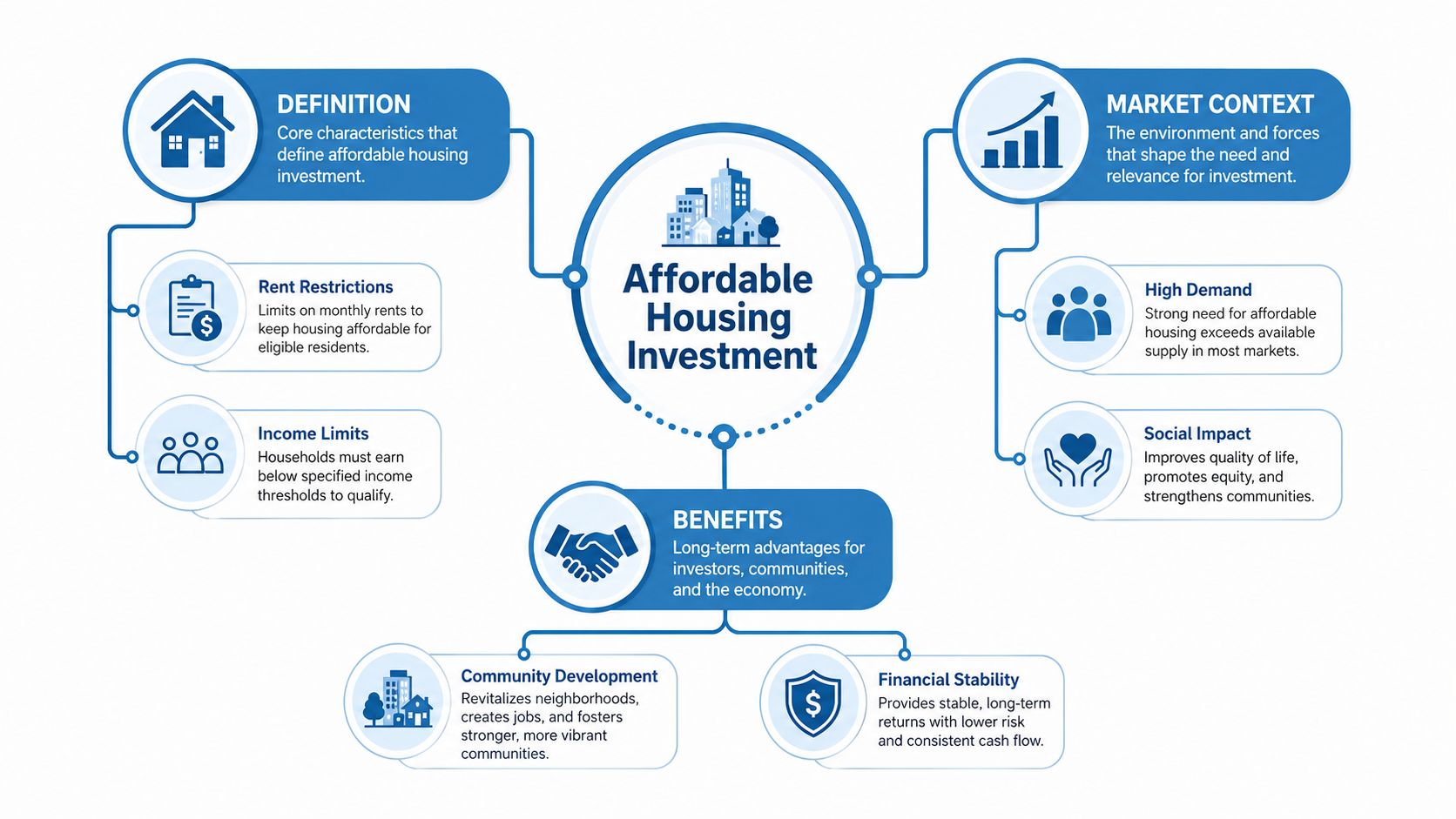
Affordable housing investment allocates capital to housing with legally restricted rents or income-qualified tenants, where value depends on regulation, subsidy design, and operating execution as much as on location and physical real estate.
The distinction matters because affordable housing cash flow is engineered, not merely discounted from market rent. A conventional apartment building is underwritten around market pricing power and expense control. An affordable asset is underwritten around regulatory limits on revenue, documented tenant eligibility, compliance timelines, reserve requirements, and the durability of public support. Those constraints affect basis, debt sizing, exit options, and the range of buyers at disposition.
Why this became an asset class
Housing affordability pressure is measurable, not anecdotal. The global median house price-to-income ratio is 6.2 for the private formal housing sector, versus a global average of 4.9 for occupant affordability, according to the Lincoln Institute working paper. That gap helps explain why housing that serves lower-income households increasingly requires policy intervention rather than pure market delivery.
Public capital has not closed the gap on its own. Across the OECD, real house prices increased by over 40% over the past decade, while total public investment in housing development alone was cut by nearly 90% between 2009 and 2016, according to the OECD affordable housing overview. Once rents are capped below market-clearing levels, projects need some combination of concessional debt, tax credits, grants, land discounts, or operating support to reach feasible returns. That financing reality is what turned affordable housing into a distinct investment category rather than a social-policy label attached to ordinary multifamily.
What investors are actually buying
Investors are buying a restricted income stream with a rulebook attached. The property may be new construction, preservation, adaptive reuse, rehabilitation, or recapitalization of aging stock, but the economic logic is similar. Revenue is bounded by affordability covenants. Costs are shaped by compliance and resident services. Value depends on whether the capital stack and operating model can preserve margin inside those limits.
A useful way to frame it:
| Component | What it means in practice | Why it matters |
|---|---|---|
| Restricted rents | Revenue is capped by affordability rules | Limits upside from market rent growth |
| Income targeting | Tenants must meet eligibility thresholds | Shapes demand, compliance, and turnover patterns |
| Subsidy dependence | Public tools help close feasibility gaps | Changes underwriting and capital structure |
| Compliance period | Rules persist for long durations | Adds operational and legal execution risk |
Affordable housing behaves less like unconstrained multifamily and more like a regulated operating platform. Even basic underwriting inputs, such as a property's loan-to-value ratio in real estate lending, have to be interpreted differently when restricted rents cap NOI growth and subsidy expirations can alter refinance proceeds.
Why institutional investors allocate capital here
Two characteristics draw institutional capital. First, demand is tied to household income stress, which tends to persist across cycles. Second, downside protection can be stronger than outsiders assume when the asset sits inside a durable policy framework, has waiting-list depth, and serves a submarket with limited competing supply at comparable price points.
That does not make the asset simple. It makes diligence more document-heavy and operations-sensitive. Investors are assessing whether the affordability covenant is accretive to occupancy stability, whether subsidy terms are transferable, whether neighborhood concentration raises political or operating risk, and whether the sponsor can manage recertifications, inspections, reserve waterfalls, and reporting without cash leakage. Administrative discipline is part of asset performance, which is why capabilities such as fund accounting for MA housing organizations belong in the same diligence file as rent rolls and environmental reports.
The non-obvious conclusion is that affordable housing should be viewed as a capital-stack business wrapped around real estate. Investors who treat it as a lower-rent version of conventional apartments usually misprice both the risk and the protection. Investors who understand how restrictions, subsidies, and operations interact can identify deals where capped revenue is offset by lower volatility, better financing terms, and a narrower but more predictable set of exit outcomes.
How Are Affordable Housing Deals Financed
Restricted rents cap revenue at the front end, so affordable housing finance starts with a funding gap, not a debt sizing exercise.
That changes the mechanics of the deal. In market-rate multifamily, lenders and equity partners can underwrite projected rent growth, size senior debt off stabilized NOI, and treat the rest as a sponsor equity question. In affordable housing, the first underwriting fact is that regulated rents often do not cover full development cost at standard return thresholds. The project becomes feasible only if the capital stack lowers the weighted average cost of capital enough to fit the rent regime.
Why conventional multifamily debt is rarely sufficient
Affordable units are typically income-restricted, often for households earning 30% to 80% of Area Median Income. That limitation compresses NOI and lowers proceeds available from first mortgage debt. Even before an investor gets to yield targets, the deal can fail basic lender tests on debt service coverage and proceeds.
If your frame of reference is conventional apartments, essential strategies for property financing provides the baseline logic. Affordable housing uses the same broad tools, but sizing is constrained by regulation, subsidy terms, and compliance risk rather than by rent maximization.
LIHTC usually anchors the stack
In the U.S., Low-Income Housing Tax Credit equity is often the largest gap-filling source because it converts a stream of tax benefits into upfront project capital. The effect is straightforward. Equity raised through tax credits reduces the amount of hard debt the property must support from restricted cash flow.
That is why experienced investors treat LIHTC less as a supplemental source and more as the central structuring mechanism. The actual question is not whether credits are involved, but how the credit equity prices, funds, and interacts with the rest of the stack. Pay-in timing, adjuster provisions, delivery tests, and compliance covenants can all affect near-term liquidity and late-stage execution risk.
What typically sits above and below the tax credit layer
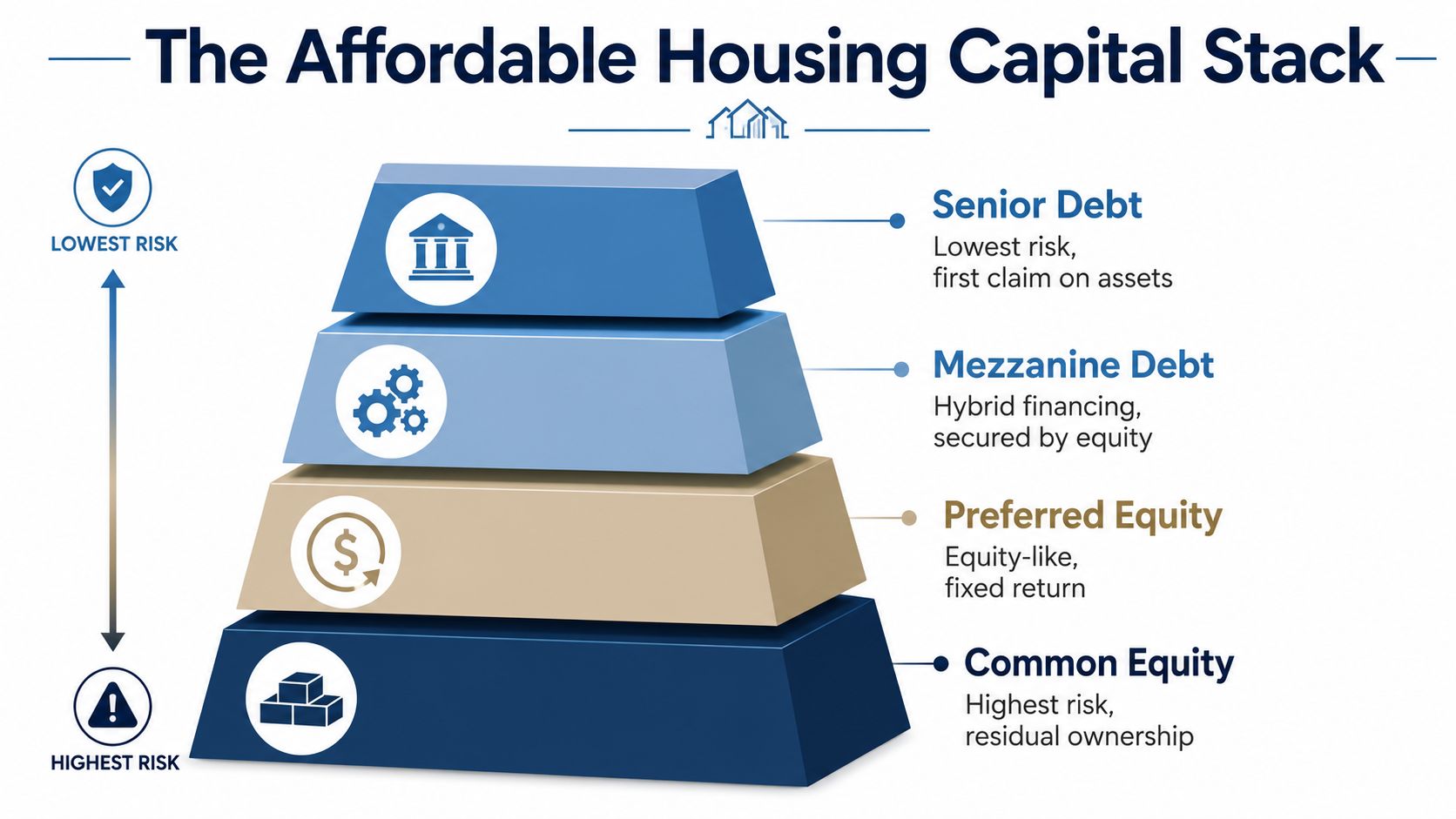
The stack is usually assembled in tranches with different return requirements, repayment expectations, and control rights.
- Senior debt: First-position financing from banks, agencies, or bond executions. Proceeds are limited by restricted NOI, debt service tests, and conservative views on future rent flexibility. A working grasp of how loan-to-value ratio affects debt sizing helps here, but affordable deals are often constrained by debt yield and DSCR before they are constrained by headline LTV.
- Tax credit equity: Equity raised from investors seeking tax credits and related losses. This layer often absorbs much of the feasibility gap.
- Tax-exempt bonds: Common in 4% LIHTC executions and useful for lowering borrowing costs while meeting program requirements.
- Soft debt: Subordinate loans from city, state, or federal sources. These often carry below-market rates, deferred payments, or cash-flow contingent repayment.
- Rental or operating subsidy: In deeper affordability deals, operating support may be needed because even a well-structured development stack cannot solve an operating deficit created by very low rents.
- Sponsor equity or deferred developer fee: Usually the most exposed capital. It is also the layer most sensitive to construction overruns, lease-up delays, and equity adjusters.
The capital stack is also a risk allocation system
This is the point generic overviews usually skip. Each layer solves a different problem, and each one introduces its own approval process, reporting burden, and closing condition. A city soft loan may preserve feasibility but add long-form regulatory agreements and transfer restrictions. Bond financing may lower cost of funds but add timing dependencies and issuer requirements. Tax credit equity may reduce debt but increase exposure to delivery benchmarks and compliance errors.
As a result, investors should read the stack not just for source diversity, but for failure points. Which commitments are fully awarded versus conditional. Which funds are drawn at closing versus placed in installments. Which lender or agency has cure rights, consent rights, or reserve controls. A deal with six sources is not automatically safer than a deal with three. It may have six ways to stall.
What strong sponsors do differently
Strong sponsors build the stack around durability, not just closing-day feasibility. They ask whether subordinate debt is forgivable or merely deferred, whether subsidy contracts survive ownership changes, whether reserve requirements trap too much cash, and whether the property manager can handle the compliance load embedded in each source.
That is why affordable housing finance is better understood as structured capital attached to real estate operations. The property matters, but the investability of the deal often turns on documentation, intercreditor terms, funding sequence, and the sponsor's ability to keep every layer in compliance over the full hold period.
How Do You Underwrite and Measure Performance
Affordable projects often face a structural feasibility gap of roughly 25% to 35% between total development cost and what restricted rents can support, according to the Urban Institute technical appendix. Underwriting starts with that gap, because everything else in the model follows from how it gets filled, on what terms, and with what operating constraints.
That changes the logic of the model. In conventional multifamily, the debate usually centers on market rent growth, absorption, and exit pricing. In affordable housing, the harder questions sit below the NOI line and inside the legal documents. How much permanent debt can restricted income support. Which subsidies are hard commitments versus soft awards. Which reserve requirements trap cash. Which compliance obligations can interrupt distributions even when occupancy is healthy.
A strong affordable housing model is therefore less about forecasting upside and more about testing durability under constraint.
Start with the revenue rulebook
Revenue is governed first by program rules, then by market demand. Analysts need to map unit mix by AMI band, applicable rent caps, utility allowance treatment, recertification assumptions, and any project-based rental assistance that changes effective collections. A property with below-market rents can still produce unstable cash flow if reimbursement timing is slow, utility assumptions are stale, or recertification execution is weak.
That is why underwritten vacancy in this sector should not be treated as a simple leasing variable. Economic vacancy may come from failed tenant file maintenance, delayed subsidy payments, or units temporarily taken offline because compliance corrections were required.
Debt sizing is constrained twice
Restricted rents limit NOI. Lenders then apply conservative coverage tests to that already constrained NOI. As noted earlier, affordable housing lenders commonly require debt service coverage around 1.20x, which means a project may show full occupancy and still support materially less permanent debt than a comparable market-rate asset.
Inexperienced analysts misread risk and return. They focus on lower top-line revenue and miss the fact that a large portion of the capital stack may function more like quasi-permanent support capital than traditional debt. The underwriting task is to determine whether that support capital is durable, transferable, and operationally manageable across the hold period.
The metrics that matter most
| Metric | Affordable Housing (Subsidized) | Market-Rate Housing |
|---|---|---|
| Revenue ceiling | Set by rent limits, income limits, and subsidy rules | Set by market willingness to pay |
| Primary NOI risk | Compliance execution, reimbursement timing, and expense drift | Leasing velocity, concessions, and market rent pressure |
| Debt capacity driver | Restricted NOI under lender coverage constraints | Market NOI and refinance expectations |
| Value creation path | Preserving subsidy value, controlling operations, and maintaining eligibility | Growing rents, reducing expenses, and timing exits |
| Primary diligence focus | Capital stack durability and file-level operating discipline | Market comps, absorption, and cap rate assumptions |
The practical implication is straightforward. Investors should track yield on cost and stabilized DSCR, but those figures are incomplete without a source-by-source review of cash flow restrictions, reserve waterfalls, and re-underwriting triggers tied to compliance.
Why lower nominal rents do not automatically mean weaker performance
Affordable housing can produce better risk-adjusted performance than many investors expect because tenant demand is deep, turnover is often lower, and rent collections may be supported by public payment streams rather than household income alone. Those characteristics can reduce revenue volatility even when contractual rent growth is limited.
The key is to separate nominal rent level from cash flow quality. A low-rent property in a sound submarket with durable subsidy support and disciplined management can be easier to underwrite than a higher-rent asset dependent on aggressive lease trade-outs. Investors who already think carefully about closed-end fund volatility may recognize the same principle in portfolio construction and downside control discussed in this guide to CEF investment risk.
What institutional-grade performance measurement looks like after closing
Post-close asset management needs a tighter dashboard than standard multifamily reporting. Occupancy and collections still matter, but they are lagging indicators if the property is drifting out of compliance or building concentration risk in a weak submarket.
Track at least four operating lines:
- Compliance accuracy. Tenant certifications, rent calculations, utility allowance updates, inspection results, and reporting deadlines.
- Coverage resilience. DSCR under delayed subsidy receipts, higher insurance, payroll pressure, and real estate tax changes where applicable.
- Turnover economics. Not just move-out count, but days offline, make-ready cost, recertification lag, and lost subsidy during vacancy.
- Submarket concentration. Exposure to a small set of census tracts, employers, or public funding channels that can weaken exit liquidity even if property-level operations look stable.
That last point is often ignored in generic guides. Affordable housing portfolios can look diversified by asset count while still carrying concentrated exposure to a narrow geography, a single housing authority, or a limited set of political jurisdictions. Institutional underwriting should test concentration at the neighborhood and counterparty level, not just at the portfolio level.
Analyst test: If projected returns depend on smooth subsidy administration, flawless tenant file management, and no reserve leakage, the model needs a harder downside case.
Good affordable housing underwriting does not stop at “can this deal close.” It asks whether the capital stack, operating platform, and neighborhood exposure can hold together long enough to convert statutory affordability into durable investor performance.
What Are the Core Risks and How Are They Managed
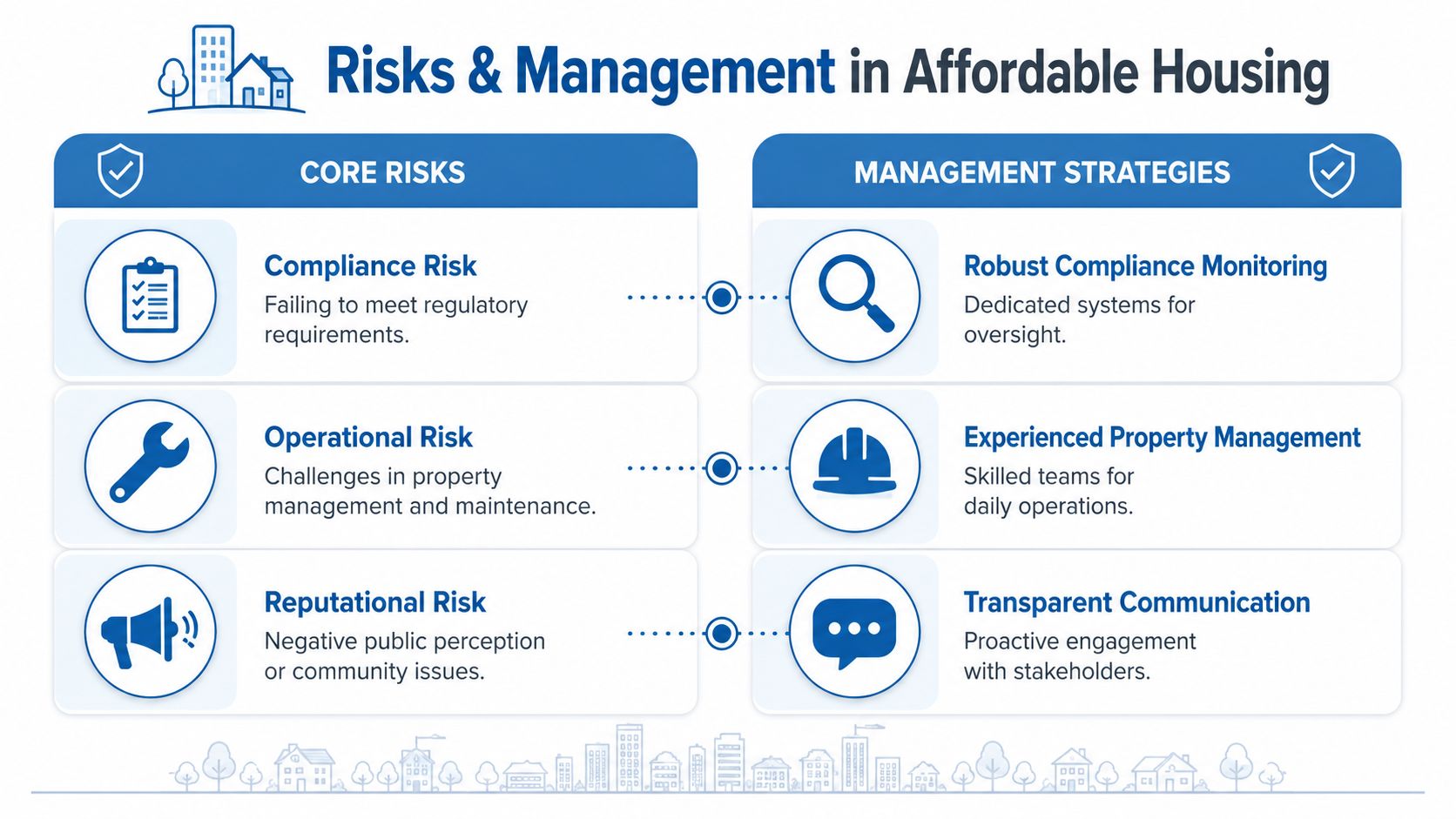
The biggest risks in affordable housing aren't just debt and interest rates. They're compliance failure, operating slippage, policy exposure, and concentration in the wrong places.
Many investors treat affordable housing as lower-volatility multifamily. That's lazy analysis. The revenue may be more durable, but the error tolerance is lower because the property sits inside a rulebook.
Compliance risk is operational, not theoretical
Affordable housing operators have to document tenant eligibility, maintain rent limits, satisfy reporting obligations, and preserve subsidy conditions. A misstep can affect cash flow, recapture economics, or legal standing.
This is why experienced property management isn't optional. A sponsor can win the deal on paper and still destroy value with weak file discipline or poor recertification controls.
Policy risk changes capital value
Affordable housing relies on public frameworks. That doesn't automatically make it fragile, but it does mean investors need to map program-specific exposure. Some subsidies are firmly embedded and historically durable. Others are more vulnerable to administrative delays or changing budget priorities.
A disciplined risk process should look more like institutional portfolio oversight than simple real estate screening. For investors building that framework, broader thinking from a guide to CEF investment risk can be useful as a reminder that yield quality depends on understanding structure, not just headline return.
The concentration risk many investors ignore
The contrarian risk is affordable housing concentration. Place-based investment in low-resource neighborhoods, without mobility strategies or access to higher-opportunity areas, can perpetuate segregation and limit resident outcomes, as outlined by Local Housing Solutions.
That has two implications for investors.
| Risk | Why it matters | How managers respond |
|---|---|---|
| Compliance risk | Errors can impair income and trigger legal issues | Build formal monitoring and specialized reporting workflows |
| Operating risk | Thin margins leave little room for waste | Use managers with subsidy-specific property experience |
| Concentration risk | Reputational and social outcomes can deteriorate | Pair place-based strategy with mobility and access planning |
A deal can satisfy underwriting and still fail the strategy test if it deepens concentration in a low-resource submarket with no path to resident mobility.
What good mitigation looks like
Strong managers don't just avoid bad neighborhoods or chase politically favored submarkets. They ask harder questions:
- Is the site connected to jobs, schools, and transit?
- Does the investment preserve existing affordability or warehouse low-income households?
- Are resident outcomes considered alongside occupancy and collections?
- Can the property absorb compliance overhead without starving maintenance?
Risk management in affordable housing is less about eliminating uncertainty and more about preventing avoidable fragility.
How to Access Deals and Conduct Due Diligence
Affordable housing transactions often clear through narrower channels than conventional multifamily, which means access and screening discipline matter as much as pricing.
The investable universe is fragmented by design. Many assets sit inside local developer networks, nonprofit ownership structures, public agency pipelines, or recapitalizations tied to expiring restrictions and deferred capital needs. As a result, the best opportunities often do not resemble a standard brokered apartment sale. They surface as preservation deals, tax credit resyndications, bond-financed rehabs, portfolio carve-outs, or partnerships where ownership, regulation, and capital planning are tightly linked.

Where investors get exposure
The access route should match the investor's staffing model, return target, and tolerance for compliance complexity.
- Dedicated affordable housing funds: Best suited to institutions that want manager expertise across tax credit, bond, and preservation strategies without building an internal operating bench.
- Specialized REITs or housing platforms: Better for investors who prioritize scale, reporting consistency, and portfolio aggregation over custom deal structuring.
- Direct investment or joint venture: Appropriate when the investor has local sourcing relationships and in-house capacity to review regulatory agreements, reserve structures, and execution risk.
- Preservation and rehab programs: Often the most executable strategy in markets where new construction rents cannot support development costs without layered subsidies.
This is a capital-stack business before it is a cap-rate business. Access improves when investors understand which counterparties control each layer of the stack, including housing finance agencies, syndicators, mission-driven sellers, soft-debt providers, and local public-sector partners.
Why early screening is data-led
The first pass is less about finding "cheap" assets and more about identifying assets where regulated cash flow can remain durable after capital needs, compliance costs, and neighborhood constraints are fully priced. That requires investors to screen for ownership tenure, maturing affordability covenants, unresolved liens, pending debt maturities, permit history, and signs that a property may need a recapitalization rather than a light repositioning.
Operational quality matters as much as submarket demand. Affordable housing can produce stable occupancy because tenant turnover is often lower than in market-rate product, but that stability does not protect investors from bad reserve planning, weak file compliance, or a property that sits in a low-access area with worsening concentration risk. The early screen should test both.
A due diligence workflow that fits this asset class
A credible process works from legal structure outward to physical condition and neighborhood context.
Ownership and title review
Confirm legal ownership, transfer history, use restrictions, encumbrances, and any signs of pending distress, recapitalization, or disputed control.Capital stack review
Map every source of debt and soft financing, including subordinate loans, maturity dates, reserve requirements, and consent rights that can delay a transaction or limit distributions.Physical asset review
Assess unit mix, building age, permit history, deferred maintenance, life-safety exposure, and whether the rehab scope matches available subsidy and reserve capacity.Regulatory and compliance review
Verify income targeting, rent restrictions, affordability periods, recertification procedures, reporting obligations, and any cure history with agency counterparties.Location and concentration review
Evaluate access to jobs, schools, transit, and neighborhood amenities. A property can meet occupancy targets and still fail an institutional strategy test if it reinforces concentration in a low-resource corridor.
Investors who want a practical starting point can adapt a standard real estate due diligence checklist, then add deal-specific reviews for subsidy layering, affordability covenants, and agency approvals.
A short explainer helps illustrate how many moving parts can appear before you even finalize your model:
The execution advantage
In this segment, the edge often comes from faster disqualification, not broader sourcing. An investor who can eliminate weak deals early avoids months of work on assets with broken consent structures, unrealistic rehab budgets, hidden subordinate debt, or compliance histories that make recapitalization difficult.
That is why institutional due diligence in affordable housing has to be multi-layered. The question is not only whether the property is occupied and cash-flowing today. The question is whether the full structure, site, and operating model can support affordability, debt service, and capital reinvestment over the next hold period.
BatchData helps investors and operators turn fragmented property research into a repeatable workflow. If you're evaluating affordable housing acquisitions, preservation targets, or subsidy-sensitive portfolios, BatchData can support sourcing, ownership verification, lien review, and portfolio monitoring with large-scale U.S. property data and investor-grade delivery options.