




































Batch skip tracing is a fast and automated way to find contact details – like phone numbers, emails, and mailing addresses – for large lists of people or properties. Instead of manually searching through public records, you upload a file, and the system cross-references data from multiple sources to deliver accurate results in minutes. This tool is widely used by real estate professionals and marketers to quickly connect with property owners or decision-makers, even those hidden behind LLCs or trusts.
Key Features:
- Contact Details: Provides phone numbers (mobile/landline), emails, and mailing addresses.
- High Match Rates: Up to 76% right-party contact rate.
- Compliance Built-In: Filters out numbers on the National Do Not Call list and flags TCPA risks.
- Detailed Property Data: Includes ownership history, liens, and mortgage information.
- Speed: Processes thousands of records in minutes.
How It Works:
- Upload Data: Start with a clean CSV file of names and addresses.
- Data Matching: The system cross-references multiple databases, including public records and utility data.
- Verification: Confirms accuracy by validating details across sources.
- Output Results: Delivers a detailed file with contact info and property insights.
Batch skip tracing saves time, reduces costs, and improves outreach efficiency by providing accurate, actionable data for lead generation.
How To Use Batch Skip Tracing
Watching a video is a great start, but you can also read our guide on how skip tracing works to see how these tools find people quickly.
sbb-itb-8058745
How Batch Skip Tracing Works
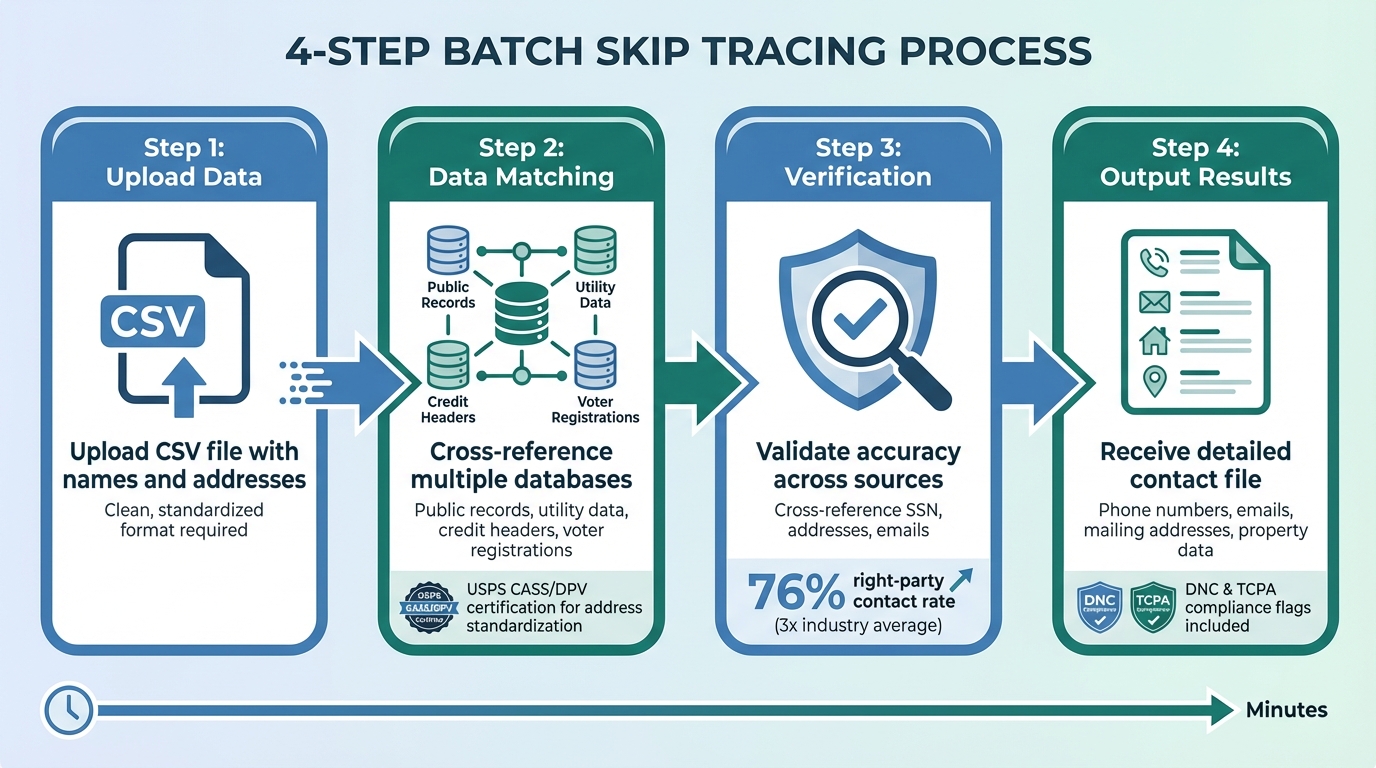
How Batch Skip Tracing Works: 4-Step Process from Upload to Results
Batch skip tracing operates through a powerful matching system that cross-references your uploaded addresses with more than a dozen data sources. These include public records, private databases, and proprietary datasets, all working together to create accurate contact profiles.
A self-updating engine ensures the data stays accurate by validating and cleaning it in real time. This process is fueled by feedback from thousands of active users. For instance, when a phone number is flagged as disconnected or invalid across multiple campaigns, the system automatically updates the record to reflect this.
"We operate a self-enriching engine that constantly verifies and cleanses data in real-time. We refresh our datasets daily." – BatchData
Advanced algorithms go a step further by identifying key decision-makers. For example, if a property is owned by "XYZ Holdings LLC", the system connects the dots using address history, corporate filings, and ownership records to pinpoint the actual person you need to contact, rather than just the registered agent’s office.
To help you stay compliant, the system also filters results against the National Do Not Call list and TCPA litigator records. This ensures you don’t accidentally reach out to individuals who are legally off-limits.
Data Aggregation and Cross-Referencing
The process kicks off as soon as you upload your CSV file. First, the system standardizes the addresses to meet USPS delivery standards (CASS/DPV certification), ensuring the data is clean and reliable. Then, it queries multiple databases simultaneously, pulling from sources like public property records, utility connections, credit headers, voter registrations, and carrier-level phone data. Each source contributes valuable information – property records confirm ownership, while carrier data identifies whether a phone number is active and whether it’s mobile or a landline.
The system then cross-references this information in layers. For example, it compares Social Security numbers, previous addresses, and email addresses across different databases to verify that the contact details truly belong to the property owner. The more confirmations it finds, the higher the match confidence score.
"Skip tracing excels at cross-referencing information from multiple sources… By comparing details such as addresses, phone numbers, and social security numbers across various databases, skip tracing helps corroborate the authenticity of the information." – Tracers
This thorough verification process delivers a 76% right-party contact rate – nearly three times the industry average. The result is a highly accurate and detailed output.
What Data You Get from Batch Skip Tracing
Once the data is standardized and verified, the final CSV output includes far more than just phone numbers. You’ll receive multiple contact numbers per record, each flagged as either mobile or landline. This distinction is essential for deciding whether to engage via SMS or voice calls.
Email addresses are another key data point, with deliverability rates averaging around 89%, and match rates typically falling between 30% and 55%. Additionally, you’ll get the owner’s current mailing address, which is often different from the property address – particularly useful for reaching absentee owners or out-of-state investors.
Beyond contact details, the output includes property-related information such as ownership history, transaction records, lien data, tax assessments, and mortgage details. This extra context allows you to qualify leads even before making contact.
For properties owned by LLCs or trusts, the system identifies the individuals behind the corporate structure. Instead of generic details for a registered agent’s office, you’ll get the names and contact information of the actual decision-makers. The system also flags compliance risks by marking records that appear on the DNC registry or are tied to known TCPA litigators.
| Data Type Returned | Description |
|---|---|
| Phone Numbers | Multiple numbers flagged as mobile or landline |
| Email Addresses | Current, deliverable email addresses for the owner |
| Mailing Addresses | Owner’s current primary residence, often different from the subject property |
| LLC/Trust Data | Identification of the true individuals behind corporate ownership |
| Compliance Flags | Indicators for DNC registry status or known TCPA litigators |
| Property Metadata | Ownership history, liens, and loan information |
Pro tip: always download the full CSV file instead of relying on previews. Many platforms show only the top three phone numbers, but the complete file often includes six or more potential contacts per record. Having access to all this information can be the difference between successfully reaching someone and hitting a dead end.
Step-by-Step Guide to Batch Skip Tracing
Running a batch skip tracing operation involves transforming basic property information into actionable contact details through a structured process. Here’s how to do it:
1. Preparing Your Data
Start by collecting property owner names and addresses from trusted sources like pre-foreclosure lists, tax lien records, or property deed databases. Organize this information into a CSV file with clear columns for details like owner name, property address, city, state, and ZIP code. Consistency is key – format addresses uniformly (e.g., "123 Main St, Anytown, CA 90210") to avoid mismatches.
Deduplicate your list to remove redundant entries and verify all address details to ensure skip tracing accuracy. Missing or incorrect information, such as incomplete ZIP codes or misspelled street names, can lower your match rates. If you’re targeting properties owned by LLCs or trusts, include the full business name for better results. To avoid common issues like outdated lists or formatting errors, test a small sample (about 10% of your list) before processing the entire dataset. Once your data is ready, choose a provider capable of handling it efficiently.
2. Choosing a Skip Tracing Provider
Selecting the right provider is crucial for successful batch skip tracing. Look for a service with a high hit rate (90% or more) that uses tier-1 databases like public records, credit headers, and utility connections. Ensure the provider automatically screens results against the National Do Not Call (DNC) registry and TCPA litigator lists, as this compliance step helps you avoid hefty fines – up to $43,792 per violation.
Check if the platform can handle large datasets, process thousands of records at once, and return multiple phone numbers per record (with clear mobile and landline indicators). Some providers even offer data scoring to help you focus on the most reliable leads. Modern systems can deliver results in minutes, and API integrations can provide real-time data in milliseconds. Transparent pricing models, like pay-per-match rates (e.g., $0.07 per successful match) with no monthly minimums, are ideal for scaling your campaigns.
3. Uploading and Processing Your Data
Upload your CSV file through the provider’s platform. During this step, you’ll map your file’s columns (e.g., aligning "Property Address" with the system’s "Address" field). Double-check these mappings to ensure accuracy.
Once uploaded, the system will standardize addresses to USPS delivery standards and cross-reference multiple databases to confirm the contact details match the property owner. The system also flags entries on the DNC registry or those linked to known TCPA litigators. Most batch jobs are completed within minutes, and you’ll be notified when your results are ready. Be sure to download the full CSV file to access all the processed data. With this refined data, you can start fine-tuning your outreach efforts.
4. Using Your Results
After processing, review the results to check hit rates and identify any invalid entries. Use the confidence scores provided to prioritize leads – higher scores indicate better verification across multiple sources.
Before reaching out, ensure compliance by removing contacts who have opted out. Remember, the FTC requires calls to be made only between 8:00 AM and 9:00 PM local time, and you must have a documented permissible purpose for each contact.
Finally, import your cleaned data into your CRM or dialer system. Mobile numbers can be flagged for SMS campaigns, landlines for voice calls, and mailing addresses for direct mail efforts. For properties owned by LLCs, having direct contact information for decision-makers – rather than generic registered agent details – can greatly improve your connection rates. Track your connect rates and right-party contact success to refine your approach for future campaigns.
Benefits of Batch Skip Tracing
Let’s dive into how batch skip tracing can transform your outreach efforts with its unmatched efficiency and results.
Speed and Scale
Batch skip tracing can process thousands – or even millions – of records in just minutes. This efficiency allows you to launch outreach campaigns almost immediately, eliminating the need for weeks of manual public record searches. With instant access to enriched data, you get mobile numbers, landlines, email addresses, and even uncover the real individuals behind LLCs and trusts.
Data Accuracy and Compliance
One of the standout advantages is its accuracy. Batch skip tracing boasts connection rates between 75% and 95%, a massive leap compared to the 10% to 20% seen with generic lists. This means your team can focus on meaningful conversations with property owners instead of wasting time on wrong or disconnected numbers.
"Our data undergoes continuous validation from over a dozen sources to ensure top-tier right-party contact rates, which are currently nearly three times higher than the industry average." – BatchData
Additionally, automated compliance features like DNC registry scrubbing and litigator identification help safeguard your campaigns from TCPA violations.
Lower Cost Per Lead
Batch skip tracing isn’t just effective – it’s also cost-efficient. With costs as low as $0.02 per record, you’re looking at approximately $0.45 per deal. Compare that to the $50–$100 price tag for traditional motivated seller leads, and the savings are undeniable.
When you combine verified phone, email, and mailing data, response rates can jump by over 300%, giving you even more bang for your buck.
Batch Skip Tracing with BatchData
BatchData takes skip tracing to the next level with features designed for precision, speed, and seamless integration. With access to over 150 million property records nationwide, the platform enriches your data by providing verified contact details like mobile numbers, landlines, deliverable email addresses, and verified mailing addresses. It boasts an impressive 76% right-party contact rate – about three times higher than the industry average. This level of accuracy ensures more effective connections and faster campaign rollouts.
"We don’t just pull from one static list; we aggregate and cross-verify data from multiple top-tier sources." – BatchData
Property and Contact Data Coverage
BatchData goes beyond basic contact information by offering detailed property data, including ownership records, transaction history, property characteristics, lien data, tax assessments, and mortgage details. The platform also provides carrier insights, phone confidence scores, and metadata verified across multiple sources. Additionally, BatchData identifies individuals behind LLCs and trusts, enabling you to bypass registered agents and directly contact decision-makers. All data is scrubbed against the National Do Not Call registry and flagged for TCPA compliance risks. This rich dataset integrates seamlessly into BatchData’s tools, allowing you to act on it immediately.
API Integration Options
BatchData’s dedicated APIs for property search, skip tracing, and bulk data delivery integrate effortlessly into CRMs and custom workflows. Results are delivered in milliseconds, making it ideal for real-time applications and automation. Developers can access detailed API documentation, while non-technical users can easily upload CSV files through the BatchLeads platform.
Flexible Service Options
BatchData offers flexible pricing models, including pay-as-you-go options with no monthly fees. Subscription plans reduce per-record costs to as low as 7¢ for 150,000+ records. Users can access the platform through three methods: single lookups for individual searches, bulk imports for larger lists, or API endpoints for real-time integration.
Conclusion
Batch skip tracing has revolutionized how real estate professionals handle large-scale contact discovery. Instead of painstakingly researching each property one by one, users can now upload entire neighborhoods or lead lists and instantly receive verified contact details – like mobile numbers, email addresses, and mailing addresses. Tasks that once took half an hour are now completed in mere seconds. As Chris Finck, Director of Product Management, put it:
"What used to take 30 minutes now takes 30 seconds. BatchData makes our platform superhuman".
This tool doesn’t just save time – it ensures accuracy and compliance. By uncovering the real individuals behind LLCs and trusts, batch skip tracing connects professionals directly with decision-makers, bypassing intermediaries like registered agents. Built-in compliance features, such as scrubbing against DNC registries and flagging TCPA risks, make the process both efficient and responsible.
BatchData’s platform boasts a 76% right-party contact rate, achieved through rigorous cross-verification across more than a dozen data sources. With access to over 155 million properties and 700+ attributes per record, it offers the depth needed to power targeted lead generation campaigns. Plus, daily data updates ensure users work with the most current information, avoiding the pitfalls of outdated lists.
The platform’s flexibility is another highlight. Whether users prefer bulk CSV uploads or real-time API integration, BatchData accommodates their needs with pricing as low as 7¢ per record.
For real estate professionals aiming to scale their outreach while keeping data accurate and compliant, BatchData’s batch skip tracing transforms static property lists into actionable leads – quickly and effectively.
FAQs
What fields should my CSV include?
Your CSV file for batch skip tracing should have the following fields, each in its own column:
- First Name and Last Name
- Property Address: Includes house number, street name, city, state, and zip code
- Mailing Address: Includes house number, street name, city, state, and zip code
These fields are crucial to ensure precise and efficient skip tracing.
How accurate are the contacts?
The success of skip tracing hinges on how accurate and up-to-date the data sources are. BatchData sets itself apart by relying on verified, compliant, and consistently updated data, which helps them achieve an impressive right-party contact (RPC) rate of up to 76%. To put that into perspective, the industry average typically falls between 25% and 35%.
While it’s impossible for any system to guarantee 100% accuracy, BatchData enhances reliability by employing continuous validation and real-time updates. This approach ensures that critical details like phone numbers and addresses are as accurate as possible, giving users a significant edge over traditional methods.
What outreach is legally allowed?
When it comes to skip tracing outreach, it’s perfectly legal – as long as it adheres to regulations like the Fair Credit Reporting Act (FCRA) and relies on data collected through lawful methods. The key here is that the outreach must have a permissible purpose and align with privacy laws such as the Gramm-Leach-Bliley Act (GLBA) and the Driver’s Privacy Protection Act (DPPA).
On the ethical side, responsible practices are essential. This means using public records appropriately, steering clear of any behavior that could be seen as harassment, and ensuring all communication respects both legal limits and individuals’ privacy.


