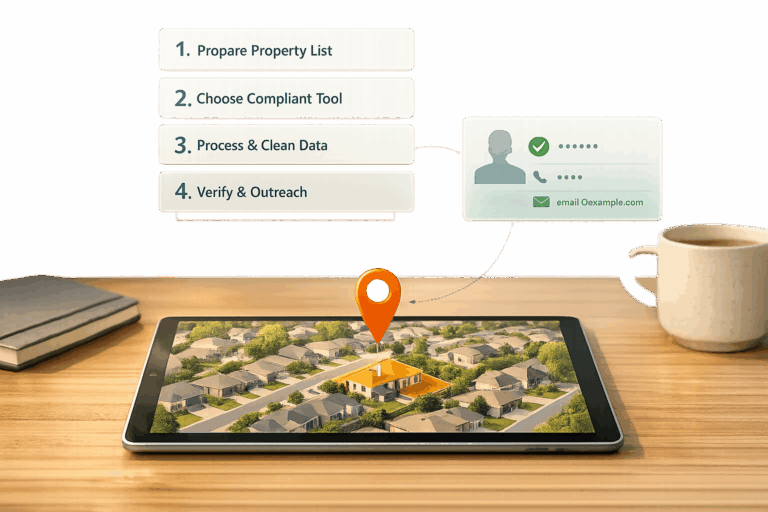
Skip tracing helps real estate investors find accurate contact details for property owners when this information isn’t easily accessible. It’s especially useful for off-market properties, allowing investors to connect directly with owners before competitors. By using tools and data from public and private sources, skip tracing improves outreach success rates and saves time compared to manual research. Here’s how it works:
- Start with a property list: Gather accurate property data like addresses, owner names, and tax records. Organize this information in a clean format to improve results.
- Choose the right tool: Look for skip tracing services that provide verified contact details, including phone numbers and email addresses, while ensuring compliance with laws.
- Process the data: Upload your list, run the trace, and review results for accuracy and legal compliance.
- Use the data for outreach: Contact property owners via calls, texts, emails, or direct mail using the enriched contact details.
Skip tracing is a powerful way to build a pipeline of motivated seller leads, especially for properties with signs of distress (e.g., tax delinquency or pre-foreclosure). Tools like BatchData simplify the process, offering bulk processing, API integrations, and compliance features. By combining skip tracing with smart targeting, you can improve your lead generation efforts and close more deals.
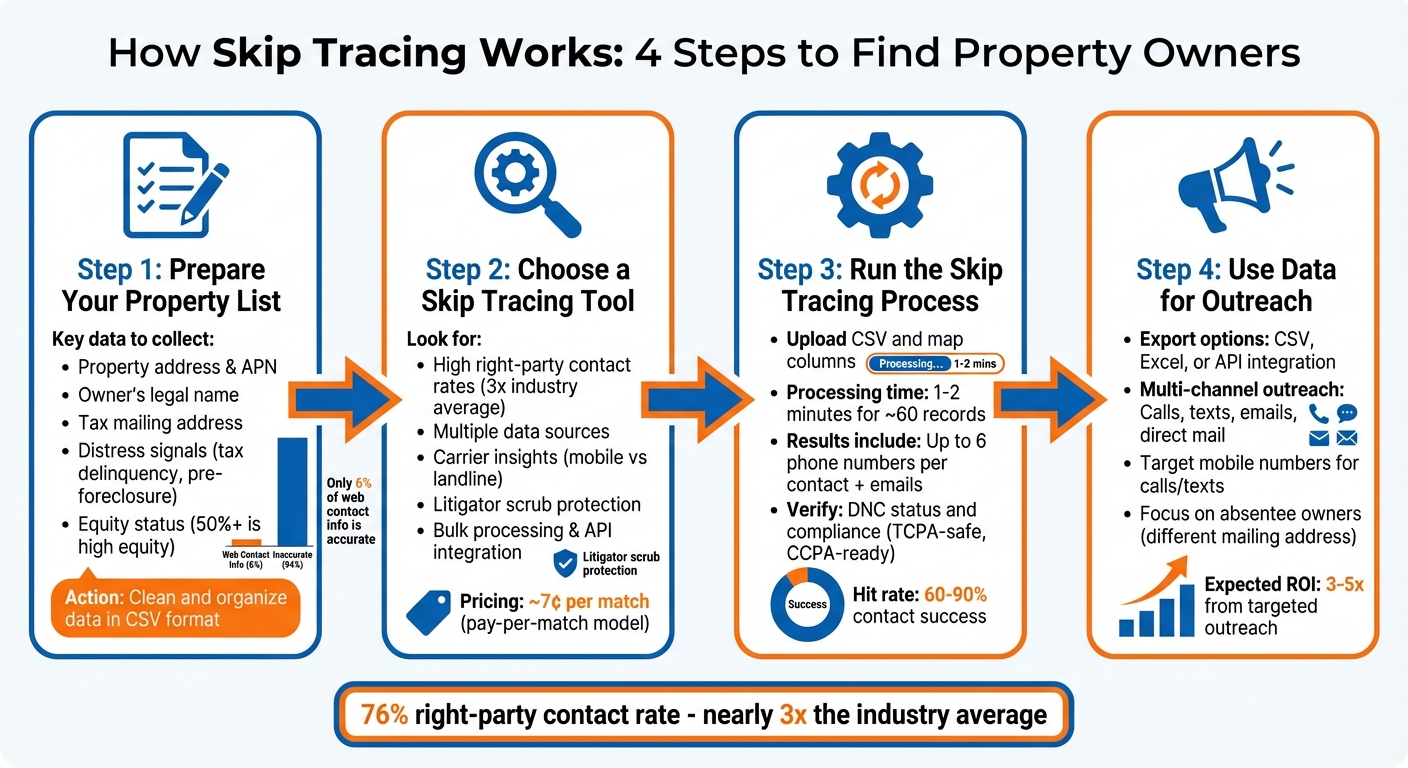
4-Step Skip Tracing Process for Real Estate Lead Generation
How to Make the Most of Skip Tracing
Step 1: Prepare Your Property List
Accurate, well-organized data is the backbone of effective skip tracing. Starting with reliable property details helps you avoid wasting credits and ensures you connect with the right property owners more quickly. Before uploading anything, take the time to gather and arrange all key information.
Collect Property Data
Begin with the essentials: the property address and the Assessor’s Parcel Number (APN). The APN serves as a unique identifier and is crucial for accessing deeper property and owner records from various county offices. Next, obtain the owner’s legal name from the most recent deed, which can be found at the County Recorder or Clerk’s office. If the property is held by an LLC or trust, confirm ownership details through the Secretary of State’s records.
Another critical piece of information is the tax mailing address, available from the county assessor’s records. A tax mailing address that differs from the property address often indicates an absentee owner. To zero in on motivated sellers, look for distress signals such as pre-foreclosure status, tax delinquency (typically three or more years), vacancy, probate, or divorce. Financial details like mortgage balances and estimated equity (properties with 50% or more equity are considered “high equity”) can help you prioritize which leads to pursue first. Ensuring your records are accurate saves time and money while improving your chances of success.
| Record Source | Information Found |
|---|---|
| County Assessor | Owner name, APN, property characteristics, tax mailing address |
| County Recorder/Clerk | Deeds, mortgages, liens, title transfer history |
| Tax Collector | Payment status, delinquency records, tax sale info |
| Secretary of State | Registered agents or managing members for LLC-owned properties |
To avoid chasing outdated information, cross-check the owner name from the county assessor’s tax file with the name on the most recent deed. Additionally, tools like Geographic Information System (GIS) mapping can provide parcel boundaries and zoning details, giving you a clearer picture of each property.
Clean and Organize Your Data
Once you’ve gathered all the necessary details, it’s time to organize them. Use a CSV template to format your data, creating separate columns for property address, city, state, and ZIP code. While a property address alone can suffice, including the owner’s first name, last name, and mailing address greatly improves your chances of accurate matches. Remove any entries that already include phone numbers to avoid paying for unnecessary searches.
Standardize your data by removing duplicates and verifying addresses with a standardization tool. Make sure CSV headers like Property Address, City, State, and ZIP are in separate columns to prevent processing errors. Before uploading, scrub existing phone numbers against the National DNC Registry to ensure compliance and avoid redundant costs.
“Low-quality data will hamper your business, but high-quality data will enable you to connect more effectively in ways you never imagined were possible.” – BatchLeads
Instead of uploading broad, unfocused lists, narrow your targets by filtering for “pain indicators” that suggest motivation. For example, focus on “tired landlords” who have owned a property for over seven years, with homes built before 1990 and 20–30% equity. It’s worth noting that only 6% of contact information found on the general web is accurate, so taking the time to prepare high-quality data is essential for better results. With your list ready, you’re all set to choose a skip tracing tool to enhance your outreach.
Step 2: Choose a Skip Tracing Tool
With your property list ready, the next step is finding a skip tracing service that provides accurate contact information while staying within your budget. The right tool should strike a balance between precise data, compliance features, and affordability. Prioritize tools that rely on robust verification processes and multiple reliable sources to ensure you’re connecting with the actual property owners.
Features to Look for in Skip Tracing Tools
When evaluating skip tracing tools, focus on their ability to deliver accurate data and high right-party contact rates. Leading services can achieve right-party contact rates nearly three times higher than the industry average. This is crucial because contacting the wrong person wastes both time and money. Seek tools that utilize data verification loops and pull ownership details from multiple trusted sources.
Go beyond just phone numbers. The best tools provide enriched data, including email addresses, carrier insights (to distinguish mobile numbers from landlines), and the ability to identify individual members behind LLC-owned properties. Additional features to prioritize include:
- Litigator Scrub: Protects against professional plaintiffs who target telemarketers.
- Bulk Processing: Handles large volumes of records efficiently.
- API Integration: Automates skip tracing within your CRM or workflow for scalability.
| Feature to Look For | Why It Matters |
|---|---|
| Carrier Insights | Helps select the right outreach method by identifying mobile vs. landline numbers. |
| Litigator Scrub | Shields your campaigns from legal risks tied to professional plaintiffs. |
| Property Search API | Enables instant access to property and owner details for faster processing. |
How BatchData Supports Skip Tracing

BatchData simplifies the skip tracing process by enriching property records with verified phone numbers, email addresses, and other key details from trusted sources. Built for scale, the platform can handle millions of records, delivering results in minutes for bulk imports. Its proprietary algorithms enhance match accuracy, improving the efficiency of your outreach efforts.
BatchData provides multiple contact methods for each record and offers specialized insights into LLC-owned properties, revealing the individuals behind corporate ownership. The platform is designed with compliance in mind, featuring TCPA-safe and CCPA-ready tools, along with built-in litigator scrubs and enterprise-grade security to safeguard your campaigns.
You can access BatchData’s skip tracing capabilities through single searches, bulk imports, or real-time API endpoints that integrate with your workflows. Pricing depends on the product, usage volume, and business requirements. For current pricing and available options, contact the BatchData sales team.
Additional features include address standardization and USPS-compliant Delivery Point Validation to help improve address quality before running a skip trace.
Since BatchSkipTracing merged with the BatchData platform on August 15, 2025, all skip tracing tools are now available through a single, streamlined interface. With BatchData, you’ll have the accurate, enriched data you need to confidently execute your skip tracing process.
Step 3: Run the Skip Tracing Process
Once you’ve chosen your skip tracing tool and prepared your property list, it’s time to process the data and gather contact details. BatchData provides three main ways to upload your information: bulk file uploads, manual data entry, or advanced API requests for automated workflows. For efficiency, bulk CSV uploads are the way to go.
Upload and Process Your Property List
Start by uploading your CSV file to BatchData. During this step, you’ll need to map the columns in your file to the required fields, such as Owner First Name, Owner Last Name, and Mailing Full Address. This mapping ensures the system can accurately match your data with its extensive database, which pulls from over a dozen verified sources.
If you’re working with an existing list, you can filter records based on criteria like vacancy status or date tags. Once filtered, select “skip trace” from the actions menu. Be sure to name your file and organize the results for easy access later. For smaller batches (around 60 records), processing typically takes 1–2 minutes. Larger lists are also processed quickly, often within minutes. Plus, you’re only charged for successful matches – there are no fees for duplicates or entries that don’t return contact information.
After processing, it’s important to review your results and ensure compliance before moving forward.
Review Results and Check Compliance
When the skip tracing process is complete, you’ll receive a detailed analysis, including the total number of records submitted, the number of successful matches, the hit percentage, and the overall cost. The enriched data file usually contains up to six phone numbers per contact, along with email addresses and carrier details. For additional insights, hover over the “i” icon to check the type of phone number and its recent connectivity status.
To ensure compliance, review the DNC (Do Not Call) status of the contacts and use the Litigator Scrub feature. This helps protect your outreach efforts from professional plaintiffs who may file lawsuits against telemarketers. BatchData delivers information that is TCPA-safe and CCPA-ready, keeping you aligned with federal and state privacy regulations. If your list is outdated, take advantage of the “update and re-skip trace records” option to refresh the data and maintain accuracy.
Once you’ve verified and scrubbed your results, you can download the updated file or push the data directly into tools like BatchDialer for immediate outreach. With verified and compliant contact details at your fingertips, you’re ready to connect with property owners efficiently and confidently.
Step 4: Use Traced Data for Outreach
Once your data is verified and ready to go, it’s time to focus on outreach. With BatchData, this process becomes straightforward thanks to its multiple export options and direct CRM integration. This means you can start your campaigns without unnecessary delays.
Export and Organize Your Data
BatchData lets you export enriched contact data as a CSV or Excel file for manual uploads into your CRM. Alternatively, you can integrate directly through their API endpoints for automated lead management. Using the API simplifies large-scale data enrichment, keeping everything running smoothly within your workflow.
Accuracy matters here. BatchData provides confidence scores and phone type details to ensure right-party contact rates that are nearly three times higher than the industry average. This means your outreach targets actual property owners, not outdated or incorrect contacts. You can also categorize phone numbers – mobile numbers are great for calls and texts, while landlines are better for voice calls. Organizing your data this way helps you prioritize and plan your outreach effectively.
Start Your Outreach Campaigns
Now it’s time to put that traced data to work. Use it for multi-channel outreach, including calls, emails, and direct mail. Match your outreach methods to the phone type – mobile numbers are ideal for texts and calls, while landlines should be reserved for voice calls. To avoid potential issues, filter out high-risk contacts using DNC flags and litigator scrub results. If a contact has multiple phone numbers, start with the one showing the most recent connectivity.
For direct mail campaigns, focus on absentee owners by comparing the property address with the tax mailing address. If these differ, it often signals a landlord who might be more motivated to sell.
With accurate data and compliant outreach strategies, you’ll be in a strong position to connect with property owners and turn leads into deals.
Best Practices for Skip Tracing Success
Getting the most out of your skip tracing efforts requires more than just processing property lists. The key to moving from average outcomes to outstanding results lies in how you organize your data, track performance, and streamline repetitive tasks. These practices take the foundational steps to the next level, helping you make the most of every lead.
Combine Skip Tracing with List Stacking
List stacking helps you zero in on your most promising leads by layering multiple data points. Instead of tracing every property owner in your database, focus on those who show strong signals of intent – like long-term ownership, high equity, or absentee ownership. By combining these property characteristics with skip tracing, you can prioritize leads that are more likely to convert. This approach not only minimizes time spent on unproductive leads but also ensures your outreach budget is directed at motivated sellers. Pre-cleaning your lists before skip tracing improves match rates and boosts your return on investment.
Track Your Performance Metrics
Tracking the right metrics is essential for evaluating your skip tracing success. Focus on these three:
- Contact match rate: The percentage of property owners for whom you’ve obtained valid contact information.
- Lead conversion rate: The percentage of contacted leads that result in closed deals.
- Campaign response rate: The percentage of property owners who respond to your outreach efforts.
For example, calculate your contact match rate using this formula: (successful traces ÷ total attempts) × 100. If your match rate consistently falls below 80-90%, it might be time to refine your strategy. Additionally, keep an eye on cost-per-lead and cost-per-deal to get a clear picture of your acquisition costs. Companies like BatchData report a 76% right-party contact rate – nearly three times the industry average, which significantly reduces wasted marketing dollars on incorrect or outdated contact info.
Automate with APIs
Automation can take your skip tracing process to the next level. APIs integrate seamlessly with your CRM, direct mail platforms, or custom systems, automating every step of the workflow. These tools can send property data, retrieve updated contact information in real time, and populate your lead management system without requiring manual input. For instance, BatchData offers APIs for property search and phone verification, enabling bulk data processing and automated enrichment. This not only minimizes human error but also ensures consistent data across systems. Plus, it allows you to scale your lead generation efforts without increasing your workload proportionally.
Conclusion
Skip tracing helps uncover up-to-date contact information for motivated sellers, allowing you to connect with them directly. The process includes preparing your list, choosing the right tool, running the trace, and executing targeted outreach.
With BatchData, this workflow becomes faster and more efficient. Their real-time processing delivers results in minutes, achieving contact rates nearly three times higher than the industry average while staying compliant with legal standards. Features like LLC transparency to help identify property ownership, compliance-focused contact data, and scalable data-access options can support lead generation workflows across different campaign sizes. For current pricing, product availability, and commercial terms, contact the BatchData sales team.
To maximize results, combine skip tracing with smart strategies. Use list stacking to focus on high-equity or absentee owners, monitor key metrics like match rates and conversion percentages, and streamline repetitive tasks through API integrations with your CRM. These steps help turn raw data into actionable leads.
The payoff? Investors report seeing 3–5× ROI from targeted outreach compared to generic lead sources, with contact hit rates ranging from 60–90%. BatchData’s platform also cuts manual processing time from hours to just minutes per batch. Whether your goal is wholesaling, flipping, or building a rental portfolio, effective skip tracing gives you the upper hand in spotting off-market opportunities before they reach the MLS.
FAQs
Is skip tracing legal for real estate outreach?
Yes, skip tracing in real estate is legal as long as it’s done ethically and within the boundaries of the law. The process typically relies on publicly available records to locate individuals or property owners. However, accessing private or restricted data without the proper permissions is against the law. Always make sure to follow relevant regulations to steer clear of any legal complications.
What data fields improve skip trace match rates most?
Certain data points play a major role in improving skip trace match rates. These include property ownership history, transaction records, tax liens, mailing addresses, and verified contact details such as phone numbers and email addresses.
Adding data from private sources and keeping this information updated in real time can make the results even more precise.
When should I re-skip trace a list?
When your contact details are outdated, incorrect, or your initial outreach doesn’t yield results, it’s time to re-skip trace your list. This process helps you update and verify the information, giving you a better shot at reaching the right people and making meaningful connections.