


































Real estate APIs are essential for modern property technology, but not all APIs deliver the same level of data quality or functionality. In 2026, the best APIs go beyond simply providing raw data – they clean, structure, and enrich it for seamless integration into AI-driven workflows. Here’s a quick look at three leading APIs:
- BatchData.ai: Offers daily updates for over 155 million U.S. properties with 1,000+ attributes per record. Features include advanced entity resolution, normalization, and AI-ready delivery via REST API, Snowflake, or S3. Ideal for teams needing precise, actionable property intelligence.
- ATTOM Data Solutions: Focuses on extensive public records but uses older technologies like FTP and SOAP APIs. Suitable for enterprises needing historical data but less optimized for modern AI systems.
- Estated: Provides property data from 3,100+ counties in a developer-friendly JSON format. Good for basic property lookups but lacks advanced features like entity resolution and contact enrichment.
Quick Comparison:
| Feature | BatchData.ai | ATTOM Data Solutions | Estated |
|---|---|---|---|
| Property Coverage | 155M+ properties | Broad public record data | 3,100+ counties |
| Attributes per Record | 700–1,000+ | Not specified | Standardized schema |
| Entity Resolution | Yes (LLC/Trust linking) | No | No |
| Update Frequency | Daily | Not specified | Not specified |
| Delivery Methods | API, S3, Snowflake, etc. | FTP, SOAP APIs | API |
Choosing the right API depends on your goals. For AI-ready, detailed property intelligence, BatchData.ai stands out. ATTOM is better for historical data, while Estated works for straightforward property lookups.
1. BatchData.ai
BatchData.ai is designed to deliver property data that’s clean, organized, and immediately usable. Covering over 155 million U.S. properties with updates happening daily, it ensures that changes like ownership transfers, new liens, and recent sales are reflected almost instantly – no need to wait for quarterly updates.
Multi-Source Coverage
BatchData pulls data from an impressive range of sources – over 3,000 county tax assessors, recorder offices, MLS feeds, utility records, and building permit databases. What sets it apart is its proprietary 12-source waterfall logic, which cross-references these sources to fill in gaps that a single public record might miss. For example, if a county assessor’s record doesn’t show a recent deed transfer, a private utility feed might already have that information. This process ensures a complete, unified property record that includes everything from core specifications and zoning details to distress indicators like notices of default or unpaid balances.
Normalization and Deduplication
One major challenge with county data is inconsistency – address formats, ownership spellings, and field structures can vary widely. BatchData tackles this with its normalization engine, which standardizes these variations and organizes fragmented inputs into clean, consistent JSON schemas. Each property gets a unique identifier, ensuring duplicate records are eliminated before they even reach your system. This saves time and removes the need for extensive ETL (Extract, Transform, Load) processes.
Entity Resolution
BatchData’s entity resolution engine takes things a step further by linking corporate ownership to real individuals with a 76% Right Party Contact rate, which is three times higher than the industry average. This capability "pierces the corporate veil", making it easier to connect the dots between owners and properties. These cleaning and linking processes are the backbone of BatchData’s ability to integrate seamlessly with AI systems.
AI Integration Readiness
BatchData is built to support modern AI workflows. It offers bulk data delivery via Snowflake or S3, along with REST API endpoints for real-time lookups tailored for Model Context Protocol (MCP) servers and AI agents. With over 1,000 structured attributes per property and daily updates, the platform provides the kind of detailed, up-to-date information that large language models need to generate accurate insights without relying on outdated inputs. Together, its waterfall sourcing, normalization, entity resolution, and AI-ready delivery create a system that eliminates dirty data at every step.
As Chris Finck, Director of Product Management at BatchData, puts it:
"What used to take 30 minutes now takes 30 seconds. BatchData makes our platform superhuman."
The platform offers flexible pricing options, including a pay-as-you-go model for smaller teams and custom enterprise packages for larger organizations. This ensures the same robust data infrastructure can scale with your needs – whether you’re starting with an MVP or running a full-scale enterprise deployment.
sbb-itb-8058745
2. ATTOM Data Solutions
ATTOM Data Solutions is a well-known provider of real estate data, pulling together public records from thousands of county recorders, assessors, and courts across the United States. Their database includes information on deeds, mortgages, tax assessments, and pre-foreclosure filings, offering a wealth of historical data that can be helpful for teams needing in-depth archival insights.
Multi-Source Coverage
ATTOM collects data from various public records, including county deed and mortgage filings. However, because it relies heavily on public records, the platform may have regional inconsistencies and fewer data attributes compared to platforms with daily updates. These gaps can create challenges in standardizing the data and integrating it into advanced AI systems.
Normalization and Deduplication
ATTOM’s infrastructure includes basic tools for normalizing and deduplicating data. For example, it can standardize variations like "123 Main St" versus "123 Main Street." While functional, the normalization process is relatively simple, which can limit its effectiveness for more complex data needs.
Entity Resolution
The platform provides owner-of-record data but doesn’t offer advanced entity resolution capabilities. For instance, it struggles to link LLCs or trusts back to individual owners. This limitation can impact the quality of the data and make it harder to perform real-time analytics.
AI Integration Readiness
ATTOM relies on older technologies like FTP drops and SOAP APIs, which can slow down how the right real estate API transforms business operations and AI workflows. For teams working with large language models or advanced AI tools, the lack of low-latency REST APIs and direct cloud delivery options can be a bottleneck, delaying seamless integration.
3. Estated
Estated offers a property data API that gathers information from over 3,100 counties across the United States. It simplifies access to property data solutions with a developer-friendly approach.
Broad Data Coverage
Estated collects information from various sources, including county assessor offices, tax collectors, and recorders of deeds, ensuring a comprehensive dataset.
Standardized and Clean Data
With its proprietary processing system, Estated transforms data from thousands of local jurisdictions – each with its own format – into a single, consistent schema. This standardization makes it easier to work with and is particularly useful for machine learning applications.
AI-Ready Functionality
Thanks to its unified schema, Estated’s API integrates smoothly with AI workflows. By delivering data in a structured JSON format, it supports machine learning pipelines and predictive modeling for real estate investing, catering to the growing demand for tools that are both easy to use and compatible with AI technologies.
This streamlined approach highlights the shift toward APIs designed with both developers and AI systems in mind.
Pros and Cons of Each API
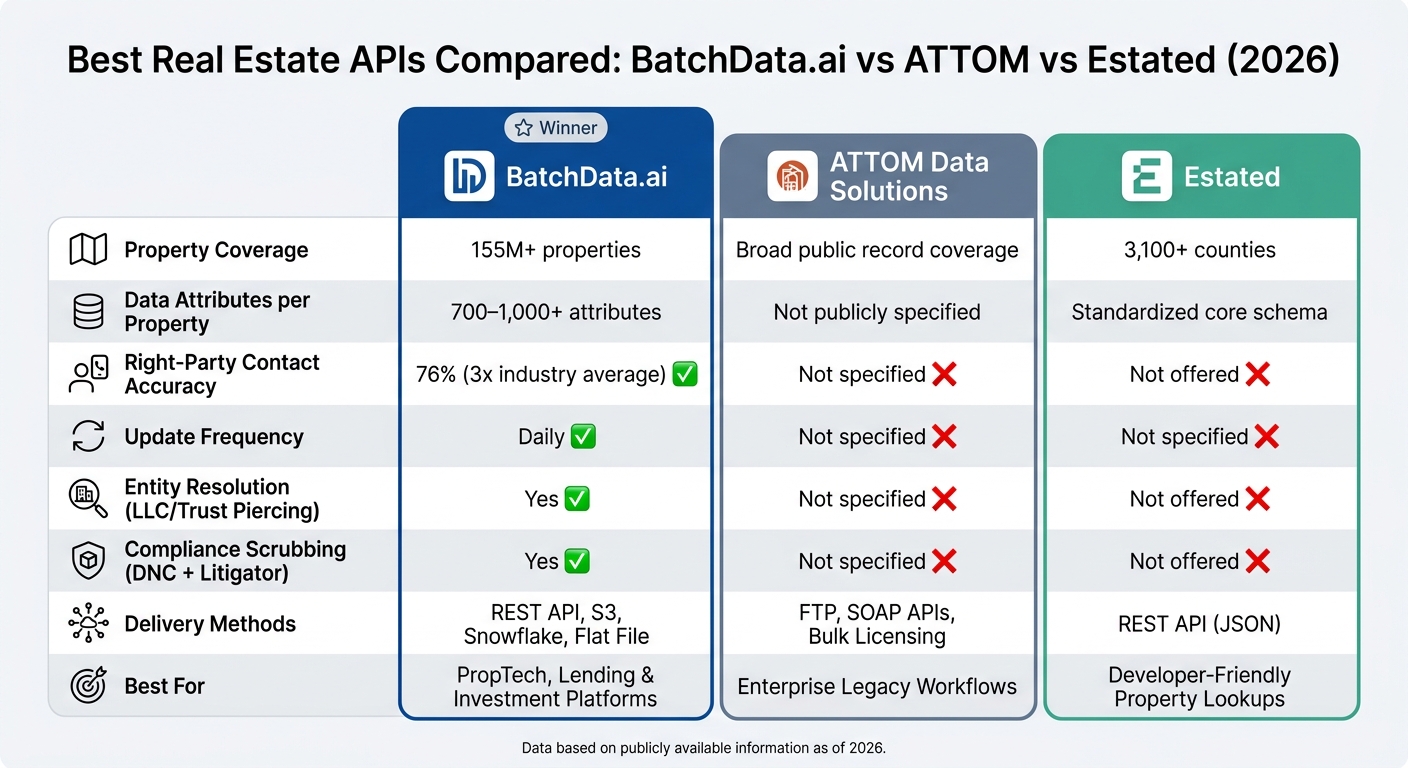
Best Real Estate APIs Compared: BatchData.ai vs ATTOM vs Estated (2026)
Every API has its strengths and trade-offs, making them suitable for different use cases. Here’s a quick breakdown of their key features and differences.
BatchData.ai stands out for its depth, speed, and accuracy. With data on over 155 million properties and 700–1,000 attributes per record, it boasts a 76% right-party contact accuracy rate. The data is refreshed daily, ensuring up-to-date insights, and it offers flexible delivery options such as REST API, Snowflake, S3, or flat files. This API is ideal for tech-savvy teams that can utilize its enrichment and entity resolution capabilities to the fullest.
ATTOM Data Solutions is a go-to choice for enterprises relying on extensive public records. However, its older infrastructure can lead to longer integration timelines compared to more modern, API-first systems.
Estated is perfect for simple property lookups across more than 3,100 counties. Its structured JSON schema works seamlessly with machine learning pipelines. However, it lacks advanced features like contact enrichment, entity resolution, and compliance tools, making it less suitable for complex PropTech or investment needs.
Here’s a side-by-side comparison for better clarity:
| Feature | BatchData.ai | ATTOM Data Solutions | Estated |
|---|---|---|---|
| Property Coverage | 155M+ properties | Broad public record coverage | 3,100+ counties |
| Data Attributes | 700–1,000+ per property | Not publicly specified | Standardized core schema |
| Right-Party Contact Accuracy | 76% (3x industry average) | Not specified | Not offered |
| Update Frequency | Daily | Not specified | Not specified |
| Entity Resolution | Yes (LLC/Trust piercing) | Not specified | Not offered |
| Compliance Scrubbing | DNC + litigator scrubbing | Not specified | Not offered |
| Delivery Methods | API, S3, Snowflake, flat file | Traditional bulk licensing | API |
| Best For | PropTech, lending, and investment platforms | Enterprise legacy workflows | Developer-friendly property lookups |
This comparison highlights the importance of choosing the right API for your specific needs, especially when modern PropTech workflows demand precision and flexibility.
Conclusion
Picking the right real estate API isn’t just about technology – it directly impacts the accuracy and reliability of your platform’s insights, workflows, and models. The difference between raw public records and well-organized property intelligence can have a big impact on U.S. PropTech, lending, and investment platforms.
Data quality from multiple sources is essential. Fragmented or inconsistent data can throw off outreach efforts, property valuations, compliance processes, and even AI models that rely on clean inputs. Platforms that depend on a single county feed or unverified bulk data often spend more time fixing data issues than building innovative solutions. High-quality, unified data provides a solid foundation for development and reliable AI-driven insights.
For teams that need accurate, AI-ready data, BatchData.ai stands out. Its platform takes fragmented and inconsistent property records and turns them into a dependable resource for scalable PropTech, lending, and investment workflows. With BatchData.ai, teams can focus on creating and delivering solutions rather than wrestling with messy data. This seamless integration speeds up decision-making and allows platforms to innovate without worrying about data problems.
Whether you’re working on a PropTech MVP, automating underwriting, or training a real estate-focused AI model, the data foundation you choose will define your success. BatchData.ai provides the unified, compliant, and AI-optimized property intelligence that today’s U.S. real estate platforms require.
FAQs
What is a Unified Property Record?
A Unified Property Record pulls together data from multiple fragmented sources to create a single, standardized property profile. It eliminates inconsistencies, such as address variations, and merges information from public records, MLS databases, and proprietary sources into one streamlined system. By connecting tax records, deeds, mortgages, and verified contact details, it turns messy, conflicting data into clear, actionable insights, providing a complete picture of each property.
How does the 12-source waterfall improve accuracy?
The 12-source waterfall improves precision by cross-checking information from a variety of sources, including county tax assessors, recorders, and private utility feeds. This method ensures property records are validated, uncovers actual owners (even through corporate entities), and eliminates duplicates or incorrect entries. By constantly verifying and standardizing the data, it maintains reliability – even during local disruptions – providing clear, dependable information for essential decisions.
How do I integrate BatchData.ai into Snowflake or S3?
BatchData.ai offers bulk data delivery services that are perfect for handling large datasets, whether you’re working on machine learning models or offline analytics. Here’s how you can connect it with Snowflake or AWS S3:
- Snowflake Integration: BatchData.ai uses secure Data Sharing to integrate with Snowflake. This approach eliminates the need for file transfers, saving you time and reducing delays.
- AWS S3 Delivery: For S3, data can be delivered in widely-used formats like CSV or Parquet, making it easy to work with your existing tools and workflows.
To get started, reach out to a BatchData.ai expert who can help you set up a delivery pipeline tailored to your infrastructure.