




































Real estate professionals often face repetitive tasks like property research, ownership verification, and lead generation. APIs simplify these processes by integrating real estate data into tools, saving time and improving efficiency. Key workflows include property enrichment, skip tracing, property search, valuation, and lead generation. Here’s a quick overview of the top APIs for real estate workflow automation:
- BatchData: Known for property enrichment, skip tracing, and wholesale lead generation with a focus on accuracy and scalability.
- ATTOM Data: Offers extensive property data, geospatial insights, and climate risk analysis.
- Zillow: Provides property valuations and rental trends via Zestimates and public records.
- HouseCanary: Focuses on predictive analytics, risk assessments, and rental forecasts.
- TovoData Spring: Delivers detailed property data with customizable data streams and legal documentation.
Each API caters to specific needs, from small-scale investors to large enterprises, with varying pricing models and features. Choose based on your workflow requirements, coverage, and budget.
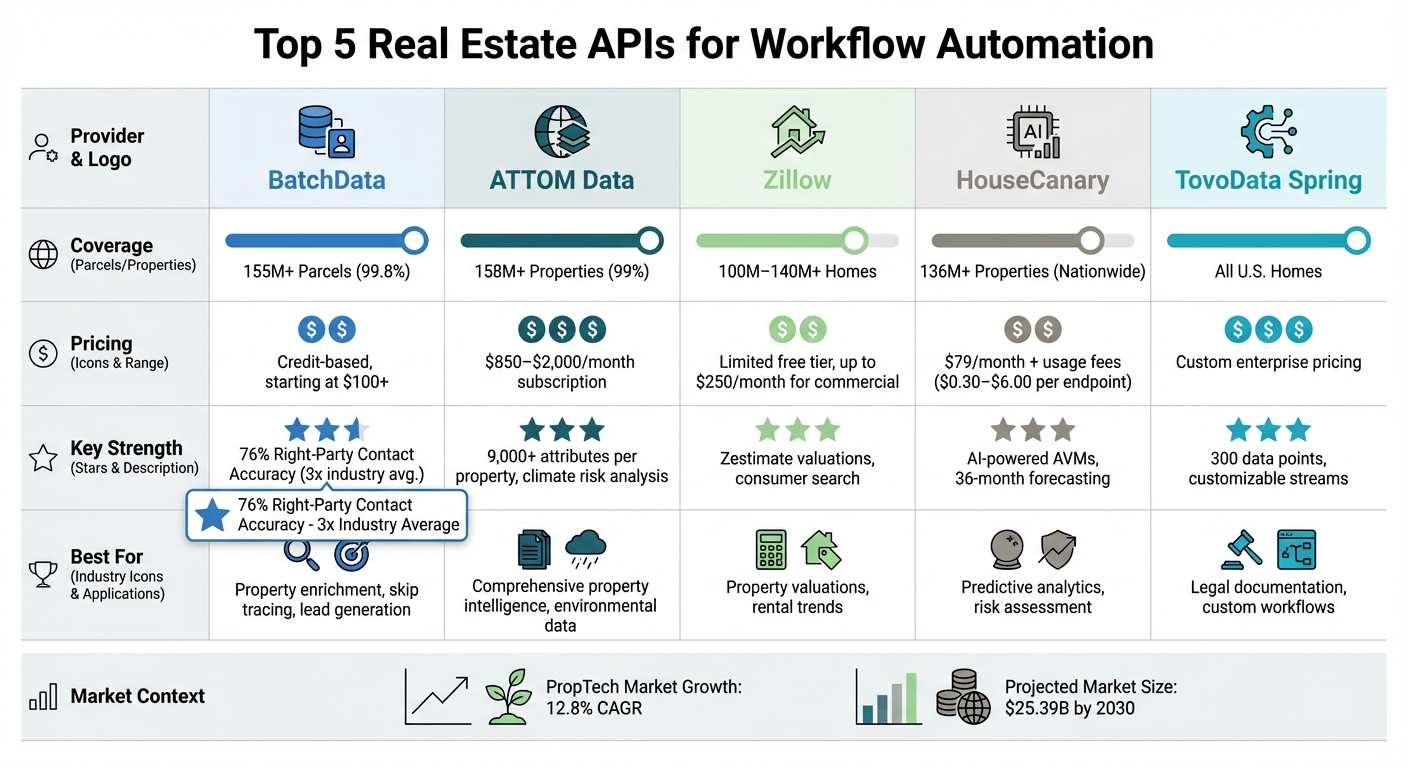
Real Estate API Comparison: Coverage, Pricing, and Key Features
Real Estate Data Masterclass 2025: AI + Automation
sbb-itb-8058745
1. BatchData API

The BatchData API covers over 155 million U.S. parcels and provides 700–1,000+ detailed property attributes. These include building specs, tax history, sales records, and legal descriptions, among others. It boasts an impressive 76% accuracy in right-party contact for skip tracing – three times the industry average – ensuring verified phone numbers and email addresses effectively reach decision-makers.
Key Features
This API offers a range of automated workflows, including:
- Property Enrichment: Access comprehensive details like the number of bedrooms and bathrooms, square footage, zoning codes, lot features, and construction data – all through a single endpoint.
- Skip Tracing and Entity Resolution: Uncover true property ownership, even for LLCs, by "piercing the corporate veil." Gain access to mobile and landline numbers, email addresses, and reachability scores.
- Data Verification: Standardize addresses to USPS-compliant formats, validate phone numbers in real time, and screen against Federal DNC and known litigator lists to mitigate legal risks.
- Lead Generation Tools: Target motivated sellers by identifying pre-foreclosure properties, tax defaults, involuntary liens, and high-equity opportunities.
- Market Analysis Capabilities: Leverage nationwide data on active, pending, and sold listings, access comparable property data, and use automated valuation models for quick pricing insights.
The API also provides details on construction materials, lot size differences, and tax assessments, helping teams focus their efforts while minimizing wasted outreach. These features are available via various integration methods, designed for both real-time and bulk data applications.
Integration Options
BatchData offers multiple ways to integrate its services:
- RESTful API: Ideal for real-time property lookups and contact enrichment, offering low-latency endpoints for seamless application use.
- SDKs for Python and Node.js: Simplify integration with official software development kits, supported by interactive documentation on the developer portal.
- Bulk Data Delivery: Deliver large datasets directly to platforms like Snowflake, BigQuery, or Databricks, or as Parquet files to cloud storage for offline analysis and machine learning.
The API connects to a live production database that’s continuously updated, ensuring users have access to the most current data. Additional professional services, such as custom dataset creation and migration support, are available to meet specific business needs.
Workflow Benefits
Using the BatchData API can significantly enhance real estate operations. For lead generation, tools like the Deal Analyzer and Smart Search identify distressed properties and automatically generate leads based on buyer or seller criteria. The Owner Portfolio feature offers a complete view of an owner’s real estate holdings, net worth, income, and household size, enabling better decision-making.
Direct cloud access supports advanced BI queries and machine learning model training without API rate limits. Address standardization ensures USPS-compliant deliverability for direct mail campaigns, while the Value Estimator uses multi-channel listing data to streamline property valuations. By automating compliance checks and cleaning marketing lists of disconnected numbers and invalid addresses, the API reduces wasted marketing spend and legal risks.
2. ATTOM Data API
The ATTOM Data API provides access to information on 158 million U.S. properties, covering 99% of residents. With over 70 billion rows of data and roughly 9,000 attributes per property, it includes details like ownership, mortgage history, tax assessments, and risk factors [[2]](https://www.attomdata.com/news/attom-insights/best real estate APIs). This extensive database is ideal for nationwide property intelligence applications.
Key Features
The API organizes data into categories tailored for real estate needs:
- Property Data: Includes ownership records, mortgage histories, tax assessments, AVMs, square footage, lot sizes, and zoning details.
- Geospatial and Boundary Data: Features parcel boundaries, school attendance zones for 127,000 schools, neighborhood boundaries, and building footprints.
- Community and Demographic Insights: Offers crime rates, population demographics, income levels, education stats, and commuter times.
- Environmental and Risk Data: Tracks risks like floods, wildfires, droughts, hail, and tornadoes, along with climate change projections through 2050.
- Market Analytics: Provides insights into sales trends, foreclosure activity, vacancy rates, and rental AVMs.
The API also includes a POI (Point of Interest) database with 14 business categories, adding context to property data. A standout feature is the "ATTOM ID", a persistent identifier that links property data with neighborhood and community information across API packages, simplifying data integration.
Integration Options
The API uses RESTful architecture with JSON and XML response formats. Authentication is managed via a unique API key included in the HTTP header, and all requests are sent securely over HTTPS to api.gateway.attomdata.com. The API’s standard URL structure works seamlessly with programming languages like Python, PHP, Ruby, and JavaScript. Developers can query data using addresses, ZIP codes, GeoIDs, or latitude/longitude coordinates.
To assist developers, the ATTOM Developer Portal offers interactive documentation, Postman collections, and cURL examples for testing API calls. A 30-day free trial is available for evaluating endpoints before committing to full integration. For large-scale applications, bulk data delivery is available via FTP in CSV format, with updates provided weekly, monthly, or quarterly – bypassing the API’s 24-hour caching limit.
Workflow Benefits
ATTOM streamlines time-consuming real estate tasks with its extensive data and integration features. It automates processes like pre-filling forms, generating targeted marketing content, and speeding up analytical modeling. For example, the /transaction/salestrend endpoint provides five years of historical data on median sale prices and sales counts, enabling automated market trend analysis.
"Instead of spending time aggregating and updating data, the APIs allow you to focus on building your product through a consistent interface." – ATTOM Developer Platform
Real-world applications demonstrate its value. AgentFire uses ATTOM data to create hyper-local websites with neighborhood-specific insights. Similarly, SetSchedule integrates ATTOM’s AVM to power its "SetValue" network, delivering real-time property value estimates to homeowners. For enterprises managing extensive property portfolios, the API’s comprehensive coverage and unified approach simplify operations.
3. Zillow API
The Zillow API provides property valuation and rental trend analytics using its proprietary Zestimates, covering locations across the United States. Its broad scope makes it a valuable tool for real estate professionals seeking up-to-date market valuations and forecasting data for acquisitions and portfolio analysis. Zillow offers both real-time API access and downloadable CSV datasets, catering to commercial needs and academic research.
Key Features
At the heart of Zillow’s offerings is the Zestimates API, which delivers current property, rental, and foreclosure valuations. Additionally, the Zillow Home Value Index (ZHVI) offers a seasonally adjusted measure of median home values by region and housing type, while the Zillow Rent Index (ZRI) provides similar insights for rental markets.
The Public Records API, accessible through Zillow’s Bridge platform, includes parcel, assessment, and transactional data from county records, with a historical range of about 15 years. Zillow also provides detailed metrics like median home values, rents, inventory levels, sales prices, transaction volumes, and home value forecasts. These insights are available at various geographic levels, from neighborhoods to national markets, with historical data extending back to the late 1990s.
Integration Options
Zillow’s API uses a RESTful architecture with JSON responses, making it suitable for most commercial applications. Developers need to register for a Zillow Web Service ID (ZWSID) to make API calls, while tools for mortgages and lenders require a Partner ID. The Bridge Interactive platform serves as the main hub for accessing normalized MLS listings and public records data.
Standard API licenses typically allow up to 1,000 calls per day, but higher limits can be granted following a Zillow review. For larger projects or academic research, Zillow’s Economic Research team offers free CSV datasets, providing flexibility for data analysis. Real estate professionals can also automate lead management by setting up partner-defined endpoints to receive JSON-formatted contact notifications from Zillow’s platforms. These integration options streamline workflows and enhance property analytics.
Workflow Benefits
Zillow’s API enhances valuation accuracy by processing extensive property data to deliver real-time market estimates. For acquisition workflows, the combination of ZHVI and historical metrics supports forecasting models. Many professionals integrate this data into machine learning tools like Prophet or LSTM networks to predict future home and rent values. The 15-year transactional history available through the Public Records API simplifies due diligence by eliminating the need for manual county record searches.
The Bridge Listing Output ensures consistency across MLS sources, making comparative market analysis more straightforward. For rental property management, the Lead API automates lead processing by delivering inquiries directly to CRMs via HTTP POST callbacks, enabling faster response times. Users of publicly accessed data must comply with Zillow’s branding requirements, which include proper attribution and the use of Zillow logos and links.
4. HouseCanary API
The HouseCanary API offers AI-powered property valuations and risk analytics for over 136 million U.S. properties. By leveraging machine learning, it processes and normalizes data from thousands of sources to deliver accurate valuations, market forecasts, and detailed risk assessments. These insights are particularly useful for portfolio management and underwriting, making it a go-to platform for 6 of the top 10 Single Family Rental REIT operators and 8 of the top 10 mortgage lenders.
Key Features
HouseCanary’s Automated Valuation Models (AVMs) are updated monthly using real-time market data. Its predictive tools can forecast property values and rental prices up to 36 months into the future. The platform also evaluates risks such as crime rates, FEMA disaster zones, and natural hazards like earthquakes, hurricanes, and floods – all at the block level. Users can access over 75 data points, covering details from individual properties to broader ZIP code and state-level insights.
For managing real estate portfolios, the API provides automated alerts for changes in valuation, listing status, or notices of default. It even employs image recognition to identify room types and assess home conditions. The proprietary "Privacy Scores" feature evaluates a property’s exposure and view angles. For high-volume users, batching capabilities allow up to 100 items per POST request, enabling efficient large-scale analysis.
"HouseCanary’s user-friendly platform has allowed us to accurately assess property risk and generate precise valuations for thousands of properties in a matter of hours, which previously took our analytics group days to accomplish."
- W. Luke Newcomb, VP, Capital Markets
These features integrate smoothly into various workflows, showing how the right real estate API will transform business operations by offering flexibility and efficiency.
Integration Options
The REST-based API uses HTTPS with Basic Authentication and provides sample code in multiple programming languages. Developers can speed up integration with the Python API Client or test functionality using the "New Test API Key" feature in the Developer Center before deploying to production. Enterprise users can also integrate bulk property data into cloud platforms like AWS and Snowflake for large-scale analytics.
For non-developers, the "Match and Append" application allows easy access to HouseCanary data through spreadsheets, eliminating the need for coding expertise. Standard users have a rate limit of 250 components per minute, while enterprise customers can negotiate custom limits. Additionally, HTTP response headers like X-RateLimit-Remaining and X-RateLimit-Reset help developers manage request pacing effectively.
Security is a priority, with the platform maintaining SOC 2 Type I and II compliance. It uses 256-bit encryption for data at rest and TLS 1.2 for data in transit. Pricing begins at $79/month (or $790/year) with usage-based fees ranging from $0.30–$0.50 for basic endpoints and $4.00–$6.00 for premium endpoints.
Workflow Benefits
HouseCanary simplifies key operational processes by combining real-time data with predictive analytics. This enables users to automate complex property evaluations and consolidate risk assessments into a single source, eliminating the need to query multiple databases. As Chad Collishaw, Partner, pointed out:
"The clean and accessible crime score data is excellent, and having a single source of data through a well-documented API is a huge benefit".
For portfolio optimization, the property/nod endpoint provides real-time updates on notices of default, allowing users to manage risks proactively. The Value Analysis endpoint offers context on AVM confidence levels and neighborhood trends, helping users decide when manual valuations are necessary. Additionally, the platform’s forecasting tools integrate seamlessly with machine learning workflows, supporting strategies for property acquisitions and rental income projections over several years.
5. TovoData Spring API
The TovoData Spring API stands out as a comprehensive tool for automating real estate workflows. It brings together tax, deed, and mortgage records into a single source of property intelligence, covering every home in the U.S. With access to 300 data points per property – spanning ownership, characteristics, valuations, and liens —often supplemented by accurate skip tracing data for outreach— – it offers a wealth of information for anyone needing quick, accurate real estate data nationwide.
Key Features
TovoData boasts an impressive repository of historical data, tracking over 795 million real estate transactions. It covers 98% of deeds and mortgages and 99% of Automated Valuation Models (AVMs). To keep users updated, MLS listing data is refreshed daily, and property ownership details are updated weekly.
For those with specific needs, the platform offers add-ons like the Legal & Vesting API, which provides detailed legal descriptions and vesting information, making it ideal for home equity lending workflows. The Comparables API is another highlight, enabling users to quickly find similar properties for valuation and market analysis. Additionally, foreclosure data is available, with 86% coverage that tracks properties from pre-foreclosure through REO status.
A standout feature is the "Create Your Own Real Estate API" option, which allows users to customize data streams to focus on the exact information their workflows require.
"Property Spring offers up to 300 data points relating to a property: ownership, property characteristics, mortgage, valuation and more." – TovoData
Integration Options
TovoData supports a range of integration methods to meet diverse technical needs. Options include REST, SOAP, Streaming APIs, SFTP, and S3 Buckets. Users can work with various file formats like .json, .xml, .bin, .csv, .xls, .sql, and .txt, ensuring compatibility with most systems. Data delivery can be configured to update in real-time or on a schedule – whether every second, minute, hour, or day.
The platform is designed for ease of use, allowing developers to set up a data stream "in just minutes". Through the API Store, users can preview property data and reports before committing to full integration. This flexibility ensures that both technical and non-technical teams can efficiently incorporate TovoData into their operations.
Workflow Benefits
TovoData Spring is a powerful tool for simplifying real estate tasks, particularly in lending and market analysis. For lenders, the platform provides detailed borrower and property insights, speeding up risk assessment and loan approvals. The Legal & Vesting API ensures that mortgage professionals have the exact documentation needed for confident decision-making.
Real estate investors will appreciate the Comparables API, which quickly identifies similar properties and market trends, dramatically cutting down on research time. The platform’s data is sourced directly from county recorders and tax assessors, ensuring accuracy and reliability. With weekly ownership updates and daily MLS refreshes, users can trust that their workflows stay aligned with current market conditions. Plus, the ability to customize data streams means users can focus only on the information that matters to their specific needs.
API Comparison Table
Here’s a breakdown of the five APIs discussed, summarizing their coverage, pricing, and key automation features to help you decide which one aligns with your workflow, budget, and coverage needs:
| API Provider | U.S. Coverage | Pricing Model | Key Automation Strengths |
|---|---|---|---|
| BatchData | 155M+ Parcels (99.8%) | Credit-based, starting at $100+ | AI predictive analytics (BatchRank) and address normalization |
| ATTOM | 158M+ Properties (99%) | Subscription, $850–$2,000/month | Data standardization (EDMP), climate risk analysis, 9,000+ attributes |
| Zillow | 100M–140M+ Homes | Limited free tier for non-commercial use | Consumer search, Zestimate valuations, basic property lookups |
| HouseCanary | Nationwide | Enterprise subscription | Automated valuation models (AVMs), predictive analytics, rental estimates |
| TovoData Spring | All U.S. homes | Custom pricing | 300 data points per property, customizable data streams, Legal & Vesting API |
For startups and small investors, BatchData stands out with its budget-friendly credit-based model starting at $100+, making it easier to scale operations. On the other hand, ATTOM offers an enterprise-grade solution priced between $850 and $2,000 per month, providing extensive data coverage and over 9,000 attributes for comprehensive analysis.
Zillow’s API, while largely restricted for commercial use, includes a free tier for non-profits and premium options for small-scale businesses, with costs reaching up to $250 per month.
Each API offers distinct advantages. For example, BatchData excels in predictive analytics, while HouseCanary focuses on risk assessments and rental estimates. TovoData Spring brings flexibility with customizable data streams and a Legal & Vesting API, catering to more specialized needs.
With the PropTech market growing at a compound annual growth rate (CAGR) of 12.8% and projected to hit $25.39 billion by 2030, selecting the right API is more crucial than ever. The choice should not only address your current workflow challenges but also position you to adapt as the industry evolves.
Conclusion
Selecting the right API boils down to your budget, technical needs, and business goals. Among the options, BatchData stands out for property and contact data workflows, boasting a 76% right-party contact accuracy – three times the industry average – and access to over 700 property attributes through a single API. This eliminates the hassle of juggling multiple vendors, simplifying integration for investors, PropTech platforms, and marketing teams.
If your focus leans toward property intelligence with neighborhood and environmental insights, ATTOM delivers with over 9,000 attributes and strong data standardization. For automated valuation models and predictive analytics, HouseCanary excels in risk assessment. Meanwhile, TovoData Spring offers customizable data streams with 300 data points per property. While Zillow’s API is limited for commercial use, it provides basic property lookups and Zestimate valuations for non-profits and researchers.
BatchData’s modern architecture is designed for seamless integration, offering a credit-based pricing model that caters to startups and scales up for enterprise needs. Its low-latency REST API and bulk cloud delivery options enable real-time lookups and scalable analytics while maintaining compliance. Built-in compliance tools also help safeguard outreach campaigns from legal challenges.
FAQs
What are the main advantages of using APIs to automate real estate workflows?
APIs bring a host of advantages to the real estate industry, simplifying workflows and boosting efficiency across the board. By automating time-consuming tasks – like property research, data entry, or financial reconciliation – APIs free up valuable time, minimize errors, and let professionals concentrate on higher-level, strategic activities.
They also provide instant access to real-time, enriched data, such as property ownership records, valuations, and market trends. This kind of information empowers professionals to make better decisions and stay ahead in a fast-moving market. Plus, APIs integrate effortlessly with tools like CRMs and analytics platforms, ensuring smoother operations and improved accuracy. In short, APIs transform real estate processes into streamlined, data-driven systems that save time and enhance productivity.
What should real estate professionals consider when selecting an API for workflow automation?
When choosing an API to automate real estate workflows, it’s important to focus on several key aspects to ensure it aligns with your needs. Start by assessing the data quality and coverage the API provides. You’ll want access to accurate, up-to-date property details, market trends, and contact information specific to your target area.
Next, check the API’s compatibility with your existing systems. An API with clear documentation can make the integration process much smoother. Reliability and scalability are equally important, especially if you need real-time updates or plan to handle large volumes of data.
Don’t overlook the pricing model – whether it’s pay-as-you-go or subscription-based. Make sure it fits both your budget and your expected usage. If you require more specialized solutions, look for APIs that offer customization options, such as data enrichment or tailored integrations. By carefully weighing these factors, you can select an API that supports your business objectives and simplifies your real estate processes.
What features does the BatchData API provide for managing property data?
The BatchData API is an impressive resource for handling property data with ease. It taps into a massive database of over 155 million properties, offering 700+ attributes like ownership records, transaction history, lien details, tax assessments, and mortgage data.
What’s more, the API delivers real-time property updates, keeping your information current and reliable. These capabilities simplify workflows and empower smarter decision-making in real estate management.


