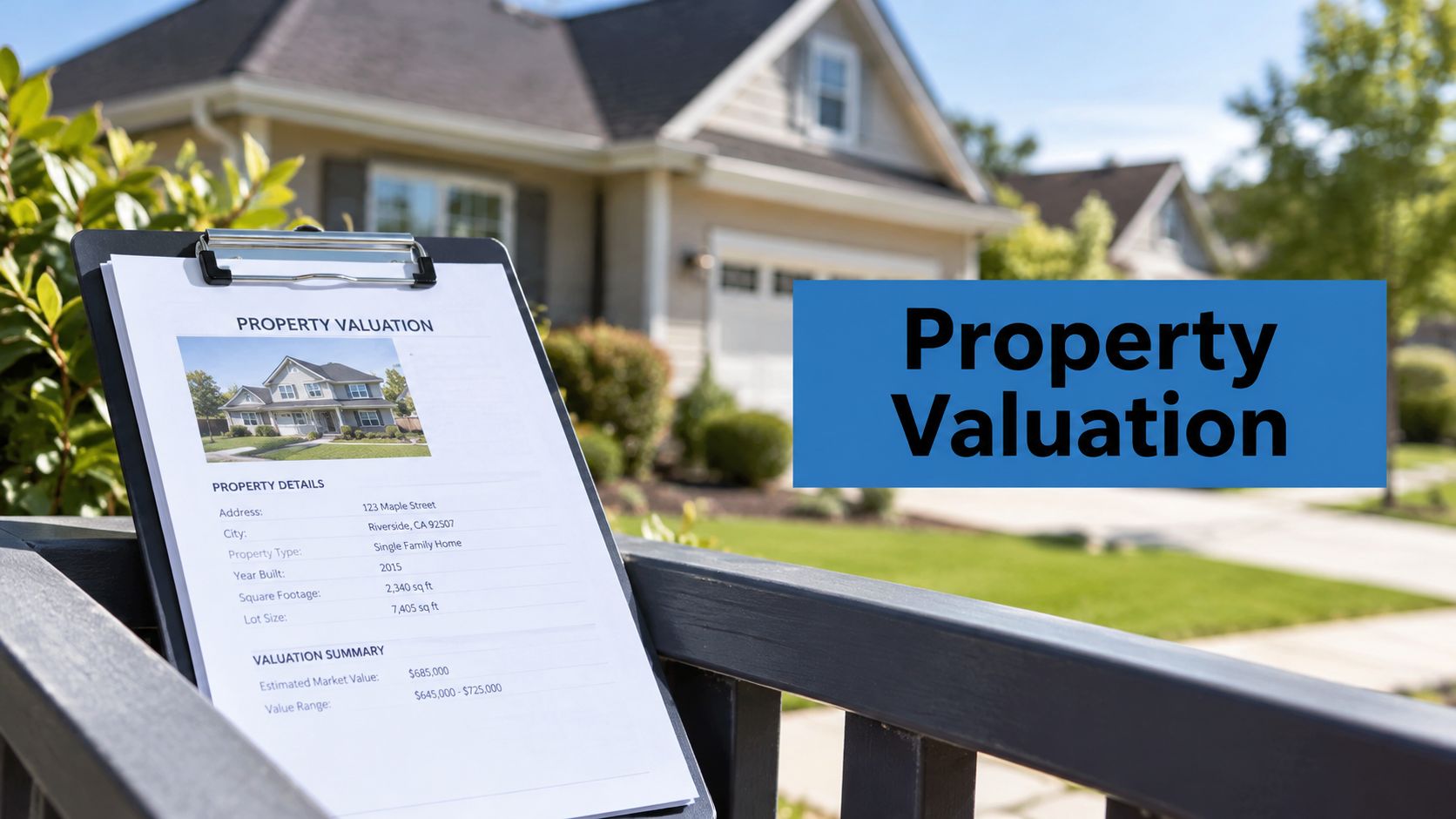
A precise property value isn't automatically a defensible valuation. Reliable real estate valuation services combine property data, valuation methods, confidence measures, and human review. Fannie Mae research found that gross living area agreed within plus or minus 10% in 85% of examined comparisons, while lot size agreed within that range in 90%, showing why input consistency matters as much as model design (Fannie Mae).
The practical takeaway is simple:
- AVMs provide fast, repeatable estimates for properties that fit their data and model scope.
- Full appraisals support higher-risk or more complex decisions through inspection, documented analysis, and professional judgment.
- BPOs and desktop appraisals can reduce turnaround time when the assignment and acceptance requirements allow them.
- Governance matters: confidence, data freshness, comparable evidence, and escalation rules tell you when a number deserves trust.
The right service isn't the one with the most impressive headline accuracy. It's the one whose evidence, controls, and review process fit the transaction.
What Real Estate Valuation Services Actually Do
Real estate valuation services are layered workflows that combine property records, market evidence, valuation methods, and human review to produce a defensible opinion of value. The output may be a single estimate, a value range, a formal appraisal report, or a decision-ready set of signals such as comparable sales, equity, confidence, and exception flags.
Think of the main formats as restaurants serving different needs:
- An automated valuation model, or AVM, is fast-casual. It processes structured property and market data quickly, making it useful for repeatable decisions across many properties. It works best when the subject resembles the properties represented in its training and comparison data.
- A full appraisal is a tasting menu. A licensed appraiser defines the assignment, inspects or investigates the property as required, analyzes comparable evidence, applies relevant approaches, and reconciles the results into a supported opinion.
- A broker price opinion, or BPO, is a neighborhood spot check. A broker uses local market knowledge and property information to estimate likely market value or sale performance. It can be useful for servicing, disposition, and other workflows, subject to applicable requirements.
- A desktop appraisal is a delivery order built on trusted kitchen data. The appraiser completes the analysis without the same physical inspection process as a traditional assignment, relying on records, images, market evidence, and other available information.
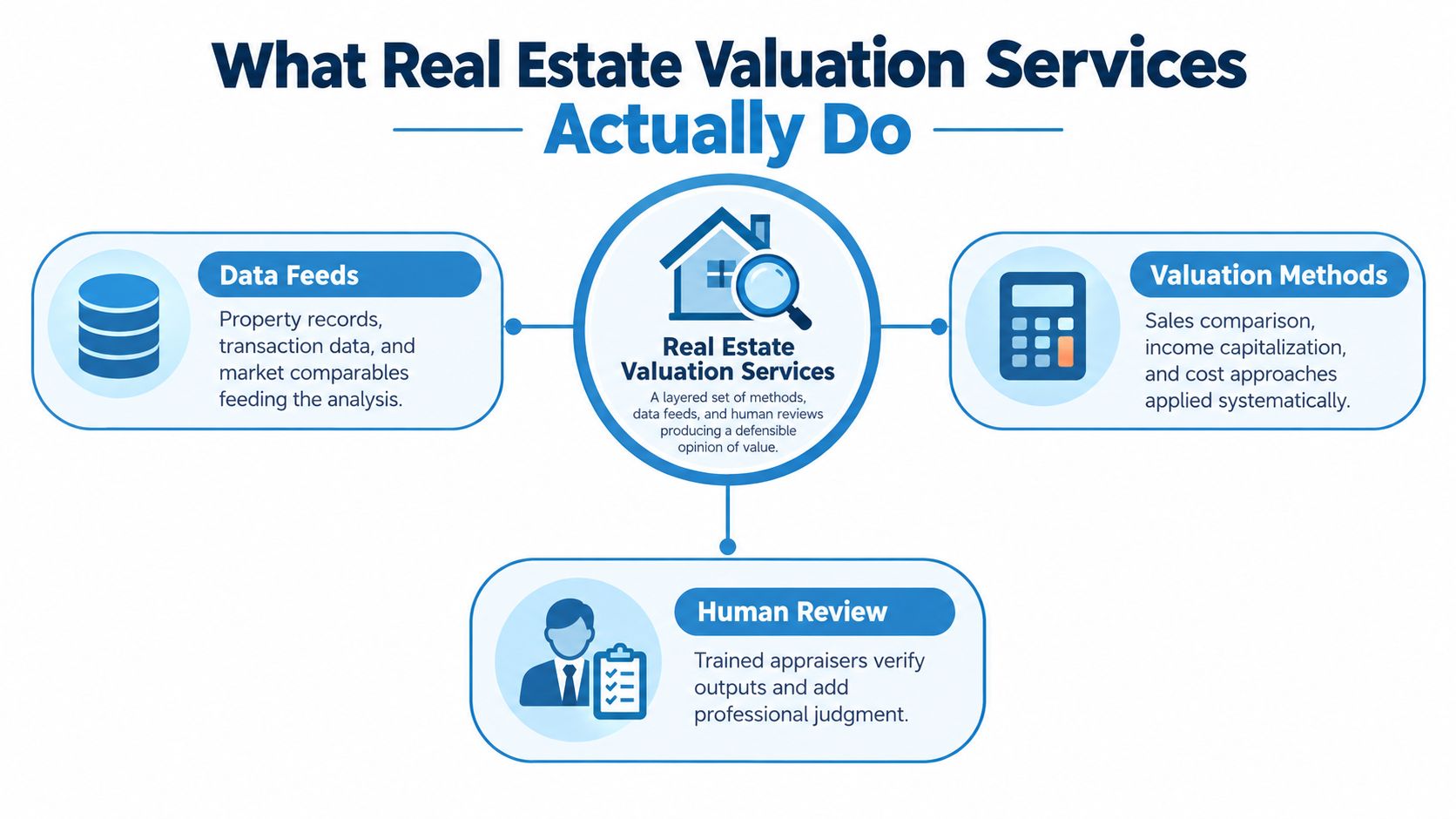
Why the format matters
These services exist to reduce risk, support compliance, and help people make decisions at an appropriate speed. A lender may need a scalable screen before ordering a more intensive review. An investor may need consistent values across a portfolio. An insurer may need property characteristics and replacement-cost inputs rather than a mortgage-style market value.
A rental owner starting with market positioning may also benefit from practical guidance on how to price a rental home before commissioning a formal valuation.
The choice isn't “which method is best?” It is which method is fit for the asset, transaction, decision-maker, and risk tolerance. The following sections separate those trade-offs, identify failure points, and show what to demand from a valuation vendor.
Comparing the Main Valuation Methods
AVMs are fastest, full appraisals are generally the most defensible for complex assignments, and desktop or BPO products sit between them when their scope is appropriate. Cost and turnaround vary by provider, property, geography, and assignment requirements, so treat the table as a workflow comparison rather than a universal price list.
| Method | Accuracy range | Turnaround | Typical cost band | Best fit |
|---|---|---|---|---|
| AVM | Varies by geography, property type, data quality, and model scope | Fast, often near real time | Lowest per property | Portfolio screening, triage, repeatable monitoring |
| Full appraisal | Strongest when inspection, evidence, and scope fit the assignment | Slower because analysis and review are deeper | Highest | Mortgage collateral, complex assets, litigation, high-risk decisions |
| BPO | Depends heavily on broker expertise, local coverage, and supplied property facts | Faster than a full appraisal | Mid-range | Servicing, disposition, market checks |
| Desktop appraisal | Depends on data completeness and the appraiser's ability to verify the property remotely | Faster than an inspection-based appraisal | Mid-range | Suitable residential assignments with reliable records and images |
How the methods produce an estimate
An AVM compares the subject with relevant data and calculates an estimate according to its model. A credible AVM should also provide a confidence measure, comparable diagnostics, data-age indicators, and exception flags. RICS describes confidence as related to the relevance, quantity, and recency of comparable data, or to the model's forecast variation against a benchmark (RICS AVM roadmap).
A full appraisal uses one or more recognized approaches. The sales-comparison approach examines similar closed transactions. The income-capitalization approach connects value to expected income. The cost approach considers the cost of replacing or reproducing improvements, adjusted for relevant depreciation and land value. Professional standards and assignment scope determine how the evidence is collected and reconciled.
Fannie Mae generally expects a U.S. residential appraisal using the sales-comparison approach to include at least three closed comparable sales, normally with sales from the prior 12 months when available (Fannie Mae comparable sales guidance). The newest sale isn't automatically the best one. A physically and legally similar older transaction may provide stronger evidence if the appraiser explains market-condition changes.
Decision rule: Choose the least intensive method that still satisfies the loan, asset, regulatory, investor, and documentation requirements. Escalate when property complexity or uncertainty exceeds the method's reliable scope.
For a focused comparison of broker-driven comparative market analysis and automated models, see CMA versus automated valuation models.
Where Valuation Services Fail
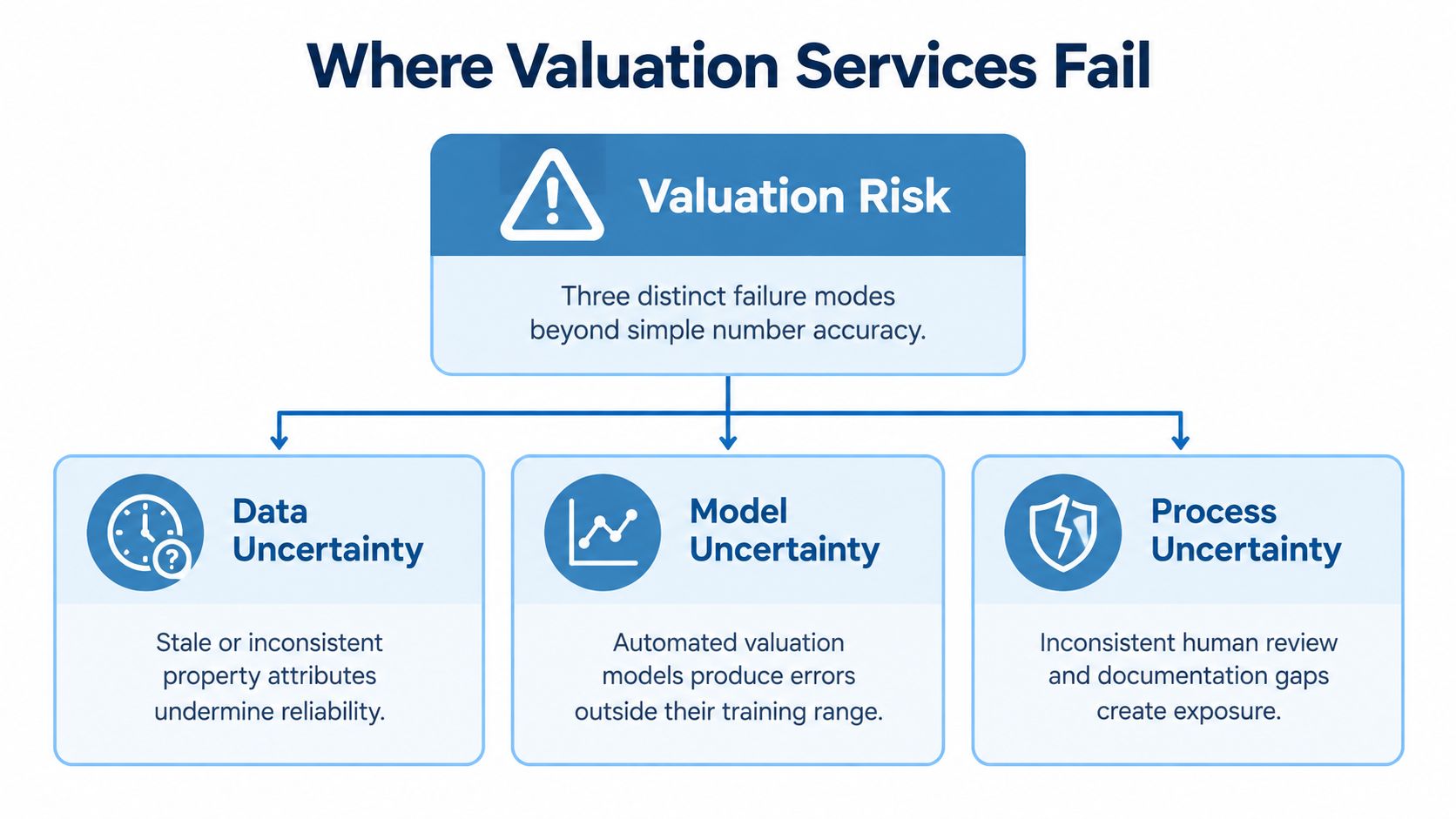
A precise number can still rest on weak evidence. Closeness to a later sale price matters less than whether the service exposes uncertainty created by bad data, unsuitable models, unstable markets, or weak review processes. A reliable workflow makes those limits visible instead of presenting one figure as established fact.
Three different kinds of uncertainty
Data uncertainty begins with stale, missing, or contradictory property facts. A renovated rural home may carry an outdated condition record and have few comparable sales. Conflicting tax and market attributes can produce a polished output built from incompatible inputs. Fannie Mae's research on living area, lot size, view, and location illustrates why teams should reconcile attributes before selecting comparables, rather than wait until after a model produces a result. The Appraisal Institute appraisal insights also highlights how gaps in property information can affect reliability.
Model uncertainty appears when an AVM operates beyond the geography, property type, or market conditions represented in its dependable range. A condominium in a building with few recent sales may resemble nearby units while differing materially in fees, views, renovations, or building condition. The method can be mathematically consistent and still poorly matched to the assignment.
Market uncertainty increases when comparable evidence is thin or conditions change quickly. A model may return a confident estimate even though recent transactions no longer reflect current buyer behavior. Shorter refresh cycles and wider review thresholds can help, but they also increase operating effort.
The human process creates another practical risk. Separating property-data collection from appraisal analysis can cause problems when third-party collectors miss condition, renovations, deferred maintenance, or other material features.
What a defensible workflow exposes
The 2025 appraisal issues survey reported that 55% of U.S. appraisers were asked at least monthly to appraise outside the geographic area or property type in which they considered themselves experts. That finding does not establish that every assignment is unreliable. It does show why expertise fit and escalation rules should be visible.
A useful service should expose:
- Confidence: A measure tied to comparable relevance, data coverage, and model behavior.
- Freshness: Dates for property attributes, transactions, listings, permits, and assessments.
- Diagnostics: The comparable sales and adjustments influencing the result.
- Escalation: Clear triggers for human review, inspection, or specialist analysis.
Low confidence can be the correct output when a property falls outside reliable coverage. It gives reviewers a reason to inspect the inputs, change methods, or request specialist analysis.
Inputs That Power a Modern Valuation Stack
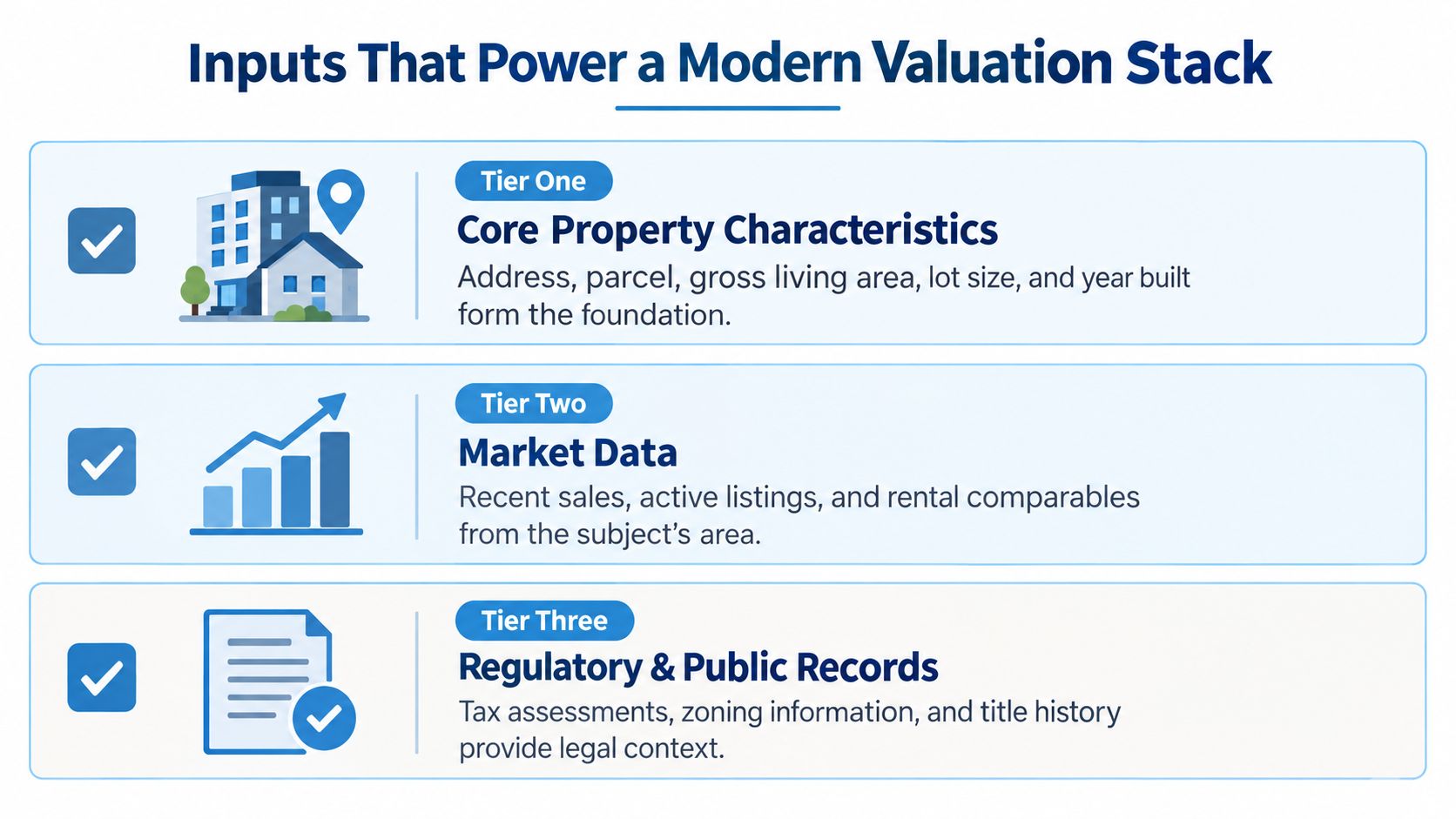
A valuation service produces a defensible result only when its property facts, market evidence, and controls work together. Consistent, current, traceable attributes beat a large pile of records that disagree. Each input should carry enough context for a reviewer to see where it came from, when it was updated, and how conflicts were handled.
The three input tiers
Core property characteristics describe the asset itself. Address, parcel, gross living area, lot size, year built, room count, condition, view, construction type, and updates shape comparable selection and adjustments. A mismatch in any of these fields can make a nearby sale look more relevant than it really is.
Ownership and lien data describe control and financial context. Transfer history, current owner, mortgage information, lien details, equity estimates, and pre-foreclosure signals support underwriting, portfolio analysis, and disposition workflows. These records answer questions about the property's financial position, not just its physical features.
Market signals show how buyers and renters behave around the subject. Closed sales, active listings, pending transactions, rental comparables, permits, tax assessments, and local market indicators help separate a plausible comparable from a record that is merely nearby.
Fannie Mae's modernization research found agreement within plus or minus 10% for gross living area in 85% of examined comparisons, lot size in 90%, reported view in 90%, and location in 87%. It also reported a 0.6% difference in defect rates between property-data-collection valuation options and traditional appraisals in that sample. The operational lesson is clear: reconcile important attributes before asking a model to price the property.
What to check with a vendor
A provider's coverage claims matter less than the controls behind them. Ask for evidence of:
- Lineage: The original source for every material attribute and comparable.
- Reconciliation: Rules for resolving conflicts among tax, assessment, deed, listing, permit, and market records.
- Freshness: Update cadence by field, rather than a general “current data” label.
- Confidence: Attribute-level or property-level signals connected to review thresholds.
- Coverage: Performance by geography, property type, condition, and transaction type.
- Delivery: APIs, bulk files, and usable change indicators for operational systems.
The multi-source data and automated valuation models analysis explains why combining sources can improve model inputs. The buying question is whether the fields agree, whether their dates are visible, and what the service does when they conflict. Field count matters only after those controls are in place.
The 2024 Federal AVM Quality Control Rule
The July 17, 2024 federal rule made AVM governance a formal mortgage requirement for covered originators and secondary-market issuers. Six agencies issued the final rule: the Federal Housing Finance Agency, Federal Deposit Insurance Corporation, Office of the Comptroller of the Currency, National Credit Union Administration, Consumer Financial Protection Bureau, and Federal Reserve (FHFA final rule).

What the rule changes
The rule requires covered organizations to maintain policies and controls designed to:
- Produce highly reliable estimates.
- Prevent data manipulation.
- Address conflicts of interest.
- Conduct random sample testing and reviews.
- Comply with applicable nondiscrimination laws.
That list matters because it shifts the conversation from model output to operating controls. A provider can't treat the AVM as a standalone price generator and leave governance to the customer.
Earlier reforms under FIRREA established appraisal requirements and allowed regulators to set a de minimis threshold below which a traditional appraisal isn't required. The result is a two-track ecosystem. Professional appraisals remain important for complex and higher-risk assignments, while AVMs and related evaluations can support faster decisions when reliability, explainability, data integrity, and fair-lending safeguards are demonstrable.
What buyers should request
Ask vendors for documentation, not slogans:
- Model governance and change-control procedures.
- Data-quality monitoring and manipulation safeguards.
- Conflict-of-interest controls.
- Random-sample testing methodology.
- Fair-lending compliance processes.
- Geography and property-type back-testing.
- Drift monitoring and escalation thresholds.
USPAP provides a generally recognized U.S. ethical and performance framework for professional appraisal work, while the Appraisal Foundation's Yellow Book provides specialized federal-land-acquisition guidance covering problem definition, scope of work, data analysis, valuation approaches, and reconciliation (Appraisal Foundation Yellow Book). RICS guidance similarly treats AVMs as controlled analytical systems that require suitability analysis before professional reliance.
The emerging standard is clear: model performance and documented operational controls are both necessary.
Matching Valuation Services to Business Use Cases
The right valuation method depends on the decision being made, not on the label attached to the product. A mortgage underwriter, portfolio manager, insurer, marketer, and logistics planner may all ask for “property value” while needing different evidence.
| Business use case | Useful valuation layer | What the workflow needs |
|---|---|---|
| Mortgage origination and servicing | AVM for triage, appraisal or approved evaluation for higher-risk decisions | Confidence, comparable evidence, exceptions, compliance documentation |
| Portfolio monitoring | AVM and recurring property data | Trend signals, equity estimates, refreshed attributes, change detection |
| Marketing and lead prioritization | AVM plus ownership and contact enrichment | Propensity, verified reachability, property context |
| Insurance underwriting | Property characteristics, inspections, and cost-related evidence | Construction, condition, updates, replacement-cost inputs |
| Logistics and site selection | Structured property and geospatial data | Parcel, building, access, zoning, and location filters |
A lender reviewing a large loan book may use an AVM to identify routine files and route unusual properties to human review. A portfolio team monitoring rental assets may care less about a formal opinion for every property and more about changes in value, equity, condition, ownership, and market exposure.
A marketing team scoring absentee owners has a different objective. It may need an estimated value as one feature, but verified owner identity, contactability, occupancy, equity, and propensity can matter more than a formal appraisal. For Spanish property buyers evaluating financing security, Bluevectis deposit valuation advice provides useful context on how valuation connects to mortgage deposit decisions.
Use the cheapest acceptable layer
The practical rule is to use the least expensive method that meets the decision's risk threshold, then add review where blind spots matter.
- Low-risk, high-volume screening: Start with a governed AVM and exception rules.
- Moderate-risk monitoring: Combine recurring estimates with refreshed ownership, lien, market, and condition signals.
- Complex or disputed property: Order a specialist appraisal with an assignment-specific scope.
- Unusual manufactured housing: Follow property-type-specific evidence requirements rather than forcing a standard residential workflow.
Fannie Mae's manufactured-housing guidance illustrates the point. It requires a market-based valuation supported primarily by sales comparison and secondarily by cost, with at least two comparable manufactured-home sales. For a single-width home, one comparable should be the same configuration when available (Fannie Mae manufactured-housing guidance). Property type changes the evidence burden.
How to Choose a Valuation Vendor and Pricing Model
Choose a vendor by evidence, controls, and exception handling, not by a single aggregate accuracy claim. A credible pilot should reveal where the system knows less, what it does with contradictions, and how easily your team can act on the output.
Vendor checklist
Must-have capabilities
- Data lineage: Source, date, transformation, and confidence for material attributes.
- Coverage breadth: Geography, property type, condition, ownership, liens, permits, and transactions.
- Governed AVMs: Documented testing, monitoring, fairness controls, and change management.
- Operational delivery: API and bulk options with stable schemas and usable error responses.
- Review signals: Confidence, comparable diagnostics, stale-data flags, and escalation rules.
Useful additions
Daily or otherwise frequent updates can support monitoring that annual snapshots can't. Propensity modeling, contact enrichment, verified phone and email data, and delivery through S3, Snowflake, or flat files can reduce the work required to connect valuation with acquisition, servicing, or marketing systems.
Disqualifiers
Reject a service that can't identify its material data sources, offers no meaningful confidence signal, has no documented controls, or presents a marketing score as if it were a statistical guarantee. An opaque estimate may look inexpensive until an undetected property error creates a bad underwriting, acquisition, or insurance decision.
Pricing models
| Pricing model | Best fit | Main trade-off |
|---|---|---|
| Per-property or per-hit | Irregular searches and small workflows | Simple to start, less predictable at scale |
| Monthly subscription | Stable recurring usage | Efficient for consistent volume, wasteful if demand fluctuates |
| Bulk file or data license | Large recurring datasets and internal analytics | Requires ingestion, matching, storage, and governance |
| Usage-based API | Software products and event-driven workflows | Flexible, but usage monitoring and integration design matter |
For a pilot, select properties that include easy, difficult, and atypical cases. Compare outputs by geography and property segment against a defensible ground-truth set. Grade the vendor on stale-data detection, comparable relevance, confidence calibration, escalation behavior, and documentation. Aggregate accuracy is useful, but it won't tell you whether the system fails predictably on the properties that create the most risk.
Where Platforms Like BatchData Fit In
A modern property-data platform sits beneath the valuation workflow as a data and enrichment layer. It can supply normalized records, ownership history, mortgage and lien details, comparable evidence, AVM inputs, equity estimates, and verified owner contacts to systems that perform underwriting, monitoring, marketing, or due diligence.
That role is different from acting as an appraisal firm. An appraiser still defines the assignment, evaluates evidence, and applies professional judgment when a formal opinion is required. A data platform makes the underlying facts more usable by reconciling tax, assessment, deed, listing, permit, and market signals before they reach the model or reviewer.
The operating layer
A platform such as BatchData provides access to 155M+ U.S. property records and 1,000+ attributes, including core characteristics, ownership history, AVMs and equity, mortgage and lien details, listings, permits, and pre-foreclosure activity. Its delivery options include low-latency APIs and bulk formats such as S3, Snowflake, and flat files, according to the publisher's product description.
The useful capabilities are workflow-specific:
- Normalization and reconciliation reduce conflicts across public and market sources.
- Attribute-level consistency scoring helps identify properties that need review.
- Frequent updates support monitoring rather than one-time valuation.
- BatchRank propensity modeling helps teams prioritize opportunities after valuation.
- Contact enrichment and verification connect property intelligence with outreach.
- API and bulk delivery let teams embed outputs into underwriting, portfolio, and marketing systems.
The BatchData automated valuation model is one example of how a platform can provide valuation estimates and related property signals without replacing the appraiser's role. The strongest architecture treats the AVM, BPO, desktop appraisal, and full appraisal as different decision layers connected to the same governed data foundation.
The result isn't a promise that automation removes valuation risk. It is a more practical goal: make every method faster to operate, easier to audit, and more explicit about uncertainty.
BatchData provides property records, AVMs, ownership and lien data, equity estimates, verified contacts, APIs, and bulk delivery for valuation, underwriting, portfolio monitoring, and marketing workflows. Visit BatchData to evaluate the data coverage, confidence signals, and delivery options that fit your valuation stack.