SEO Title: Phone Verification USA: A Valid Number Is Not Proof
Meta Description: A valid US number is not a verified person. See what each check proves, where SMS codes fail, and which Do Not Call and consent records you must keep.
Meta Keywords: phone verification usa, STIR/SHAKEN, National Do Not Call Registry, SMS OTP, TCPA consent, line type lookup, caller ID spoofing, phone verification API
Between 2010 and 2018, the FCC pursued caller-identity and telemarketing cases with proposed or imposed forfeitures totaling $245,923,500, under the Truth in Caller ID Act or the Telephone Consumer Protection Act, according to a Congressional Research Service summary. The Act was signed on December 22, 2010. A number that looks valid is not the person, or the permission, on your screen.
Phone verification in the USA is a set of separate proofs, not a single yes. Most products answer only whether the number exists. Control, identity match, and permission to call are different records. Teams that collapse those into one "verified" flag ship bad logins and unlawful dials.
- Exists: the line is real and reachable right now.
- Controlled: someone who has the handset returned a challenge.
- Matched: that someone is the person on the record.
- Permitted: consent, suppression, and caller ID allow this specific outreach.
The checks below show what each method can and cannot prove.
What does phone verification actually confirm before you contact anyone?
YouMail estimates that US consumers received 52.5 billion robocalls in 2025, including 29.6 billion telemarketing and scam calls, according to YouMail's Robocall Index. Those counts illustrate why a number that looks clean in a contact file is not enough to justify outreach.
Phone verification often confirms only that a number exists and can be reached. It does not, by itself, establish who controls the line, whether that person matches your records, or whether your organization may contact them. Keep evidence for these four outcomes separate:
- The number exists. A line-status check can indicate whether it is reachable.
- A specific user controls it. A challenge code shows that someone could access the destination at that time, not necessarily who they are.
- The identity matches the record. A CRM name does not establish that the person who answered is that individual.
- Outreach is permitted. Permission requires separate consent and suppression checks, with records stored apart from the dialer.
Caller ID also has a distinct compliance role. Under the Truth in Caller ID Act, knowingly transmitting inaccurate or misleading caller-ID information with intent to defraud, cause harm, or wrongfully obtain something of value is a federal violation. An active line does not establish ownership, consent, or authority to call.
Reachability and permission to call are separate facts. Store them in different fields.
Matching a phone number to a property owner through skip tracing can support record matching, but it does not prove current control or consent. How phone number matching improves skip tracing describes that matching process, not authorization to dial.
Which US phone verification methods exist and what does each prove?
Five US methods are in common use, and each proves one narrow fact. None of them proves identity by itself.
Carrier and line-type lookup returns the carrier, whether the line is mobile, landline, or VoIP, and porting history. You learn the category of the number. You don't learn who holds it or whether they agreed to hear from you. That scrub belongs at the front of a large list, before you spend on messages.
A live status check confirms the line is connected at query time. Nothing else. It is the right filter for dead numbers, and a bad filter for "this is our borrower."
An SMS one-time passcode proves a message reached a messaging endpoint at send time. If the destination is VoIP, shared, or recycled, that delivery is weak identity evidence.
An IVR voice passcode proves a live call was answered and the code was keyed in. Use it when the line is a landline or SMS failed. A shared, forwarded, or freshly ported line can still pass.
STIR/SHAKEN sits on the caller side, not the contact side. Under FCC rules in 47 CFR 64.6301, most voice providers must use STIR/SHAKEN on the IP portions of their networks. The implementation deadline was June 30, 2021. Providers authenticate caller ID for SIP calls they originate, pass that authentication when it's technically feasible, and verify it on terminating calls. Legacy non-IP networks must move to IP or run another operational authentication method. An active-number check does not prove the displayed caller ID is trusted, or that the person controlling the number is the account holder. Attestation also does not prove the call is wanted, lawful, or honest.
| Method | What it checks | What it cannot prove | Best use |
|---|---|---|---|
| Carrier and line-type lookup | Carrier, line type (mobile, landline, VoIP), porting history | Who holds the line or whether they agreed to contact | Scrubbing large lists before outreach |
| Live line status check | Whether the line is connected at query time | Ownership, consent, or lawful calling authority | Filtering dead numbers before sending |
| SMS one-time passcode | A message reached a messaging endpoint at send time | Identity when the destination is VoIP, shared, or recycled | Login step-up and account access |
| IVR voice passcode | A live call was answered and the code was keyed in | Identity when the line is shared, forwarded, or ported | Fallback for landlines and SMS failures |
| STIR/SHAKEN caller-ID attestation | Whether caller ID was authenticated on IP networks | Whether the call is wanted, lawful, or honest | Judging inbound caller trust, not outbound proof |
Combine at least two methods before any decision that moves money or opens an account. One green check is not an identity.
How does an SMS or voice code check run step by step, and where does it fail?
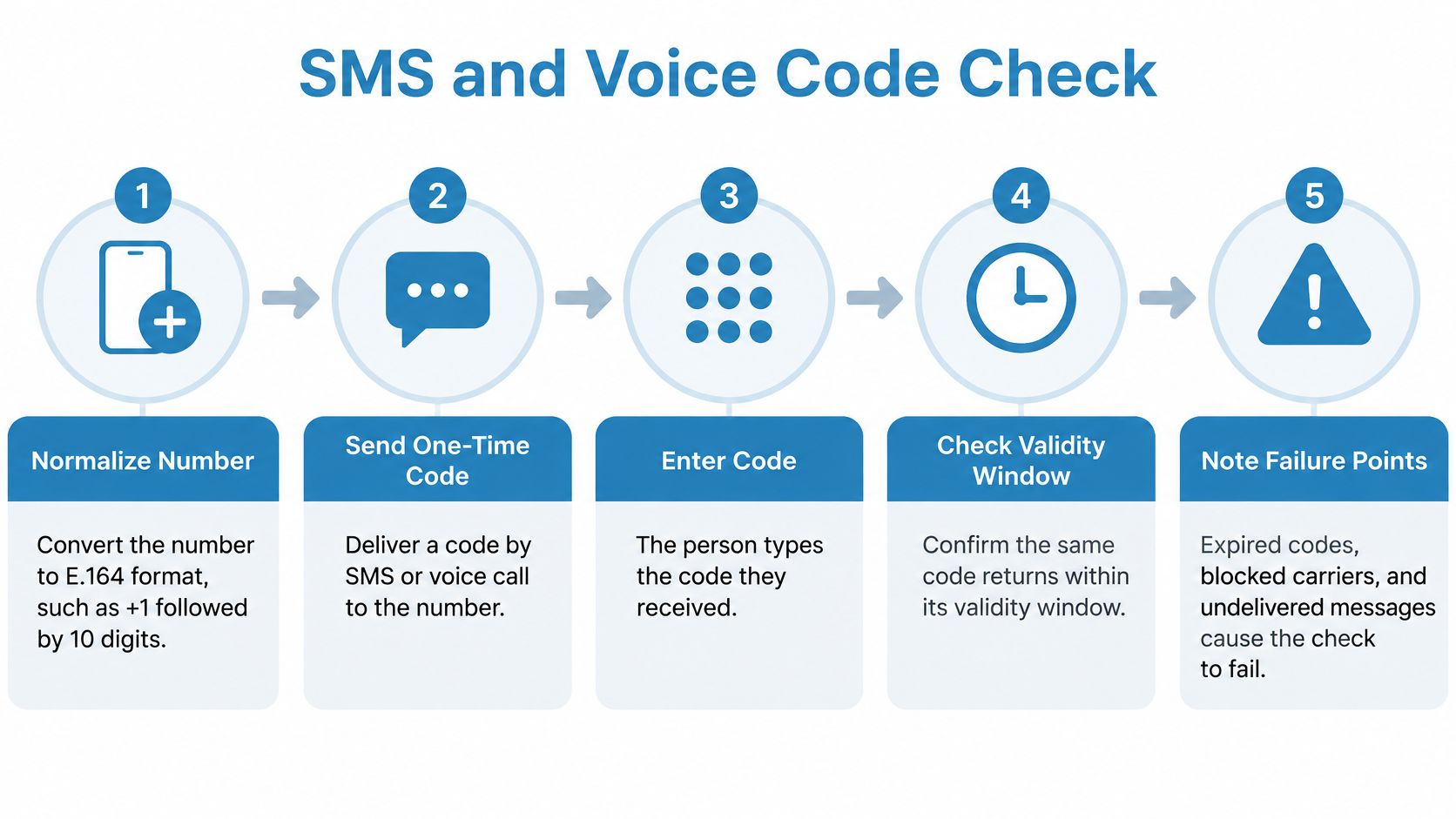
A code check has a narrow result: it tests whether someone can receive and return a code through a number at a particular time. It does not establish that the number belongs to a specific person, that the person's identity matches a record, or that outreach is permitted.
Six steps and why each one exists
- Normalize to E.164. Convert the input to
+1plus ten digits, and reject malformed strings before sending. Invalid numbers waste carrier fees and add noise to logs. - Classify the line. Use a line-type lookup to identify mobile, landline, or VoIP. Choose the delivery channel based on that result.
- Issue a short-lived code. Generate a random code, set an expiry, and store a hash rather than the live code. This limits exposure if the database is accessed.
- Send through the appropriate channel. Send SMS to mobile numbers. Use an IVR voice call for landlines or when SMS fails.
- Limit attempts. Cap tries per number and IP, then lock the flow after repeated failures. This reduces opportunities to guess codes.
- Bind the result. Link a successful entry to the device or session that requested the code, and record the timestamp and outcome. Entry from another session does not provide the same evidence.
Where the check lies to you
NIST classifies authenticators sent over the public switched telephone network, including SMS one-time passwords, as restricted. They provide weaker evidence than cryptographic device authenticators. As a separate product control, check whether the destination is a genuine mobile or landline number. VoIP destinations can carry higher takeover risk, but a line-type check does not establish who controls the number.
The outcomes remain distinct: a number can exist without the user controlling it; control does not prove identity; and identity does not establish permission to contact. A successful SMS confirms access to a messaging endpoint at that time. It is weaker evidence of identity if the number is VoIP, shared, recycled, or compromised.
Practical rule: A delivered code that nobody enters does not show that the number is dead. A code entered from a new device soon after a SIM change is a risk signal, not proof of identity.
Record the outcome and timestamp, then apply separate identity and contact-permission checks before taking consequential action.
Which TCPA and Do Not Call rules apply before dialing a verified number?
A valid number answers only a reachability question. Before a marketing call, determine whether the call is live or prerecorded, whether it goes to a wireless or residential landline, whether the number is on a suppression list, and whether the required consent exists. A passed verification check does not establish permission to call.
Registry rules depend on the call
In fiscal year 2024, the National Do Not Call Registry held more than 253 million active registrations, and the FTC received more than 2 million complaints about unwanted calls, according to the FTC's FY 2024 unwanted-call report. In fiscal year 2025, the FTC received more than 2.6 million complaints about Registry violations, as reported in its biennial report to Congress. Complaint counts are consumer reports, not verified counts of calls. They show why a reachable number cannot be treated as a willing contact.
The Telemarketing Sales Rule guidance requires sellers and telemarketers to access the Registry, suppress listed numbers, and refresh suppression data at least every 31 days before covered telemarketing calls. Registry restrictions have exceptions, including an established business relationship and a consumer's prior inquiry, subject to the applicable rules and time limits. A scrub older than 31 days does not meet the refresh requirement for covered calls. Civil penalties of up to $53,088 per violation apply to violations of the relevant telemarketing rules, not every call to a registered number.
Consent and caller ID depend on the call method
Consent requirements also vary by call type and destination. Under FCC consumer guidance, prior express written consent is required for telemarketing calls using an autodialer or prerecorded or artificial voice to wireless numbers, and for prerecorded telemarketing calls to residential landlines. It is not a blanket requirement for every live-agent marketing call. Store the consent language, timestamp, collection method, number, and permitted call types so the dialer can match evidence to the call.
The FCC also prohibits caller-ID spoofing intended to defraud, cause harm, or wrongfully obtain something of value. Penalties of up to $10,000 apply to each illegal spoofing violation, not to ordinary caller-ID errors outside that prohibition.
| Requirement | Scope and rule | Exposure | What to record |
|---|---|---|---|
| National Do Not Call Registry | Scrub before covered telemarketing calls; exceptions include qualifying established business relationships and prior inquiries. Refresh suppression at least every 31 days. | Up to $53,088 per violation of applicable telemarketing rules; not a penalty for every call to a listed number. | Scrub date, Registry data version, and any documented exemption |
| Written consent | Required for covered autodialed or prerecorded telemarketing to wireless numbers and prerecorded telemarketing to residential landlines. | Applies when a covered call is made without the required consent. | Consent wording, timestamp, collection method, number, and allowed call types |
| Caller ID | Do not transmit misleading or inaccurate caller ID with intent to defraud, cause harm, or wrongfully obtain value. | Up to $10,000 per illegal spoofing violation. | Caller-ID value sent and originating account |
A dialer and consent store need a shared key for each number and call type. TCPA compliance for automated outreach depends on matching that evidence to the planned call. A number's existence, user control, identity match, and legal permission are separate outcomes; a verification result alone proves none of the last three.
How do you run phone verification at scale through an API?
At scale, verification is a fixed pipeline. Each number passes the checks in order, and each check writes evidence to the record. Run the code flow above, including E.164 normalization and rate limits, then add the gates that a login screen never sees.
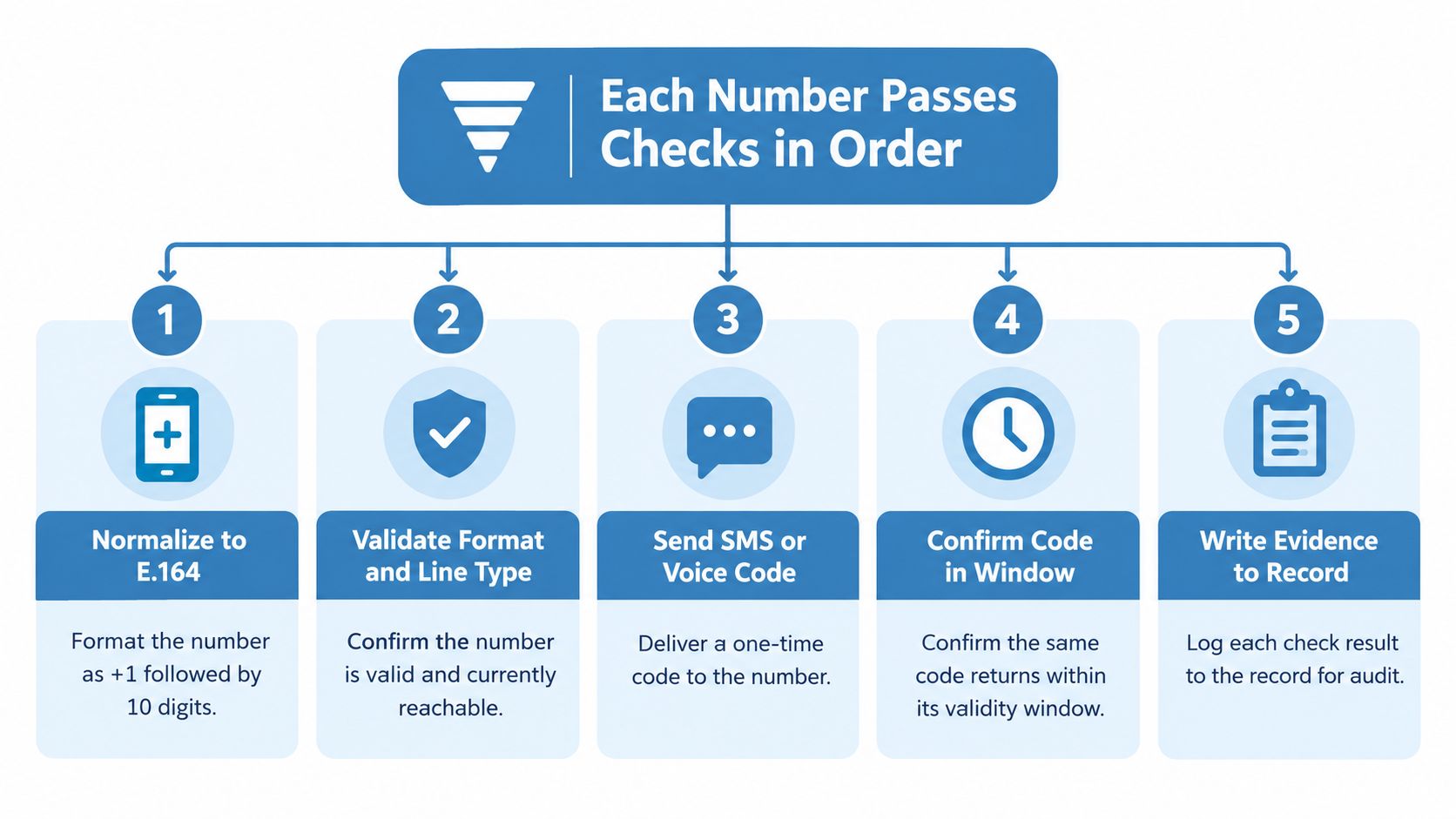
What the pipeline adds after the code
- Flag recent porting and SIM changes. A number that moved yesterday is not the number you verified last quarter.
- Scrub suppression. Check the National Do Not Call Registry and your internal suppression list, and refresh that scrub at least every 31 days.
- Read consent before the call type. No automated or prerecorded call leaves the queue without a matching consent record.
- Score four outcomes. Store a result and a timestamp for existence, control, identity match, and permission. A single Boolean hides which proof you have.
- Route on the score. Clean mobile numbers can take SMS. VoIP and landlines go to IVR or another channel. Ported or SIM-changed numbers go to an authenticator app, a document check, or a person.
Split real-time API calls for login and form checks from batch runs on full lists. A useful response returns line type, carrier, status, a porting flag, the suppression result, consent status, and a confidence score. If a field is missing, the decision that needs that field waits.
NIST guidance on phone-based authenticators treats phone verification as a risk-scoring signal, not a standalone identity factor. The verifier has to tie the registered number to a specific physical device. Device swaps, SIM changes, and number porting are risk indicators. SMS can be intercepted or redirected at scale, so it stays weaker than a cryptographic authenticator. Practically, the pipeline distinguishes mobile, landline, and VoIP, rate-limits OTP attempts, binds a pass to the device or session, and offers passkeys or an authenticator app for high-value actions.
For list-scale enrichment, BatchData returns scrubbed phone data with line and carrier detail plus confidence scores alongside contact enrichment and skip tracing. APIs for contact data enrichment in real estate show how that payload sits next to property attributes. Test a sample of your own file before a bulk run, and don't treat the score as a substitute for the consent row.
| Use case | Required checks | Hold back when |
|---|---|---|
| Account login step-up | SMS or IVR passcode, attempt rate limits, device or session binding | Number recently ported or SIM-changed; route to an authenticator app |
| Outbound marketing calls | Do Not Call scrub, prior written consent record, truthful caller ID | Number on the registry or no documented written consent |
| Lead list enrichment | Line-type lookup, live status check, Do Not Call scrub | Disconnected line or VoIP number with no ownership signal |
| Lending or insurance outreach | Line status, ownership signal, consent record, Do Not Call scrub | Ownership unconfirmed; escalate to human review |
The hold-back column is the product decision. A higher pass rate that ignores it is a higher complaint rate.
Where does phone verification create false confidence?
Phone checks can produce four different outcomes: a number exists, a user controls it, an identity matches it, and outreach is permitted. These are separate questions. A valid number does not establish a verified person or authorize a call.
The FTC logged about 1.1 million robocall complaints in FY 2024, compared with roughly 1.2 million in FY 2023 and more than 3.4 million in FY 2021. The broader complaint total was 2,805,032 in FY 2024 versus 5,008,987 in FY 2021, about a 44% decline. The FTC describes these as unverified consumer reports, not call volume. YouMail estimated 52.5 billion robocalls for 2025. Complaints capture reports people made, not every call that reached a phone.
| Signal | What it proves | What it misses | Fix |
|---|---|---|---|
| SMS-verified label | A code reached a messaging endpoint at send time | Who controls the line; whether it is VoIP or recycled | Use an authenticator app or document check for high-value actions |
| STIR/SHAKEN-attested caller ID | Caller ID was authenticated on IP network paths | Whether the call is wanted, lawful, or honest | Treat it as an inbound trust signal only |
| Valid, answered number | The line works and someone answered | Identity match or permission under Do Not Call and TCPA | Scrub the registry and check written consent before dialing |
A code confirms temporary access to a delivery endpoint. It does not prove the user's identity, ongoing control, or permission to contact them. A successful call has the same limits: answering does not establish consent.
The FCC's December 2025 caller-ID proceeding proposed measures involving more accurate caller names and Rich Call Data. That proposal addresses limitations in the information caller ID can provide to consumers; it does not establish that current caller ID is wholly ineffective.
NIST's digital-identity guidance cautions against relying on PSTN-based out-of-band verification alone. It directs organizations to consider device swaps, SIM changes, number porting, and other abnormal behavior when using a phone number for authentication. A syntactically valid, answerable number may still be recycled, ported, associated with someone else, or exposed to takeover.
Lenders, insurers, marketplaces, and real-estate platforms need distinct evidence for line status, line type, carrier, tenure, reassignment risk, consent history, and behavior. Verification friction can improve security. For a high-risk number, route the user to email, an authenticator app, a document check, or human review rather than treating another code as proof.
BatchData phone verification is part of contact enrichment for property, mortgage, insurance, and home-services lists. It returns line detail, suppression flags, and confidence scores, but those fields do not verify a person. Pair them with your consent log and a fresh Do Not Call scrub before dialing. Details are available from BatchData.