




































Phone number matching is the backbone of effective skip tracing, especially in real estate. It ensures you connect with hard-to-reach property owners like absentee landlords, pre-foreclosure sellers, or heirs of probate properties. By linking property records to verified, current phone numbers, you can cut down on wasted outreach efforts, improve contact rates, and close more deals.
Here’s why it works:
- Phone numbers degrade over time (2% monthly), making updated data critical.
- Verified numbers achieve 15–20% contact rates, compared to 8–10% with unverified data.
- Confidence scores help prioritize outreach, improving efficiency and results.
- Compliance checks (e.g., scrubbing against the Do Not Call Registry) protect against legal risks.
Platforms like BatchData streamline this process by combining property data, phone verification, and compliance features into one workflow. The result? Fewer dead ends, better conversations, and more deals closed.
Phone Number Matching in Skip Tracing: Core Concepts
What Is Skip Tracing and How Is It Used in Real Estate?
Skip tracing is the process of locating updated contact information for property owners who are otherwise unreachable through regular methods. In real estate, it’s commonly used to track down owners of tax-delinquent properties, individuals served with a Notice of Default, absentee landlords, or those hiding behind LLCs or trusts tied to distressed properties. When mail campaigns fail and public records don’t provide current details, having a verified phone number often becomes the only way to make contact. Let’s break down how phone number matching works and why it’s essential to this process.
How Phone Number Matching Works
Phone append starts by taking details like the owner’s name and property address, then standardizing the data (e.g., converting "St." to "Street"). From there, it cross-references this information with telecom and public record databases to link it to relevant phone numbers – whether mobile, landline, or VoIP. These numbers often come with additional metadata, such as type, source, and the date they were last verified.
On the other hand, reverse lookup works in the opposite direction. Starting with a phone number, it retrieves the associated owner’s details. This method is especially useful for verifying unexpected numbers or vetting inbound leads. Once these numbers are matched, the next step is ensuring their quality, which plays a key role in successful outreach.
Why Match Quality Affects Outreach Success
Although 60–80% of records typically return a phone number, only about 30–50% of these numbers are active and capable of connecting you to the right person. The likelihood of a number being useful is determined by confidence scores, which are based on factors like source reliability, how recently the number was verified, and whether it has been cross-checked.
Here’s how confidence scores guide outreach strategies:
| Confidence Score | Recommended Action |
|---|---|
| 90–100% (High) | Use for direct calls; ideal for personalized outreach by senior agents. |
| 60–89% (Medium) | Suitable for automated campaigns or lower-priority call queues. |
| Below 60% (Low) | Best for digital ad targeting; not recommended for direct outreach. |
Compliance Rules for Phone Number Matching
Compliance is a non-negotiable part of phone number matching. Laws like the TCPA (Telephone Consumer Protection Act) prohibit using autodialers or prerecorded messages to contact cell phones without prior written consent. Additionally, the National Do Not Call (DNC) Registry contains over 246 million numbers, making it essential to scrub lists against this database before initiating outreach.
Professional tools and platforms, such as BatchData, integrate these compliance checks directly into their workflows. They help ensure that lists are cleared of DNC-listed numbers, distinguish between mobile and landline numbers, and enforce time-of-day calling restrictions. These safeguards not only keep outreach efforts lawful but also protect businesses from potential penalties.
How to Make the Most of Skip Tracing
How to Prepare Your Data for Phone Matching
Getting the most out of skip tracing starts with well-prepared data. If your list isn’t clean, consistent, and organized, you’ll end up with poor match rates and wasted money. The saying "garbage in, garbage out" applies perfectly here – if your input data is flawed, the results will reflect that. Skipping this step means you might pay for matches that won’t lead you to the right person.
Cleaning and Standardizing Property Data
One of the biggest reasons phone matching fails isn’t a bad database – it’s inconsistent formatting. Matching engines rely on field-by-field comparisons, so even minor differences like "St." versus "Street" or "CA" versus "California" can prevent a match from happening.
To avoid this, make sure all addresses follow USPS standards. That means using two-letter state abbreviations, standard street suffixes (like AVE, BLVD, RD), directional indicators (N, SW), and consistent unit labels (APT, STE). Including the ZIP+4 code is a game-changer, as it significantly boosts the chances of matching with third-party property and phone databases. Running your list through a CASS-certified address validator can correct or enhance 10–30% of addresses in a typical U.S. dataset.
For owner names, break full names into separate fields for first, middle, last, and suffix (like Jr., Sr., III), and ensure proper casing and punctuation. If the property is owned by an entity, store the legal name in a dedicated entity_name field. Forcing names like "SUNSET HOLDINGS LLC" into a first/last name structure will only lead to errors.
Once your data is standardized, the next step is eliminating duplicates.
Deduplicating and Merging Data Lists
Real estate investors often pull leads from multiple sources – county tax rolls, MLS exports, list brokers, and their own CRM systems. Without deduplication, you risk paying to process the same property multiple times. Research shows that around 12% of records in typical business databases are duplicates.
Start by consolidating all your sources into a master list with a consistent schema. Then, deduplicate using a hierarchy of keys. Begin with APN (Assessor’s Parcel Number) + county, as this is the most stable identifier. If APN is missing, fall back to the standardized property address + ZIP. As a last resort, use owner name + mailing address.
When merging duplicates, establish clear rules for which data to keep. For example, prioritize county recorder data over list broker data, and always retain the most recently verified contact information. Adding a source_list field to each record will help you trace which channel provided the lead after the merge.
Segmenting Records for Targeted Matching
Not all records should go through the same matching process. A quick way to segment your list is by comparing the property address to the owner’s mailing address. If they’re different, the property is likely absentee-owned, which calls for a different outreach strategy and often a different data source for phone matching.
Next, separate individual owners from entities. Look for identifiers like LLC, LP, TRUST, CORP, or HOLDINGS in the name field. These records require a different approach – one that focuses on registered agent data and business contact databases instead of consumer phone records. For owner-occupied properties, prioritize personal mobile numbers from consumer data sources. For absentee or entity-owned properties, focus on business contact lines and, where possible, the individuals behind the entity.
This segmentation ensures that each record is matched against the most relevant data source, improving your hit rate and overall results.
Once your data is cleaned, deduplicated, and segmented, you’ll be ready to run an efficient and accurate phone matching process.
How to Run Phone Number Matching Step by Step
Once your data is prepared and segmented, following a clear process ensures that every matched phone number meets high standards. The way you execute these steps can significantly influence the quality of your matches.
Choosing Between Deterministic and Probabilistic Matching Models
Deterministic matching focuses on exact matches across fields like name, address, and ZIP code. While this method is quick and precise, it can overlook records with inconsistent data entry. On the other hand, probabilistic matching uses scoring algorithms to account for variations, such as "Jon Smith" versus "John Smyth" or "Ave" versus "Avenue." This flexibility makes probabilistic matching particularly useful in skip tracing, where public records often contain discrepancies. It typically results in a higher hit rate overall.
A good approach is to start with deterministic matching to secure high-confidence matches. Then, follow up with probabilistic matching to capture additional leads. Afterward, use phone append methods to add potential phone numbers to your records.
Running Phone Append and Data Enrichment
Phone append involves submitting property and owner records to a database that returns possible phone numbers for each record. These databases often contain over 600 million updated U.S. phone records sourced from deeds, tax assessor data, business registrations, and telecommunications records.
Each record provides candidate phone numbers ranked by a confidence score. This score is based on factors like how recent the data is, the credibility of the source, and the number of independent confirmations.
Verifying and Prioritizing Matched Phone Numbers
Before initiating outreach, perform a carrier lookup on each number. This live check verifies if the number is active and identifies whether it’s a mobile, landline, or VoIP number. This step is crucial since contacting a VoIP number linked to TCPA litigants could lead to fines ranging from $500 to $1,500 per incident.
Once verified, prioritize the numbers based on their confidence scores:
| Score Tier | Confidence Level | Recommended Action |
|---|---|---|
| High | 90–100% | Use for direct dials and personalized one-on-one outreach |
| Medium | 60–89% | Suitable for automated SMS, email drips, or lower-priority calls |
| Low | Below 60% | Best used for digital ad targeting only |
With a prioritized list of verified contacts, you can move on to resolving more complex ownership records.
Handling LLCs, Trusts, and Complex Ownership Records
For properties owned by entities like LLCs or trusts, you’ll need to resolve ownership details to contact the right person. LLC records often include a registered agent or managing members in state and local filings. Use these details to cross-reference consumer phone databases and locate personal mobile numbers. For trusts, start with the grantor’s mailing address, as it’s often different from the property address and a better lead.
Effectively resolving these complex records is key to improving skip tracing outcomes. Tools like BatchData streamline this process by integrating property data, public records, and contact databases into one workflow, eliminating the need for manual cross-referencing across multiple sources.
sbb-itb-8058745
Adding Phone Matching to Your Skip Tracing Workflow
Building a Repeatable Skip Tracing Pipeline
A dependable skip tracing workflow breaks down into clear, manageable steps: importing property and owner data, cleaning and standardizing that information, running phone matching, validating the results, and performing compliance checks. By treating each stage as its own process, you can quickly identify and resolve any quality issues that arise.
For example, a small acquisitions team might set up a system where a virtual assistant uploads a daily pre-foreclosure CSV file into a shared folder. From there, an automated script could standardize addresses and owner names, followed by an API call to a phone-matching service like BatchData – Ivo Draginov. This service might return up to five phone numbers per record, along with details like phone type, validation status, and match confidence. By the next morning, the cold caller has a prioritized dialer list ready to go. Since contact data becomes outdated over time, running this process regularly ensures your lists stay accurate. Once you’ve established a smooth pipeline, the next step is using match data to sharpen your outreach strategy.
Using Match Data to Improve Outreach Campaigns
The insights from phone matching – such as phone type, carrier, confidence scores, and validation status – can significantly improve how you approach leads. Using the confidence score framework we discussed earlier, you can prioritize your outreach to get better results. For instance:
- Assign high-confidence mobile numbers to direct calls for a personal touch.
- Use medium-confidence numbers for automated SMS or lower-priority calls.
- Save low-confidence numbers for digital ad targeting campaigns.
This method allows your agents to focus on the leads most likely to respond, while still finding ways to use less reliable matches in your broader marketing efforts. Multi-channel campaigns that leverage these enriched and segmented profiles can boost response rates by over 25% compared to sticking with a single-channel approach.
As you refine your outreach using this data, it’s equally important to build compliance checks directly into your workflow.
Automating Compliance Checks in Your Workflow
Compliance isn’t something you want to leave to chance or handle manually during calls. Instead, integrate it into your automated pipeline. After phone matching and before any numbers are uploaded into your dialer or SMS platform, automatically screen them against the National DNC registry and your internal suppression lists. Also, flag numbers by type – mobile, landline, or VoIP – so mobile numbers are treated differently, in line with TCPA requirements.
Adding a TCPA litigator API check provides an extra layer of protection by flagging numbers linked to individuals known for filing lawsuits. This is particularly important since TCPA violations can result in fines ranging from $500 to $1,500 per incident. By the time a phone record exits this stage, it should carry a clear label, such as “Mobile – Active – High Confidence – DNC OK” or “Landline – Active – National DNC.” These labels ensure your routing rules operate seamlessly. Don’t forget to refresh your suppression list every quarter to account for newly registered DNC numbers. Embedding compliance into your workflow not only reduces legal risks but also strengthens the overall effectiveness of your skip tracing efforts.
| Compliance Check | What It Does | Why It Matters |
|---|---|---|
| National DNC scrub | Flags numbers on the federal registry | Helps avoid TCPA violations |
| Internal suppression | Removes prior opt-outs and DNC requests | Protects relationships and minimizes risk |
| Phone type identification | Differentiates mobile, landline, and VoIP | Ensures TCPA-compliant auto-dialing |
| TCPA litigator check | Identifies numbers tied to known litigants | Reduces exposure to expensive lawsuits |
| Data freshness refresh | Re-validates records quarterly | Accounts for monthly data decay |
Measuring the Results of Phone Number Matching
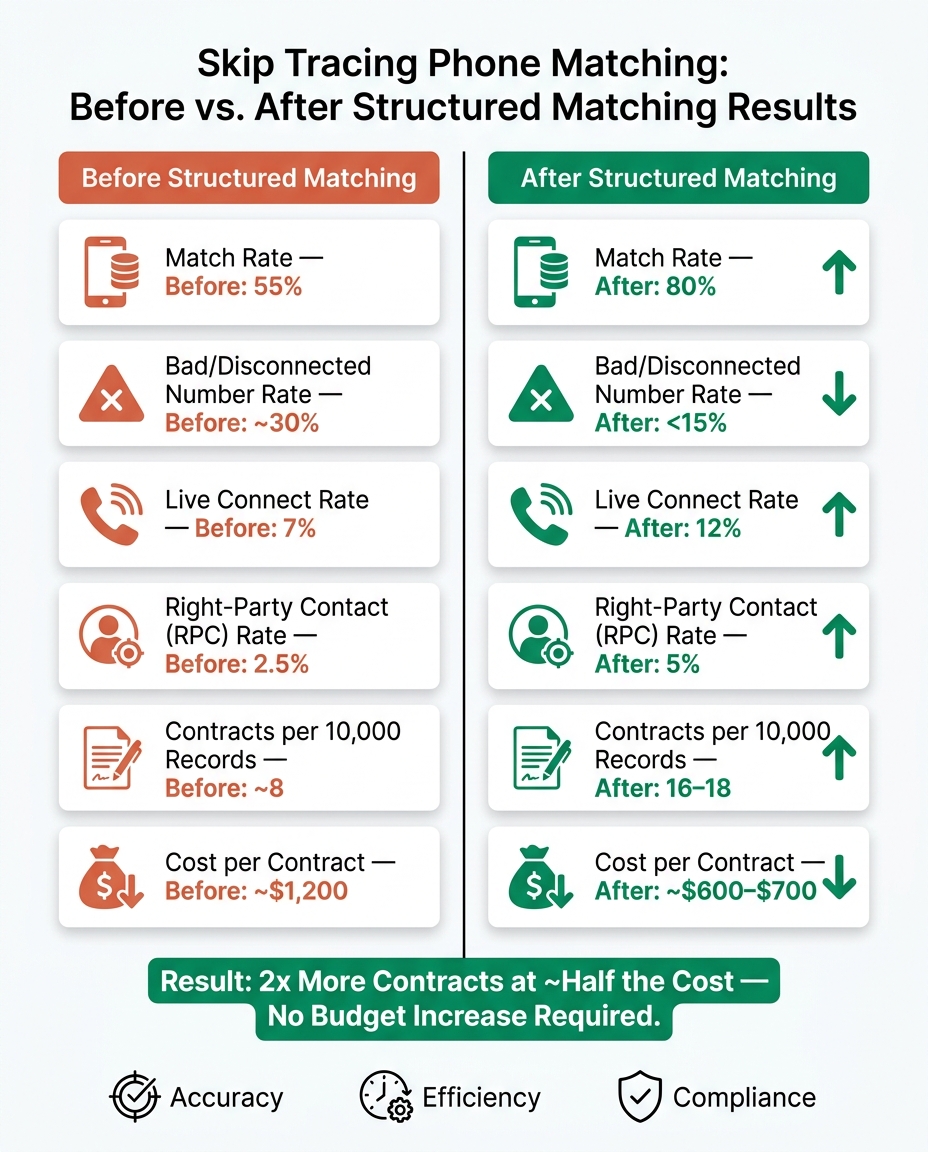
Skip Tracing Phone Matching: Before vs. After Structured Matching Results
Key Metrics for Tracking Phone Matching Performance
When evaluating phone matching, focus on these essential metrics:
- Match rate: Calculated as the number of phone records returned divided by the total records submitted. For example, if 7,500 out of 10,000 records are matched, the match rate is 75%.
- Contactability rate: The proportion of callable, compliant numbers (excluding disconnected, Do Not Call-listed, and litigator-flagged entries) divided by the total matched numbers.
- Live connect rate: The number of live conversations divided by total dial attempts.
- Right-party contact (RPC) rate: The number of conversations with the actual property owner or authorized decision-maker divided by total dial attempts.
- Cost per contactable lead: Total spending on data and dialing divided by the number of verified, callable records.
For U.S. real estate skip tracing, aim for a match rate of 70–85% and an RPC rate of 3–8% when working with individual owner records. Records tied to LLCs or trusts generally show lower match rates – around 50–70% – because identifying the person behind the entity requires extra steps. These metrics are critical for improving operational efficiency.
How Better Phone Matching Reduces Wasted Effort
Low-quality phone data can significantly hamper efficiency. Contact centers report that 15–30% of dial attempts are wasted on invalid or incorrect numbers if the data isn’t validated or updated regularly. High-quality phone matching reduces this waste by increasing the accuracy of your data.
For example, doubling the RPC rate from 3% to 6% cuts the number of dials needed to reach property owners in half. On a campaign of 10,000 dials, this reduction saves 5,000 calls, translating to approximately $1,240 in labor costs at $20 per hour. Beyond saving time and money, verified phone lists help maintain your dialer’s reputation and reduce wrong-party complaints, which can demoralize your team and lead to compliance issues. These benefits highlight why phone matching should be treated as an ongoing, measurable process rather than a one-off effort.
Before-and-After Comparison of Skip Tracing Results
To see the tangible impact of improved phone matching, take a look at this example from a small U.S.-based wholesaling team. They processed 10,000 off-market single-family records monthly, transitioning from a low-cost provider with minimal verification to a structured process using cleaned data, carrier intelligence, and verified numbers through a service like BatchData:
| Metric | Before Structured Matching | After Structured Matching |
|---|---|---|
| Match rate | 55% | 80% |
| Bad/disconnected number rate | ~30% | <15% |
| Live connect rate | 7% | 12% |
| RPC rate | 2.5% | 5% |
| Contracts per 10,000 records | ~8 | 16–18 |
| Cost per contract | ~$1,200 | ~$600–$700 |
By simply improving phone data quality, the team doubled their contracts and reduced their cost per deal by nearly half – all without increasing their budget.
To confirm that phone matching is the key driver of these results (and not other factors like new scripts or seasonal changes), conduct an A/B test. Split the same type of list between your old and new matching methods during the same time frame, keeping callers and dialer settings consistent. A four-week test with a few thousand records per group should yield statistically reliable insights.
Conclusion: Getting More from Skip Tracing with Phone Number Matching
Phone number matching plays a crucial role in improving the performance of your skip tracing efforts. By cleaning your data, running structured phone appends, verifying and prioritizing the most reliable numbers, and embedding compliance checks into your workflow, you can make your outreach more precise and effective.
Here’s why it matters: accuracy ensures you’re connecting with the right person instead of wasting time on disconnected numbers; efficiency reduces unnecessary calls, saves agent time, and lowers your cost per contact; and compliance protects your operations by using verified data to avoid costly TCPA and DNC violations, where fines can range from $500 to $1,500 per call.
Even small improvements in phone match quality can make a big difference when working with large lists. The secret lies in treating phone matching as an ongoing process rather than a one-time task. This means standardizing your input data, removing duplicates, enriching lists with data from multiple sources, verifying line types and activity, and refreshing your records every 3–6 months since contact data decays at a rate of over 2% per month.
BatchData is designed to streamline this process. It offers tools for real estate-focused skip tracing, phone verification, bulk data enrichment, and developer-friendly APIs that integrate seamlessly with your CRM or dialing systems. For teams aiming to scale their phone number matching efforts, BatchData provides the property and contact intelligence needed to turn raw lists into prioritized, verified outreach pipelines.
FAQs
How often should I refresh skip tracing phone numbers?
To keep your skip tracing data reliable, make it a habit to update phone numbers at least once a month. Static lists can quickly lose relevance as phone numbers get reassigned and property owners move. For the best results, look into tools that update data on a daily basis. Another smart move? Test your existing records by running a sample of 500–1,000 leads through an enrichment API. This can help you spot outdated details and ensure your information stays current.
What data fields boost phone match rates the most?
To boost phone match rates, prioritize using accurate and detailed input data. Begin with core identifiers like the property address, city, state, and ZIP code. Add the owner’s first and last name, as well as their mailing address, which might differ from the property address. Clean and standardize your data by correcting typos and normalizing abbreviations. This step is crucial, especially when cross-checking with multiple verified sources, as it significantly improves the reliability of your results.
How do I stay TCPA and DNC compliant when calling?
Keeping your outreach efforts in line with TCPA and DNC regulations is essential to avoid legal trouble and hefty fines. One way to ensure compliance is by automating the process of scrubbing your contact lists against the National Do Not Call (DNC) registry and TCPA litigator lists.
BatchData makes this easier by flagging numbers registered on the DNC list and identifying litigators, helping you steer clear of high-risk contacts. On top of that, it can determine the type of phone number – so you can ensure mobile numbers are handled using compliant communication methods.
By setting up regular, automated verification of your contact lists, you can protect your outreach efforts while minimizing legal risks.