


































Choosing between Google Address Validation API and BatchData depends on your needs. Here’s the bottom line:
- Google Address Validation API is great for basic address verification and geocoding. It standardizes addresses, provides geographic coordinates, and integrates well with Google’s ecosystem. However, it has strict limitations:
- 30-day data retention
- 100 address validations per second
- No property insights or contact data
- BatchData is tailored for real estate professionals. It combines address validation with property data enrichment, skip tracing, and contact verification. BatchData supports bulk processing, offers unlimited data storage, and includes over 700 property attributes like ownership, equity, and distress indicators.
Quick Comparison:
| Feature | Google Address Validation API | BatchData |
|---|---|---|
| Address Standardization | Yes (USPS CASS) | Yes (USPS CASS) |
| Geocoding | Yes | Yes |
| Property Data Enrichment | No | Yes |
| Contact Verification | No | Yes |
| Data Retention | 30-day limit | Unlimited |
| Bulk Processing | Limited | Supports large-scale datasets |
| Pricing | Pay-as-you-go | Tiered subscription or PAYG |
If you’re in real estate and need detailed property insights or large-scale data handling, BatchData is the better fit. For simple address validation, Google’s API is sufficient.
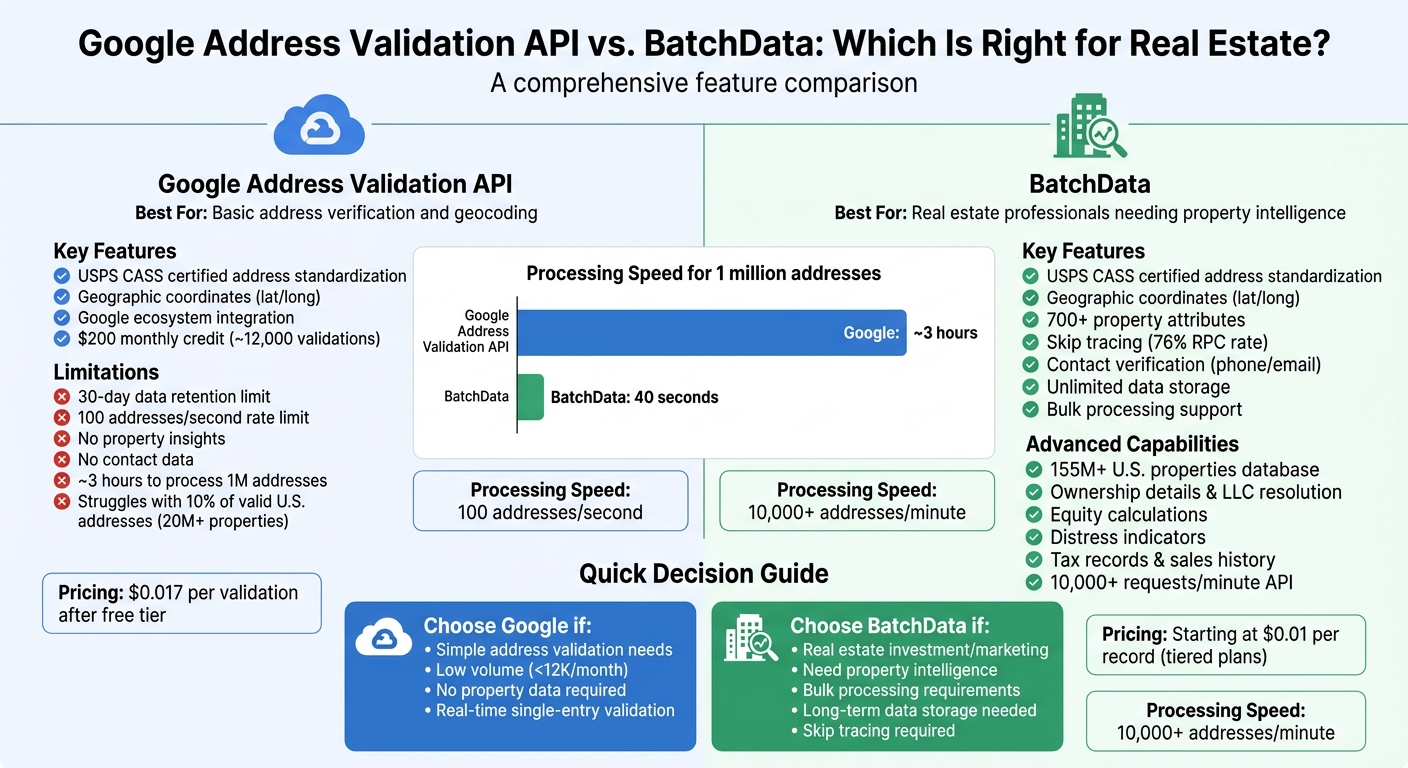
Google Address Validation API vs BatchData Feature Comparison for Real Estate
Address and Entities Validation (Google Maps/Places APIs)
sbb-itb-8058745
What Is Google Address Validation API?
The Google Address Validation API is a cloud service that helps verify and standardize real-world addresses, making them suitable for mailing. It also provides precise geographic coordinates for locations in about 40 countries. The API breaks down addresses into components like street number, route, city, and state. For addresses in the U.S. and Puerto Rico, it applies CASS™ (Coding Accuracy Support System) certification to align them with USPS standards. Each address component gets a "confirmation level" label – marked as confirmed, unconfirmed, or suspicious. The API can fix errors, fill in missing details, and adjust inaccuracies to ensure the address is valid.
In addition to validation, the API provides latitude and longitude coordinates, a Place ID, and "validation granularity" signals. These signals indicate how precisely an address is verified, whether down to the building level (PREMISE) or even a specific apartment or suite (SUB_PREMISE). It also includes metadata like whether the property is residential, commercial, or a PO Box. These features form the foundation of the API’s capabilities.
Main Features
The API handles international address formats by identifying components, correcting errors, and standardizing them to meet local postal requirements. Its "verdict" property summarizes the overall quality of an address, including its granularity and completeness, helping users determine whether the address is deliverable. For U.S. addresses, it offers USPS-specific metadata like Delivery Point Validation (DPV) codes. For instance, a dpvConfirmation value of "S" means the building is matched, though the specific unit number might not be verified.
The API also flags "synthetic" addresses – locations that don’t exist as precise points in Google’s database but can be approximated using other geocoding methods. Businesses already using the Google Maps Platform benefit from its integration with other Google Cloud services. Additionally, Google provides a $200 monthly credit that can be applied across Maps, Routes, and Places APIs, which covers up to 12,000 address validation lookups each month.
"Address Validation helps us identify and resolve problematic components of the bad addresses, which in turn improves business efficiency. We have more granular information on the errors." – Pedro Dias, Senior Software Engineer, Slerp
Where It Falls Short for Real Estate
While the API is powerful for validation, it has limitations when applied to real estate. It provides geocodes and basic metadata but doesn’t include property details like ownership, square footage, or year built. Additionally, it restricts data storage to 30 days, making it unsuitable for long-term analysis required for underwriting or portfolio management.
The API is also rate-limited, processing 100 addresses per second (6,000 per minute). Validating one million addresses would take nearly three hours, compared to just 40 seconds with some specialized enterprise solutions. It’s designed for single-entry requests, so handling large real estate datasets requires custom code to process individual validations.
Another drawback is its occasional inability to separate granular address components accurately. For example, it might group "North Main Street" as one "route" instead of breaking it into "N" (predirectional), "Main" (street name), and "St" (suffix). The API can also produce false positives by matching disorganized inputs incorrectly. Moreover, since it relies heavily on USPS data, it struggles to validate the roughly 10% of valid U.S. addresses – over 20 million – that aren’t in the USPS database.
What Is BatchData?
BatchData is a data intelligence platform tailored for real estate professionals. Unlike general-purpose data tools, it combines multiple capabilities – address verification, property enrichment, contact data, skip tracing, and bulk processing – specifically designed for proptech and home services. The platform boasts a database of over 155 million U.S. properties, enriched with more than 700 property attributes. These include valuations, tax records, sales history, ownership details, and mortgage information.
Using CASS-certified software, BatchData meets USPS standards while adding real estate-specific metadata like vacancy flags, residential/commercial indicators, and DPV codes. It even includes provisional addresses for new builds and planned properties, offering professionals an advantage in identifying off-market opportunities before they hit USPS databases. Let’s dive into the features that make BatchData a standout tool for real estate data intelligence.
Real Estate Features
BatchData’s strength lies in its ability to enhance property intelligence and identify motivated sellers. It provides insights like financial distress indicators and high-equity homeowner data, helping investors zero in on potential opportunities. The platform also excels at resolving complex ownership structures, uncovering the actual owners behind LLCs and trusts – bypassing generic registered agents. This feature is especially useful for targeting institutional or corporate-owned properties.
Its skip tracing capabilities are seamlessly integrated into workflows, allowing users to perform single lookups, bulk CSV imports, or API-based searches. BatchData claims a 76% right-party contact accuracy rate – about three times higher than the industry average. Verified contact data includes phone numbers and emails, with automatic scrubbing against the National Do Not Call registry and "Litigator Scrubs" to weed out known TCPA litigators. To ensure data remains current, the system updates daily to address the 2% monthly decay rate typical of contact information.
"What used to take 30 minutes now takes 30 seconds. BatchData makes our platform superhuman." – Chris Finck, Director of Product Management
APIs and Custom Services
BatchData supports its advanced features with powerful APIs and customizable services. These RESTful APIs cover address validation, property enrichment, skip tracing, and contact appending. They can handle over 10,000 requests per minute, with endpoints like /validate-address and /enrich-property accepting JSON inputs and outputs. Developers can also integrate BatchData into their systems using Python or JavaScript SDKs, enabling automated lead scoring and CRM enrichment.
For businesses scaling their operations, BatchData offers custom APIs, data pipeline orchestration, and integrations with platforms like Salesforce. Dedicated account managers assist in scaling pipelines capable of processing 50 million or more records each month. Case studies highlight a 40% reduction in processing time for proptech companies running nationwide campaigns. Pricing is flexible, following a pay-as-you-go model with no hidden fees or restrictive annual contracts. Scalable subscription tiers are also available for high-volume users.
Google Address Validation API vs. BatchData: Feature Comparison
Feature Comparison Table
Google’s Address Validation API focuses on standardizing addresses and geocoding, while BatchData adds layers of functionality like property intelligence and contact verification.
| Feature | Google Address Validation API | BatchData |
|---|---|---|
| Address Standardization | Yes (USPS CASS) | Yes (USPS CASS) |
| Geocoding | Yes | Yes |
| Property Data Enrichment | No | Yes (includes property intelligence and tax data) |
| Contact Verification | No | Yes (skip tracing, phone, email) |
| Non-Postal Addresses | Struggles with ~10% of addresses | Enhanced coverage |
| Parsing Granularity | Groups street name and suffix | Separates address components |
| Data Retention | 30-day limit | Unlimited storage permitted |
This breakdown highlights how BatchData extends beyond Google’s API, offering more robust features for industries like real estate and property management.
One key difference lies in how addresses are parsed. Google combines elements like "Main St" into a single field, which can make it harder for real estate professionals to manage property databases effectively. BatchData, on the other hand, separates components like street name and suffix, making it much easier to organize and query property records with precision.
Handling Large-Scale Operations
For businesses managing huge datasets, scalability is just as important as features. Address validation often involves processing large volumes of data, and the ability to handle this efficiently can be a game-changer.
Google’s API processes addresses one at a time, requiring custom batch scripts for large datasets. At a rate of 100 addresses per second (6,000 per minute), validating 1 million addresses would take nearly three hours. This limitation is further compounded by Google’s restrictive data retention policy, which only allows storing address data for 30 days unless tied to a specific transaction.
"Google’s batch address validation is limited… it necessitates custom code and workarounds." – Smarty
BatchData eliminates many of these hurdles by supporting bulk processing through asynchronous file uploads. This approach not only speeds up operations but also reduces the technical effort required for large-scale validation. Additionally, BatchData’s unlimited data storage policy is a significant advantage for professionals building long-term property databases, enabling them to retain and manage data without worrying about time-based restrictions.
Pricing: What Each Platform Costs
Google Address Validation API Costs
Google’s pricing operates on a pay-as-you-go system, with costs tied to the number of requests you make each month. They offer a $200 monthly credit, which allows for about 12,000 address validations at no charge. Once you exceed this credit, each request costs around $0.017, translating to $17 for every 1,000 addresses.
For higher volumes, the costs scale quickly:
- 50,000 addresses: approximately $850
- 150,000 lookups: about $2,380
- 499,000 addresses: roughly $7,126
A key limitation is Google’s 30-day data retention policy, which requires repeated validations for ongoing or long-term data use. Software engineer Landon Fackrell highlights this restriction:
"If you’re handling address data for any other purpose than a ‘downstream transaction’, you’re not permitted to store the address data at all. Full stop."
This limitation can drive up costs for businesses that need to retain address data for extended periods.
BatchData Pricing
BatchData takes a different approach with its tiered subscription model, offering predictable costs and extensive property data features. Designed for high-volume real estate operations, their plans provide clear pricing:
- Growth plan: $1,000/month for 100,000 records ($0.01 per record)
- Professional plan: $2,500/month for 300,000 records (~$0.0083 per record)
- Scale plan: $5,000/month for 750,000 records (~$0.0066 per record)
- Enterprise: Custom pricing for larger needs
Each plan includes 240+ property data points, covering details like mortgage liens, pre-foreclosure status, and building permits. For additional insights, BatchData offers optional add-ons:
- MLS Data and Property Valuations: $600/month each
- Owner Contact Data: $5,000/month
- Skip tracing services: Starting at $2,000/month for 100,000 traces
For businesses seeking flexibility, BatchData also provides a pay-as-you-go option without monthly commitments. Unlike Google, BatchData imposes no restrictions on how long you can store your data, making it a more appealing choice for long-term data management.
What Google Isn’t Telling You: API Limitations
Missing Property Details and Real Estate Insights
While Google’s API can confirm and standardize addresses, it doesn’t provide critical property details like ownership, square footage, year built, or liens. On top of that, Google’s Terms of Service explicitly restrict using its data for analytical purposes. Another major limitation? The API enforces a strict 30-day data retention policy. For real estate professionals who need long-term access to detailed property data, these constraints make Google’s API a poor fit.
Rate Limits That Hinder Bulk Processing
Google’s API is also capped at processing 100 addresses per second (or 6,000 per minute). To validate a million addresses, you’d need almost three hours. Since the API processes addresses one at a time, this limitation requires custom coding, which slows down bulk operations even further.
For real estate teams handling large lead lists or conducting broad market analyses, these restrictions can be a dealbreaker. In contrast, BatchData’s real estate platform is designed to tackle these challenges head-on, offering efficient bulk processing and access to detailed property intelligence.
Why BatchData Works Better for Real Estate
Property and Contact Data Enrichment
BatchData goes beyond basic address validation, offering a wealth of property details that are particularly useful in real estate. While Google might confirm an address exists, BatchData enriches it with more than 1,000 data points. These include assessed value (e.g., $450,000), square footage (2,100 sq ft), year built (1995), the number of bedrooms and bathrooms (3/2), ownership history, and mortgage details like lender and loan amounts. This level of detail helps real estate professionals pinpoint seller motivation. For example, one company identified properties with high equity and long-term ownership, leading to a 25% higher response rate in direct mail campaigns.
The platform also automatically calculates equity (e.g., a $600,000 property with a $300,000 mortgage equals $300,000 in equity) and flags key indicators such as long-term ownership, recent life changes, or financial distress. Unlike Google’s API, which focuses solely on address validation, BatchData taps into public records and proprietary databases to provide insights that can be stored and analyzed for future use.
Built-In Skip Tracing and Phone Verification
BatchData simplifies workflows by combining skip tracing and phone verification with address validation, eliminating the need for multiple tools. With just a partial address, users receive a validated address enriched with property data, along with phone and email matches boasting 80–90% accuracy. The platform achieves a 76% right-party contact (RPC) rate by linking LLCs and trusts to the actual owners, bypassing intermediaries to connect with decision-makers.
"BatchData leads the industry with a 76% right-party contact (RPC) rate. This is approximately 3x the industry average." – BatchData
Phone verification ensures accuracy by checking line status through carrier databases (active, disconnected, mobile/landline), evaluating risk scores for VOIP or burner numbers, and ensuring compliance with do-not-call lists through integrated DNC scrubbing. In one example, a mid-sized real estate investment firm validated and enriched 50,000 distressed property addresses, appending skip-traced phone numbers with 92% accuracy. This automation enabled outbound calls that identified 1,200 motivated sellers (a 2.4% hit rate), leading to 45 closed deals worth $12 million in acquisitions within six months. This streamlined process was 3x faster than manual efforts and delivered a 5:1 ROI on data costs.
Custom Solutions for Growing Operations
For larger teams, BatchData offers custom APIs and seamless integrations to handle high-volume operations efficiently. These include tailored APIs, white-label dashboards, and dedicated servers capable of processing over 1 million records daily with 99.9% uptime. For example, a national brokerage used a private API endpoint to handle 2 million monthly validations and enrichments, integrated directly with Salesforce CRM. This reduced latency from 5 seconds to just 200 milliseconds per record during peak market activity. Flexible pricing options include pay-per-record rates starting at $0.02 or enterprise flat fees, with no long-term contracts. Integration is easy through RESTful APIs, webhooks, or SDKs for Python and Node.js.
"Google validates addresses, but BatchData delivers actionable intelligence at scale – our custom API cut acquisition costs 35% by enriching leads with motivation scores." – Proptech CTO, $100 Million Real Estate Firm
One proptech startup scaled from 10,000 to 500,000 monthly calls by upgrading to a custom tier. This included owner affinity scoring, seamless Zapier and CRM integration, and automated workflows that saved 30 hours per week in manual data handling. BatchData also supports bulk delivery via CSV, Amazon S3, or direct Snowflake access, enabling portfolio analysis and machine learning for greater operational efficiency on a large scale.
Which Tool Should You Choose?
Choosing the right tool ultimately depends on what you need from your real estate data. If your primary goal is to validate addresses at the point of entry – like standardizing inputs on web forms or ensuring proper formatting in a CRM – Google’s API is a solid choice. It not only confirms an address’s existence but also standardizes its format and provides geocodes. Plus, with Google’s $200 monthly credit, you can handle around 12,000 lookups, making it a cost-effective solution for basic validation tasks with modest volumes.
However, for real estate professionals with more complex needs, BatchData offers a more robust option. This tool goes beyond simple validation by transforming an address into a detailed investment profile. With access to over 1,000 property attributes – including equity calculations, ownership history, mortgage details, and distress signals – BatchData provides the deep insights necessary for strategic portfolio analysis. While Google’s API excels in real-time, single-entry validations (processing up to 100 addresses per second), BatchData shines when it comes to handling large-scale marketing lists or database audits. It’s particularly effective for addressing the natural 2% monthly decay in address accuracy.
For teams that also need skip tracing or phone verification, BatchData simplifies operations by integrating these features into one platform. It offers custom APIs, white-label dashboards, and flexible pricing models that can scale to fit different business needs. This makes it a versatile choice for professionals looking to streamline their workflow and access actionable property data.
FAQs
Can I store Google-validated addresses longer than 30 days?
Yes, Google-validated addresses can be stored for longer than 30 days. Google’s documentation and related sources do not specify any restrictions on how long these addresses can be kept.
How can I quickly validate and enrich a large CSV list?
To handle large CSV lists effectively, BatchData’s automated tools can be a game-changer. These tools help you standardize and validate addresses by cross-checking them against USPS standards, ensuring your data is both accurate and consistent.
Need to fill in missing details? You can enrich your data by adding information like ZIP codes or geocodes. Plus, with batch upload features, you can process thousands of records at once – saving time and cutting down on tedious manual work.
Does BatchData include owner phones/emails and DNC scrubbing?
BatchData offers access to owner phone numbers and emails through its contact data enrichment services. To ensure compliance, it includes DNC (Do Not Call) scrubbing, which helps maintain outreach standards. The platform is particularly skilled in skip tracing property owners, providing verified contact details while following regulations like DNC. This approach supports effective and lawful communication strategies.