


































Underwriting is the formal risk assessment process lenders and insurers use to approve or deny an application, centered on the applicant's ability to pay and the value of the underlying asset. In mortgage lending, that process often becomes the slowest part of the deal, commonly taking about 30 to 60 days, even though some lenders say the initial review can take about three business days once a complete file is in.
Hearing ‘underwriting' often brings paperwork to mind. That's incomplete. The job involves deciding whether the risk makes sense, under what conditions, and whether the inputs are still reliable by the time the deal closes.
If you're building in proptech, this matters for three reasons:
- Legacy underwriting is document-heavy. It relies on pay stubs, W-2s, tax returns, bank statements, and debt verification.
- The decision framework is structured. Underwriters usually work from credit, capacity, and collateral.
- The model is changing. Static, point-in-time review is giving way to continuous monitoring of borrower and property risk.
- Operational drag is real. Incomplete or inconsistent files create extra conditions, rework, and delays.
- Property complexity breaks simple rules. Distressed and non-standard assets need deeper title, lien, equity, and valuation analysis.
The Underwriting Bottleneck Is Breaking
Mortgage underwriting still acts like a batch process in a real-time world. The traditional workflow often takes about 30 to 60 days, and even the initial review is often only about three business days after a complete application lands according to Bankrate's mortgage underwriting overview.
That timing tells you something important. Underwriting isn't just a compliance checkpoint. It's the point where a lender tries to convert messy, incomplete, and sometimes stale information into a binary decision with money behind it.
Why this stage slows everything down
The bottleneck usually isn't a single review. It's the chain reaction that follows weak inputs.
- Missing data creates conditions. If income, assets, debt, or property details don't line up, the file gets pushed back for clarification.
- Static documents age fast. A file assembled days or weeks ago may no longer reflect the borrower or the asset by the time a decision is finalized.
- Property risk is harder than it looks. A clean single-family home is straightforward. A property with title issues, lien complexity, or unusual use isn't.
Underwriting is where speed and certainty collide. Push too fast and you miss risk. Review too slowly and the file changes underneath you.
What actually matters
For a sharp operator, the useful question isn't just what is underwriting process. It's: what inputs drive the decision, where does the process fail, and how do you reduce avoidable surprises?
The practical answers are straightforward:
- Know the logic. Underwriting is a structured assessment, not a black box.
- Know the file path. Application review, verification, appraisal, title work, and decisioning all introduce friction.
- Know the industry context. Mortgage, insurance, and commercial underwriting solve different risk problems.
- Know the modern shift. Real-time property and lien data are pushing the market away from one-time review.
What Is the Underwriting Process Fundamentally
Underwriting is a risk-quantification system. An underwriter takes an applicant, an asset, and a set of program rules, then asks a simple question: Does the evidence support this exposure?
In mortgage lending, the classic framework is the three Cs: credit, capacity, and collateral. Lenders commonly verify items such as pay stubs, W-2s, tax returns, bank statements, and debt obligations before issuing a decision, as outlined in Blueprint's explanation of the underwriting process.
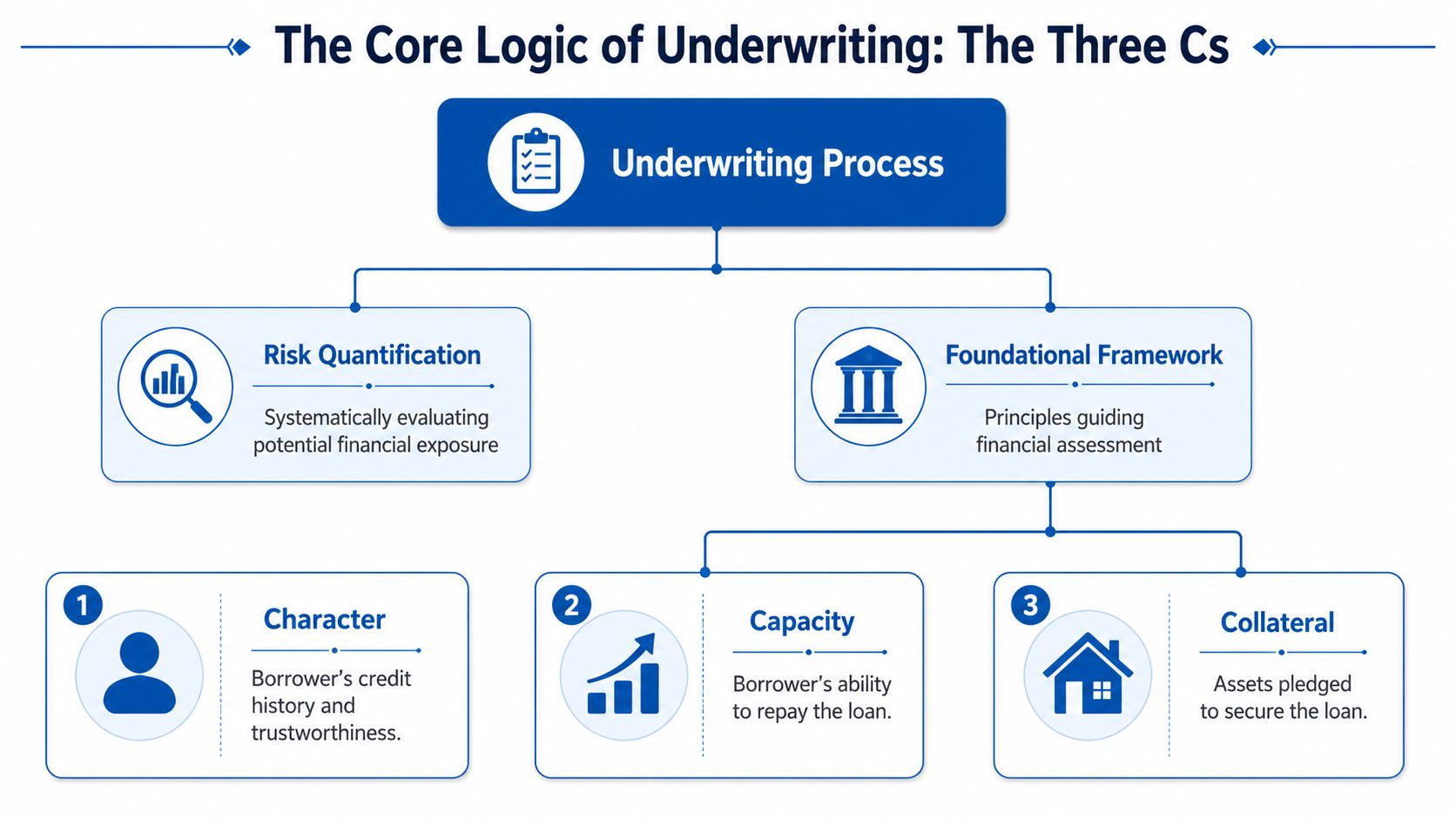
The three Cs are the core model
Think of the three Cs like a three-legged stool. If one leg is weak, the whole structure gets unstable. Sometimes one strong area offsets another weaker one. Sometimes it doesn't.
| Component | What it means | What underwriters look for | Why it matters |
|---|---|---|---|
| Credit | Past repayment behavior | Credit profile, debt obligations, payment patterns | It signals how the applicant has handled obligations before |
| Capacity | Ability to repay | Income documents, employment consistency, existing liabilities, cash flow evidence | It shows whether the payment is realistically supportable |
| Collateral | Asset securing the exposure | Property value, condition, title status, marketability | It determines the lender's fallback if the borrower defaults |
Credit is about reliability
Credit isn't morality. It's pattern recognition. Underwriters use it to judge whether the applicant has handled borrowed money consistently enough to trust future repayment.
A common mistake is treating credit as the whole decision. It isn't. A strong credit profile can still fail if income is unstable or the property doesn't support the loan.
Capacity is where the file either works or breaks
Capacity answers the repayment question directly. Can this borrower carry the obligation without the file depending on optimistic assumptions?
This is why income verification gets so much attention. Pay stubs, W-2s, tax returns, and bank statements aren't random paperwork. They're evidence that cash flow exists, is recurring, and can support the requested loan.
Practical rule: The cleanest file is the one where the story told by the application matches the story told by the documents.
Collateral is often underestimated
Founders who haven't lived inside credit policy tend to focus on borrower data and underweight the asset. That's a mistake in real estate.
Collateral isn't just “the house.” It includes valuation confidence, marketability, title clarity, lien position, and whether the property fits the rules of the loan program. If the asset is hard to value or hard to liquidate, underwriting tightens fast.
Underwriting is not arbitrary
A lot of borrowers experience underwriting as opaque because they only see the conditions list. But the logic is usually mechanical:
- Collect evidence
- Test it against policy
- Resolve inconsistencies
- Measure residual risk
- Issue approval, conditional approval, or denial
That's the fundamental answer to what the underwriting process is. It's a controlled method for converting uncertainty into a decision.
How Underwriting Varies Across Industries
Underwriting isn't one process copied everywhere. The word stays the same, but the object of analysis changes. Mortgage underwriters are usually asking whether a borrower and a property support a loan. Insurance underwriters ask whether a risk should be covered and on what terms. Commercial underwriters focus on business cash flow, operations, and the durability of repayment.
Underwriting process comparison by industry
| Attribute | Mortgage Underwriting | Insurance Underwriting | Commercial Underwriting |
|---|---|---|---|
| Primary goal | Decide whether to extend credit secured by property | Decide whether to accept a risk for coverage | Decide whether to extend business credit or financing |
| Core risk focus | Borrower repayment and collateral quality | Likelihood and severity of loss | Business viability and repayment strength |
| Main inputs | Income docs, asset docs, debt obligations, property data, title and appraisal materials | Property characteristics, exposure details, claims history, coverage details | Financial statements, cash flow records, ownership structure, liabilities, collateral |
| Asset relevance | Central. The property secures the loan | Varies by line, but property condition and exposure often matter | Often important when the loan is asset-backed |
| Decision outputs | Approval, conditional approval, denial | Bind, decline, exclusions, pricing terms | Approval, structure changes, covenants, denial |
| Operational pain point | Stale documents and late-breaking collateral issues | Incomplete exposure data and inconsistent property records | Non-standard financials and complex entity structures |
Mortgage underwriting is document logic plus property logic
In mortgage, the underwriter cares about the borrower and the house at the same time. A first-time homebuyer with clean income and assets can still hit friction if the appraisal, title, or lien picture is messy.
That's why property data products now sit much closer to the underwriting stack than they used to. Teams dealing with property-centric insurance workflows see a similar issue in exposure modeling and verification. For a practical example of how API-delivered property records support that work, see BatchData's overview of property data for insurance underwriting and risk assessment.
Insurance underwriting cares about exposure shape
Insurance doesn't underwrite “repayment.” It underwrites the probability and size of a future loss. That shifts the workflow.
A carrier reviewing a commercial fleet policy, for example, isn't primarily asking whether the applicant can make a monthly payment. The carrier is asking what could go wrong, how likely that is, and whether the policy terms match the risk.
Commercial underwriting lives in nuance
Commercial underwriting is usually less standardized because the borrower itself is more complex. A small business loan can involve entity structures, uneven revenue, owner guarantees, and collateral that's harder to liquidate than a house.
Commercial files often fail for a simple reason: the business may be real, but the evidence package is not decision-ready.
The operational lesson across all three categories is the same. Underwriting quality depends on input quality. The difference is which inputs matter most.
What Are the Core Steps of Underwriting
A typical mortgage underwriting file moves through a predictable sequence, even if the actual work loops backward when something doesn't reconcile. In mainstream mortgage workflows, the initial underwriting review is commonly reported to take about three business days, while the full underwriting stage can extend to roughly 30 to 60 days depending on loan type, document quality, and whether more verification is needed, according to Wells Fargo's guide to mortgage underwriting steps.
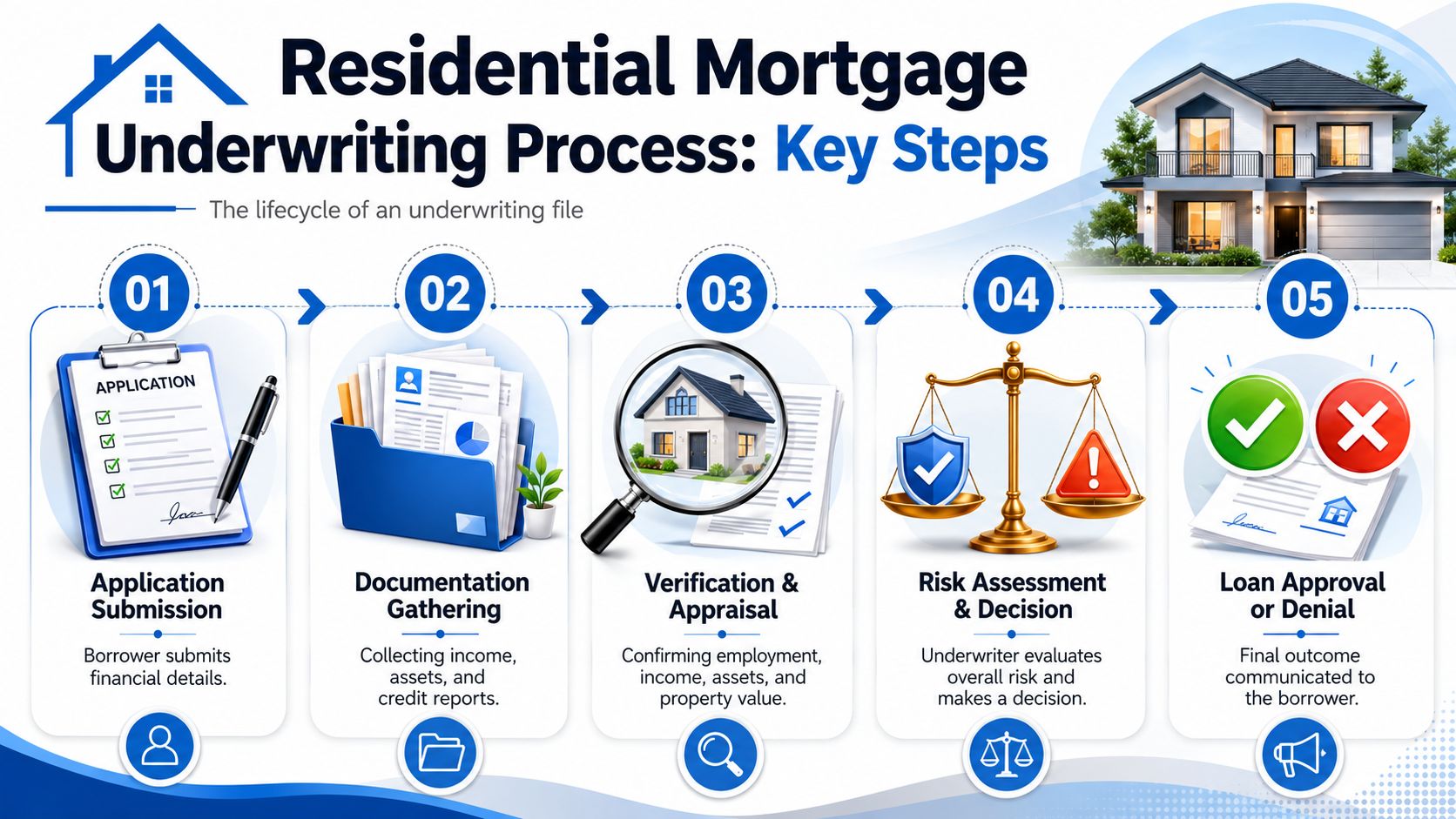
Step 1. Application review
At this point, the file first becomes underwritable. The borrower submits core financial details, and the lender checks whether the package is complete enough to evaluate.
The goal isn't deep judgment yet. It's basic coherence. Do the applicant's stated income, assets, debt, occupancy, and property details create a file that can move forward?
Step 2. Document verification
The underwriter now starts proving the file instead of reading it.
Common document categories include:
- Income evidence. Pay stubs, W-2s, and tax returns help verify repayment ability.
- Asset evidence. Bank statements help confirm funds and reserves.
- Liability evidence. Debt obligations are checked to understand monthly burden.
- Consistency checks. Names, dates, addresses, balances, and employer details have to match.
A lot of delay happens here because the file often tells two different stories. The application says one thing. The documents imply another. That's when conditions appear.
If you work across insurance and lending workflows, temporary coverage documentation can create parallel confusion around when protection begins and what has been bound. For a clear explanation of that issue, Cover Club's insurance cover note guide is a useful reference.
Step 3. Property appraisal and title review
At this stage, collateral is tested. A lender doesn't just need a property. It needs a property with supportable value and clean enough ownership and lien status to secure the loan.
A practical underwriting stack at this stage usually needs:
- Valuation support so the lender knows whether the collateral can carry the exposure.
- Title clarity so ownership and lien position are understandable.
- Property-risk context so condition, legal status, and marketability don't undermine the file.
Teams building around this workflow often map these checks into a broader property risk assessment workflow because the underwriting decision is only as good as the underlying collateral picture.
Step 4. Final risk assessment
Once borrower evidence and property evidence are in hand, the underwriter compares the file against loan-program rules, secondary-market requirements, and regulatory standards.
At this point, the decision usually narrows to one of three outcomes:
| Outcome | What it means | What usually happens next |
|---|---|---|
| Approval | The file meets policy as submitted | The loan moves toward closing |
| Conditional approval | The file is acceptable if specific issues are resolved | The borrower or loan team provides additional documentation |
| Denial | The file does not meet policy or risk tolerance | The process stops or the structure changes |
Step 5. Decision issuance
The borrower finally sees the result, but the core issue is whether the result is stable. A conditional approval that relies on documents likely to change isn't really settled. It's provisional.
The cleanest underwriting process isn't the fastest one on paper. It's the one with the fewest late reversals.
That distinction matters because the modern failure mode isn't always the original review. It's the change that occurs after the review.
The Shift to Continuous Underwriting with Real-Time Data
Static underwriting is losing ground because the file can change after the underwriter thinks the work is done. In Q3 2024, 40% of mortgage denials were tied to unexpected changes in the borrower's file or the property's value after the initial application, according to BatchData's analysis of real-time property data and underwriting workflows.
That single point exposes the weakness in the old model. Traditional underwriting treats risk like a snapshot. Modern deal risk behaves like a live feed.
Why point-in-time underwriting breaks
The legacy process assumes that documents collected earlier in the workflow remain reliable until closing. Sometimes they do. Sometimes they don't.
The problem set is familiar:
- Borrower files change. Income, debt, asset balances, or supporting documents can shift.
- Property values move. A valuation that looked sufficient at application may look weaker later.
- Lien status can change. New filings or discovered encumbrances can alter collateral quality.
- Distress signals appear late. Pre-foreclosure and ownership-history complications don't always show up when the original file is assembled.
This is why “complete at submission” isn't enough anymore. A complete file can still become an outdated file.
What continuous underwriting actually means
Continuous underwriting means the lender or platform keeps monitoring risk-relevant data during the life of the transaction instead of only at intake. The objective is simple: catch changes early enough to adjust, reprice, pause, or cure the file before closing fails.
That changes the operating model from review once to verify, monitor, and re-evaluate.
A practical continuous workflow usually watches for:
| Monitoring area | Static model | Continuous model |
|---|---|---|
| Property value | One appraisal or one valuation checkpoint | Updated AVM and valuation signals during the process |
| Lien activity | Title review at a specific point in time | Ongoing alerts for newly surfaced issues |
| Distress signals | Checked only if the file raises concern | Monitored as part of standard collateral surveillance |
| Decision posture | Binary approval based on stale inputs | Dynamic risk posture that can be updated before closing |
What works and what does not
What works:
- API-based monitoring. Teams ingest property updates directly into origination and review workflows.
- Exception-based review. Underwriters don't need more dashboards. They need fewer surprises and better alerts.
- Collateral re-checks near decision points. Value and lien status should be treated as time-sensitive, not permanent.
What doesn't:
- Assuming the appraisal solved valuation risk. It solved valuation risk at one moment.
- Treating title review as final too early. A “clean” result can age.
- Relying on manual refreshes. If humans have to remember to recheck every file, misses are inevitable.
One option teams use for this shift is BatchData, which provides property records, AVMs, lien details, ownership history, and monitoring workflows through APIs and bulk delivery. For builders looking at live property feeds specifically, this overview of real-time property updates APIs is the technical direction that matters.
Continuous underwriting doesn't remove human judgment. It removes blind spots between the first review and final commitment.
For a proptech founder, that's the key takeaway. The future of underwriting isn't faster document collection alone. It's better risk persistence. If the collateral and borrower profile can drift before closing, the underwriting model has to keep listening.
Frequently Asked Questions About Underwriting
How does underwriting differ for non-traditional properties
Underwriting gets harder when the asset doesn't fit the assumptions built into standard residential workflows. In 2024, distressed property transactions rose by 15%, yet standard guides rarely explain how to assess risk on assets with complex ownership histories, pre-foreclosure liens, or inaccurate tax assessments. That gap is noted qualitatively in the market discussion referenced earlier.
For a standard single-family home, the underwriter usually expects stable comparables, straightforward title history, and valuation methods that work without much manual intervention. Distressed assets break that pattern.
Key differences include:
- Title complexity. Ownership history may be messy, incomplete, or recently transferred.
- Lien uncertainty. Pre-foreclosure activity or subordinate liens can alter collateral quality.
- Weak valuation confidence. Traditional AVMs may struggle when the property condition or legal status is abnormal.
- Tax record issues. Public records can lag reality, especially when the asset has been neglected or partially reworked.
The practical fix is deeper evidence, not looser standards. Underwriters usually need better title research, clearer lien sequencing, stronger collateral review, and more skepticism about automated value estimates.
What KPIs actually matter in underwriting operations
The most useful underwriting KPIs are the ones that reveal where risk review is slowing down or becoming unstable.
Here's a clean operating set:
| KPI | What it tells you | Why it matters |
|---|---|---|
| Turnaround time | How long files sit before decision | It measures throughput and queue friction |
| Condition rate | How often files require additional items | It shows file quality and intake discipline |
| Exception volume | How often policy overrides or special handling occur | It reveals process drift and edge-case concentration |
| Approval mix | Share of approvals, conditional approvals, and denials | It helps diagnose whether standards or intake quality are aligned |
| Post-decision fallout | Files that fail after apparent approval progress | It exposes stale-data risk and weak monitoring |
A lot of teams track turnaround time obsessively and ignore exception quality. That's backwards. A fast queue with unstable approvals is operationally expensive because the rework appears later.
What is the difference between pre-qualification, pre-approval, and full underwriting approval
These terms get mixed together constantly, but they mean different levels of evidence and certainty.
- Pre-qualification is an early estimate based largely on self-reported information. It's useful for orientation, not commitment.
- Pre-approval usually means the lender has done a more serious initial review of credit and financial information, but the property and final verification work may still be open.
- Full underwriting approval means the file has been tested against underwriting standards with supporting documentation and collateral review. Even then, conditions may still need to be cleared before closing.
A borrower hears “pre-approved” and thinks the loan is done. An underwriter hears it and thinks the file has started to become real.
That distinction matters in product design. If you're building borrower-facing workflows, don't blur soft signals with final credit decisions. It creates bad user expectations and painful handoff problems for the credit team.
If you're building lending, insurance, or property-risk workflows, BatchData is worth evaluating for the data layer. The useful angle isn't marketing. It's operational. Teams can plug property records, ownership history, AVMs, lien signals, and monitoring feeds into underwriting and portfolio review systems so decisions rely less on stale snapshots and more on current collateral data.