






































Finding a person's complete address history is the foundational step for identity verification, risk assessment, and high-value lead generation, unlocking strategic data that is otherwise invisible. This guide provides the exact methods, tools, and compliance frameworks required to search for previous addresses effectively. The core challenge is not a lack of information, but navigating fragmented data sources—from manual public record dives to high-speed API automation.
- Key Takeaway: Professional data providers offer 95%+ accuracy, while free, manual methods are time-intensive and yield variable results.
- Best Tool: For scalable, automated searches, a data API is the only viable solution.
- Compliance Risk: Misusing data regulated by the Fair Credit Reporting Act (FCRA) for non-permissible purposes like marketing carries significant legal penalties.
This deep-dive will cover the manual search process, a comparison of professional tools, and the technical steps for automating lookups via API.
Why Does Finding a Previous Address Matter?

A person's address history provides a verifiable timeline of their life, offering a powerful layer of context that current data alone cannot supply. This historical footprint is a critical asset for any industry where accuracy and deep background understanding are paramount for decision-making.
For lenders and financial institutions, a complete address history is a core component of risk modeling. It directly supports identity verification, flags potential fraud by cross-referencing locations against application data, and strengthens overall due diligence. Private investigators and legal professionals depend on past residences to validate backgrounds, locate witnesses, or uncover assets tied to former addresses.
Strategic Business Applications
Address history is a direct driver of business growth. Marketers use it to refine audience segmentation, building hyper-targeted lead lists for location-specific services. A real estate investor can leverage enriched ownership history data to identify motivated sellers or analyze neighborhood stability by tracking residential tenure.
The consumer data market has matured significantly, with comprehensive residential databases now containing contact information for over 335 million individuals, covering nearly every U.S. household. In this environment, the ability to search for previous addresses is a standard operational capability. The scale of this data is evidenced by providers like Data Axle.
An address history is more than a list of locations; it is a verifiable record of major life events. Each previous address is a data point linking to property records, financial obligations, and personal connections.
Core Use Cases
The primary goal is always to build a complete, actionable profile of an individual or property. The table below details where a search for previous addresses creates the most value.
| Industry/Use Case | Primary Objective | Key Data Points Uncovered |
|---|---|---|
| Real Estate | Identify motivated sellers & off-market opportunities | Ownership duration, equity, move frequency, related properties. |
| Lending & Finance | Enhance KYC protocols & mitigate fraud risk | Identity verification, undisclosed properties, residency gaps. |
| Legal & Collections | Locate individuals & assets for legal proceedings | Last known addresses, property ownership records, potential relatives. |
| Marketing | Create hyper-targeted advertising campaigns | Geographic history, homeowner status, neighborhood profiles. |
Insights from an address history are far-reaching. Understanding where someone has been is often the most reliable indicator of what they will do next.
How Do I Manually Find Previous Addresses?

You can uncover significant address history information by querying publicly available data, primarily through government-run websites like local county tax assessor and recorder of deeds offices. This method requires no financial cost but is labor-intensive.
Approximately 98% of the U.S. housing market now has property records accessible online. These databases provide direct access to deed history, ownership details, and property tax valuations.
Navigating County Records
Begin by navigating to the website for the tax assessor or county recorder in the suspected area of residence. These sites feature search functions that allow lookups by owner name or property address.
Property deeds are the most valuable documents, as they are the official record of ownership transfers.
- Grant Deed: A direct transfer of ownership that guarantees the title is clear of other claims.
- Quitclaim Deed: A transfer of an individual's interest in a property to another, without title guarantees. Common among family members.
- Deed of Trust: A document securing a loan on a property, not a direct transfer of ownership.
These documents name the buyers and sellers (grantor and grantee), list transfer dates, and provide a legal property description, allowing you to build an ownership timeline.
Leveraging Digital Footprints
A person’s digital footprint provides clues that can fill gaps in official records. A social media post is not as definitive as a property deed but can direct your search to the correct jurisdiction.
A manual search is an exercise in connecting disparate data points. A LinkedIn profile mentioning a city provides the county needed to search official property records. One piece of information validates the next.
Use specific search operators in Google to narrow results. Searching for "John Smith" + "Anytown, CA" returns only pages containing that exact name and location. Adding terms like "resident" or "new home" further refines the search. For more advanced techniques, our guide on how address history helps skip trace an individual is a useful resource.
This manual approach is effective for singular searches but is not scalable. Data is siloed by county, and accuracy can be inconsistent.
What Are the Best Professional Search Tools?
Professional platforms deliver comprehensive address histories by aggregating data from sources far beyond public records, including credit bureaus, utility records, and proprietary databases. These tools consolidate fragmented information into a single, queryable interface, providing a complete picture of an individual's address history.
The market includes public records aggregators, specialized skip tracing services, and large-scale data platforms like BatchData. Key differentiators are data sources, accuracy, and access methods (web UI vs. API).
Platform Selection Criteria
Choosing the right tool requires focusing on data quality and utility. The value of a search for previous addresses is directly tied to the data powering it.
- Data Sources and Freshness: Evaluate the data update frequency. Daily updates provide a significant advantage over monthly refreshes.
- Accuracy and Confidence Scores: Top-tier providers score the reliability of their data. A 95% confidence score on a current address is more actionable than a list of unverified locations.
- Delivery Method (UI vs. API): Determine if your workflow requires a web interface for occasional lookups or a high-volume, automated API integration.
- Compliance Features: The platform must clearly segregate FCRA-regulated data (for credit/employment) from non-FCRA data (for marketing/research).
The core value of a professional data provider is not just finding an address but delivering verified data at scale and speed. A manual search can take an hour per individual; a professional platform processes thousands of records in minutes.
Method Comparison Table
This table contrasts manual research with professional data platforms to guide your selection based on specific needs.
| Attribute | Manual Research (Public Records) | Professional Data Providers (UI/API) | Skip Tracing Services |
|---|---|---|---|
| Typical Cost | Free (time-intensive) | Subscription or per-hit fee | Per-search fee |
| Accuracy | Variable; dependent on record quality | High; often includes confidence scoring | High; specialized for locating individuals |
| Scalability | Low; not viable for bulk searches | High; designed for bulk processing | Medium; often managed on a case-by-case basis |
| Best For | One-off searches, initial investigations. | Businesses needing reliable, high-volume data. | Legal, collections, and private investigation. |
For any business that depends on consistent, accurate location data for core operations—be it in real estate, risk analysis, or marketing—a professional data provider is an operational necessity.
How Can I Automate Address Searches with an API?
An Application Programming Interface (API) is the only method to automate and scale the process of searching for previous addresses, eliminating the operational bottleneck of manual lookups. An API acts as a secure connection, allowing your software (e.g., CRM, underwriting platform) to programmatically request and receive data from a provider's database.
API Integration Workflow
The process begins with an HTTP request to a specific API endpoint—a unique URL that performs a single function, such as /person/search or /property/search. You send the request with key identifiers like a person's name and last known city and state.
The API processes the request, queries its database, and returns the information in a structured JSON (JavaScript Object Notation) format. Your system then parses this JSON response to extract the required data, such as a full address history or property details.
This automated workflow replaces manual data entry with high-speed data retrieval.
Executing an API Search
Using a platform like BatchData, developers can use endpoints like /person/search to initiate a query. A well-formed API request might include:
- Name: The individual's full name.
- Address: Their last known street, city, and state.
- Phone or Email: Secondary identifiers to increase match accuracy.
The API documentation specifies all available parameters and the structure of the returned data, which is essential for developers to build reliable integrations.
Parsing the Response
A single API call can deliver a rich payload of data aggregated from thousands of sources. Major providers like BatchData maintain access to 155 million U.S. property records updated daily, a scope detailed in resources like the sheer scope of modern property data on Smarty.com.
The power of an API lies in retrieving structured, multi-layered data at machine speed. You can pull a complete, chronologically sorted history of every known residence, along with linked properties and co-owners, not just a single address.
For a deeper technical dive, review our guide on the top APIs for historical property data integration. Automation via API transforms a manual task into a strategic advantage, enabling data enrichment for thousands of leads or entire real estate portfolios simultaneously.
How Do I Stay Compliant with Data Privacy Laws?
Handling personal information like address histories carries significant legal responsibilities, primarily governed in the U.S. by the Fair Credit Reporting Act (FCRA). This federal law strictly regulates how consumer information can be collected, accessed, and used.
The central concept of the FCRA is permissible purpose. This means a consumer report, which often includes address history, can only be accessed for a limited number of legally defined reasons. Violations result in severe penalties.
FCRA vs. Non-FCRA Data Use
The most critical compliance step is determining if your reason to search for previous addresses falls under FCRA guidelines.
FCRA-Permissible Purposes: This is a narrow list of use cases, including decisions about offering credit, insurance, or employment. A lender reviewing a loan application or an employer conducting a background check is operating under FCRA and must use data from a certified Consumer Reporting Agency (CRA).
Non-FCRA Purposes: This category is broader and includes marketing, skip tracing for non-credit-related debt, general research, or internal identity verification. For these activities, data from non-CRA providers is appropriate.
Misusing FCRA-regulated data is a direct violation of federal law. For example, pulling a credit-grade report to build a marketing list is illegal. You must verify your data provider’s compliance certifications and be explicit about your intended use case.
API security is as critical as legal compliance. Understanding the top API security risks and how to mitigate them is essential to protect the data you handle.
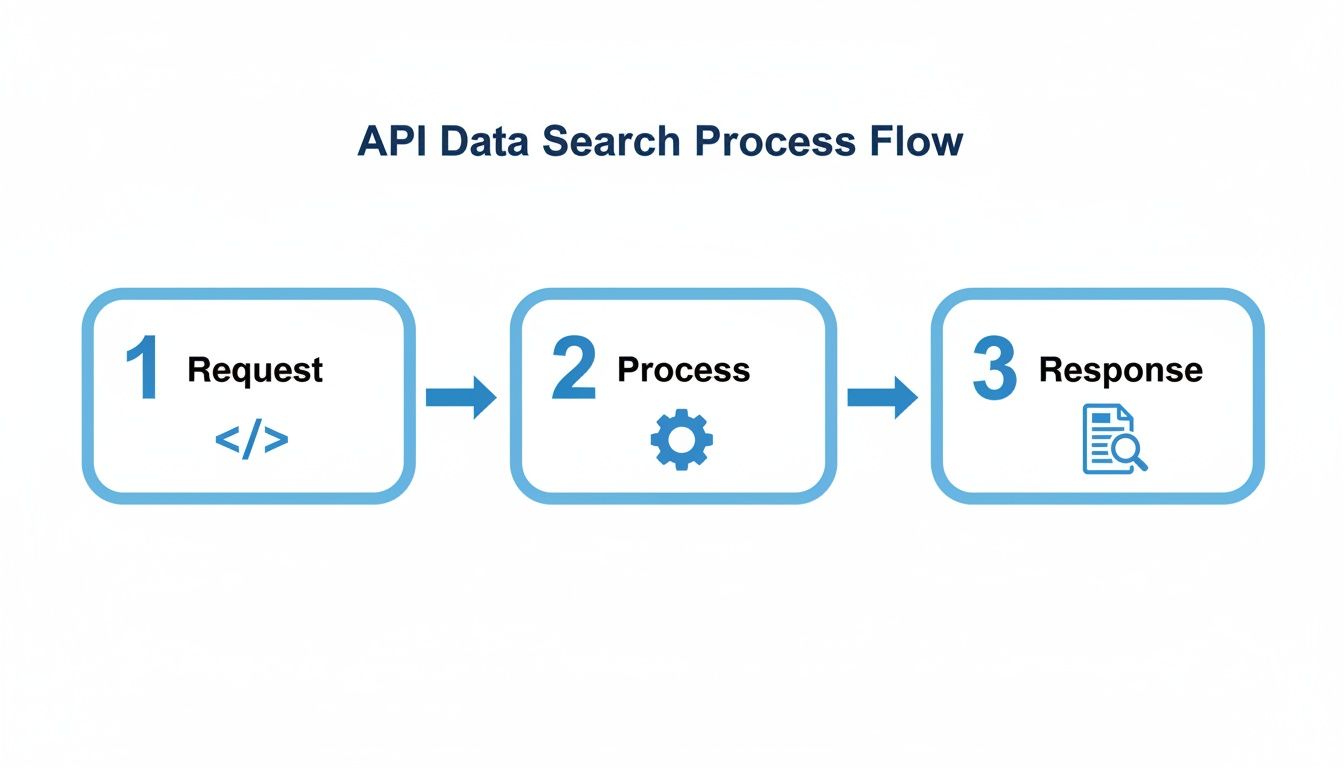
This simple request-process-response flow is fundamental for handling sensitive personal data in a compliant manner.
Actionable Compliance Steps
Partner exclusively with reputable data providers who are transparent about their data sources and compliance standards. They must clearly differentiate between their FCRA and non-FCRA datasets.
Maintain meticulous records. Documenting the specific, permissible purpose for every data access is your primary defense against compliance violations.
What Are the Most Common Questions About Finding Previous Addresses?
Key questions regarding legality, accuracy, and cost consistently arise when searching for address histories. Here are direct answers to the most frequent inquiries.
How Accurate Is Address History Data?
Data accuracy varies significantly by source. Free public records from a county assessor are generally reliable for property ownership but can lag behind real-time changes and will not include rental histories.
Professional data providers aggregate data from thousands of sources, including credit headers and utility records, creating a more complete and accurate profile. They often provide a confidence score indicating the certainty of a match between a person and an address.
No single data source is 100% perfect. The most effective strategy is to cross-reference data. Use a professional service to identify a probable address, then verify ownership dates using public property records.
Can I Find Previous Addresses for Free?
Yes, you can find previous addresses without cost, but it requires a significant investment of time.
- County Recorder/Assessor Websites: Search by name to find property deeds showing when an individual bought or sold a property.
- Advanced Google Searches: Use search operators to uncover data. A query like
"Jane Doe" + "123 Main St" + obituarycan reveal an old address in a public notice. - Social Media: Platforms like LinkedIn often list job histories with locations, providing clues for where to focus a public records search.
The challenge with free methods is that data is fragmented across countless sources. This approach is viable for a single search but is impractical at any scale.
What Is the Most Reliable Search Method?
For business applications requiring speed, accuracy, and dependability, a professional data provider with API access is the superior method. These platforms are built on massive, multi-source datasets that are continuously updated.
They deliver information in a structured format (JSON), allowing for direct integration into your systems. Most importantly, an API enables the processing of thousands of searches in the time it takes to perform a few manual lookups. This combination of data quality, speed, and scalability makes professional data services the industry standard for reliable address history searches.
For organizations that need accurate, scalable, and compliant address history data, BatchData offers a solution built for professionals. Get access to over 155 million U.S. property records and deep owner details through our fast APIs or bulk data delivery. Power up your underwriting, marketing, and due diligence workflows by visiting BatchData.io.