
The strongest general-purpose strategy is a diversified, policy-based portfolio with explicit concentration limits, risk budgets, independent valuation checks, and predetermined rebalancing rules, and the case is clearest over longer horizons, when 86.6% of U.S. large-cap funds underperformed their benchmark over five years. The right tactical overlays then depend on your mandate and liquidity, not on recent performance rankings.
Real estate portfolio management isn't a single allocation model. It's the operating system for deciding what to own, how much risk each position contributes, when valuations are stale, when exposure breaches policy, and whether capital should be deployed, held, or released. Effective teams combine strategic allocation with property-level monitoring across markets, debt, tenants, and cash flows.
- Construction first: Set targets, concentration limits, and liquidity reserves before you select assets.
- Risk visible daily: Track ownership, valuation, mortgage, lien, permit, and distress signals at property level.
- Action by rule: Rebalance, hold, or sell when a written threshold is crossed, not on impulse.
- Costs audited: Compare management and operating costs, including Destin property management fees, against net income.
The ten Portfolio Management Strategies below move from construction to risk control, monitoring, rebalancing, sourcing, and disposition.
1. Modern Portfolio Theory (MPT)
Modern Portfolio Theory builds a portfolio to maximize expected return for a given level of risk by combining assets whose returns don't move in lockstep. Harry Markowitz formalized that idea in his 1952 portfolio-selection framework, as summarized in Cambridge's treatment of diversification in modern portfolio theory. Risk depends on correlations between holdings, not only on each asset's volatility.
The diagram below maps the core components, assumptions, and data inputs behind that framework.
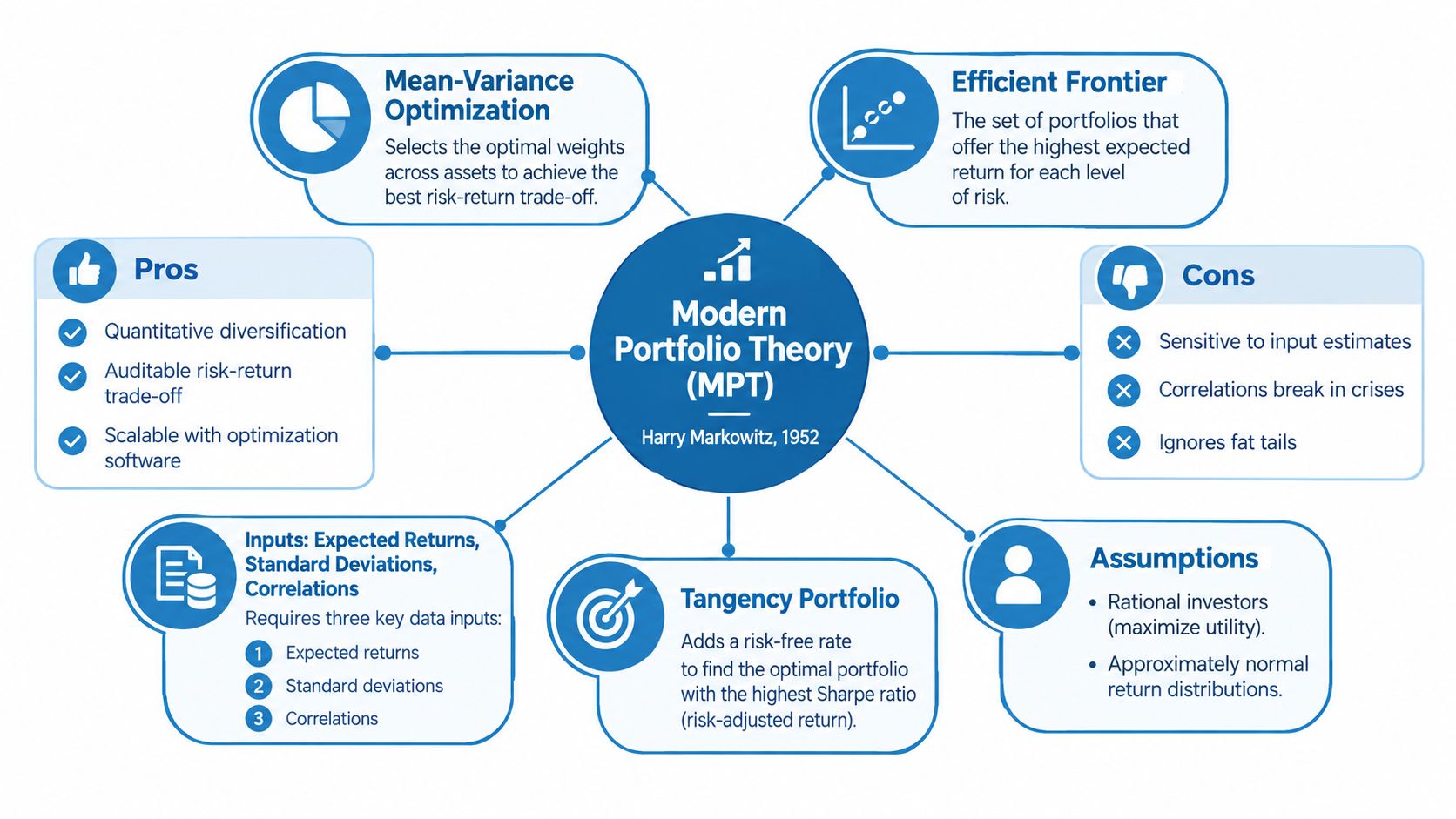
The output is the efficient frontier, the set of combinations offering the highest expected return for each risk level. In real estate, that means a warehouse, a multifamily block, and a short-lease retail unit shouldn't be judged alone. You judge how their rents, refinancing windows, and local employers move together, then constrain the optimizer so it doesn't pile into one property type.
How Teams Audit It
Practitioners now supplement variance with downside risk, stress testing, factor exposure, and liquidity checks, because appraisal-based returns smooth volatility and understate correlation in a crisis. That's where AI portfolio optimization for real estate becomes useful, provided inputs are current and constraints are explicit. Estimate returns from several methods, not trailing averages alone, and cap single-asset weights before you accept any output.
The short walkthrough below shows the mean-variance logic in practice.
2. Strategic Asset Allocation (SAA)
Strategic Asset Allocation sets a long-term target mix based on return objectives, risk tolerance, and time horizon, and you change it only when circumstances change. It's the first decision most institutions make because policy mix drives the risk you live with. Security or property selection happens inside that policy, not instead of it.
The consultation image below reflects where SAA starts, with goals and constraints agreed before holdings are chosen.

Write the Investment Policy Statement first. Specify target weights by asset class and, for real estate, by market, property type, financing band, and lease duration. Add drawdown limits, liquidity reserves, and who can approve an exception.
- Bands, not dates alone: Set rebalancing bands around each target so drift triggers review.
- Current assumptions: Test capital market assumptions against current yields and valuations, not only historical averages.
- Tax location: Coordinate placement with smart super and tax allocation tips where retirement accounts are part of the picture.
The Yale endowment model under David Swensen is the familiar institutional example, with heavy long-term allocations to alternatives and real assets. You don't need that scale to copy the discipline. You need written targets that survive a bad quarter.
3. Tactical Asset Allocation (TAA)
Tactical Asset Allocation temporarily shifts weights away from strategic targets to exploit valuation or momentum signals, then reverts when conditions normalize. It's a bounded deviation, not a new strategy. If you can't state the signal, the size limit, and the exit rule in advance, you're market timing without a policy.
Mebane Faber's rules-based work is a useful template because the rule is testable. An asset is held when price trend is positive and reduced when trend turns negative. Applied to real estate, you can't trade a building on a monthly signal, so the tactical lever is different. You slow acquisitions in a hot submarket, accelerate dispositions where pricing runs ahead of rent growth, or hold more cash for distressed buying.
Practical rule: Pre-commit the maximum tactical deviation and require two independent signals, such as trend and valuation, before you act.
Backtest any signal with transaction costs and realistic execution lags. A signal that looks clean on listed REITs may fail on direct property because sale timelines, financing contingencies, and appraisal lags destroy timing precision. Audit false positives separately. A rule that repeatedly pulls you out of recovering markets costs more than a rule that occasionally holds through weakness.
4. Core-Satellite Portfolio Strategy
Core-Satellite management splits the portfolio into a low-cost, broadly diversified core and concentrated satellite positions that carry active risk within a capped budget. The core captures market exposure cheaply. Satellites express specific views you can measure and, if needed, cut.
The binders below are a simple visual for that separation, one stable core file and several distinct active files.

In listed portfolios, a total-market fund often forms the core, with sector or factor funds as satellites. In direct real estate, stabilized multifamily or industrial holdings with durable income form the core. Value-add repositioning, a single-market bet, or a development exposure belongs in the satellite bucket, with its own return hurdle and loss limit.
Where It Breaks
Overlap is the common failure. A satellite that duplicates the core's largest tenants, lenders, or metro exposure adds concentration without adding a distinct return source. Audit holdings for overlap by market, tenant industry, debt maturity, and insurer, not only by property count.
Measure each satellite against its own benchmark and review whether it still earns its risk budget. If it doesn't, shrink it. The structure only works if the core stays boring.
5. Risk Parity
Risk parity allocates so each asset class contributes a similar amount of portfolio risk, rather than a similar dollar amount. Because lower-volatility assets contribute less risk per dollar, the method typically overweights them and may use borrowed capital to raise expected return. Bridgewater's All Weather approach popularized the principle for institutional allocators.
That trade-off is what you must stress test. When stocks and bonds fall together, a portfolio built on their historical diversification can lose on both sides at once. Real estate adds a third problem: stale valuations that make risk look lower than it is until transactions force a repricing.
- Rolling risk estimates: Recalculate contributions on a rolling window and investigate drift, don't set weights once.
- Financing terms: Prefer transparent, term-matched borrowing over loans you can lose in stress.
- Common-cause scenarios: Test refinancing, insurance repricing, and local employment shocks together, using market risk analytics for property portfolios to surface shared exposures.
A portfolio can show lower measured volatility while becoming more fragile if marks are stale and exposures are grouped too coarsely.
For property-heavy portfolios, risk parity is best used as a diagnostic, not a mechanical weighting rule. It tells you which bucket drives losses.
6. Factor Investing (Smart Beta)
Factor investing tilts toward characteristics that have historically explained returns, such as value, size, momentum, quality, and low volatility. Rules-based funds package those tilts without active stock selection. The discipline is in defining the factor clearly and holding it through periods when it lags.
Institutional ESG work shows how a factor should be tested rather than assumed. In the 2024 Stanford, Hoover Institution, and MSCI Sustainability Institute survey, 67% of investors treated ESG as one of multiple inputs and 68% ranked governance as the most important dimension. That's factor thinking applied to governance quality, integrated into selection and monitoring instead of used as a binary screen.
Apply the same test to real estate factors. Define value as price relative to replacement cost or in-place income, quality as tenant credit and lease term, and momentum as rent and transaction trends by submarket. Then measure whether the tilt improves downside capture and risk-adjusted return after controlling for sector and region.
Implementation Checks
- Verify exposure: Confirm you own the factor, don't rely on a fund or deal label.
- Combine factors: Pair uncorrelated tilts, such as value and momentum, to smooth cycles.
- Size for patience: Position size must let you hold through multi-year underperformance.
7. Passive Index Investing
Passive index investing replicates a market index and accepts index return minus fees instead of trying to beat the market. It's the benchmark discipline every active decision should have to justify itself against. If an active property strategy can't beat a diversified, low-cost alternative after fees, risk, and illiquidity, it hasn't earned its complexity.
The SPIVA evidence explains why. S&P Dow Jones Indices launched the scorecard in 2002, and figures summarized in SPIVA research on active versus passive performance show 60.9% of U.S. large-cap funds underperformed over one year and 79.8% over three years. Short-term winners also frequently fail to repeat, which undermines manager selection based on recent rankings.
That doesn't make passive universally optimal. Active management can serve tax, liability-matching, liquidity, or control objectives that an index can't. Direct real estate is active, you choose the asset, financing, tenant, and exit. The passive lesson still applies, control costs, diversify broadly, and evaluate over long horizons.
Compare expense ratios among funds tracking the same index and check tracking difference, not headline fee alone. For property exposure, compare net returns against a stated benchmark after management, maintenance, vacancy, and selling costs.
8. Systematic Rebalancing (Calendar and Threshold Methods)
Systematic rebalancing restores a portfolio to target weights after market movements cause drift, either on a schedule or when a threshold is breached. The SEC definition of rebalancing and asset allocation stresses selling overweight holdings, buying underweight holdings, or directing new money to underweight categories. It also warns that taxable sales can create capital-gains tax and fees.
Threshold rules link action to risk, not the calendar. Vanguard describes examples in its guidance on threshold-based rebalancing, where a 60% equity target with a 5-percentage-point band triggers review below 55% or above 65%. A published analysis summarized by WealthManagement.com on annual monitoring with a 5% threshold reported 9.8% annualized volatility and 1.6% annual turnover for the tested approach.
A Workable Property Rule
For real estate, rebalance with cash flows first. Direct new capital, retained income, and sale proceeds to underweight markets before you force a sale, and read dynamic rebalancing versus static hold for property returns before assuming frequent trading helps. FINRA makes the same point for listed portfolios in its guidance on diversification among and within asset classes, redirect contributions first and account for fees and tax.
9. Liability-Driven Investing (LDI)
Liability-driven investing structures assets to match the timing and size of future cash obligations rather than to beat a market benchmark. Pension plans and insurers use it to hedge rate and inflation risk. Real estate owners have liabilities too, debt maturities, capital calls, tax, insurance, and planned capital expenditure, and they rarely arrive when selling is convenient.
The planning image below captures the core task, matching asset cash flows to a schedule you already owe.

Liquidity is where LDI succeeds or fails. Survey findings in Schroders global investor research on liquidity show 47% of investors say liquidity differences between public and private markets are becoming more important, while 61% identify managing client expectations around liquidity as the biggest challenge when adding alternatives. Cash isn't just drag here. It's decision-making capacity during stress.
Build a liquidity runway from recurring obligations, debt maturities, expected distributions, and realistic sale timelines. Stress it for falling rent, insurance repricing, margin or collateral calls, and delayed private-market distributions. If the runway depends on selling a property quickly at the appraised value, you don't have a runway.
10. Core-Plus Real Estate Portfolio Strategy
Core-plus real estate holds mostly stabilized, income-producing properties with modest debt and adds a minority of assets needing light repositioning to lift return. Core income pays the bills. The plus element, lease-up, modest renovation, or operational improvement, provides the incremental return, and it must be underwritten property by property.
Data quality determines whether that underwriting is defensible. A 2023 BNP Paribas survey of 420 institutional participants, reported in its global ESG survey findings, found 65% compare multiple data sources to address data challenges. Apply that directly to property, reconcile appraisals with automated valuations, recent transactions, permits, liens, and listing signals before you trust a mark.
Hidden concentration is the other core-plus risk. Research discussed in the Northern Trust global asset owner peer study highlights concentrations that appear when public and private exposures are viewed together. Your properties may span several cities yet share one lender, insurer, flood exposure, employer base, or refinancing window.
- Leverage discipline: Keep core borrowing modest enough that income covers debt when rates rise.
- Valuation checks: Flag stale appraisals when market signals move and the book value doesn't.
- Sensitivity tables: Model value changes as cap rates and rent assumptions move.
Benchmark the result against an institutional core index and explain variance by income, valuation, debt, and fees.
10 Portfolio Management Strategies Compared Side by Side
| Strategy | 🔄 Implementation Complexity | ⚡ Resource Requirements | 📊 Expected Outcomes | ⭐ Key Advantages | 💡 Ideal Use Cases |
|---|---|---|---|---|---|
| Modern Portfolio Theory (MPT) | High: requires modeling and optimization | Return, volatility, and correlation data; optimization software | Efficient portfolios balancing expected return and risk | Quantifies diversification and risk-return trade-offs | Portfolio construction across multiple assets |
| Strategic Asset Allocation (SAA) | Low to moderate: set targets and review periodically | Long-term market assumptions; investment policy and monitoring | Stable long-term exposure aligned with objectives | Encourages discipline and provides a clear benchmark | Investors with long horizons and defined risk tolerances |
| Tactical Asset Allocation (TAA) | High: requires signals, rules, and ongoing monitoring | Market data, research, and trading capacity | May reduce drawdowns or capture short-term opportunities; results vary | Adds a systematic response to changing conditions | Liquid portfolios where bounded short-term shifts are practical |
| Core-Satellite Portfolio Strategy | Moderate: manage a broad core and smaller active positions | Low-cost diversified funds, satellite research, and monitoring | Broad market exposure with potential for targeted excess returns | Limits active risk while allowing focused investments | Investors seeking a low-cost base with selected active views |
| Risk Parity | High: requires risk modeling and potentially leverage | Volatility and correlation data; derivatives or borrowing access | Balances risk contributions across asset classes | Reduces reliance on any single asset class for portfolio risk | Institutional investors able to manage leverage and liquidity |
| Factor Investing (Smart Beta) | Moderate to high: select, combine, and monitor factors | Factor data, rules-based funds, and periodic analysis | Systematic exposure to factors that may earn premiums over time | Transparent, rules-based alternative to traditional active selection | Investors seeking diversified factor exposure over long periods |
| Passive Index Investing | Low: select and hold index-tracking funds | Benchmark funds and basic monitoring | Returns broadly track the index, less fees | Simple, transparent, and typically low-cost | Investors seeking broad market exposure without market timing |
| Systematic Rebalancing | Low to moderate: establish schedule or drift thresholds | Portfolio tracking, trading, and tax-aware procedures | Restores target risk exposure; may control portfolio drift | Applies a consistent buy-low, sell-high discipline | Portfolios with defined target allocations |
| Liability-Driven Investing (LDI) | High: requires liability modeling and specialist oversight | Liability forecasts, duration analysis, derivatives, and liquidity reserves | Reduces sensitivity of funding levels to interest-rate and inflation changes | Aligns assets with future obligations | Pension plans, insurers, and other institutions with defined liabilities |
| Core-Plus Real Estate Portfolio Strategy | Moderate to high: requires property selection and asset oversight | Real estate capital, valuation data, property management, and financing | Income-focused returns with added potential from modest repositioning | Combines relatively stable assets with limited improvement opportunities | Institutional investors seeking real estate income with measured growth potential |
Build a Portfolio That Can Explain Its Next Move
The best strategy is the one that survives changing conditions because its rules are written down, its data is current, and its risk is visible at property level. That sentence is easy to agree with and hard to operate. Most portfolios fail earlier, at the point where a target allocation exists on paper but nobody can say which properties breach it, which valuations are stale, or which debt maturity forces the next decision.
Start with policy, not product. Define concentration limits by market, property type, tenant, lender, and maturity year. Set debt thresholds, a minimum liquidity reserve, approved valuation sources, performance benchmarks, and rebalancing bands that trigger review. Write down who owns each decision and what evidence is required before capital moves.
Then separate monitoring from trading. You should monitor frequently and trade deliberately, because property transaction costs and timelines punish churn. Automated alerts for ownership changes, valuation shifts, mortgage and lien events, permits, listings, and pre-foreclosure activity let a small team watch a large portfolio without manual spreadsheet work. The alert isn't the decision. It's the prompt to check the alert against policy.
Audit the data behind those alerts as rigorously as the assets. Record source provenance, update frequency, missing fields, and how conflicts between sources are resolved. Separate normalized property records from derived risk scores and from decision outputs such as watchlists or rebalance recommendations, so investment, compliance, and risk teams can trace why a property was flagged. A signal you can't explain won't survive an investment committee, and it shouldn't.
Apply the same discipline to performance review. Compare net results with the benchmark you chose at the start, after fees, vacancy, maintenance, financing, and tax where relevant. Context from other markets, including real estate return rates in Israel, can inform assumptions, but it doesn't replace your own property-level cash-flow record. Attribute variance plainly. If outperformance came from borrowed funds or one lucky sale, say so, and don't budget for it to repeat.
BatchData can support that workflow with 155M+ U.S. property records, valuations, verified owner contacts, daily updates, and APIs and bulk delivery for underwriting, monitoring, due diligence, and lead generation. That's infrastructure, not a strategy. Your strategy is the set of limits and responses you commit to before the next alert arrives.
Run the next review around three questions. What changed in the portfolio since the last review? Which written policy threshold, if any, was crossed? What action, buy, hold, fix, refinance, or sell, has the highest risk-adjusted value after costs and liquidity? If your team can answer all three with current property-level evidence, your Portfolio Management Strategies are working as a system. If it can't, fix the data and the policy before you add another asset.
Put that system into practice with property, ownership, valuation, mortgage, lien, permit, and listing data your team can monitor and audit every day. Visit BatchData to explore its portfolio monitoring APIs and bulk data delivery for underwriting, risk review, and acquisition decisions.