



Data matching identifies records that refer to the same real-world entity across datasets. The main approaches are deterministic matching for exact identifiers, probabilistic matching for incomplete evidence, and fuzzy matching for similar but nonidentical values.
A county assessor may list “John A. Smith”, an MLS export may show “J. Andrew Smith,” and a marketing database may contain “J Andrew Smyth.” Before your team mails an offer, it needs to decide whether those records describe one owner, several people, or an unsafe assumption.
That decision is the practical meaning of what is data matching. It connects records for the same person, property, organization, address, or transaction, while accounting for missing fields, inconsistent formats, ownership structures, and uncertainty.
At a glance:
- Deterministic matching joins records through an exact, trusted identifier.
- Probabilistic matching combines several imperfect signals and estimates match likelihood.
- Fuzzy matching measures similarity between values with spelling or formatting differences.
- Blocking limits candidate pairs so large datasets remain computationally manageable.
- Precision and recall determine whether your workflow should prioritize avoiding wrong links or finding more possible links.
- Human review and audit trails keep uncertain decisions from becoming invisible data errors.
For a real estate team, matching isn't a generic cleanup step. It's a domain-specific decision about whether tax, assessment, ownership, contact, listing, and portfolio records belong together.
Why Real Estate Teams Need Data Matching
A county assessor lists Robert J Smith as the owner of a parcel. A contact file contains R J Smith Jr, while an older ownership record says Bob Smith. The acquisitions team wants to know whether to send one offer, several offers, or none at all.
Data matching is the discipline of deciding whether those records refer to the same owner, parcel, property, or transaction across separate datasets. The output should be more useful than a list of possible duplicates. It should give the team a trusted identity view, the evidence behind each linkage, and a clear treatment for uncertainty.
Without an explicit matching process, operators usually fall into predictable traps:
- Fuzzy eyeballing: An analyst links records based on intuition, but the decision can't be reproduced or audited.
- Duplicate outreach: Several source records trigger separate campaigns to the same owner.
- Skipped opportunities: A legitimate owner is missed because the name or address doesn't match exactly.
- Contaminated portfolios: Unrelated owners or properties are merged into one entity.
The cost isn't limited to inconvenience. Industry sources commonly report that CRM databases without active data-quality controls often contain 20% to 30% duplicates, while duplicate records affect roughly 10% to 30% of healthcare records. Gartner-cited estimates place the annual cost of poor data quality at about $12.9 million to $15 million per enterprise. These figures are discussed in Data Ladder's explanation of data matching.
Ownership is not a simple name field
Real estate creates ambiguity that generic deduplication rules often miss:
- A revocable trust may hold title while a person appears in a contact system.
- An LLC may own several parcels under variations of its legal name.
- Several owners may hold partial interests as tenants in common.
- Historical transfers can leave older owner names attached to current property records.
- An absentee owner may have a mailing address unrelated to the property address.
Practical rule: Match the relationship your workflow needs, not just the text that looks similar.
A property-monitoring workflow may need to preserve multiple parcels under one ownership entity. A mailing workflow may need a validated contact identity. A compliance workflow may require a high-confidence link with documented evidence. Those are different decisions, even when they use some of the same source fields.
Deterministic, Probabilistic, and Fuzzy Matching Explained
Deterministic matching requires exact agreement on a selected identifier, probabilistic matching weighs multiple fields to estimate whether two records belong together, and fuzzy matching measures similarity when values differ slightly.
The field has formal roots in administrative and public-health research. Halbert L. Dunn's 1946 paper, “Record Linkage,” is commonly treated as an early foundation, followed by Howard Borden Newcombe's probabilistic work in 1959 and the 1969 Fellegi-Sunter theory, which formalized match and non-match decisions under uncertainty. This history is summarized by Semarchy's overview of data matching.
| Method | Input Requirements | Output Type | Confidence Range | Best Use Case |
|---|---|---|---|---|
| Deterministic | A stable identifier that agrees exactly, such as a parcel ID | Binary match or non-match | Usually high when the identifier is authoritative | Linking the same parcel across systems |
| Probabilistic | Multiple fields with missing, inconsistent, or conflicting values | Match, non-match, or review classification with a likelihood score | Variable, based on evidence and thresholds | Linking owners across tax, contact, and historical records |
| Fuzzy | Similar text or address values that aren't identical | Similarity score or candidate match | Variable, and not a verdict by itself | Handling typos, abbreviations, punctuation, and word-order changes |
Deterministic matching
A deterministic rule might join records when a parcel identifier agrees exactly after normalization. It's fast, explainable, and easy to audit. It also fails immediately when the identifier is missing, reformatted, mistyped, or absent from one source.
Deterministic logic works best when the identifier represents the same object across systems and has strong stewardship behind it. It shouldn't be treated as universally reliable because the output looks binary.
Probabilistic matching
Probabilistic matching compares several attributes, assigns weights based on how strongly they distinguish matches from non-matches, computes a match probability, and applies thresholds. Pairs above the auto-match threshold can be linked, pairs below the non-match threshold can remain separate, and borderline pairs can enter human review. Record linkage documentation describes this general model.
For real estate, the evidence might include owner name, mailing address, parcel information, entity type, and ownership history. A similar name alone may be weak evidence. A similar name combined with a consistent mailing address and compatible parcel context can be much stronger.
Fuzzy matching
Fuzzy matching handles values that are close but not equal. Common techniques include Levenshtein distance and Jaro-Winkler, which can absorb spelling variation, transposition, and formatting drift. RudderStack's guide to data matching techniques explains this similarity-based approach.
The right choice depends on the problem:
- Use deterministic matching for reliable parcel or source identifiers.
- Use probabilistic matching when several incomplete signals must be combined.
- Use fuzzy matching inside a controlled workflow for names, addresses, and entity names that vary in form.
How Matching Pipelines Actually Scale
A naïve matcher compares every record in one dataset with every record in another. Because pairwise comparison grows quadratically, that approach becomes impractical as parcel, owner, listing, and contact datasets expand.
The standard solution is blocking. Blocking first creates smaller candidate groups using shared characteristics, then a similarity model scores only the pairs inside those groups. Real estate teams might block by parcel ID prefix, postal area, normalized address components, surname prefix, or geocoded location bucket.
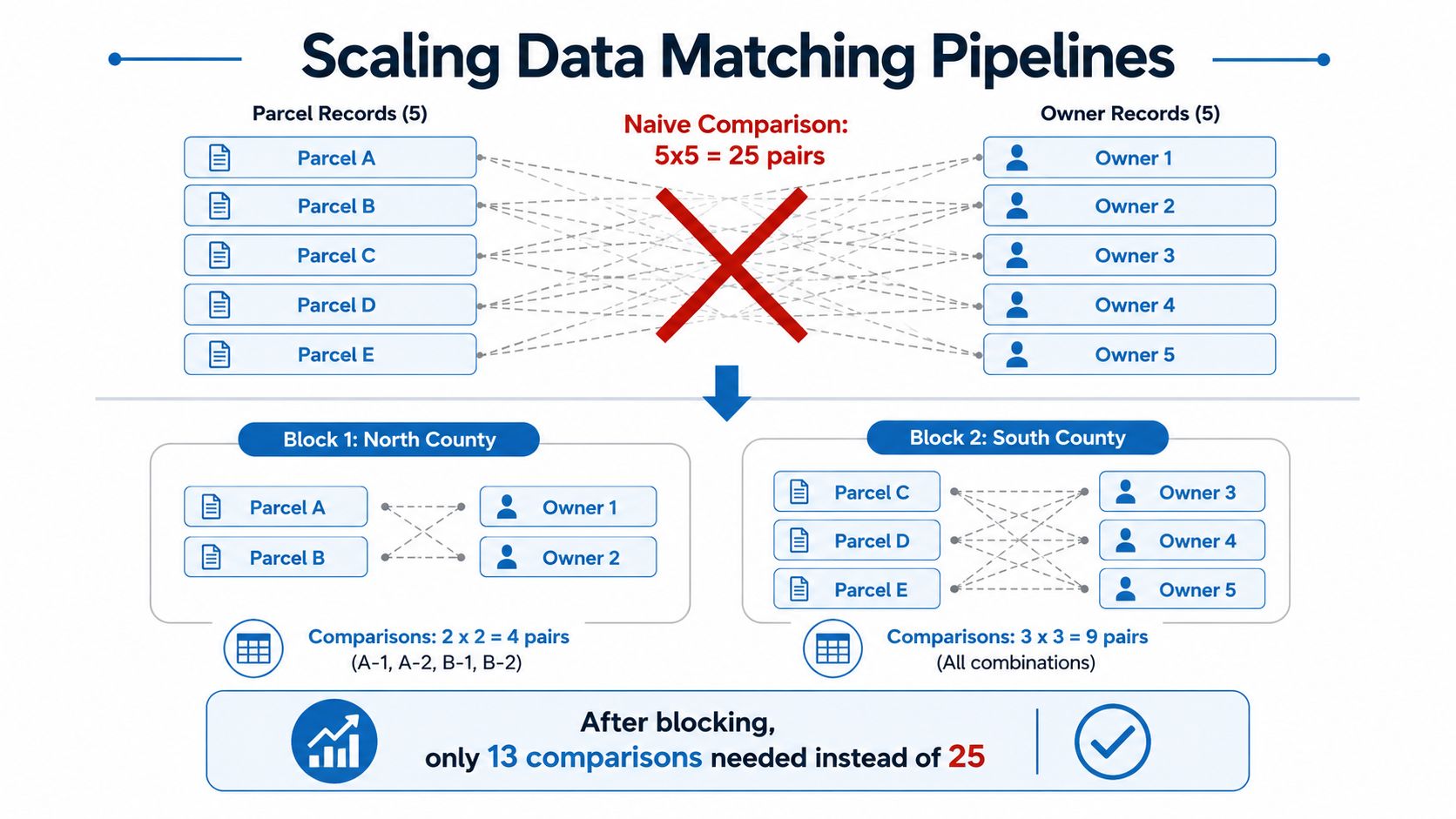
Blocking can reduce comparisons by 99% or more, and some learned blocking systems operate on only 0.05% to 1% of the full comparison space, according to Zingg's discussion of entity resolution at scale. That reduction is what makes large-batch and near-real-time matching feasible.
Candidate generation is a recall decision
A blocking key isn't just a performance setting. It determines which true pairs are even allowed to reach the scoring stage.
Blocking only on last name and postal area is quick, but it can exclude LLCs, trusts, abbreviated entities, and owners whose mailing addresses differ from the property location. A stronger pipeline uses multi-pass blocking, such as:
- Parcel identifier or normalized address.
- Owner name and postal area.
- Entity name and registered address.
- Ownership or transfer relationships.
- A broader fallback block for unresolved records.
Each pass catches a different class of relationship. The pipeline can then score duplicate candidates and consolidate confirmed relationships with a clustering method such as union-find, while preserving the source records and decision evidence.
Data teams also need to classify source fields before selecting blocking keys. A practical reference on data classification for business owners can help teams distinguish sensitive, operational, and identifying information before those fields enter a matching workflow.
The blunt lesson is simple: fast matching with poor blocking can produce confident incompleteness. A pipeline may run efficiently while missing entire categories of owners.
Real Estate Matching Challenges You Cannot Ignore
A public record may show Robert J Smith, another source may list R J Smith Jr, and a contact file may use Bob Smith. Exact equality sees three values. A human sees a plausible relationship, but a matcher still needs supporting evidence before it links them.
Real estate records create these conflicts constantly. Address formats change by county and source. Directionals may appear before or after a street name. Unit identifiers can look like apartment numbers in one dataset and lot numbers in another. Punctuation, abbreviations, county conventions, and mailing-address fields all create variation that has nothing to do with a change in ownership.
The ownership graph is more complicated than the record
A single person can appear under a maiden name, a married name, an estate-related name, or a nickname. A deceased owner can remain in historical records. A trust or LLC may appear as the legal owner while a person appears only in a contact or management record.
Multi-parcel holdings create another problem. The same owner may control several parcels, but identical names don't prove that every record belongs to one person. Conversely, a shared name can cause a naïve matcher to merge unrelated owners. The system needs property context, entity type, address evidence, and temporal logic.
| Challenge | Why It Breaks Matching | Recommended Fix |
|---|---|---|
| Name variants | Exact comparison misses initials, nicknames, suffixes, and spelling changes | Normalize names, compare multiple fields, and route ambiguity to review |
| Address-format drift | The same address can use different directional, unit, punctuation, or abbreviation conventions | Standardize components before similarity scoring |
| LLCs and trusts | Legal entities may represent people, portfolios, or ownership structures differently across sources | Model entity relationships instead of flattening everything into one name |
| Multi-parcel holdings | One owner can legitimately connect to many parcels | Cluster by supported ownership relationships and preserve parcel-level detail |
| Historical transfers | Old ownership records may be valid historically but wrong for current outreach | Add effective dates and separate current from historical relationships |
| Shared names | Similar names can belong to unrelated owners | Require corroborating address, parcel, entity, or contact evidence |
These aren't edge cases. They are the steady state of property data. A matcher that ignores them can double-bill an owner, miss an absentee owner, or fold unrelated LLCs into a single cluster.
For a deeper operational treatment of normalization, survivorship, and review workflows, use this real estate data deduplication guide. The important design choice is to preserve uncertainty rather than hide it inside a merged master record.
Precision, Recall, and Confidence Scores Demystified
Precision asks whether the matches your system produced are correct. Recall asks whether your system found the true matches that exist. F1 combines both into a single balance, but the right balance still depends on what the real estate team will do with the output.
A useful operational translation looks like this:
- High precision: Few unrelated owners or properties are linked.
- High recall: More legitimate relationships are discovered.
- False positive: Two different owners or properties are incorrectly merged.
- False negative: A real relationship is missed.
- Confidence score: The model's estimate of how strongly the available evidence supports a match.
A probabilistic evaluation cited in the research reported 98.3% true-match detection with 0.7% false links, while a newer patient-linkage study found F1-scores above 0.82 across demographic strata and up to 0.99 for some groups. These findings come from different domains and shouldn't be copied directly into a property workflow. They demonstrate that data completeness and field quality can materially affect results, even when the matching method is strong. See the probabilistic patient-linkage evaluation for the cited evidence.
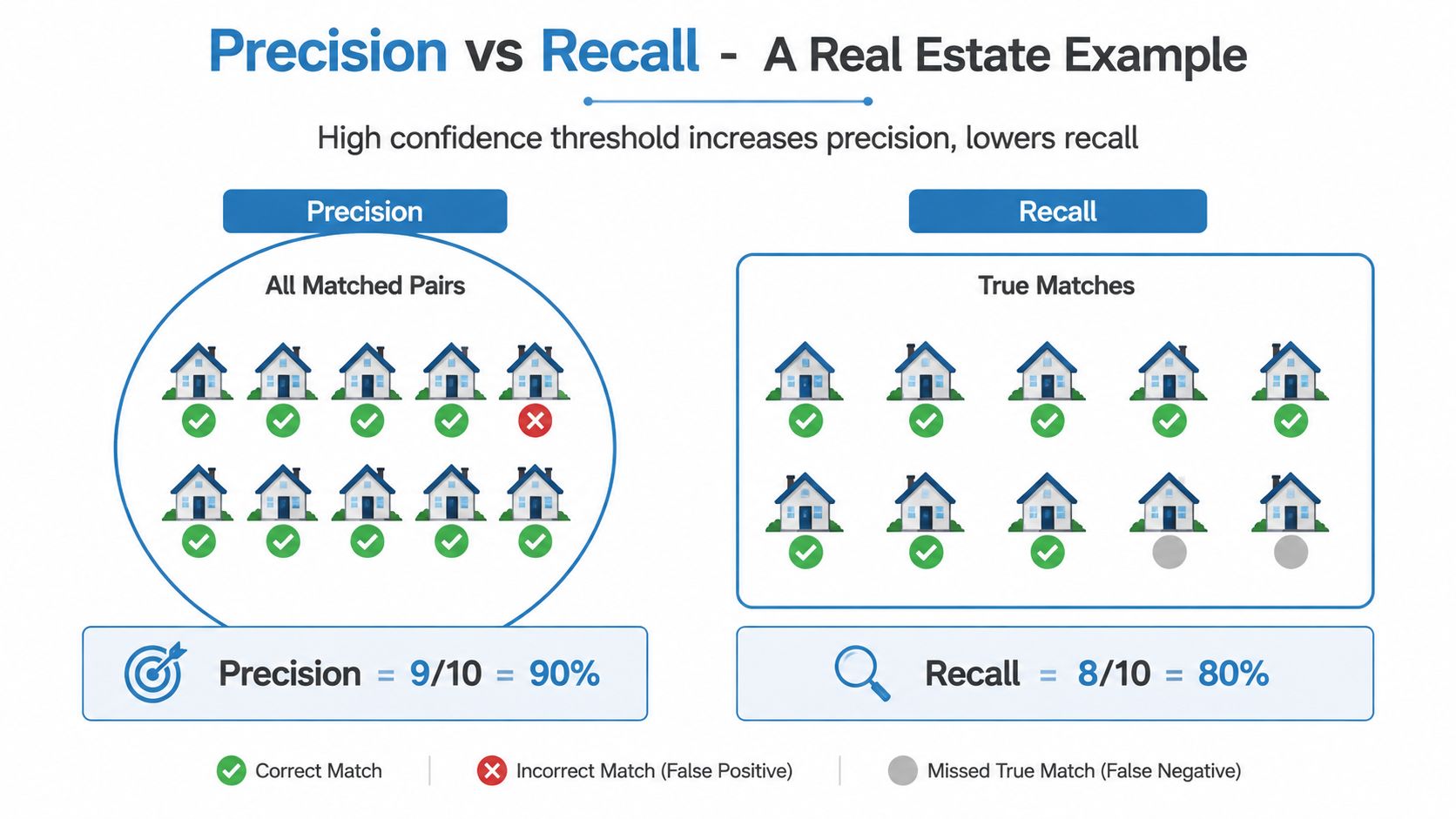
Thresholds must follow the consequence
A 0.95 confidence band may be suitable for routing a likely owner to skip tracing, where the next step includes additional verification. A 0.80 score might be acceptable for marketing-list hygiene but too weak for a legal mailing or compliance-grade owner identification. Those values are policy examples, not universal accuracy guarantees.
| Use Case | Risk Profile | Threshold Direction | Review Expectation |
|---|---|---|---|
| Owner append | Moderate uncertainty | Favor strong precision while retaining useful coverage | Review unresolved or conflicting records |
| Absentee-owner detection | Missed relationships can reduce reach | Allow more recall, but require property and address context | Review borderline owner-property links |
| Portfolio clustering | Incorrect merges distort holdings | Favor precision and relationship evidence | Review clusters with shared names or entities |
| Compliance-grade identification | Wrong identity can create legal exposure | Use a high-confidence threshold | Require documented evidence and human approval |
One cited electronic-record study reported 0.76 recall, 1.0 precision, and a 1.9% manual-review size. That combination illustrates a strict workflow: the accepted matches were highly precise, but the system did not capture every true relationship. Tilores' explanation of precision and recall in identity resolution provides that example.
Confidence scores also need monitoring. County formats, vendors, ownership practices, and source completeness change over time. Confidence scoring in data workflows is useful background, but your team should validate thresholds against labeled property records and downstream risk.
Evaluating a Matching Service or API the Right Way
Evaluate a matching API on your records and decision standards, not on a vendor's headline match rate. A service should show what evidence supports each relationship, how it handles unresolved pairs, and what happens when source records change.
Start with a controlled test:
- Request known pairs. Ask for a ground-truth test set containing confirmed matches and confirmed non-matches.
- Sample your own portfolio. Include trusts, LLCs, multi-parcel owners, address variants, historical transfers, and shared names.
- Measure precision and recall. Count wrong links and missed links separately. A single match-rate number can't reveal the tradeoff.
- Inspect borderline records. Review the pairs nearest your proposed threshold. They expose whether the score behaves sensibly.
- Test reprocessing. Update source fields and confirm that the service can revise relationships without creating duplicate identities.
Integration details decide production reliability
Developers should test more than the matching algorithm:
- Idempotency: Repeating the same request shouldn't create new identities or duplicate relationships.
- Rate limits: The service should document request limits and failure responses.
- Batch performance: Confirm that bulk jobs complete within your operational window.
- Latency: Measure response time for interactive lookups separately from batch processing.
- Auditability: Store source values, scores, rules, timestamps, and review decisions.
- Identity stability: Determine whether the service returns deterministic owner IDs or opaque clusters that can change unexpectedly.
- Update behavior: Check how re-matching works when an owner changes address, an LLC changes status, or a parcel transfers.
A provider such as BatchData can be evaluated through the same lens. Its matching-related capabilities include confidence scoring, deterministic owner IDs, and batch endpoints, so a real estate team should test those outputs against its own labeled records before putting them into production. For implementation context, see the identity resolution API overview.
Teams comparing data suppliers may also consult a practical guide to best Bright Data alternatives, but the selection criteria remain the same: evidence quality, documentation, stable identifiers, operational fit, and measurable error behavior.
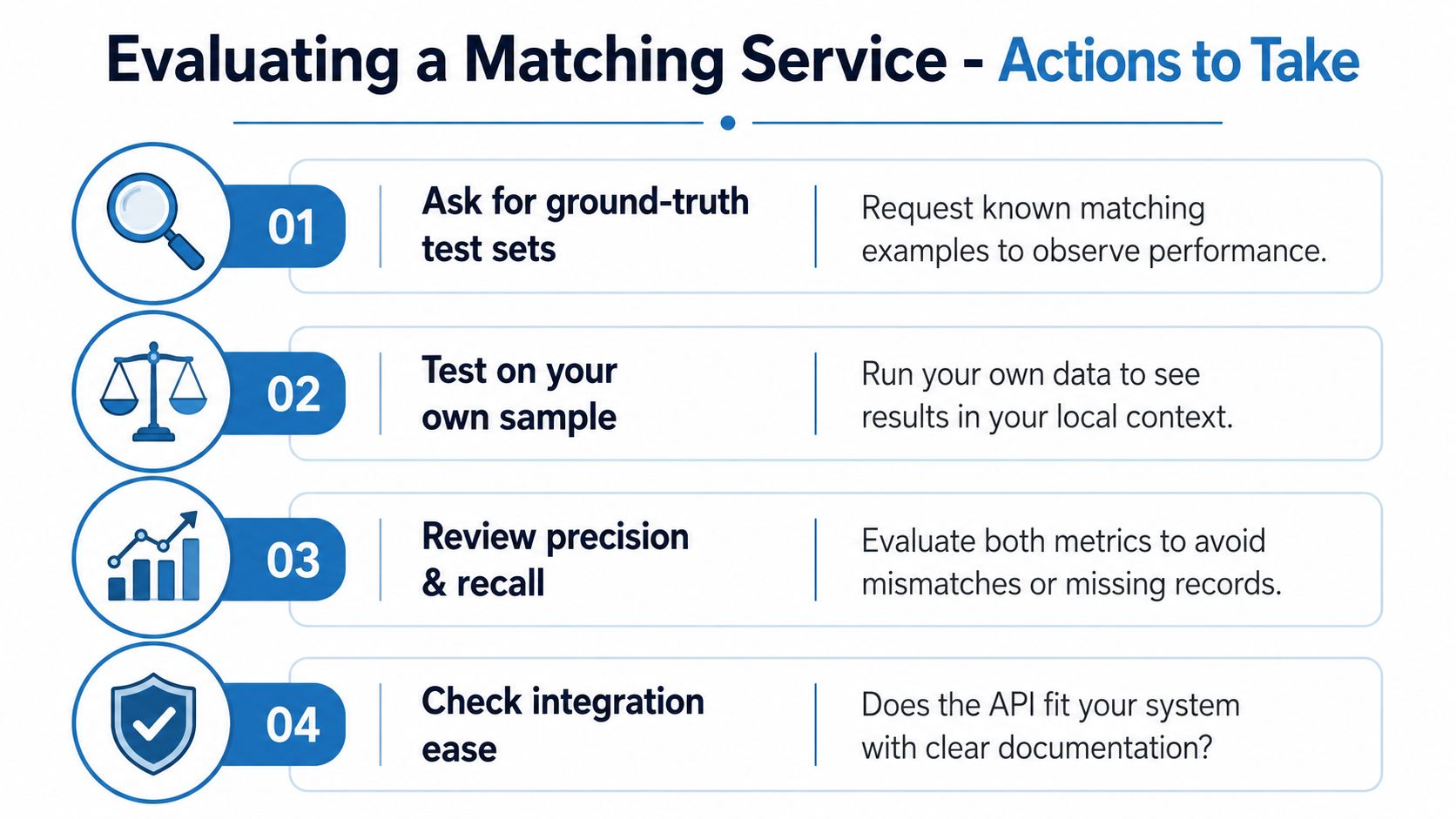
Don't approve an API because it returns a confident-looking answer. Approve it when your team can explain why the answer was produced, reproduce it later, and reverse it when new evidence appears.
The Privacy Shift Reshaping Matching Strategy
Privacy requirements are pushing matching workflows toward deterministic, first-party, and consent-aware evidence. Third-party identifiers can disappear, permissions can narrow, and a team may no longer have a lawful or durable basis for retaining every signal used by a broad identity graph.
That changes the engineering tradeoff. A probabilistic-heavy workflow may find useful connections across sparse records, but it can become harder to explain, harder to maintain, and more exposed when third-party identifiers are withdrawn. A deterministic-first workflow may leave some cold records unresolved, yet it provides clearer provenance and a more defensible basis for action.
Build around evidence you can govern
Real estate teams should separate identity resolution from activation. A possible owner link isn't automatically permission to contact that person, enrich a profile, or use the relationship for a sensitive decision.
Use a hierarchy of evidence:
- First-party identifiers: Prioritize identifiers collected directly through a documented relationship or approved workflow.
- Consent-bearing signals: Preserve the consent status and purpose attached to the data, not just the value itself.
- Offline property evidence: Use parcel, ownership, assessment, and transfer information with clear source provenance.
- Residual uncertainty: Treat unresolved or weakly supported links as a review or compliance state, not as an invitation to guess.
Recent industry coverage describes identity resolution as increasingly important for privacy compliance and projects the identity resolution software market at USD 1.8 billion in 2026, growing to USD 4.48 billion by 2031 at a 20.01% CAGR. Those figures are market projections from Mordor Intelligence's identity resolution software report, not a guarantee about any particular real estate platform.
A durable system should degrade gracefully. If an identifier disappears, the workflow should preserve the last supported relationship, mark the evidence as stale or incomplete, and prevent automatic escalation into a higher-risk action. That's better than substituting a weaker signal and presenting the result as certain.
Matching Checklist for Real Estate Operators
Before deployment, make these decisions explicit. A matching workflow becomes governable when the team can point to a rule, metric, owner, and fallback for every important choice.
- Define the match goal: Decide whether the workflow links parcels, owners, entities, contacts, transactions, or portfolio relationships.
- Choose the method by data quality: Use deterministic rules for authoritative identifiers, fuzzy methods for controlled text variation, and probabilistic scoring when several incomplete signals must be combined.
- Set use-case-specific targets: Marketing, skip tracing, portfolio clustering, and compliance don't carry the same cost of error. Select precision and recall priorities accordingly.
- Select real estate blocking keys: Include parcel, owner, address, entity, and historical context where appropriate. Don't rely on a generic surname block.
- Require per-pair evidence: Store the fields compared, the score, the method, the source, and the decision timestamp.
- Create a review state: Borderline pairs shouldn't be forced into match or non-match. Give trained reviewers the authority to confirm, reject, or defer.
- Confirm lawful use: Verify the purpose, consent posture, retention policy, and permitted downstream action before using personal identifiers.
- Monitor drift: Track match rates, precision, recall, review volume, and recurring error patterns over time. Review the workflow quarterly.
- Document identifier loss: Specify what happens when a parcel identifier, contact value, address, or third-party signal disappears.
- Protect reversibility: Keep source records and merge history so an incorrect relationship can be undone without destroying the evidence.
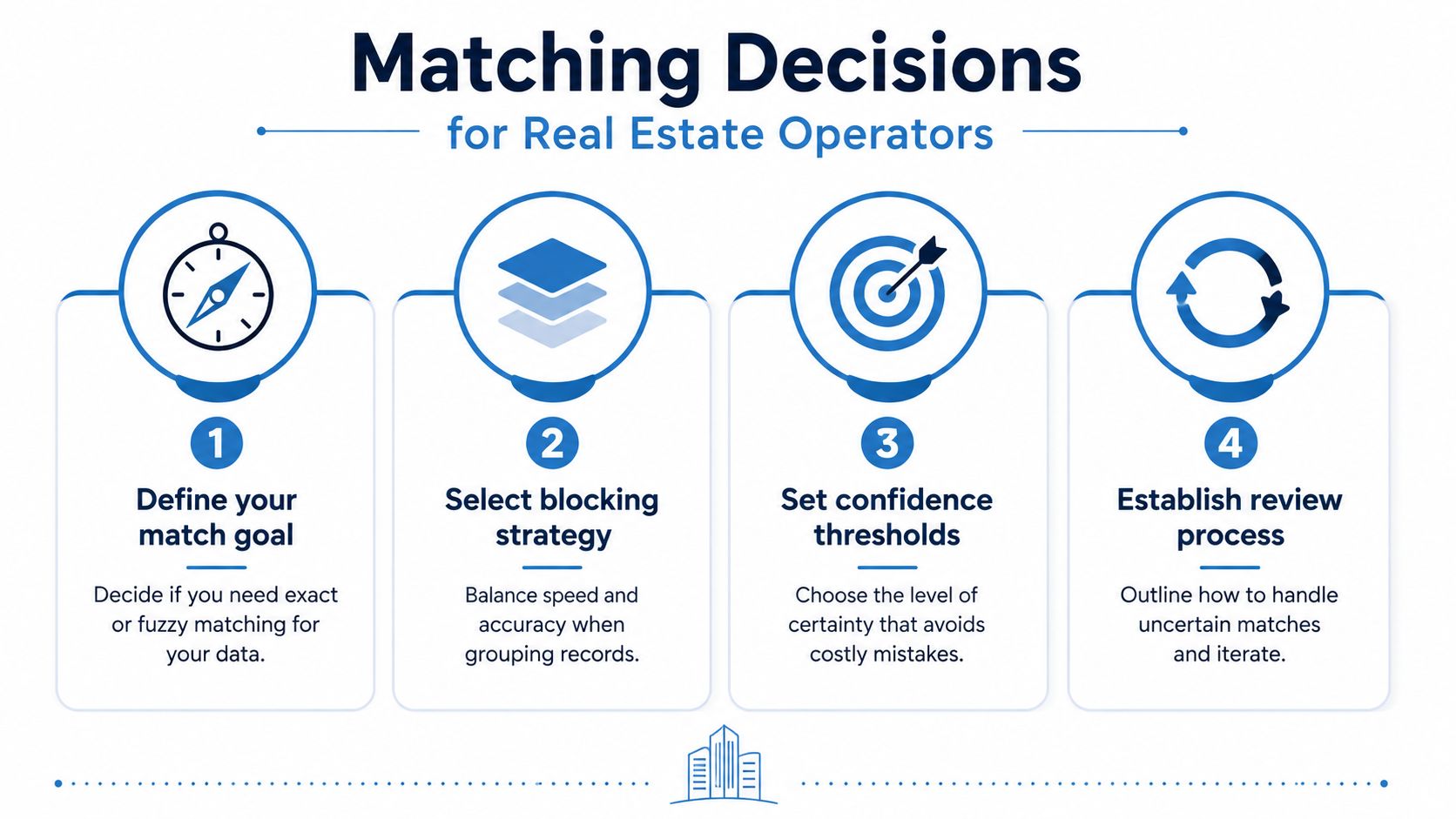
This checklist turns matching from an opaque utility into an operating contract. The method addresses data quality, blocking addresses scale, precision and recall define risk, confidence scores support review, and integration controls preserve auditability.
BatchData provides real estate data services that can support owner and property matching, including confidence scores, deterministic owner IDs, batch delivery, and custom matching services. Visit BatchData to evaluate how its property, ownership, contact, and monitoring capabilities fit your labeled records and threshold policy.