






































Bad address data costs U.S. businesses over $20 billion annually. For professionals in real estate, mortgage, or insurance, the attempt to verify mailing addresses at scale is a constant drain on resources, but ignoring the 2%+ monthly decay rate of this data is a direct path to operational failure. This guide provides the exact workflows to transform messy, decaying data into a reliable, high-ROI asset.
- Core Problem: Address data decays at over 2% per month, leading to failed deliveries and wasted marketing spend.
- Solution: Implement a multi-step process of standardization, verification, and enrichment using specialized tools.
- Key Methods: Utilize real-time APIs for point-of-entry cleaning and bulk processing for existing large datasets.
- ROI: Proper verification can eliminate up to 5% of shipping waste, reallocate 10-15% of staff time, and significantly reduce compliance risks.
This is the definitive playbook for achieving near-perfect data accuracy.
What is the true cost of inaccurate address data?
Inaccurate addresses directly sabotage marketing campaigns, operational functions, and customer trust. Every returned mailer, botched delivery, and misdirected invoice is a tangible drag on your daily operations, eroding your profit margin and brand reputation with each failure.

Direct Financial Bleeding
The most obvious costs originate from wasted resources like printing, postage, and the staff time required to handle returned items. Bad addresses frequently cause failed deliveries, forcing businesses to avoid no courier redelivery fees and other penalties. These direct costs multiply rapidly, capable of turning a promising marketing campaign into a financial black hole.
Failed deliveries stemming from bad address data drain over $20 billion from U.S. businesses every single year. Companies without solid verification can see failure rates as high as 5% of their total shipments.
The High Cost of Data Decay
Address data decays at a blistering rate of over 2% per month, rendering a new lead list unreliable in under a year without constant cleansing and verification. For professionals using data-intensive platforms—like users of BatchData's 155M+ U.S. property records—this decay is the primary driver of operational waste. By leveraging verified owner contacts, these users see significantly fewer bounced mailers on marketing and due diligence campaigns.
This data degradation creates a ripple effect:
- Wasted Marketing Spend: Campaigns aimed at outdated addresses yield dismal returns.
- Operational Drag: Teams waste hours correcting errors instead of focusing on revenue-generating tasks.
- Poor Customer Experience: Failed deliveries damage brand reputation and lead to churn.
- Compliance Risk: Sending sensitive information to the wrong address can result in severe fines and legal action.
The financial impact is stark when comparing operations with and without verification.
ROI of Address Verification: A Comparison
| Metric | Without Verification | With Verification |
|---|---|---|
| Mail/Shipping Cost | Up to 5% higher due to returns & redelivery fees | <1% waste, achieving 99%+ deliverability |
| Marketing ROI | Lower returns, budget wasted on undeliverable mail | Higher conversion rates from reaching the correct audience |
| Operational Staffing | 10-15% of staff time spent on manual data correction | Staff time reallocated to growth-focused activities |
| Customer Churn | Higher churn from frustrating delivery experiences | Improved customer satisfaction and brand trust |
| Compliance Fines | Significant risk of penalties from misdirected documents | Mitigated risk, adherence to regulatory standards |
The numbers confirm that leaving address data unverified is an active financial drain. It's also critical to distinguish between a correctly formatted address and one confirmed as deliverable, a concept detailed in our guide on using an address verification checker for accuracy. Implementing a robust process to verify mailing addresses is an investment in efficiency, customer loyalty, and your bottom line.
How do you standardize addresses for deliverability?
An address must be converted into a clean, uniform format before it can be verified. This critical first step, known as address normalization, transforms inconsistent user-entered data into a structure that automated postal systems can interpret. Without it, even a valid address like "123 main st, apt four" will be rejected because sorting machinery expects "123 MAIN ST APT 4."
CASS Certification
For U.S. addresses, CASS Certified is the non-negotiable industry benchmark. CASS, or Coding Accuracy Support System, is a certification granted by the United States Postal Service (USPS) only to software that meets its exacting standards for address correction.
A CASS Certified service is proven to:
- Correct and standardize addresses to precise USPS formatting rules.
- Append the correct ZIP+4 code, which narrows delivery to a specific segment of a street or a single building.
- Confirm an address is a genuine, known delivery point within the official USPS database.
Using a CASS-certified tool is the primary defense against returned mail.
Address Parsing
Address parsing is the process of deconstructing an address into its individual components. Advanced verification services use algorithms to break down an input like "25 westwood blvd #100-b, Los Angeles, ca" into clean, discrete fields. This structured output enables accurate matching, deduplication, and validation against official sources.
| Component | Original Input | Parsed Value |
|---|---|---|
| Street Number | 25 | 25 |
| Pre-directional | (none) | W |
| Street Name | westwood | WESTWOOD |
| Street Suffix | blvd | BLVD |
| Secondary Unit | #100-b | STE 100B |
| City | Los Angeles | LOS ANGELES |
| State | ca | CA |
| ZIP Code | (none) | 90024 |
| ZIP+4 | (none) | 90024-1708 |
The USPS itself provides extensive rules for this process, which certified tools follow precisely.
This USPS guidance confirms that relying on certified tools is the only reliable path to high deliverability. To learn more, see our guide on the correct mailing address format.
Common Standardization Challenges
The real value of a modern address verification platform is its ability to algorithmically solve ambiguous addresses that cause the costliest delivery failures.
Common problems include:
- Ambiguous Street Names: A good parser knows that "MLK Blvd" is an alias for "Martin Luther King Jr Blvd" and standardizes it correctly.
- Missing Unit Numbers: If an address for a multi-unit building is missing an apartment number, a CASS-certified system flags it as incomplete, preventing a guaranteed delivery failure.
- Vanity City Names: A resident may write "Beverly Hills," but the official USPS-recognized city is "Los Angeles." An effective tool corrects this to prevent routing confusion.
By breaking down and rebuilding addresses according to strict USPS guidelines, standardization and parsing set the stage for true verification.
Which verification workflow is best?
Choosing the right method to verify mailing addresses comes down to two primary workflows: real-time (one-by-one) or bulk (all at once). The optimal choice depends entirely on when and where you need clean data. Think of it as a choice between a real-time gatekeeper that prevents bad data from entering and a large-scale cleaning crew that scrubs existing datasets.
Real-Time Single Record API Verification
A single-record API is your frontline defense, integrated directly into applications like web forms or CRMs. When a user enters an address, an API call instantly validates, standardizes, and suggests corrections for typos before the data is even submitted. This workflow is fundamental for maintaining a clean database from the outset.
This workflow is essential for:
- E-commerce Checkouts: Prevents mis-shipments by confirming an address is deliverable before an order is placed.
- Lead Generation Forms: Instantly validates a lead's address, boosting pipeline quality.
- CRM Data Entry: Ensures sales and support teams work with accurate location data.
Bulk Verification for Large Datasets
Bulk verification is the workhorse for large data-cleaning projects. It's designed for cleansing spreadsheets with thousands or millions of addresses simultaneously. Users typically upload a file (e.g., CSV) to a verification platform, which processes the entire file to correct formats, fix typos, and flag undeliverable records. For more automated setups, a bulk API can be used to regularly clean data stored in a warehouse like Snowflake or a cloud bucket.
This process of transforming messy input into a clean, deliverable address powers both real-time and bulk workflows.
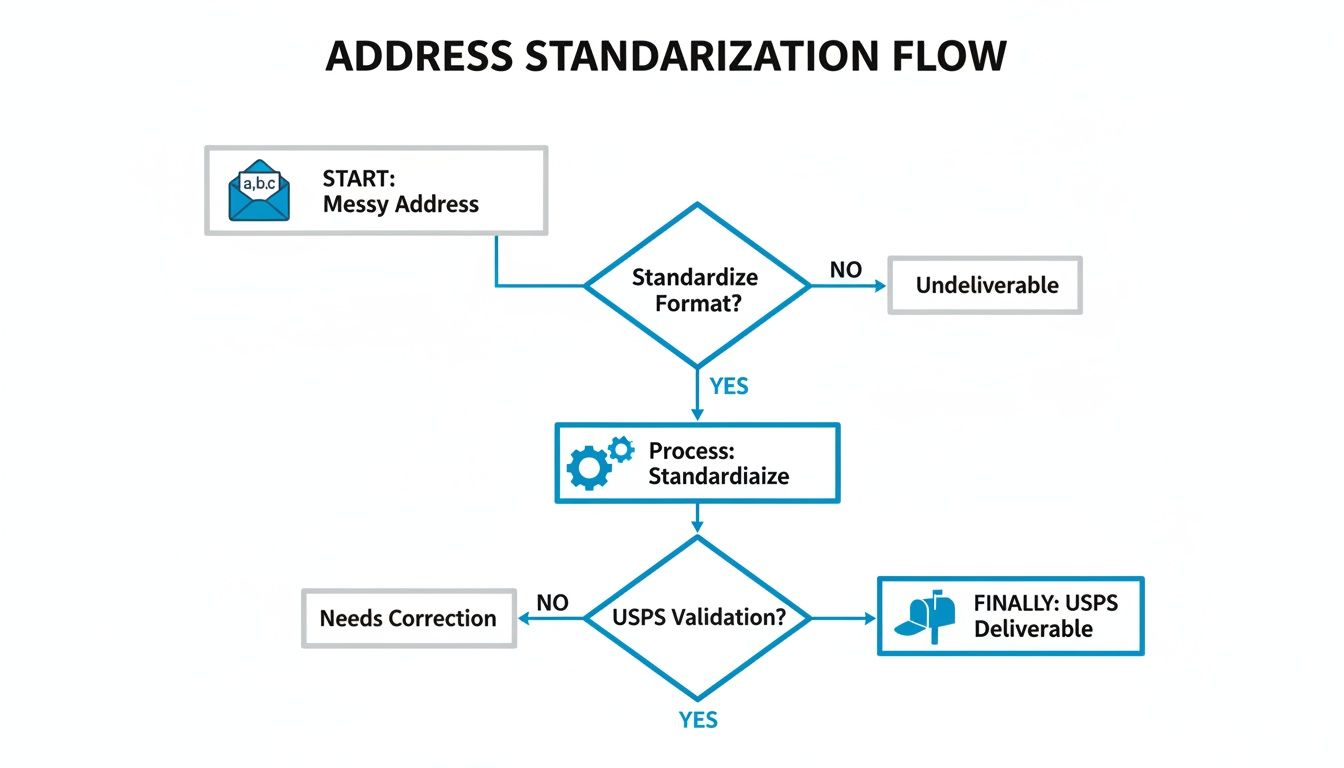
Single vs. Bulk Workflow Comparison
The choice between a real-time API and bulk processing is about job-specific requirements, not inherent superiority.
| Factor | Single Record API | Bulk Verification (File/API) |
|---|---|---|
| Primary Use Case | Point-of-entry validation (web forms, checkouts) | Cleansing large, existing datasets (CRMs, property lists) |
| Speed | Instantaneous (sub-second response) | Slower (minutes to hours, depending on file size) |
| User Experience | Excellent. Fixes errors in real-time without user friction. | Not applicable. Backend process invisible to end-users. |
| Cost Structure | Per-API call; can be more expensive at high volume. | Cost-effective for large volumes; often priced per-record. |
| Developer Effort | Requires initial integration into front-end or back-end apps. | Minimal for file uploads; API integration is more involved. |
| Best For | E-commerce, CRMs, lead capture, fraud prevention. | Real estate investors, direct mail marketing, database migrations. |
For many businesses, such as real estate investors using a platform like BatchData, a hybrid approach is optimal. An investor might use a bulk workflow to clean a newly acquired list of 50,000 property records, while their internal CRM uses a single-record API to verify new leads on the spot.
How do you handle complex and international addresses?
The true test of a verification system is its ability to handle exceptions—addresses that deviate from the standard street, city, state, zip format. These edge cases, both domestic and international, are a major source of returned mail and require a system that can manage their complexity.

Tackling Domestic Edge Cases
While CASS-certified tools are the standard for most U.S. addresses, several categories require more sophisticated logic.
- PO Boxes: A smart verification system not only validates the box number but also flags the address as a PO Box, enabling segmentation for different delivery methods (e.g., ones requiring a signature).
- Military Addresses (APO/FPO/DPO): Mail for armed forces personnel uses a unique structure with codes like "APO" (Army Post Office) and "AE" (Armed Forces Europe) instead of traditional city/state names. A verification tool must recognize and format these correctly.
- Rural and Highway Routes: Rural addresses often use Rural Route (RR) or Highway Contract (HC) numbers instead of standard street names, requiring specialized validation logic.
New Construction and Provisional Addresses
Addresses for new constructions often fail standard verification because they are not yet in the USPS database. This is where the concept of a provisional address is critical. A provisional address is a pre-official, non-standardized address for a property that is planned or under construction.
Verifying provisional addresses provides a significant competitive advantage, allowing you to target properties before they hit the open market.
Industry innovators are now adding provisional U.S. addresses to their core services. This allows platforms like BatchData, which depend on this data for daily updates, to identify new builds almost as soon as a permit is pulled. You can learn more about how provisional addresses are improving data accuracy on smarty.com.
Navigating International Address Verification
Verifying international addresses is a different beast entirely, as there is no global equivalent to the USPS CASS system. Each country has its own postal authority, formatting rules, and character sets. A German address places the postal code before the city; a UK address requires a post town; a Japanese address is structured in a near-reverse order from a U.S. one.
To successfully verify mailing addresses worldwide, a platform must:
- Handle Local Formatting Rules: Know the specific syntax for each country.
- Process Native Character Sets: Correctly handle diacritics (ñ, ö) and non-Latin alphabets (Cyrillic, Kanji).
- Utilize Multiple Authoritative Sources: Cross-reference data from official and commercial sources to achieve the highest possible match rate.
Success in today's market requires a system built for the messy reality of global data.
How can you embed verification into business systems?
The most effective strategy is to move from one-off cleanups to a continuous, automated process. This means embedding verification directly into the business tools you use daily, like CRMs and marketing platforms, to stop bad data from entering your systems in the first place. Integrating a verification API transforms address validation from a manual chore into an invisible, 24/7 automated function.

Decoding API Responses for Actionable Intelligence
When you verify mailing addresses via an API, the response contains rich metadata that explains deliverability. Understanding this data allows you to build intelligent, automated workflows.
Key data points to interpret:
- DPV (Delivery Point Validation) Codes: This is the most critical field. A DPV confirmation of "Y" means the USPS confirms delivery to that specific address, while "N" means it does not.
- Address Type Flags: An API can flag an address as
residentialorcommercial. This is crucial for logistics (e.g., avoiding freight surcharges at residential addresses) and marketing segmentation. - Vacancy Flags: Advanced services can indicate if a property is likely
vacant, a key signal for real estate investors seeking off-market deals.
Don't just check for validity; parse the metadata. An address can be technically valid but missing a suite number, making it undeliverable. The DPV codes and footnotes in an API response tell you the whole story.
Turning Verified Addresses into Enriched Property Data
A verified address is the master key to a universe of property data. It is the essential first step for data enrichment services that can transform a simple location into a detailed profile of a property and its owner. We cover this process in our guide on enriching your CRM in real time with BatchData.
With a verified address, an API can deliver over 1,000 property attributes, including characteristics, owner details, mortgage history, and sales data. This integration powers critical workflows such as:
- Skip Tracing: A verified address is the starting point for finding owner phone numbers and emails.
- Property Data Lookups: Instantly retrieve tax records, lien history, and estimated property values.
- Portfolio Monitoring: Automatically track changes like new listings or pre-foreclosure filings.
Integration Patterns for CRMs and Marketing Platforms
Connecting verification services to core platforms like Salesforce or HubSpot makes automation seamless. The objective is to make verification a background part of daily operations. By building these checks directly into your systems, you graduate from reactive data cleaning to proactive data hygiene, ensuring your entire organization operates on a foundation of clean, reliable data.
What are the most common questions about address verification?
Implementing address verification is a high-impact decision that often raises specific questions about cost, frequency, and accuracy. Here are direct answers to the most common queries.
What is the difference between validation and verification?
The distinction is critical: address validation is a grammar check, while address verification is a fact-check. Validation standardizes formatting (e.g., "Street" to "ST"), but it cannot confirm if "123 Main St" is a real building or an empty lot. Verification checks the address against an official database, like the USPS, to confirm it is a real, physical location that can receive mail.
- Validation asks: Is this address formatted correctly?
- Verification asks: Does this address actually exist and receive mail?
You need both to have confidence in your data.
How much does address verification cost?
Cost depends on usage volume, depth of verification, and workflow. As a rule, bulk file processing is cheaper per record than real-time API calls.
| Service Type | Typical Pricing Model | Best For |
|---|---|---|
| Real-Time API | Pay-per-call | E-commerce checkouts, CRM data entry |
| Bulk File Processing | Per-record | Cleaning large marketing or property lists |
| International Verification | Higher per-record | Global shipping and compliance |
Simple validation costs fractions of a cent per address. Comprehensive verification with geocoding, residential/commercial flags, and USPS Delivery Point Validation (DPV) is more expensive but delivers a higher ROI by preventing undeliverable mail, which costs U.S. companies over $20 billion annually.
How often should I verify my mailing lists?
For active databases, you should verify at least quarterly; monthly is the gold standard. Address data decays at over 2% per month due to moves, street name changes, and new construction. A "set it and forget it" approach is a recipe for failure. Continuous verification, ideally at the point of entry with an API, is the only way to combat natural data decay.
Can verification tell me who lives at an address?
No. Standard address verification confirms that a mailing address is deliverable; it does not reveal who lives there. This is a crucial distinction for privacy and compliance. Identifying residents is a separate process called identity verification or skip tracing, which involves matching the address against other data sources.
What accuracy rate can I expect?
For U.S. addresses, a top-tier, CASS-certified service should achieve an accuracy rate of over 99% by validating directly against the authoritative USPS database. However, final accuracy depends on input quality. Severe typos, missing information, new construction, and international addresses can reduce match rates. The best services use multiple data sources to maximize accuracy.
Does address verification work for international addresses?
Yes, but it is far more complex. There is no single global address standard. An effective international verification service must:
- Understand and apply local address formats for hundreds of countries.
- Handle native character sets and diacritics (e.g., ñ, ö, ü).
- Tap into each country's official postal authority and commercial databases to confirm an address.
Due to this complexity, international verification costs more but is non-negotiable for global operations.
Ready to stop wasting money on bad data? BatchData provides enterprise-grade tools to verify, standardize, and enrich your property and contact data at scale. Clean your lists, improve your deliverability, and unlock deeper insights with our powerful APIs and bulk processing services. Learn more at https://batchdata.io.