



Distressed properties represent a significant market inefficiency, offering investors a direct path to acquire assets for 70-80% of their actual market value. The core strategy is not about finding rundown houses; it's about identifying motivated sellers under financial or physical pressure and using high-quality data to reach them before anyone else. This creates an opportunity for substantial returns, but only for those with a systematic, data-driven approach.
Successful investors leverage aggregated data platforms to filter properties with multiple distress signals—like pre-foreclosure status combined with a tax lien—creating a highly qualified lead list in minutes, not weeks. The goal is to turn raw public records into actionable investment opportunities.
| Core Tactic | Description | Key Advantage |
|---|---|---|
| Data Aggregation | Using platforms to combine public records (tax liens, pre-foreclosures, code violations). | Uncovers "stacked distress" signals, indicating highly motivated sellers. |
| Signal Stacking | Filtering for properties with 2+ distress indicators (e.g., tax lien + code violation). | Dramatically increases the probability of a successful negotiation. |
| Targeted Outreach | Using skip tracing to find owner contact info and offering a solution-focused proposal. | Bypasses competition by connecting directly with the decision-maker. |
This guide breaks down the exact workflow to find, vet, and contact owners of distressed properties using modern tools and strategies.
What is a Distressed Property?
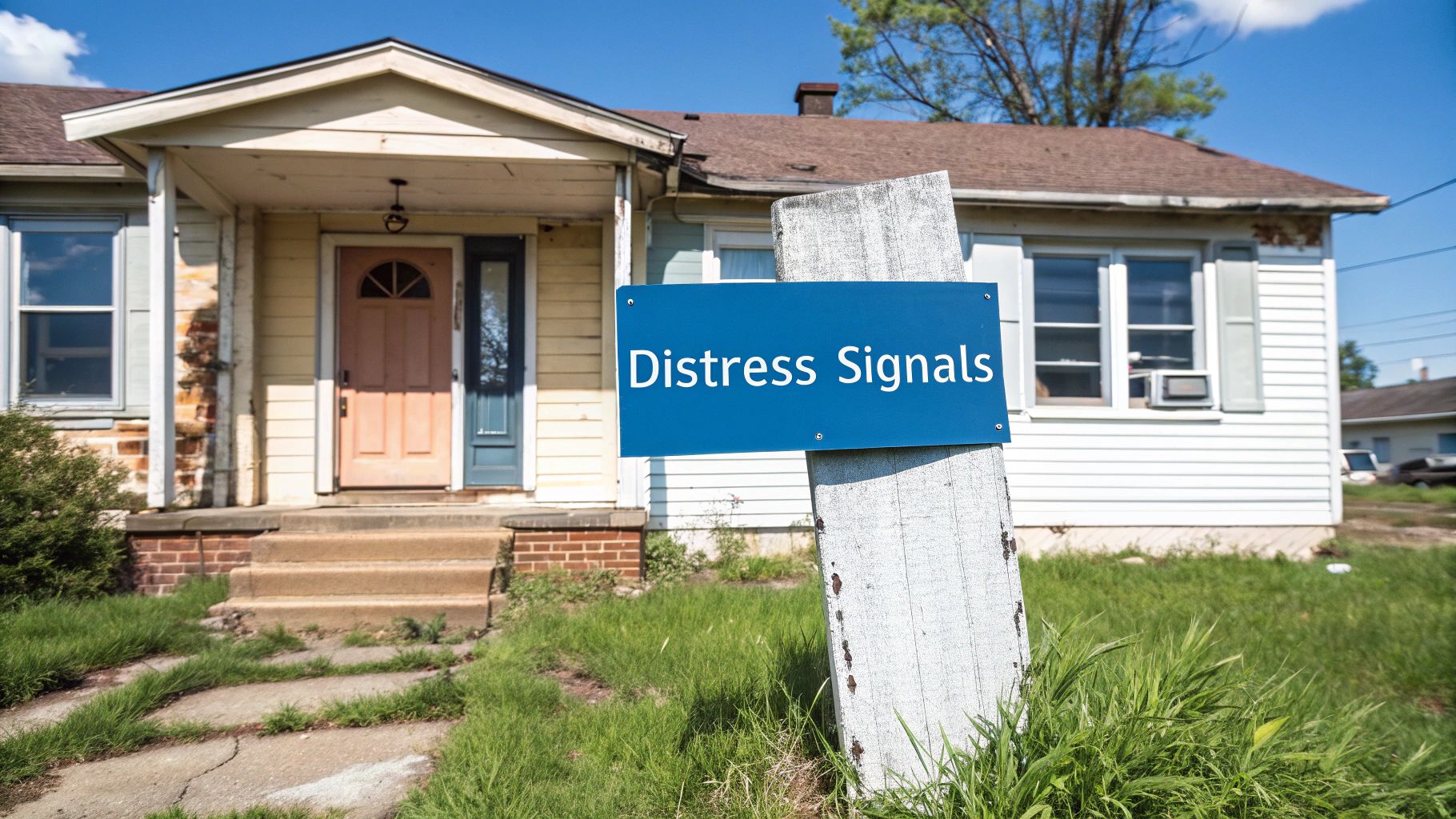
A distressed property is any real estate asset being sold under duress, forcing a sale below its true market value. The root cause of this duress falls into two distinct categories: financial distress, where the owner cannot meet monetary obligations, or physical distress, where the owner cannot maintain the property's condition. Understanding these signals is foundational to locating investment opportunities.
Financial Distress Signals
Financial distress occurs when an owner defaults on financial obligations tied to their property, creating a public record of their hardship. These signals are the most reliable and scalable indicators for investors to track.
- Pre-Foreclosure: This is the initial stage after a mortgage default, triggered by a public Notice of Default filing. It creates a critical window for an investor to contact the owner directly before the bank repossesses the property.
- Tax Liens: When property taxes are unpaid, the municipal government places a lien on the property, which is a public record indicating severe financial strain.
- Bankruptcy: A bankruptcy filing often compels the liquidation of assets, including real estate, to satisfy creditors.
- Divorce or Probate: Life events such as divorce or death can necessitate the quick sale of a property to divide assets or settle an estate.
The scale of this is substantial; the U.S. commercial real estate market's distressed property balance recently hit $116.4 billion. Private owners account for 37% of this total distressed value, signaling a broad and growing opportunity. You can read the full research about real estate distress trends for detailed statistics.
Physical Distress Signals
Physical distress is visible deterioration that the owner lacks the resources or willingness to repair. Identifying these properties typically requires direct observation or analysis of municipal records.
- Code Violations: Citations from a city for structural issues, overgrown landscaping, or unpermitted work are direct indicators of neglect.
- Abandoned Properties: Boarded-up windows, overgrown vegetation, and overflowing mailboxes are clear signs of vacancy, often linked to a distressed or absentee owner.
- Deferred Maintenance: Obvious disrepair, such as a failing roof, peeling paint, or a crumbling foundation, indicates a lack of capital for upkeep.
This table breaks down the primary financial and physical indicators investors use to locate distressed properties.
| Distress Type | Primary Signal | Data Source | Investor Action |
|---|---|---|---|
| Financial | Pre-Foreclosure | County Clerk/Recorder's Office | Contact owner directly with a pre-auction purchase offer. |
| Financial | Tax Lien | County Tax Assessor Records | Acquire the tax lien or approach the owner for a direct sale. |
| Financial | Bankruptcy Filing | Federal Bankruptcy Court (Pacer) | Monitor court-supervised asset liquidation sales. |
| Physical | Code Violations | Municipal Code Enforcement Office | Skip trace the owner to make an offer, leveraging the violation as a pain point. |
| Physical | Visible Neglect | "Driving for Dollars" | Identify the property visually, then use public records to locate the owner. |
| Physical | Deferred Maintenance | MLS Photos / Inspections | Factor repair costs into a reduced offer that solves the owner's capital problem. |
The most potent opportunities arise when financial and physical distress signals overlap. A property with both a tax lien and a code violation for a failing roof indicates a highly motivated seller facing multiple pressures, making it a prime target for acquisition.
How Do You Source Actionable Distressed Property Data?
Sourcing distressed property data is a critical function that requires choosing between traditional, manual methods and modern, scalable digital platforms. The most successful investors integrate both approaches to create a resilient deal pipeline.
Traditional vs. Digital Sourcing Methods
| Method | Description | Pros | Cons |
|---|---|---|---|
| Traditional (Manual) | "Driving for dollars," attending courthouse auctions, and manually researching public records at the county clerk's office. | Finds truly off-market deals with low competition. | Extremely time-consuming, not scalable, limited data scope. |
| Digital (Platforms) | Using aggregated data platforms to filter thousands of sources for distress signals like pre-foreclosures, tax liens, and bankruptcies. | Highly efficient, scalable, allows for "signal stacking" to find motivated sellers. | Requires a subscription; data must be verified for timeliness. |
Traditional methods like "driving for dollars" involve physically searching neighborhoods for properties showing signs of neglect. While effective for finding unlisted opportunities, this method is inefficient and difficult to scale across a large geographic area. Similarly, courthouse auctions and manual public records research provide direct-to-source data but consume significant time.
Digital sourcing represents a paradigm shift. Platforms aggregate billions of data points from public and private sources into a single, searchable database. While the MLS and auction sites like Hubzu are useful, they only show properties already on the market.
The Power of Aggregated Data Platforms
The most effective way to find distressed properties is to use an aggregated data platform. These services consolidate records, allowing an investor to layer filters for location, property type, and multiple distress indicators simultaneously. This "signal stacking" is the key advantage. A property with a single tax lien is a lead; a property with a tax lien, code violation, and a notice of default is a high-priority target.
This process transforms the workflow from manual hunting to strategic filtering. Instead of spending days at a courthouse, you can generate a hyper-targeted list in minutes. For a practical application, see this guide on using pre-foreclosure data for real estate investing.
What is the Workflow for a Targeted Search?
A successful search workflow turns raw data into a qualified list of leads through a disciplined, repeatable process. This begins with a precise investment thesis that guides every subsequent action. A strong thesis is not "finding cheap houses" but rather "Acquiring single-family homes with >40% equity in pre-foreclosure within zip codes 78704 or 78745."
Layering Filters for Precision
With a clear thesis, you apply data filters sequentially to narrow the market down to ideal targets. This funneling approach ensures efficiency.
- Geography First: Define your market boundaries (county, city, zip code, or school district) to eliminate irrelevant properties.
- Property Characteristics: Filter by asset class (e.g., single-family, multifamily), square footage, bed/bath count, and year built to match your portfolio requirements.
- Distress Signals: Apply filters for the specific indicators from your thesis, such as pre-foreclosure filings, tax delinquencies, or probate status.
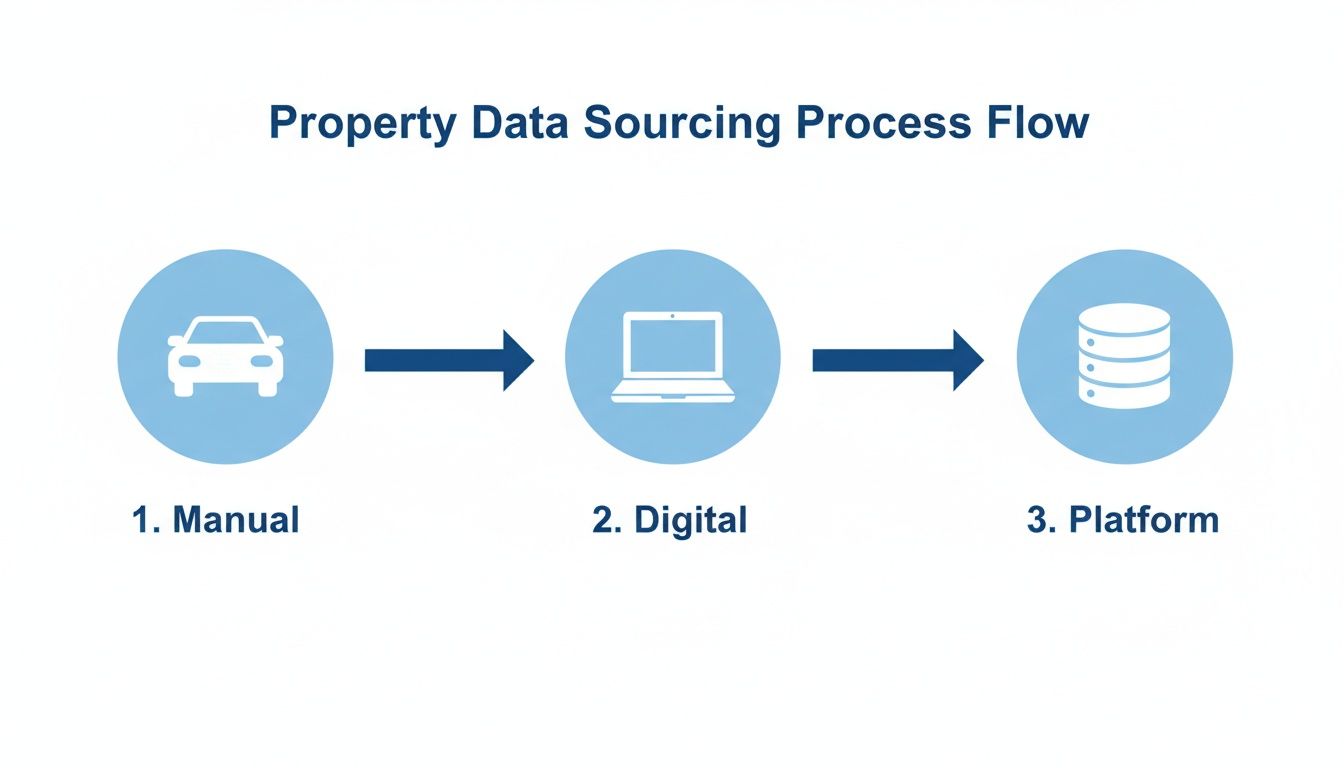
This visualization illustrates the evolution from manual data sourcing to a streamlined, platform-based workflow.
The Power of Stacking Distress Indicators
Stacking multiple distress indicators is the most effective way to identify motivated sellers. A property with several concurrent issues—such as a tax lien, a code violation, and a notice of default—points to an owner facing immense pressure from multiple directions, making them far more likely to accept a fast, fair offer. Modern data platforms make it simple to create lists that meet several distress criteria at once.
Set Up Automated Alerts for a First-Mover Advantage
The distressed market moves quickly. To gain a competitive edge, set up automated alerts within your data platform. By saving your filtered search, you can receive instant notifications when a new property matches your thesis. This automated system ensures you are among the first to know about an opportunity, often before competitors are even aware of it.
For example, the apartment market is seeing a surge in individual asset sales, up 20% to $136.8 billion, as REITs target distressed Class C properties and over-leveraged new developments. You can discover more insights about these multifamily distress trends and set up alerts to capitalize on these specific market shifts.
How Do You Execute Due Diligence and Value Opportunities?
Once you have a qualified lead list, due diligence begins. The goal of this phase is to rapidly validate a deal’s potential using digital tools *before* committing time and resources to a site visit. This modern workflow separates real opportunities from money pits with maximum efficiency.Initial Valuation with AVMs
An Automated Valuation Model (AVM) provides an instant, algorithm-based estimate of a property's market value. However, relying on a single AVM is a critical error.
- Best Practice: Pull AVMs from at least three different sources.
- Analysis: If the values are tightly clustered (e.g., $310k, $315k, $325k), you have a reliable valuation range.
- Red Flag: Wildly divergent values (e.g., $250k, $320k, $400k) indicate inconsistent data or a non-standard property, requiring manual analysis.
Calculating Estimated Equity
Estimated Equity is the next critical metric, as it determines if a deal is financially viable.
Formula:
Estimated Equity = AVM Value - Estimated Mortgage Balance
A property with an AVM of $350,000 and a $200,000 mortgage has $150,000 in estimated equity. This high-equity position signals the owner has significant room to negotiate a discounted sale price and still receive cash, making them an ideal candidate for an offer.
Verifying the Distress Signal
Data ages quickly. You must verify the original distress signal is still active.
- Pre-Foreclosure: Check county recorder records to confirm the Notice of Default is active and an auction has not occurred.
- Tax Liens: Call the county tax assessor to verify the lien's current status and confirm it hasn't been paid.
- Code Violations: Use the municipal code enforcement portal to check if the violation remains open.
Remote Physical Assessment
Before a site visit, perform a "digital drive-by" to assess the property's physical condition remotely. This initial step in your real estate due diligence can uncover deal-killing issues from your desk.
| Tool | What to Look For | Potential Red Flags |
|---|---|---|
| Satellite Imagery | Roof condition, overgrown yard, debris. | Tarps on roof, green pool water, junk vehicles. |
| Street View | Siding, windows, foundation. | Major foundation cracks, boarded windows, peeling paint. |
| Permit Data | History of major renovations (electrical, plumbing). | Open permits for major repairs that appear incomplete on satellite view. |
How Do You Conduct Ethical and Effective Owner Outreach?
Finding a property is a data exercise; connecting with the owner is a human one. Your outreach must position you as a credible problem-solver, not a predator. An ethical, solution-focused approach is what builds the rapport needed to close a deal.

Uncovering Contact Information with Skip Tracing
Many distressed properties are held in LLCs or trusts, obscuring the owner's identity. Skip tracing is the process of using specialized services to cross-reference property data with consumer databases to find the actual owner's phone numbers and email addresses. This is an essential step to turn an address into a contactable person. See this definitive guide to skip tracing for real estate for a detailed breakdown.
Crafting a Solution-Focused Message
An owner in pre-foreclosure is under extreme stress. Your message must be direct, empathetic, and focused on providing a solution.
"Hi [Owner Name], my name is [Your Name]. I'm a local property buyer and saw the public notice for the property at [Address]. I know this can be a difficult situation, and I wanted to see if a quick, fair cash offer might be a helpful option. Please let me know if you’re open to a no-pressure conversation."
This script works because it acknowledges the situation, offers a clear solution, and lowers their guard.
Maintaining Legal Compliance
Non-compliant outreach leads to severe fines and reputational damage.
- TCPA (Telephone Consumer Protection Act): Prohibits using autodialers for cell phones without explicit consent. When cold calling, dial manually and honor all do-not-call requests.
- DNC (Do Not Call Registry): Scrub all calling lists against the National Do Not Call Registry. Violations can exceed $50,000 per call.
- Local Regulations: Research and adhere to all state and municipal laws regarding real estate solicitation.
This table compares ethical outreach strategies across different channels.
| Channel | Key Principle | Best Practice | What to Avoid |
|---|---|---|---|
| Direct Mail | Empathy & Clarity | Use a simple, handwritten-style font. State your purpose clearly and provide multiple response options. | Aggressive, shaming language ("WE BUY UGLY HOUSES!"). |
| Cold Calling | Respect & Brevity | State your name and purpose in the first 10 seconds. Ask if it's a good time to talk. | High-pressure tactics. Calling before 9 AM or after 8 PM. |
| Professionalism | Use a clear subject line ("Question about your property on [Street Name]"). Keep the message short and focused. | Misleading subject lines. Mass, unpersonalized blasts. |
What Are Common Questions About Distressed Properties?
Navigating the distressed property market involves unique terminology and scenarios not found in traditional real estate. Here are direct answers to the most common questions.
What is the difference between pre-foreclosure and foreclosure?
The difference is ownership. Pre-foreclosure is the period after mortgage default but before the bank repossesses the property, creating a window to negotiate directly with the homeowner. A foreclosure is a property that the bank has already repossessed; it is now classified as an REO (Real Estate Owned) asset, and all negotiations happen with the financial institution.
Are tax lien properties a good investment?
Yes, but they are an advanced strategy. When you buy a tax lien certificate, you are not buying the property; you are buying the owner's tax debt, for which the property serves as collateral. Your profit comes from the interest earned as the owner repays the debt. If they fail to repay within the "redemption period," you can initiate foreclosure to acquire the property, but the legal process is complex and varies significantly by state.
How reliable is online property data?
Data from a reputable platform is highly reliable, but it should be treated as a starting point. Core public records like deeds and tax assessments are generally accurate. Distress signals like pre-foreclosure filings are also accurate at the time of recording, but their status can change rapidly. The best practice is to use a data platform for discovery and then verify critical details, like an active lien status, directly with the source (e.g., the county office).
What common mistakes should I avoid?
Four common mistakes sink otherwise viable deals.
| Mistake | Consequence | Prevention |
|---|---|---|
| Underestimating Repair Costs | Erases profit margins with unexpected expenses. | Always get a professional inspection before closing. |
| Skipping a Full Title Search | Inheriting existing liens or claims ("clouded title"). | A professional title search must be a non-negotiable part of due diligence. |
| Using Aggressive Outreach | Alienates the seller and closes the door on negotiations. | Approach every owner with empathy and a solution-oriented mindset. |
| Relying on a Single Data Point | Misjudging seller motivation (e.g., owner has high equity). | Analyze multiple data points to get a complete financial picture of the property. |
After acquisition, streamlining operations is key. Exploring the best property management apps can help manage your new asset efficiently and maximize returns.
Ready to transform your search for distressed properties from a manual chore into a data-driven workflow? BatchData provides the comprehensive property data, owner contact information, and powerful search filters you need to find high-potential deals before the competition.