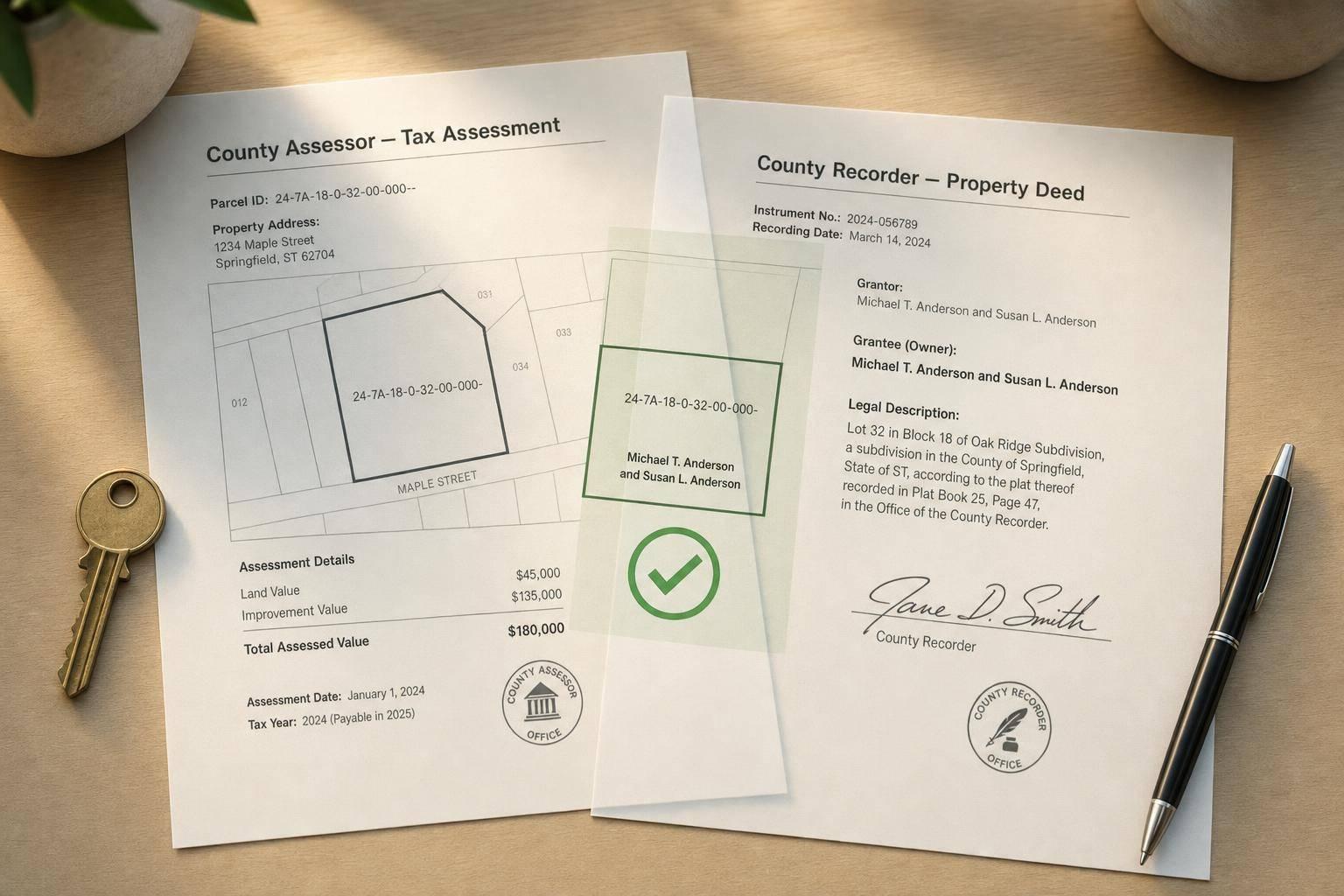
If I need tax facts, I start with assessor data. If I need transfer proof, I start with recorder deed data. That’s the short answer.
Here’s the plain-English version:
- Tax assessment data shows the parcel, tax value, exemptions, and where tax bills go
- Recorder deed data shows recorded transfers, including grantor, grantee, deed type, and recording date
- Assessor records can lag after a sale, sometimes by weeks or months
- A recorded deed is stronger proof of transfer, but it still shows only one filed document in the title chain
- APN, owner name, and situs address are the main match points, but names often stop matching first
- County data formats differ, so matching records without cleanup can fail for simple reasons like dashes, spaces, or field labels
If you’re checking ownership, title, liens, or compliance, recorder data should lead. If you’re checking tax status, parcel details, assessed value, or mailing records, assessor data should lead.
Tax Statement vs Deed What Really Shows Ownership
Quick Comparison
Tax Assessment Data vs Recorder Deed Data: Side-by-Side Comparison
| Check | Tax Assessment Data | Recorder Deed Data |
|---|---|---|
| Main job | Tax roll and parcel details | Recorded transfer history |
| Main ID | APN | Document number, deed index, often APN cross-reference |
| Update pattern | Often annual or batch-based | Event-based after recording |
| Ownership use | Taxpayer or owner of record for billing | Grantee and grantor tied to filed deed |
| Best for | Taxes, exemptions, mailing, parcel facts | Transfer checks, title review, compliance |
| Limits | May show an older owner after a transfer | County access and indexing can vary |
I’d use both before production use. One tells me the tax story. The other tells me the recorded transfer story. When they don’t match, that’s my cue to stop and verify.
What each county system contains and how it updates
For validation work, the main difference is simple: assessor data shows tax status, while recorder data shows filing events. County property data sits across both systems, and each one tells a different part of the story.
Tax assessment data: parcel IDs, assessed values, exemptions, and mailing records
The assessor's roll is built around the Assessor's Parcel Number (APN), which is the county's parcel ID. It usually includes assessed value fields, exemptions, assessment year, and property details like square footage, year built, acreage, and bed/bath counts.
You'll also usually see two address fields in assessor records:
- Situs address: the property's physical location
- Mailing address: where tax notices are sent
That split matters. The assessor owner name may list the taxpayer of record, not the deed grantee.
Assessed values often update on an annual roll cycle. Ownership data, though, can trail behind after a deed is recorded. So during a transfer window, assessor records may still show an older owner.
That makes assessor data useful for tax context. But on its own, it does not prove that a transfer happened.
Recorder deed data: grantor, grantee, instrument type, and recording dates
Recorder data works differently. Instead of tracking tax roll status, the recorder tracks filing events. When a deed or other filing is recorded, the county indexes it. Core fields usually include the grantor, grantee, instrument type, execution date, recording date, legal description, document number, and book and page references. Recorder records may also include an APN cross-reference.
That APN link is what lets you match parcels across both systems. And because recorder data updates after a filing event, not on a fixed tax cycle, it often shows a transfer sooner than the assessor's roll.
One catch: county schemas vary a lot. Field names and land-use terms often differ from one county to another, so you need to normalize them before comparing counties.
That gap is why recorder data serves as the legal transfer trail for the next section's comparison.
Tax assessment data vs recorder deed data: side-by-side differences that matter
Once you know what each record type does, the next step is simple: which source is safer for validation and compliance? The short answer is that they serve different jobs, and that difference matters more than most teams expect.
Here’s the side-by-side view:
| Aspect | Tax Assessment Data | Recorder Deed Data | Why It Matters |
|---|---|---|---|
| Update timing | Tied to assessment roll cycles and batch ownership updates | Event-driven when deeds and related instruments are recorded | Freshness can differ by weeks or months |
| Record level | Parcel-level administrative record | Instrument-level legal record | One describes the parcel; the other documents the transaction |
| Ownership use | Owner of record for tax billing; may lag | Stronger evidence of transfer and chain of title | Important for validation and compliance |
| Valuation role | Assessed and taxable values; not the same as market value | Sale dates and sale prices support sale analysis and pricing | Prevents misuse in pricing or underwriting |
| County variation | Coverage and field depth vary by county | Recording access and indexing quality vary by county | Standardize them before matching |
Freshness and field overlap
APN, owner name, and situs address are the main match keys. But in practice, ownership names are usually the first place records drift apart.
Assessor ownership can lag recorder filings by weeks or months. So if a property is mid-transfer, the recorder may already show the new grantee while the assessor roll still shows the prior owner. That gap can cause ownership checks at scale to run on stale data.
Ownership proof and valuation
A recorded deed is stronger evidence of transfer and chain of title. Still, it reflects only one instrument in that chain. That’s an important distinction. It gives you a firmer signal of transfer, but not the full story by itself.
Assessor value is a tax figure, not market value. For transaction analysis and pricing, use recorder sale history and property datasets, including sale dates and sale prices.
County coverage gaps and schema inconsistencies
County APN formats and field names vary. Standardize both before matching.
If you skip that step, matches can fall apart for pretty basic reasons: spacing, dashes, abbreviations, or county-specific field labels. Those limits shape when one source can do the job and when both need to be checked.
Best fit by workflow: when to use one source, the other, or both
The best source depends on the workflow. Start with the system built for the job, then use the other one as a cross-check.
| Workflow | Primary Source | Validation Source | Core Fields Needed |
|---|---|---|---|
| Tax bill and delinquency monitoring | Tax assessment data | Recorder deed data | Parcel ID, assessed value, exemptions, mailing address |
| Ownership verification | Recorder deed data | Tax assessment data | Grantee, recording date, legal description, owner mailing |
| Portfolio monitoring | Both | Both | Parcel ID, transfer history, assessment changes |
| Lead qualification and enrichment | Tax assessment data | Recorder deed data | Owner name, situs, mailing, transfer recency |
| Compliance review | Recorder deed data | Tax assessment data | Recorded instruments, owner of record, address validation |
Tax, servicing, and parcel analytics workflows
Assessment records are the best place to start when the job is about tax status, parcel details, or mailing address management. Tax-roll analysis, exemption tracking, and delinquency monitoring all rely on assessor data because counties use that system to handle tax billing. Use the assessor mailing address for tax notices and servicing contacts.
For lead qualification, assessor data puts owner name, situs address, and transfer recency in one record. That makes it a good starting point for an early prospect list before you skip trace property owners for more detail.
Once the issue moves from billing to legal status, move to recorder data.
Title, ownership, and compliance workflows
For title, ownership, lien, and compliance checks, recorder deed data should come first. A recorded instrument shows the grantor, the grantee, the instrument type, and the recording date. That gives you the record needed for ownership and lien validation.
Assessor data still helps, but it shouldn't lead. Use it to cross-check the owner mailing address or make sure the parcel ID lines up - not to prove a legal transfer. That's a big deal when assessor ownership lags behind a recent recorded transfer.
When the two records don't match, use both feeds to flag the gap before production use.
Using integrated data in production systems
When accuracy matters most, join both sources to catch lag and mismatches. For high-confidence operations like portfolio revaluation or compliance review, using both sources together reduces risk when individual data feeds lag. BatchData can standardize assessor and recorder inputs across APIs and bulk delivery.
This link between sources matters most in production systems. If the assessor roll shows one owner of record and the recorder system shows a different, more recent grantee, that mismatch can lead to downstream errors in outreach, compliance review, or valuation.
Conclusion: Use assessor data for tax context, recorder data for legal record, and both for validation
The takeaway is simple. Assessor data tells you about the parcel and its tax context. Recorder data shows the recorded transfer.
If you rely on just one source, you can miss a material gap.
That’s why a mismatch should be treated as a signal to validate before production use.
Use the main source that fits the job, then check it against the other source before production.
FAQs
Why don’t assessor and recorder records match?
Assessor and recorder records often don’t match because they come from two different systems with different update timing and missing data.
Recorder deed data tracks legal ownership transfers. Tax assessment records, on the other hand, are used to support local property taxes. Because each record is created through a separate admin process, they don’t always line up at the same moment.
Can a recorded deed alone prove ownership?
No. A recorded deed by itself does not prove current legal ownership.
It shows that a property transfer was placed in the public record. But that record may not reflect later changes, such as probate, quiet title actions, or ownership held through a trust or LLC.
Put simply, a deed on its own may not show the property’s current title status.
What fields should I use to match both records?
Use standard address fields and record IDs. In most cases, the best match comes from the situs address: street address, city, state, and ZIP+4, along with the property’s unique identification number.
If you need a deeper check, compare the owner name and occupancy status too. That extra step helps confirm that both records point to the same legal asset.