


































The 10 largest real estate investment managers alone oversee more than US$2.3 trillion in assets as of 2025, yet the smaller and mid-market firms writing US$10 million to US$100 million equity checks still sit inside the vast majority of transaction flow. That gap is the core story, because in this market structure, strategy, and data access often matter as much as headline returns.
- Concentration at the top is rising, with the largest managers compounding their control of capital.
- Mid-market firms still win on access, coverage, and execution in the lower-middle-market.
- Evaluation should go beyond performance, because borrowing, liquidity, fee alignment, and tax structure can change the net outcome.
- Technology now separates the fast from the slow, especially in sourcing, underwriting, and portfolio monitoring.
A serious view of real estate investment firms starts with that tension, then works through how firms are built, how they deploy capital, and how investors should judge the ones worth backing.
The Landscape of Real Estate Investment Firms
The market is highly concentrated, and that concentration shapes everything from deal access to reporting standards. The 2026 IRE.IQ Real Estate Managers Guide says the listed managers oversee more than US$5.8 trillion in real estate assets under management and more than US$200 billion in committed but uncalled capital, while the top 10 managers controlled more than US$2.3 trillion at the end of 2025, up from US$2.2 trillion in 2024 and US$2.0 trillion in 2023. That is not a neutral backdrop. It means a handful of firms shape the institutional end of the market, even though a huge amount of transaction volume still lives below their radar.
Size is not the whole market
The missed nuance is that lower-middle-market opportunity remains structurally important. A 2026 investor interview on Argosy Real Estate Partners says the lower-middle-market segment represents the vast majority of U.S. commercial real estate transaction volume, which explains why boutique and mid-sized managers can stay busy even when the largest platforms dominate the headlines. The market is not one monolith. It is a stack of capital bases, with different firms built for different slices of that stack.
Practical rule: Don't confuse fund size with market coverage. In many property segments, smaller firms see more of the actual deal flow than the biggest institutions do.
The largest names make that split visible. The 2024 IREI ranking put Blackstone at US$586 billion in real estate AUM as of December 31, 2023, while Brookfield Asset Management reported US$276.2 billion total real estate AUM, including US$179.5 billion in North America. Those are scale advantages, but they're also constraints, because the biggest platforms tend to focus on large, repeatable deployments. That leaves room for firms that specialize in local execution, niche sectors, or smaller tickets.
For investors, the key insight is simple. Scale matters, but so do capital source, strategy fit, and data access. A firm can look dominant on an AUM chart and still be a poor partner for a smaller mandate, a niche asset class, or a faster-moving acquisition process.
What Are Real Estate Investment Firms and Their Main Types
A real estate investment firm is usually an investment manager that raises committed capital and deploys it into property, platforms, development, recapitalizations, or real-estate-backed credit. That structure is broader than often assumed. It includes public vehicles, private funds, operating platforms, and family capital, and each one behaves differently when rates, liquidity, or tax treatment change.
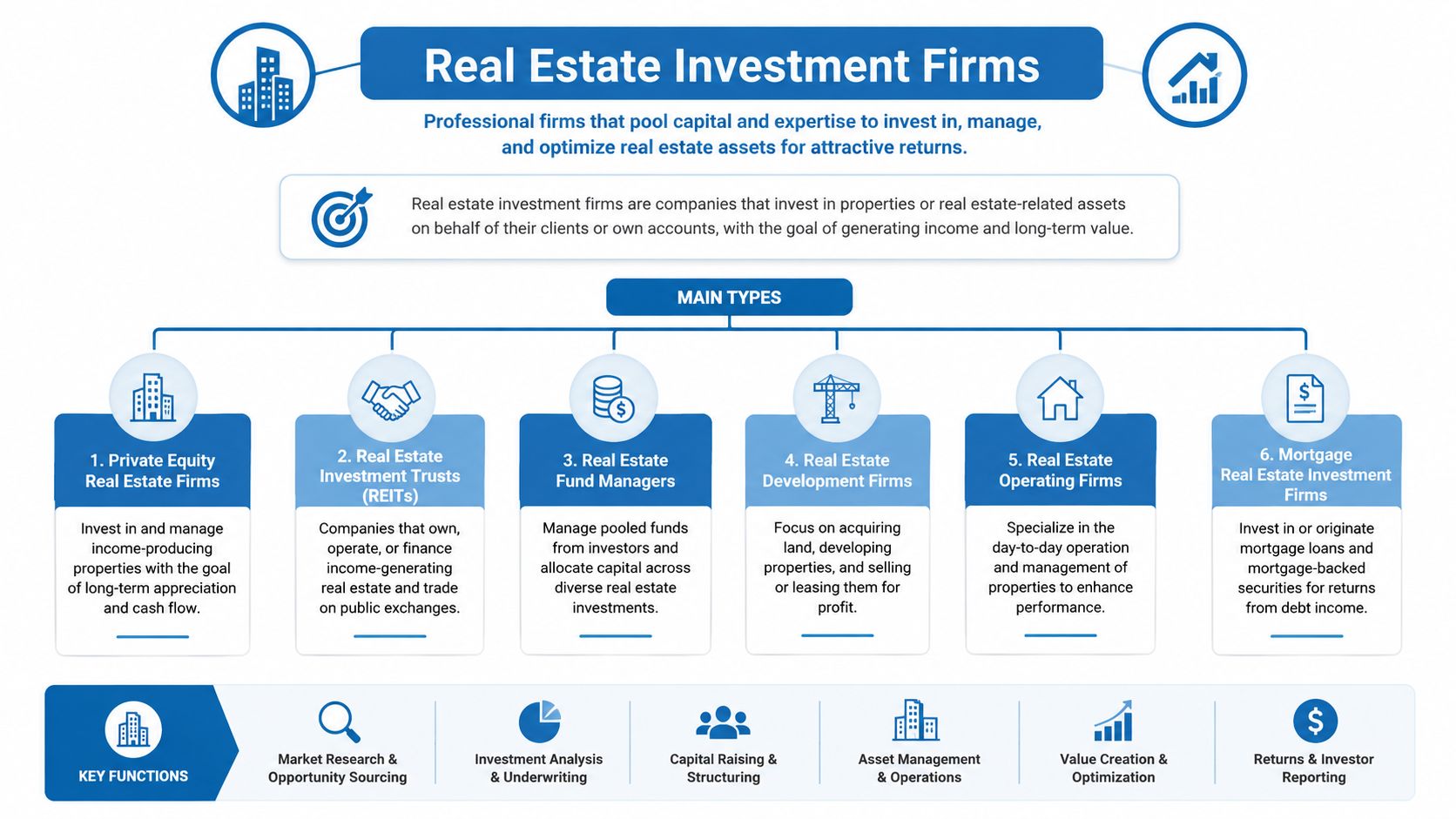
The five main structures
REITs are the clearest public-market vehicle. The U.S. SEC says a REIT owns and typically operates income-producing real estate or related assets, including office buildings, shopping malls, apartments, hotels, resorts, self-storage facilities, warehouses, and mortgages or loans. The SEC also says a REIT does not develop properties to resell them, it buys and develops properties primarily to operate them as part of its own investment portfolio. Public REIT equity market capitalization grew at a 17.6% annual rate from 1990 to 2021, rising from about US$9 billion to US$1.75 trillion, and REITs own over US$4.5 trillion in gross real estate assets across more than 535,000 properties.
Private equity real estate firms pursue a different path. They raise closed capital, source deals privately, and underwrite for a specific return profile. Their advantage is flexibility, they can move into development, recapitalizations, or credit positions without the constraints of daily public-market pricing.
Institutional real estate funds are usually strategy-specific pools, often aligned to a target risk band or asset class. They can be open-ended or closed-ended, and that difference matters because liquidity and valuation timing change investor outcomes.
Family offices often bring patient capital and narrower decision chains. They may look small relative to institutional platforms, but that can be an advantage in niche or relationship-driven transactions.
Operating companies sit closer to the asset. They may own real estate directly, but they often behave like businesses first and capital allocators second.
The underwriting reality is just as important as the legal wrapper. Smaller and mid-market funds commonly write US$10 million to US$100 million equity checks, while large multi-strategy managers can commit US$250 million or more to a single deal. That gap explains why structure and scale are not interchangeable. A firm built for a US$250 million check is not automatically built for fragmented sourcing, local leasing execution, or smaller platform deals.
Investment Strategies Used by Real Estate Investment Firms
The three core strategies are core, value-add, and opportunistic, and they sit on a real risk-return spectrum. The right one depends on whether the investor wants income, repositioning upside, or development-style volatility. Debt strategies such as mezzanine and preferred equity run alongside these, but they solve different capital needs.
The strategy spectrum
| Strategy | Risk Level | Typical Annual Return | Average Holding Period |
|---|---|---|---|
| Core | Low | Qualitative, lower relative return | Longer-term hold |
| Value-add | Moderate | Qualitative, mid-range return | Medium hold |
| Opportunistic | High | Qualitative, highest relative return | Longest hold |
Core strategies target stable, income-producing properties in mature markets. The point is cash flow stability, not dramatic repositioning. These deals usually have less renovation risk and more emphasis on tenant quality, lease durability, and operating discipline.
Value-add strategies lean into underwriting judgment. Firms pursue leasing improvements, repositioning, or operational fixes that can raise net operating income, which means the manager is betting that execution can improve the asset's economics.
Opportunistic strategies are the most aggressive. They often involve development, redevelopment, or distressed acquisitions where the manager is buying complexity and hoping to convert it into upside. That can work well, but only if the team has strong controls, deep local knowledge, and the balance sheet to wait.
Debt investing deserves separate treatment. Mezzanine and preferred equity can produce different return profiles from direct ownership, because the investor is underwriting capital stack position rather than just asset appreciation.
Investor filter: If a manager can't explain why a deal belongs in its own strategy bucket, the deal probably doesn't belong in the portfolio.
The question isn't which strategy sounds more refined. It's which one matches the investor's time horizon, liquidity tolerance, and willingness to trade certainty for upside.
How Real Estate Investment Firms Structure Operations and Measure Performance
A strong firm runs on more than deal intuition. Real estate investment firms are increasingly judged on EBITDA margins, headcount per US$1 billion of AUM, revenue per US$10 million of AUM, turnover rates, and acquisition volume per officer. NAREIM's global management survey says these firms also track workload, outsourcing, and span-of-control metrics because they shape margin structure and scaling capacity across strategies.
What the operating model reveals
Those metrics tell you whether a firm can absorb more capital without breaking its process. A team with attractive gross returns but poor operating efficiency may struggle once reporting complexity rises, compliance burdens increase, or sourcing expands into multiple markets. That is why margin structure matters. It is not a back-office detail, it is a strategic constraint.
The underwriting stack is equally unforgiving. The core ratios are NOI, cap rate, LTV, LTC, and DSCR. Industry guidance commonly treats DSCR of roughly 1.25x to 1.35x as a lender screening threshold, LTV around 60% to 65% as a conventional financing band, and debt yield around 8% to 10% as a stress-resilient check, because these metrics isolate cash-flow capacity and financing risk better than price-only analysis.
| Metric | What It Measures | Typical Healthy Threshold |
|---|---|---|
| NOI | Property cash flow before debt service | Depends on asset and market |
| Cap Rate | Price relative to income | Depends on strategy and market |
| LTV | Loan balance relative to value | Around 60% to 65% |
| LTC | Loan balance relative to cost | Deal-specific |
| DSCR | Cash flow coverage of debt service | Roughly 1.25x to 1.35x |
| Debt Yield | Income relative to loan balance | Around 8% to 10% |
If you're reviewing a platform that claims operational discipline, ask how it tracks these ratios at acquisition and after closing. A firm that monitors only entry valuation is missing the point. The operating question is whether the asset still works when rates move, leases roll, or expenses drift.
For a practical framework on how portfolios are monitored across properties and strategies, see real estate portfolio management software.
Deal Sourcing and Due Diligence Workflows in Practice
Deal sourcing starts with access, and access starts with speed. The best firms combine proprietary relationships, broker coverage, off-market channels, and data-driven screening so they can identify opportunities before the broader market crowds in. Once a target appears, the process turns into a sequence of checks that has to move fast without cutting corners.
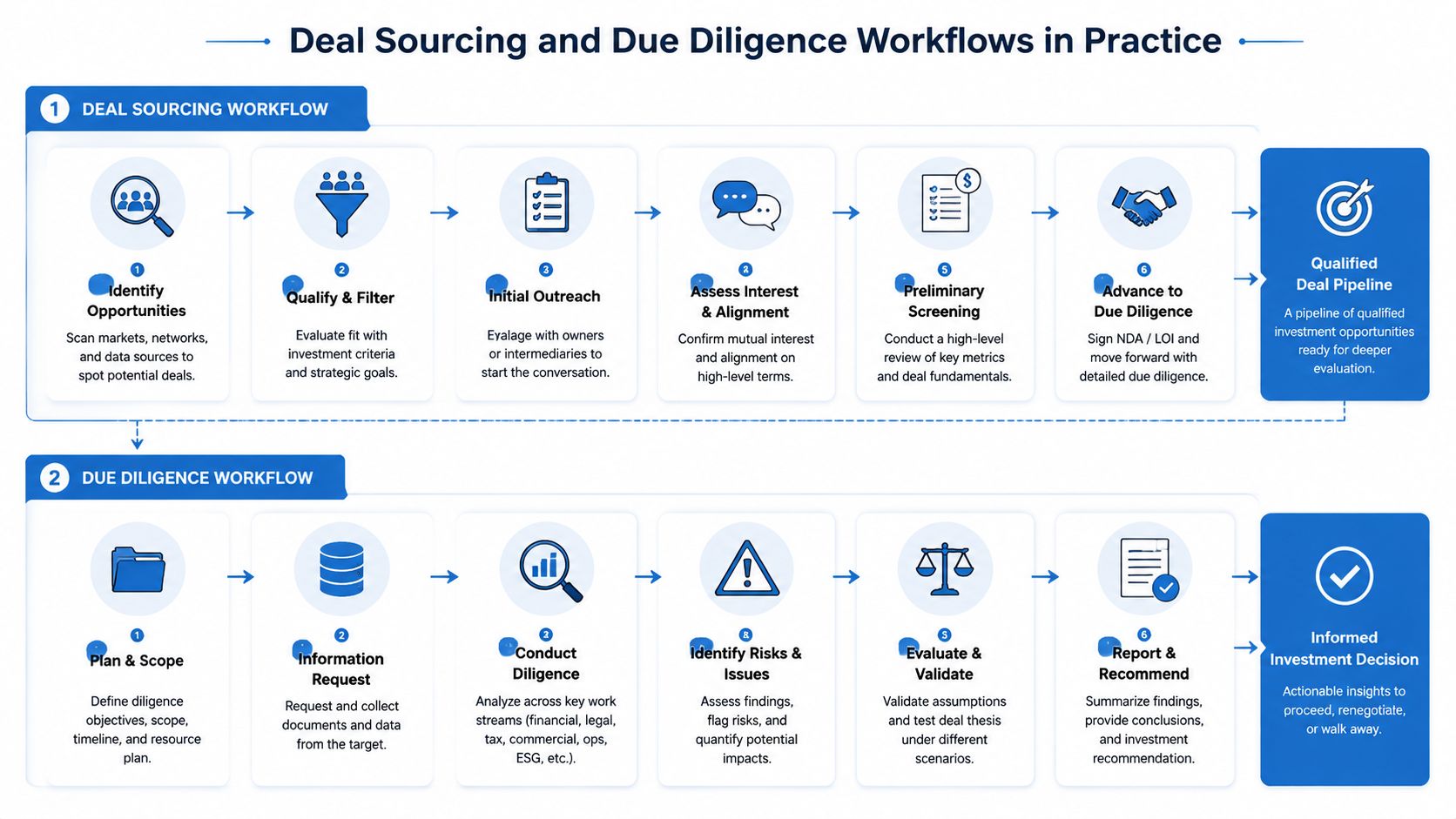
What gets checked before capital moves
The diligence path usually runs through title and lien review, physical inspection, environmental assessment, market and submarket analysis, rent roll verification, and financial underwriting. Those tracks are parallel, not linear in practice, because a weak title issue can stop a deal while leasing or engineering work is still in progress.
The bottleneck is often data fragmentation. If a team is stitching together tax records, ownership histories, rent rolls, and market comps from multiple systems, it slows down every decision. Better firms reduce that drag by standardizing the workflow and making the data legible to the investment team, not just the analyst who assembled it.
The Parkview Partners strategy evaluation guide from Parkview Partners is useful here because it reinforces a point too many investors skip. The checklist matters less than the order of operations, and the order matters less if the underlying records are incomplete.
A strong workflow doesn't just protect downside. It also changes bidding behavior. Teams that can verify title, ownership, and cash-flow inputs faster are more likely to move decisively, and in competitive submarkets that can be the difference between winning the asset and wasting the pipeline.
For a more detailed process map, see acquisition due diligence.
How Technology and Data Platforms Change the Investment Workflow
Modern real estate investing runs on continuous property intelligence, not static spreadsheets. That matters because sourcing, underwriting, and monitoring all depend on the same base layer of verified ownership, asset, and contact data. When that layer is slow or fragmented, every downstream decision gets slower too.
What a data platform replaces
Platforms like BatchData are built around that problem. The product delivers 155M+ U.S. property records, valuations, and verified owner contacts with daily updates, plus 1,000+ attributes via low-latency APIs and bulk delivery through S3, Snowflake, or flat files. It covers core characteristics, ownership history, AVMs and equity, mortgage and lien details, listings, permits, and pre-foreclosure activity. That kind of setup matters because firms don't just need records, they need records they can operationalize.
A screenshot makes the workflow easier to picture.
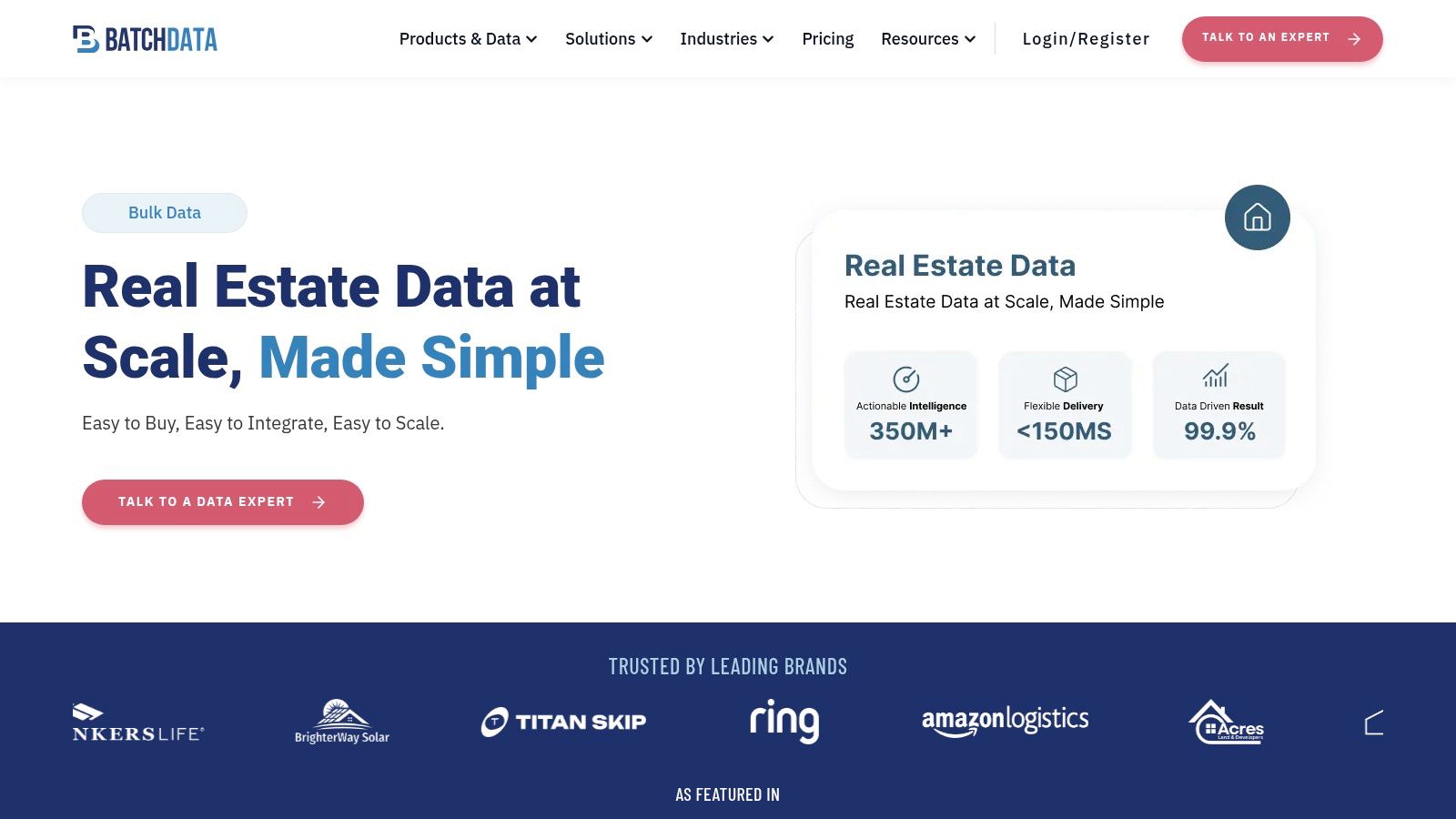
The practical value is in the handoff from raw data to action. Contact enrichment, skip tracing, phone verification, Smart Property Search, Portfolio Monitoring APIs, and BatchRank propensity modeling all support different points in the lifecycle, from acquisition targeting to asset surveillance. Firms with good data infrastructure can screen faster, track risk sooner, and avoid wasting analyst time on dead ends.
There's also a talent angle. The operational demands are similar to the ones described in talent and tech in quant funds, because both environments reward teams that can combine technical staff, rigorous process, and decision-grade data.
Operational truth: If the firm can't monitor ownership changes, lien signals, and contact reachability in one place, it's probably reacting too late.
For a deeper look at the data stack behind those workflows, see the complete guide to property data solutions.
How to Evaluate or Partner with Real Estate Investment Firms
Track record matters, but it's not enough. McKinsey's view of real estate investment management is that the sector is at a turning point, where managers need stronger operating models, better data, and clearer investor reporting to stand out. That's the right lens. Two firms can post similar gross returns and still produce very different net outcomes once debt, liquidity, and tax structure enter the picture.
What to pressure-test
| Criterion | What to Look For | Red Flags |
|---|---|---|
| AUM scale and concentration | Fit between firm size and your mandate | Oversized platform for a small ticket |
| Strategy alignment | Clear match to core, value-add, or opportunistic risk | Vague mandate drift |
| Fee structure and alignment | Terms that reward net performance | Incentives tied only to volume or gross IRR |
| Data and technology capability | Verified, current, and operationally usable data | Manual spreadsheets and slow record checks |
| Capital deployment consistency | Repeatable execution through cycles | Irregular pacing or style shifts |
Vehicle structure matters too. Open-ended and closed-ended funds do not behave the same way, and neither do joint ventures or corporate blockers. Those structures can materially change investor outcomes and tax treatment, so a manager's reported return is only part of the picture.
Edge comes from consistency. A manager that can source, underwrite, and report with discipline is more useful than one that tells a great story but cannot prove how it works. That is especially true in segments where the lower-middle-market still carries a lot of the transaction volume and where access, not brand name, drives results.
The right question is not, “Which firm had the best last cycle?” It is, “Which firm can deploy capital in a way that matches my liquidity, tax, and operational requirements without hiding the trade-offs?”
Putting It All Together, Choosing the Right Firm and Strategy
The best firm is the one that fits your capital, your timing, and your tolerance for complexity. That sounds basic, but most investors still start with performance and stop there. That's a mistake, because structure, strategy, operations, and data capability all shape the outcome.
If you want a simple decision path, use this sequence:
- Define the strategy first. Core, value-add, opportunistic, or credit will each fit a different risk appetite and hold period.
- Match the firm structure to your capital timeline. A REIT, a closed fund, a JV, or a family office platform can create very different liquidity and tax results.
- Pressure-test operating metrics. Look at margin structure, staffing efficiency, and underwriting ratios, not just pitch-deck IRRs.
- Check the data stack. If the firm can't source and monitor property data quickly, it will usually underperform on execution.
- Ask how capital gets deployed. A platform that says yes to everything often has a weaker edge than one with a clear lane.
That framework matters because the market is split in two directions at once. The top managers control enormous pools of capital, but the lower-middle-market still drives much of the transaction volume. In that environment, the firms that combine strategy discipline with operational intelligence are the ones most likely to keep winning.
If you're evaluating a manager, don't ask for a polished narrative. Ask for the underwriting thresholds, the reporting cadence, the data sources, and the reason their structure is the right one for your capital. That's where the distinction lives.
If you need cleaner property intelligence for sourcing, underwriting, or portfolio monitoring, BatchData gives investment teams verified property records, owner contacts, and workflow-ready APIs in one place. Visit BatchData to see how that data layer can support firmer decisions across acquisition and asset management.