






































Pennsylvania sits at the high end of the U.S. title insurance cost range. For teams modeling title insurance cost pa, the headline is only the starting point. The more useful question is why Pennsylvania stays expensive, even when property value alone does not explain the gap.
The answer is structural. Pennsylvania operates under a filed-rate system, and that limits how far pricing can move at the transaction level. In practice, title premiums behave more like a regulated fee schedule than a flexible vendor quote. That distinction affects more than settlement statements.
For proptech firms, lenders, and investors, it changes borrower cash-to-close estimates, pricing logic, and fallout risk. A fee engine built on national assumptions will often miss Pennsylvania by enough to affect conversion, margin, or both. The underwriting issue is not just cost inflation. It is state-specific pricing behavior that has to be modeled correctly.
That creates a useful data signal.
Pennsylvania is a strong test case for a broader operating rule in real estate. Title cost data has limited value unless the regulatory logic behind the charge is mapped into the model as well. Teams that do this well can price more accurately, spot transaction friction earlier, and separate avoidable variance from real title risk.
Introduction
Pennsylvania doesn't just run high on title insurance. It sits at the top of the national cost table.
The clearest benchmark comes from AmeriSave's state comparison of title insurance costs, which shows combined lender's and owner's title insurance fees of $3,496 in Pennsylvania, compared with a national average of $1,337. That's not a rounding error. It's a structural difference in how the state handles rates, process, and allowable pricing behavior.
For proptech teams, lenders, and investors, this matters in three ways. First, it changes borrower affordability at closing. Second, it distorts assumptions if your product or model was trained on national averages. Third, it creates a clean use case for state-aware pricing logic, title workflow automation, and better transaction-level risk scoring.
Pennsylvania title costs aren't "high because real estate is expensive." They're high because the operating and regulatory mechanics are different.
The practical takeaway is that title insurance cost pa should never be estimated with a generic national calculator. Pennsylvania needs its own logic layer.
| What matters | Why it matters |
|---|---|
| Statewide cost level | Pennsylvania's title costs sit well above national norms |
| Regulatory design | Rate structure and discount limits shape premium outcomes |
| Operational impact | Higher title costs affect quotes, closing cash, and portfolio models |
If you're building quote tools, underwriting APIs, investor dashboards, or borrower-facing closing estimates, Pennsylvania is where shallow assumptions break.
What Exactly Are You Paying For In Title Insurance
Title insurance in Pennsylvania is priced less like a pure risk product and more like a front-loaded legal verification process. The buyer pays for a policy, but the primary cost driver is the work completed before recording. That includes searching the chain of title, reviewing recorded instruments, identifying liens or judgment issues, clearing defects, coordinating payoff and recording details, and issuing a policy that stands behind the result.
Two policies, two protected parties
A standard Pennsylvania closing usually includes two separate policies.
- Lender's policy protects the lender's lien position.
- Owner's policy protects the buyer's ownership interest and equity.
Those policies solve different problems. A lender needs confidence that its mortgage will sit where it should in the priority stack. The owner needs protection against defects that could limit use, transfer, or resale value. For investors and proptech operators, that distinction matters because the insured exposure is not the same as the operational workflow. One policy follows the debt. The other follows the ownership claim.
The premium reflects search, review, and defect-clearing work
Most title premium dollars do not go toward future loss payouts in the way many buyers assume. The larger share supports labor, records review, underwriting, compliance, and settlement operations completed before closing. In Pennsylvania, that matters even more because local record quality, county-level variation, and transaction-specific exceptions can materially change how much work a file requires.
The practical implication is straightforward. Title cost is tied to the condition of the property's legal history.
A clean file with a short ownership chain, no open liens, and consistent indexing is cheaper to process operationally than a file with unresolved estates, municipal claims, boundary issues, prior unreleased mortgages, or recording gaps. The filed premium may still follow state rate logic, but the effort behind the quote is driven by file complexity. That is one reason title teams care so much about document quality and county-record normalization in Pennsylvania, where our Investor Pulse reports track county-level activity.
| What the buyer is funding | Why it affects cost and workflow |
|---|---|
| Title search | Pulls deed, mortgage, lien, tax, judgment, and related records |
| Examination | Reviews legal ownership chain and flags defects or exceptions |
| Curative work | Resolves payoff errors, missing releases, estates, or filing defects |
| Underwriting | Determines what can be insured and what must be excepted |
| Settlement coordination | Aligns closing figures, payoff handling, signatures, and recording |
| Policy issuance | Creates the final insured product for lender and owner |
A short explainer helps if you need a visual walkthrough of how title insurance works operationally:
What this means for pricing models
The mistake I see in quote tools is treating title insurance as one opaque line item. That hides the operational logic and weakens estimate accuracy.
A better model separates three components. First, the filed premium tied to policy amount. Second, the settlement and examination workload. Third, file-specific friction such as unreleased liens, municipal searches, expedited closings, or corrective recordings. That structure is far more useful for lenders estimating cash to close, proptech firms designing state-specific quote engines, and investors modeling transaction costs across Pennsylvania counties.
The plain-language answer is simple. Buyers are paying for someone to verify that the property can be transferred with insurable ownership rights, then stand behind that conclusion after closing.
Why Is Title Insurance So Expensive in Pennsylvania
Pennsylvania routinely shows up at the high end of title cost comparisons. The reason is not just "more paperwork." It is the state's rate and underwriting structure, which leaves less room for the discounts and process shortcuts that reduce costs in other states.
The biggest pricing difference is regulatory. In many markets, a prior policy can reduce the premium on a refinance or repeat transaction through reissue or transfer logic. Pennsylvania is far less flexible. That keeps costs higher for refinance borrowers, repeat buyers, and investors turning the same asset more than once.
For operators, that matters because the savings assumptions built into national quote models often fail here. A refinance funnel that works in a reissue-friendly state can materially understate borrower cash to close in Pennsylvania. A buy box model can also miss basis risk if title is treated as a flat percentage instead of a state-specific cost category.
Process rules add another layer. Pennsylvania title work often involves more intensive abstracting, certification, and file review than teams expect in lower-friction states. The rate may be regulated, but the labor behind a clean insurable file still varies by chain complexity, municipal issues, unreleased liens, estates, and corrective recordings.
That combination creates a market with two defining traits. Prices stay relatively firm, and file-level variance still matters.
Why this matters for lenders, proptech firms, and investors
I see three recurring failure points in Pennsylvania models:
- Borrower-facing estimates built from national defaults that assume refinance discounts will appear
- Acquisition models that treat title as a minor closing line instead of a state-level cost driver
- Quote engines that calculate the premium correctly but miss Pennsylvania-specific settlement and curative friction
- Portfolio pricing that ignores how repeat transactions in PA retain more title cost than comparable assets in other states
The practical response is simple. Configure Pennsylvania as its own rule set.
That means separating regulated premium logic from operational risk. It also means using county history, transaction type, prior conveyances, and known defect patterns to forecast where a file will stay routine and where it will require extra work. Our Investor Pulse reports are useful here because they add market context to title expense modeling.
The broader takeaway is the "so what." Pennsylvania's higher and more persistent title costs create an opening for better data products. Lenders can improve fee estimates. Proptech firms can build state-specific quote logic that fails less often. Investors can price acquisition and refinance economics with fewer surprises. In a regulated market like PA, the edge comes from forecasting variance around the filed rate, not pretending the variance does not exist.
How Pennsylvania Title Insurance Premiums Are Calculated
Pennsylvania title premiums follow a tiered logic. The rate per thousand of insured value declines as liability brackets rise. That's not unique to Pennsylvania, but the way it interacts with the state's regulated environment is what buyers feel.
A useful comparison point comes from UseElko's explanation of tiered title premium schedules. It shows that title insurance premiums can drop from $5.75 per $1,000 on the first $100,000 to $2.00 per $1,000 above $10M, with the effective rate falling from nearly 1% to 0.2% as fixed search costs are spread across larger policies. The same source also notes an average benchmark of 0.42% on a $318,000 home with a $1,337 premium.
The core math
For an owner's policy, the premium is generally tied to the purchase price. For a lender's policy, it ties to the loan amount. In simultaneous issuance scenarios, the lender portion is often lower than a fully separate policy because the underlying title work is shared.
That doesn't mean the final quote is simple. In Pennsylvania, transaction structure, policy combination, endorsements, and settlement services still affect what shows up on the closing disclosure.
Here is the practical point: title insurance cost pa isn't one flat percentage. It's a bracketed premium schedule plus transaction-specific additions.
Sample Title Insurance Cost Calculation in Pennsylvania 2026 TIRBOP Rates
| Sale Price | Owner's Policy Premium (Basic Rate) | Lender's Policy (Simultaneous Issue) | Estimated Total Premium |
|---|---|---|---|
| $250,000 | Varies by promulgated rate schedule | May be reduced when issued simultaneously | Final amount depends on policy structure and extras |
| $500,000 | Varies by promulgated rate schedule | May be reduced when issued simultaneously | Final amount depends on endorsements and settlement charges |
| $1,000,000 | Varies by promulgated rate schedule | May be reduced when issued simultaneously | Effective rate usually declines across higher brackets |
That table is intentionally conservative. A precise Pennsylvania quote requires the applicable promulgated schedule and the actual deal structure. If a vendor presents a single flat estimate without asking purchase price, loan amount, and policy combination, the estimate is weak.
What to ask for in a real quote
Ask for these items separately:
- Owner's policy premium
- Lender's policy premium
- Any simultaneous issue treatment
- Settlement or closing fee
- Endorsements
- Taxes or recording-related pass-throughs if shown outside the premium
That itemization matters because buyers often compare title quotes that are not quoting the same thing.
The most common pricing error isn't math. It's comparing a base premium from one provider to a nearly all-in estimate from another.
Who Pays For Title Insurance and What Other Fees Exist
In most Pennsylvania purchase transactions, the buyer pays the title insurance charges tied to the closing. That often includes the lender's policy required by the mortgage lender and, in many deals, the owner's policy that protects the buyer's equity.
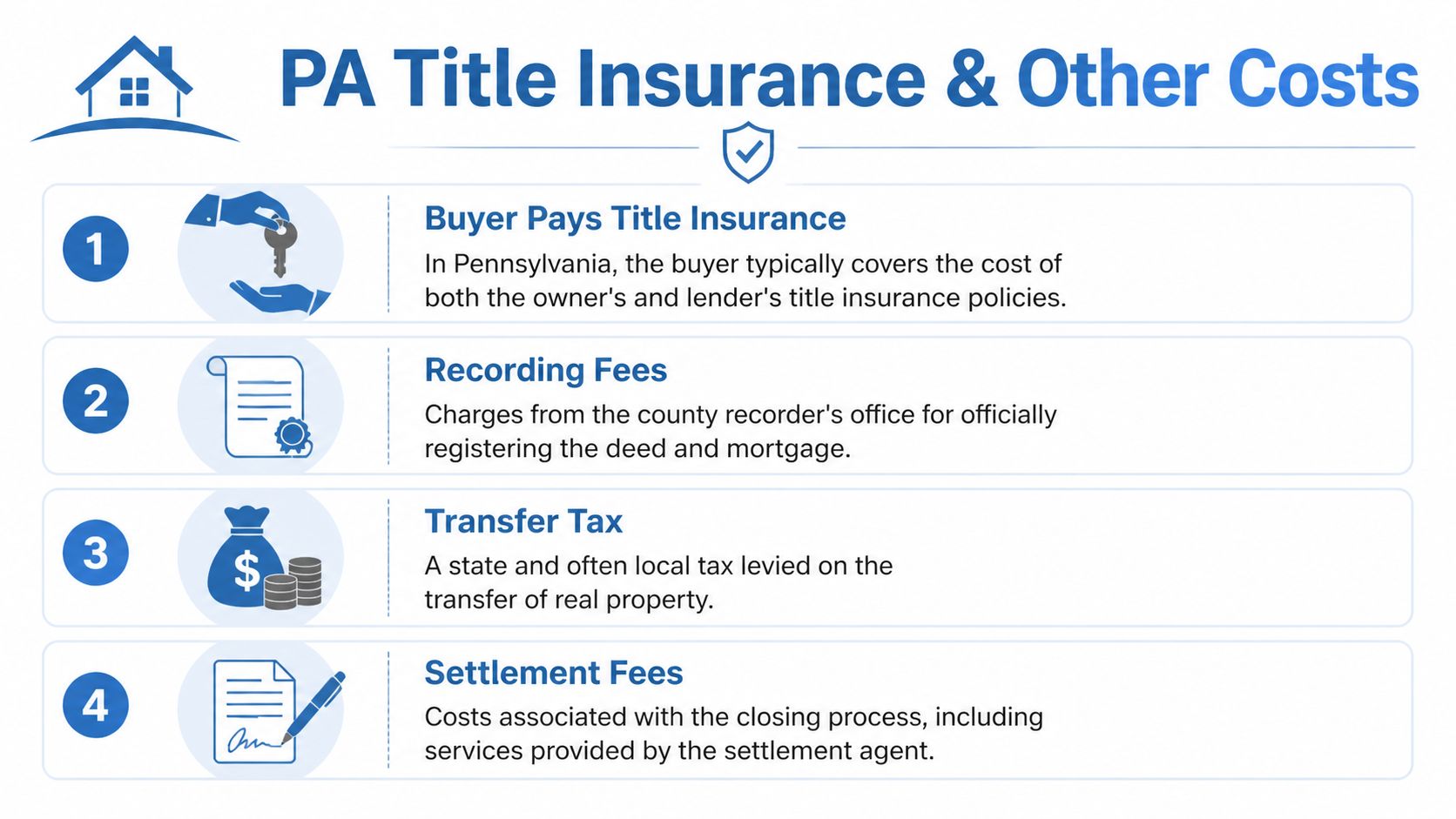
The practical problem is not who pays. The problem is that buyers, lenders, and acquisition teams often budget for the premium and miss the rest of the title bill.
In Pennsylvania, the premium is only one line item in a broader closing stack. Endorsements, settlement charges, recording fees, and transfer taxes can materially change the all-in amount, especially on financed purchases or assets with deal-specific underwriting requirements. For proptech firms and investors, that distinction matters because the premium is relatively predictable under a regulated rate structure, while the surrounding fees are where quote variance and margin leakage tend to show up.
The payer is usually clear. The total cost often is not.
An endorsement adds coverage for a defined issue or lender requirement. The effect is straightforward. A file that looks ordinary at intake can become more expensive once the lender's closing instructions, survey status, condo structure, or recorded exceptions are reviewed.
Typical add-on cost drivers include:
- Lender-required endorsements
- Survey or boundary-related coverage
- Condominium or planned community issues
- Restrictions, easements, or other property-specific exceptions
- Extra curative work before closing
That is why serious cost models separate promulgated premium from title-related closing costs. Teams reviewing Philadelphia County activity in our Investor Pulse reports often track where complex urban inventory, older chains of title, or layered financing structures create more fee expansion outside the base policy charge.
Other fees buyers usually group into "title costs"
Even when these charges are not part of the insurance premium itself, they hit the same settlement statement and affect borrower cash to close.
| Cost category | What it covers |
|---|---|
| Settlement or closing fee | File handling, document coordination, execution, and disbursement |
| Recording fees | County pass-through charges for recording the deed, mortgage, and related instruments |
| Transfer tax | State and local realty transfer tax, usually far larger than minor title add-ons |
| Endorsements | Optional or lender-driven coverage additions that raise the final title bill |
| Search or ancillary charges | Municipal, tax, payoff, or other file-specific items shown by the settlement provider |
For operators building quoting tools, bad assumptions can arise. A consumer-facing estimate that bundles premium with transfer tax tells a different story than a lender-facing estimate that isolates title charges. Both may be technically defensible. They are not analytically interchangeable.
What disciplined teams do differently
- Ask who is paying each title line item under the local contract custom. Pennsylvania practice often puts the burden on the buyer, but allocation can shift by negotiation, refinance structure, or commercial terms.
- Request endorsement assumptions before comparing providers. A low initial quote with thin assumptions is not a better quote.
- Separate regulated premium from variable closing fees in your models. That makes provider comparisons cleaner and exception analysis easier.
- Track county, asset type, and lender overlays. Those variables shape fee expansion more than many firms expect.
- Reduce manual quote intake. Operations teams handling repeat closings often benefit from automating data entry with an API so policy type, loan structure, and fee fields are captured consistently.
The recurring mistake is simple. Teams compare title quotes as if every provider is quoting the same scope of work. In Pennsylvania, cost control comes from itemization, not from assuming the headline premium tells the whole story.
How Data Platforms Modernize PA Title Underwriting
Pennsylvania's title market creates an unusual data problem. Premium rates are regulated, but file-level cost variation still shows up late, often after a quote has already circulated through lending, acquisition, and closing teams.

That matters because the underwriting question in Pennsylvania is rarely just, "What is the rate?" The harder question is, "What conditions in this file will change the final title bill, delay issuance, or alter settlement assumptions?" In a regulated market, that is where data creates margin.
Where data changes the outcome
Strong underwriting workflows pull title-relevant signals forward. Recorded documents, vesting history, open mortgages, lien filings, and transaction timing can all be analyzed before the file reaches late-stage review.
That improves decisions in four places:
- Refinance triage where prior policy history or file structure may affect how the transaction is quoted
- Portfolio acquisition review where dozens or hundreds of assets need the same underwriting rules applied consistently
- Borrower and lender quote quality where early estimates need fewer manual revisions
- Exception handling where ownership breaks, judgment risk, or lien complexity can be flagged before closing ops gets involved
For operators handling repeat transactions, the gain is operational and financial. Fewer reworked quotes. Better reserve assumptions. Faster identification of files that need human review instead of straight-through processing.
Teams that want to reduce manual rekeying between title, servicing, and underwriting systems often benefit from automating data entry with an API, especially when policy fields, borrower data, and document metadata need to move across systems without introducing new errors.
What a modern workflow looks like
In Pennsylvania, a useful title data stack does not try to replace the title agent. It helps the agent, lender, or investor get to the right file posture earlier.
A practical workflow usually includes:
- Early property and party matching. Confirm the parcel, owner, and vesting chain before pricing logic starts.
- Recorded debt and lien screening. Surface mortgages, releases, tax claims, and judgment signals that can complicate clearance.
- Transaction classification. Distinguish purchase, refinance, REO, construction, and portfolio scenarios because they do not move through the same underwriting path.
- Cost segmentation. Keep regulated premium logic separate from endorsements, search charges, curative work, and settlement-side fees.
- Escalation rules. Route clean files one way and higher-risk files another, based on objective title signals instead of inbox timing.
That last point is where many teams still lose money. If every file gets the same manual treatment, low-risk transactions subsidize high-friction ones and cycle times drift upward.
Geography also matters. Parcel complexity, municipal filing patterns, tax status, and adjacent land use can affect how quickly a file is cleared and how confidently a lender or investor prices the asset. For firms building broader property intelligence systems, geospatial analysis improves automated valuation models in ways that also support title and collateral review.
Where BatchData fits
BatchData is one example of a platform used to pull property records, ownership history, mortgage detail, lien signals, and valuation context through APIs or bulk delivery. In Pennsylvania workflows, that type of dataset supports pre-underwriting screens, quote normalization, and portfolio-level forecasting of title friction.
The business case is straightforward. Earlier visibility into title conditions improves quote discipline, staffing allocation, and exception forecasting. It also gives proptech firms and investors a cleaner way to separate regulated pricing from file-specific risk.
Waiting for the settlement package to reveal title problems is a costly operating model. By that point, the team is no longer underwriting. It is absorbing variance.
Frequently Asked Questions About PA Title Insurance Costs
Can you shop around for title insurance in Pennsylvania
Yes, but the savings usually come from service execution and closing fees, not from major premium differences. In Pennsylvania, the filed rate structure narrows price competition, so the primary trade-off is operational. Which provider clears issues faster, catches exceptions earlier, and keeps non-premium charges disciplined.
Is owner's title insurance required in Pennsylvania
Usually no for the buyer. Usually yes for the lender if the purchase is financed.
That distinction matters more than many acquisition models assume. The lender's policy protects the loan balance. The owner's policy protects the buyer's equity position and ownership rights, which is the part investors and owner-occupants retain if a title defect surfaces later.
What is the simultaneous issue discount
It is a reduced charge that can apply when the owner's and lender's policies are issued together. As noted earlier, Pennsylvania rate practices can make this a meaningful adjustment, but the exact impact depends on the file and the way the policies are structured at closing.
Why do title quotes change before closing
Early quotes are often built on limited information. The final numbers shift when the title company confirms endorsements, payoff complexity, unpaid taxes, recording requirements, or curative work.
For proptech firms and lenders, this is less a pricing mystery than a document standardization problem. Teams that extract fees and exceptions consistently from commitments, CPLs, settlement statements, and payoff documents get tighter forecast ranges. If your operation handles those documents at scale, AI-powered data extraction solutions can help normalize fee capture across inconsistent formats.
Is title insurance in Pennsylvania overpriced
Structurally expensive is the more accurate description. The cost profile reflects Pennsylvania's regulated framework, county-level recording realities, and the labor required to clear file-specific risk. For investors, the practical takeaway is simple. Do not benchmark PA against low-friction states and assume variance is noise. It is part of the operating model.
What's the most important move for investors and proptech firms
Model Pennsylvania as its own cost environment.
National average closing-cost assumptions tend to compress the very factors that drive margin in this state, including premium rules, local recording patterns, and curative intensity. BatchData can help teams work from actual property, ownership, mortgage, and lien records instead of generic closing-cost averages, which makes title expense easier to forecast before underwriting, quote generation, or portfolio acquisition decisions.