



Your real estate portfolio is leaking value, and outdated spreadsheets are the cause. For enterprise investors managing multi-million dollar assets, the operational drag from manual data entry and the financial risk of stale information create a liability that costs firms an average of 15% in operational efficiency. This guide cuts through the noise to show you exactly how modern real estate portfolio management software transforms static assets into a dynamic, data-driven growth engine.
We will analyze the core capabilities, evaluation criteria, and true ROI of these platforms. You will learn the difference between basic tools and advanced systems that offer a competitive edge through AI and automation.
- Core Takeaways:
- Vendor Vetting: Prioritize data accuracy, API latency, and SOC 2 compliance over superficial features.
- Advanced Tools: AI-driven valuations (AVMs) and programmatic monitoring are non-negotiable for modern risk management.
- True ROI: Returns are measured in operational efficiency gains and mitigated risk, not just software subscription costs.
This is your roadmap to selecting a solution that provides a single source of truth for your entire portfolio.
Why are spreadsheets a liability for modern portfolios?
Spreadsheets are a liability because they are static, error-prone, and incapable of providing the real-time data required for modern real estate investment. Every manual data entry introduces a potential failure point, leading to flawed underwriting, missed opportunities, and compliance breaches that directly threaten profitability. The market is aggressively shifting away from these legacy tools.
The real estate portfolio management software market was valued at $15 billion in 2023 and is projected to reach $31.4 billion by 2033. North America's 39.71% market share signals a clear industry consensus: smart, cloud-based platforms are the new standard.

The True Cost of Manual Management
The primary danger of spreadsheets is their inability to keep pace with dynamic market conditions. Property values, lien statuses, and ownership data change daily, but a spreadsheet reflects a single point in time. This data lag creates a critical gap between your information and market reality, killing decision-making velocity and forcing teams to operate with obsolete data.
The liability of spreadsheets isn't a typo. It's the cost of delayed action—the deal you miss, the risk you don't see, and the market shift you can't react to because your data is three weeks old.
This guide explores the critical role of automated data ingestion and how real estate APIs improve data pipelines, making real-time insight the operational standard.
What is real estate portfolio management software?
Real estate portfolio management software is a centralized platform that automates the tracking, analysis, and performance optimization of property collections. Its primary function is to eliminate information silos by aggregating disparate data—tax records, ownership history, market signals, and Automated Valuation Models (AVMs)—into a single source of truth. This provides an immediate, holistic view of every asset.
The core capability that separates modern software from digital filing cabinets is the shift from manual entry to automated data feeds via Application Programming Interfaces (APIs). This automation frees analysts from the 80% of their time previously spent on data collection and cleanup.
The Value of Automated Data
Real-time data feeds provide a distinct competitive advantage.
- Faster Underwriting: Access to the latest property and market data accelerates accurate decisions on acquisitions and loans.
- Immediate Risk Assessment: The system instantly flags risk signals like new liens, pre-foreclosure filings, or ownership changes.
- Opportunity Identification: Pinpoint market trends or property-specific events long before competitors using static data.
The right software transforms portfolio management from a reactive, backward-looking process into a proactive, forward-looking strategy.
How Data Becomes Insight
Effective software assembles thousands of scattered data points—tax records, mortgage details, zoning codes—into a coherent, actionable picture. It connects datasets that are otherwise difficult to correlate, such as linking owner contact information with property-level distress signals.
| Data Category | Specific Data Points | Strategic Value |
|---|---|---|
| Property & Tax Data | Assessed value, tax history, parcel number, property characteristics | Foundational for valuation and operational cost analysis. |
| Ownership & Liens | Current owner, deed history, mortgage details, active liens | Critical for due diligence and mitigating title risk. |
| Market Signals | Listings, pre-foreclosure status, auction data, building permits | Provides real-time indicators of market activity and momentum. |
| Valuation & Equity | Multiple AVMs, estimated equity, loan-to-value (LTV) ratios | Powers dynamic financial modeling and asset performance evaluation. |
Understanding how the software aggregates and activates data is essential. The goal is not to buy a digital filing cabinet; it is to acquire an engine for insight.
How do you choose the right real estate portfolio management software?
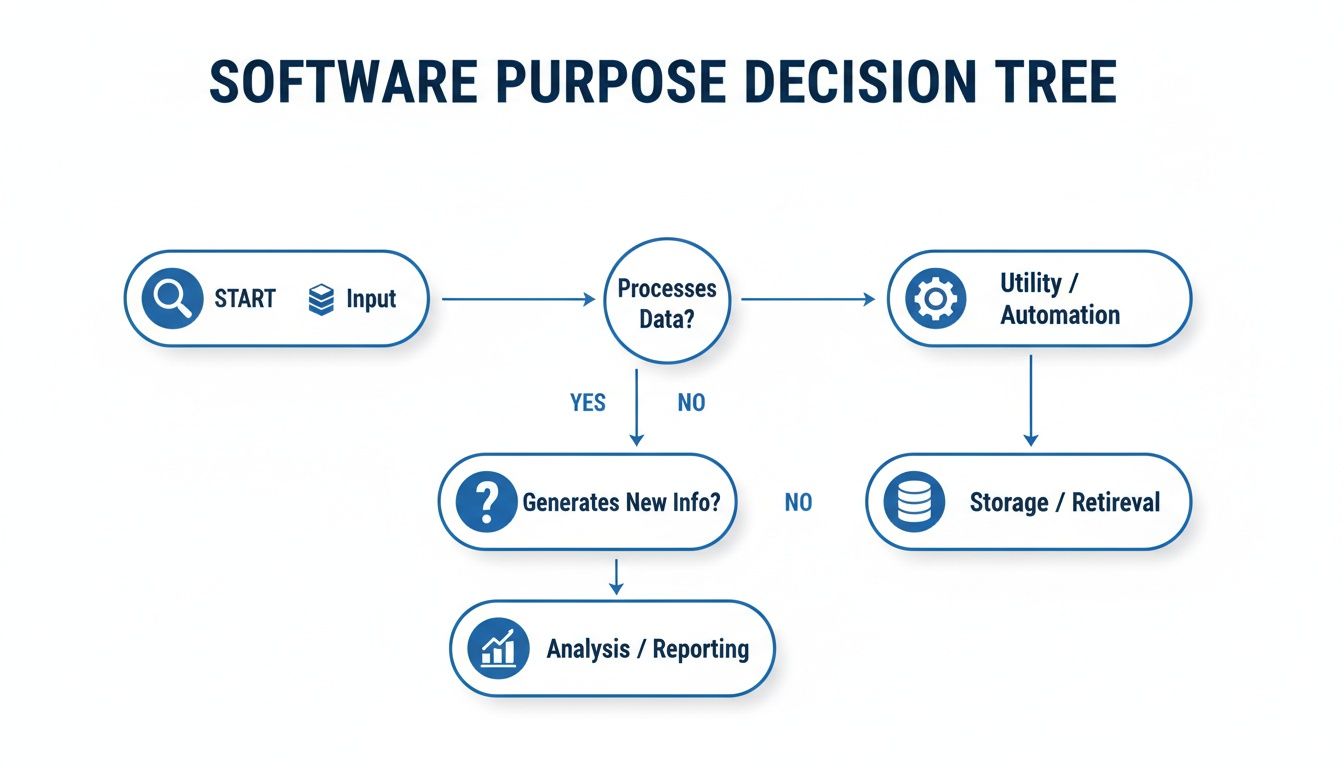
Choosing the right real estate portfolio management software requires a methodical evaluation of its performance under real-world pressure. A correct choice unlocks operational efficiency and higher returns; a wrong one creates a costly bottleneck. Your evaluation must go beyond a feature checklist to pressure-test vendors on criteria that directly impact enterprise-level operations.
The quality of any software's output—be it an investment model or a risk alert—is entirely dependent on the quality of its input data.
Data Accuracy and Refresh Cadence
Data integrity is the absolute foundation. If the data is inaccurate or stale, any resulting analysis is worthless. Your first questions must target data quality. A platform refreshing data daily operates in a different league than one updating monthly; industry analysis shows stale data causes valuation errors in over 60% of cases. Demand transparency on data sources—reputable vendors will detail their sourcing from county recorders and tax assessors and explain their validation processes.
API Performance and Developer Support
For integration into an existing tech stack, the API is the central nervous system. A slow, poorly documented API will create development bottlenecks and hamstring the platform's utility.
- Latency: The time an API takes to respond to a request. High-volume operations require latency measured in milliseconds.
- Developer Experience (DX): Clear, complete, and easy-to-follow API documentation is a signal of a mature, enterprise-ready product.
A high-performance API is the difference between a tool your team can build on and a siloed platform that creates more work. Thoroughly test the sandbox environment before committing.
Scalability and Security Protocols
The software must scale with your portfolio. It needs to handle millions of records without performance degradation. Inquire about the platform’s architecture—a cloud-native infrastructure like AWS or Azure is designed for on-demand scaling. Security is non-negotiable. Verify the vendor has SOC 2 Type II compliance, a rigorous audit of customer data protection. Data encryption (in transit and at rest) and robust access controls are baseline requirements.
Vendor Evaluation Checklist
Use this framework to compare vendors on critical business and technical dimensions, moving your decision from a gut feeling to a data-backed choice.
| Evaluation Criterion | Key Questions | Business Impact |
|---|---|---|
| Data Integrity | What is your data refresh frequency (daily, weekly)? What are your primary data sources and validation methods? | Daily updates mitigate risk and improve decision accuracy. Weak data leads to flawed underwriting. |
| API & Integrations | Can we test your API latency in a sandbox? How comprehensive is your API documentation and developer support? | A high-performing API is essential for automation. Poor support creates integration failures. |
| Scalability | Is the platform built to handle portfolios of 1M+ properties? What is the underlying cloud infrastructure? | Ensures the software supports business growth without performance degradation, preventing costly future migrations. |
| Security & Compliance | Are you SOC 2 Type II compliant? How is our data encrypted and who has access to it? | Protects sensitive data from breaches and ensures you meet regulatory requirements. Non-compliance is a major liability. |
| Pricing Model | Is pricing based on users, data volume, or API calls? Are there hidden fees for support or onboarding? | Transparent pricing prevents budget overruns and ensures costs align with business value. |
| Support & Onboarding | What does your onboarding process include? Is support handled by technical experts or a generic helpdesk? | White-glove support accelerates adoption and ROI. Poor support leads to low user engagement. |
What are the differences between essential features and advanced capabilities?
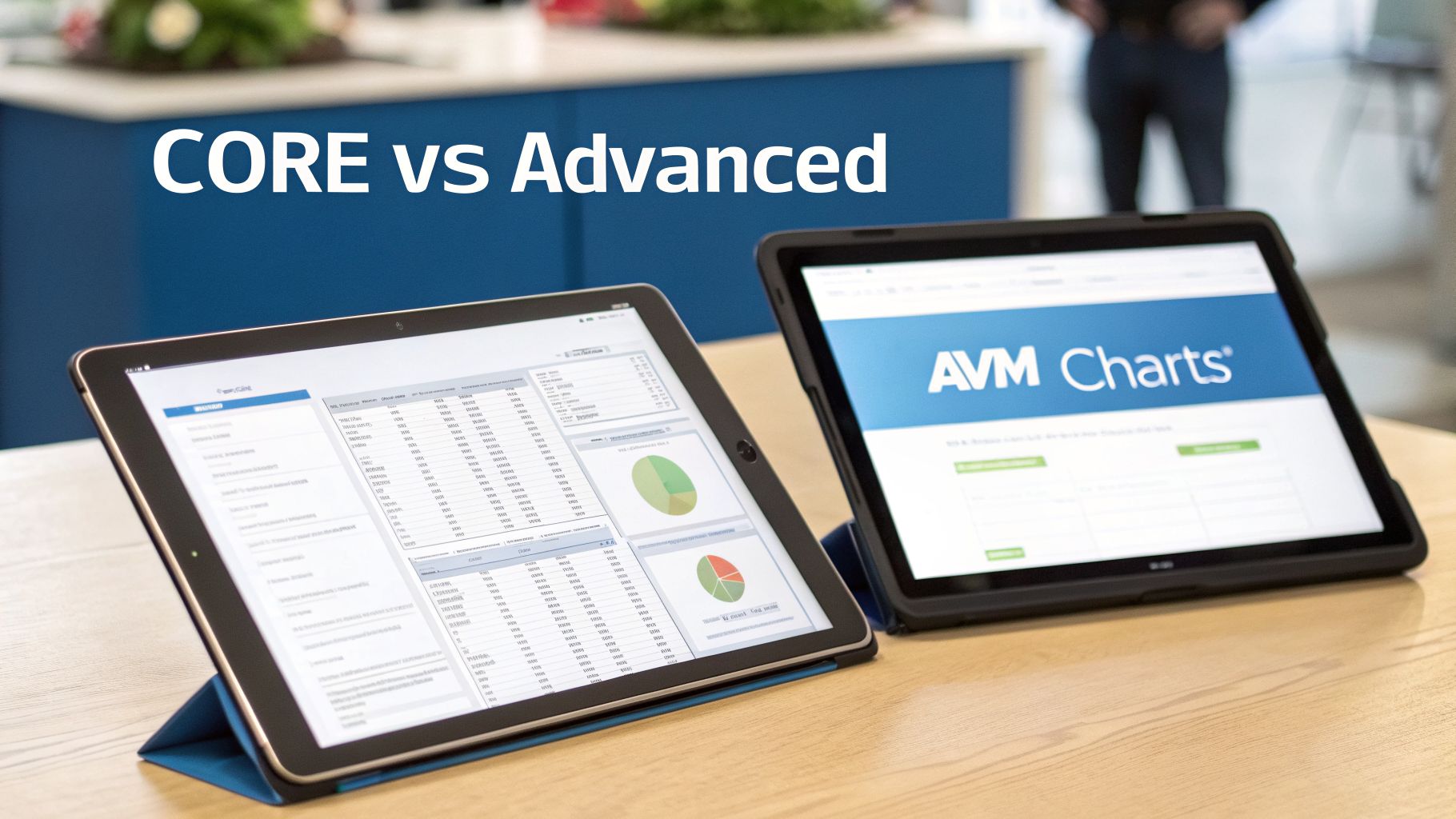
The key difference is that essential features are reactive tools for basic tracking, while advanced capabilities are proactive engines for managing risk and opportunity. Evaluating real estate portfolio management software requires separating foundational "table stakes" features from true force multipliers that provide a competitive edge. Over-investing in tools you don't need burns capital, but mistaking a game-changing capability for a "nice-to-have" leaves you years behind.
Core Features
Core features are the non-negotiable, foundational tools that replace spreadsheets. They are designed for centralized tracking and basic reporting.
- Property Data Repository: A central database for address, APN, and key property characteristics.
- Document Management: A digital filing system for deeds, loan agreements, and inspection reports.
- Basic Financial Reporting: Standard dashboards showing high-level metrics like purchase price and loan balance.
These tools are necessary but fundamentally reactive. They organize what has already happened but offer little predictive power.
Advanced Capabilities
Advanced capabilities use automation, AI, and real-time data to transform a passive database into a strategic engine. They shift your team from data mining to acting on insights.
The inflection point in software value is not when it tells you a property's assessed value. It's when it programmatically alerts you that the property's risk profile changed five minutes ago due to a new lien filing.
Programmatic Portfolio Monitoring
Programmatic portfolio monitoring automates the continuous checking of public and private data sources for specific events tied to your assets. Instead of an analyst manually checking records, the software uses event-based triggers to monitor for changes.
- Real-World Scenario: A mortgage servicer with a 50,000-loan portfolio sets up alerts for pre-foreclosure filings or tax delinquencies. When a borrower misses a tax payment, the system instantly flags it. The risk team can proactively engage the borrower months before the situation escalates into a default, dramatically cutting servicing costs and mitigating loss.
AI-Driven Valuations and Propensity Models
AI-powered analytics go beyond a single Automated Valuation Model (AVM). Leading platforms offer a suite of AVMs and use machine learning to identify the most accurate model for a specific property or submarket. This technology also powers propensity modeling, which uses predictive analytics to identify assets or owners most likely to take a specific action.
- Real-World Scenario: An iBuyer in Phoenix uses a "propensity to sell" model instead of generic mailers. The model analyzes hundreds of data points—owner's age, time in home, estimated equity, recent life events—to score the likelihood of an owner selling in the next 90 days. Their marketing is now laser-focused on a small, high-intent group, boosting campaign conversion rates by over 25% and slashing cost-per-acquisition.
How do you calculate the true ROI of new software?
The true Return on Investment (ROI) of real estate portfolio management software is calculated by quantifying its direct financial impact on operational efficiency, revenue generation, and risk mitigation. This requires moving beyond the subscription cost to connect specific platform capabilities to hard numbers. A solid ROI framework turns the platform’s value into a clear business case. For instance, eliminating manual data entry directly cuts operational overhead by reallocating expensive analyst hours to high-value work like deal sourcing.

Quantifying Cost Savings
The most immediate return comes from automating manual tasks. A team of five analysts spending 25% of their time (10 hours/week each) on manual data gathering costs 200 hours per month. At a blended rate of $75/hour, automating this workflow recovers $15,000 in productivity monthly, or $180,000 annually.
Measuring Revenue Uplift
Faster, more accurate data directly increases revenue. When underwriting teams can generate a complete property profile in minutes instead of days, deal velocity increases.
The primary advantage is the quality of speed. Unifying property data can slash due diligence time by over 70%, allowing teams to underwrite more deals with higher confidence and lower error rates.
Advanced analytics like propensity modeling open new revenue streams. By pinpointing off-market properties with a high probability of selling, a 25% boost in marketing conversion directly lowers the cost-per-acquisition and increases the volume of profitable deals.
Valuing Proactive Risk Mitigation
Risk mitigation is often the most overlooked yet most valuable component of ROI. Static spreadsheets cannot flag a new lien or pre-foreclosure filing in real time. This information lag creates a blind spot where a manageable issue can become a costly default. Real-time portfolio monitoring serves as an early warning system.
- Scenario: A $500 million loan portfolio has a historical default rate of 1.5% ($7.5 million at risk).
- Intervention: Proactive monitoring allows the servicer to intervene early with 20% of at-risk borrowers, preventing default.
- Result: This single capability prevents $1.5 million in potential losses—a direct, measurable return.
Our guide on using a real estate ROI calculator provides additional frameworks for a deeper analysis.
The ROI Calculation Framework
| ROI Component | Calculation Method | Example Financial Impact (Annual) |
|---|---|---|
| Cost Savings | (Hours Saved/Month) x (Avg. Hourly Rate) x 12 | $180,000 saved by eliminating manual data entry for a 5-person team. |
| Revenue Uplift | (Increased Deal Volume) x (Avg. Profit/Deal) | $500,000 generated from closing 10 extra deals due to faster underwriting. |
| Risk Mitigation | (Value at Risk) x (Reduction in Loss Rate) | $1,500,000 in loss avoidance from proactive default prevention. |
This framework positions the software as a strategic asset proven to drive efficiency, growth, and portfolio stability.
What is the roadmap for implementation and onboarding?
A successful software implementation requires a phased, 60 to 90-day roadmap focused on methodical data migration and user adoption. A rushed deployment is the most common cause of failure, leading to low user engagement and unrealized ROI. This plan ensures a smooth transition that minimizes operational disruption and accelerates time-to-value.
The most common pitfalls are rushing data migration and skimping on user training.
Phase 1: Discovery and Vendor Selection (Weeks 1-3)
This phase is for internal alignment. Before viewing any demos, your team must define the specific operational bottlenecks to be solved and the critical data points required for your financial models.
- Needs Analysis: Document the top three to five pain points of your current system.
- Define a Pilot Project: Select a small, representative portfolio segment (e.g., 500 properties in one county) as a vendor test case.
- Vendor Shortlisting: Choose two or three vendors and request their API documentation upfront.
Phase 2: Migration and Integration (Weeks 4-8)
This technical phase depends heavily on the vendor’s support quality and API clarity. The primary goal is to map and move existing portfolio data into the new system. This involves cleaning legacy data and establishing API connections for a real-time data flow. For a deeper dive, review this guide on how to set up a real estate API integration.
Critical Insight: Never attempt a "big bang" migration of your entire portfolio at once. Use the pilot project to validate data accuracy and test integration performance in a controlled environment before scaling.
Phase 3: Training and Rollout (Weeks 9-12)
This final phase focuses on user adoption. The vendor should provide comprehensive, role-specific training for analysts, managers, and executives. Schedule workshops and establish an internal champion to provide ongoing support. Once the pilot group is confident and achieving results, begin the full portfolio rollout. This methodical approach is what turns a new tool into a competitive advantage.
What are the most frequently asked questions?
These are the most common questions from enterprise investors, lenders, and proptech firms during the software evaluation process.
How does this software handle legacy system integration?
Integration with legacy systems is handled via Application Programming Interfaces (APIs) and custom data connectors. A modern platform with a low-latency REST API can pull data from older CRM, accounting, or loan origination systems. The key is working with a vendor that provides strong developer support and a "sandbox" environment for testing API performance before commitment.
The most common failure point is the lack of a clear data migration strategy. Before starting, map every critical data field from the old system to the new one to prevent data loss or corruption.
Where does the property data come from?
The property data is aggregated from thousands of primary public and private sources to provide a multi-layered, validated asset view.
- Public Records: Data is pulled directly from county recorders, tax assessors, and municipal courts, including deed transfers, mortgage recordings, and pre-foreclosure filings.
- Listing Data: Information is sourced from Multiple Listing Services (MLS) and other public listing portals to monitor market activity.
- Proprietary Sources: Leading platforms layer proprietary datasets, such as advanced valuation models or unique consumer behavior analytics, on top of public records.
The best platforms refresh this data daily. Stale information, even if only a week old, leads to significant underwriting errors.
What is the difference between residential and commercial platforms?
The primary difference between residential and commercial real estate portfolio management software is the complexity of the data and the financial metrics tracked.
| Feature Area | Residential Software Focus | Commercial Software Focus |
|---|---|---|
| Lease Tracking | Designed for individual tenant leases, simple rent payments, and renewals. | Built to manage complex commercial leases with multiple tenants, CAM charges, and percentage rent clauses. |
| Financial Metrics | Focuses on metrics like cash-on-cash return, occupancy rates, and individual property cash flow. | Emphasizes Net Operating Income (NOI), cap rates, and complex debt service coverage ratios. |
| Valuation Models | Relies heavily on comparable sales (comps) and standard Automated Valuation Models (AVMs). | Incorporates Discounted Cash Flow (DCF) analysis and income-based valuations. |
While some platforms claim to handle both, specialized systems almost always provide deeper, more relevant analytics for their respective asset classes.
Ready to replace outdated spreadsheets with a single source of truth for your portfolio? BatchData provides the enterprise-grade property data, developer-friendly APIs, and white-glove support needed to power faster underwriting, proactive portfolio monitoring, and smarter acquisitions. Explore our platform today.