
Real estate APIs simplify access to property data, transforming platforms into efficient, data-driven tools. By connecting directly to databases covering 160+ million U.S. properties, these APIs save time and provide actionable insights. Key benefits include:
- Property Data Enrichment: Build detailed profiles with ownership history, market values, and demographic data.
- Automated Valuation Models (AVMs): Generate property value estimates in hours, streamlining processes for lenders and investors.
- Market Trend Analysis: Predict neighborhood-level shifts with real-time data.
BatchData APIs stand out by offering over 700 property attributes, verified contact details, and tools for compliance. They support bulk data delivery, custom datasets, and high-volume requests with 99.99% uptime. Pricing starts at $0.05 per lookup, with scalable options for enterprises. Integration is developer-friendly, with clear documentation, sandbox testing, and support for real-time updates.
Platforms using BatchData report faster workflows, reduced costs, and improved lead conversion rates. Whether for real estate agents, lenders, or insurance providers, these APIs add precision and speed to decision-making.
BatchData Real Estate API Key Statistics and Benefits
Get Real Estate Property Data using Estated's API | Python Tutorial Part 2
Benefits of Integrating BatchData APIs
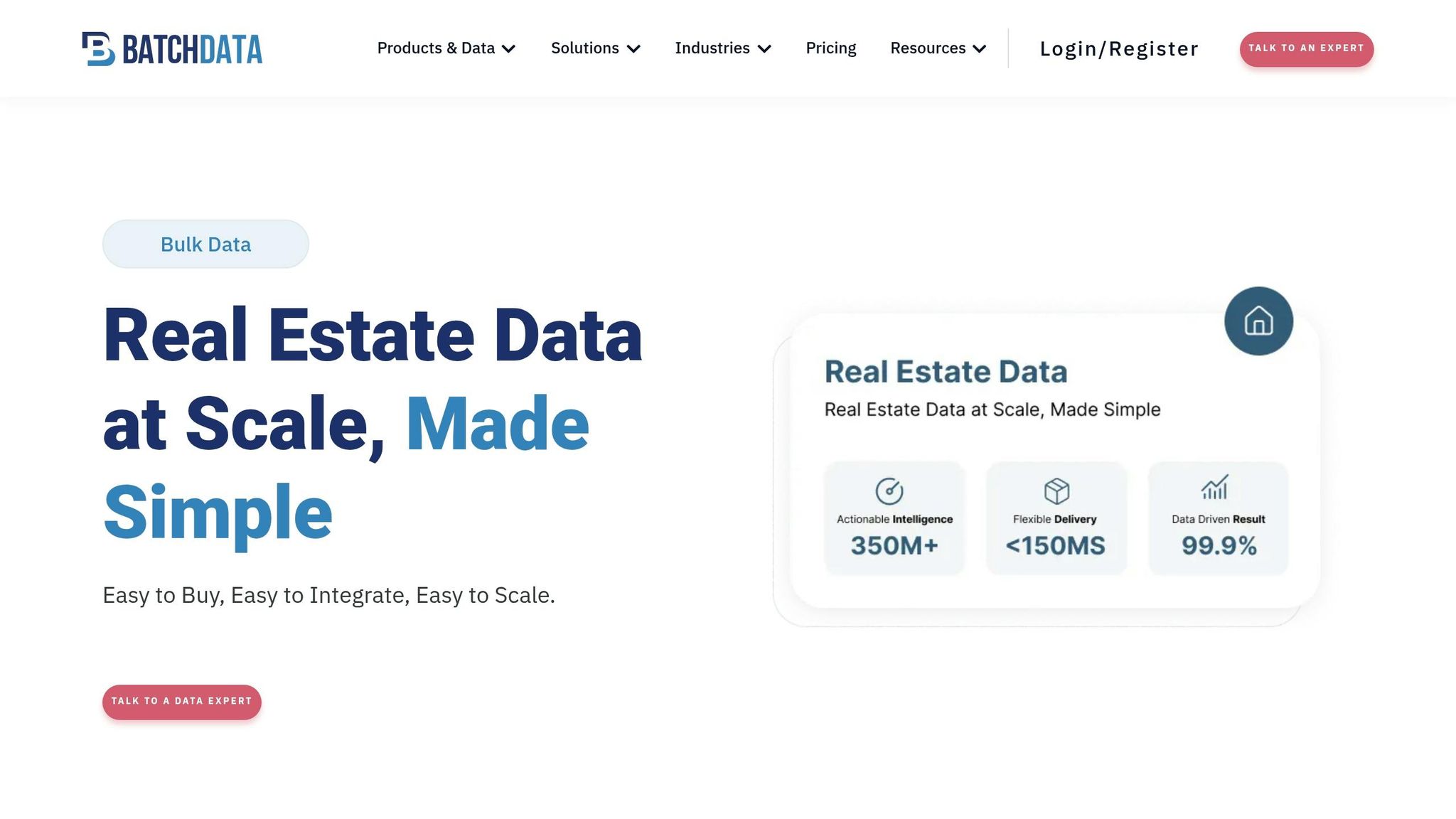
BatchData APIs transform real estate platforms into efficient, automated systems by removing the need for manual data collection. These platforms gain immediate access to over 700 data points per property across more than 160 million U.S. properties, resulting in over 1 billion total data points. With these insights, platforms can make faster, well-informed decisions that meet the demands of today’s data-driven market.
BatchData goes beyond basic information, offering highly detailed property insights.
Property Data Enrichment
BatchData provides comprehensive property records, including ownership history, physical details (like square footage, number of bedrooms and bathrooms, and year built), tax assessments, and current market values. This detailed information significantly improves the accuracy of valuation models, reducing errors by up to 90%, according to industry standards. This precision enables better property matching and more relevant user recommendations. Additionally, enriched Automated Valuation Model (AVM) outputs have been shown to increase lead conversion rates by 25%, giving investors more reliable property intelligence.
The compound query feature streamlines data retrieval by allowing multiple datasets - such as property details and owner contact information - to be accessed in a single API request. This reduces latency and is especially useful for proptech companies building investor portals, lending platforms automating underwriting processes, or insurance providers conducting risk assessments.
Contact Data and Skip Tracing
BatchData APIs also supply verified contact details, including phone numbers, email addresses, mailing addresses, and owner names tied to property parcels. The skip tracing functionality uses fuzzy matching techniques to locate property owners, even when only partial data is available. Success rates for skip tracing often exceed 70%. For example, one mid-sized real estate investment platform used BatchData to append contact details to 85% of distressed property leads, leading to a 40% increase in owner response rates. This process turns static lists into actionable pipelines, dramatically cutting down research time.
Operational Efficiency Gains
By automating data verification and enabling bulk lookups, BatchData reduces processing times by 60–80% and lowers manual entry costs by 50–70%, saving platforms as much as $15,000 per month. Delivering over 10,000 records in CSV or JSON formats eliminates the need for manual data scraping. One proptech firm, for instance, replaced tasks that previously required entire teams of analysts.
Compliance is another area where BatchData shines. Built-in tools for FCRA-compliant screening, opt-out management, and GDPR/CCPA-aligned data handling automate all compliance checks. This reduces legal risks and audit times by 75%, allowing platforms to focus on their core business without the need for dedicated compliance teams. These operational efficiencies create the foundation for scalable, data-driven solutions.
Core Features of BatchData APIs
Developer-Friendly API Design
BatchData APIs are built with developers in mind, using a clear JSON-based structure and standardized response formats that make integration smooth and efficient. With tools like fetch() or axios, developers can easily parse nested objects for details such as property addresses, ownership history, and assessed values. This streamlined setup can cut integration time by up to 40% compared to XML-based systems. Error codes follow familiar conventions (like "404" for missing data), making debugging consistent across different programming languages.
To simplify development further, BatchData provides interactive code samples in cURL, Node.js, and Python, along with a sandbox environment for testing. The system guarantees 99.99% uptime, ensuring support for over 10,000 requests per minute - ideal for real-time applications where even a tiny downtime could disrupt operations. Detailed endpoint references include complete request and response examples, featuring field names like assessedValue and lastSaleDate. The data is formatted for US standards, such as $450,000 property values and 2,000 sq ft measurements, enabling smarter, data-driven decisions with minimal effort from your development team.
BatchData also offers tailored datasets to transform your business operations, ensuring the data you need fits your specific use case.
Custom Datasets and Bulk Data Delivery
For businesses with specialized requirements, BatchData delivers customized datasets that can be filtered across more than 700 property attributes. Examples include foreclosure lists with lien amounts in USD, vacant property data filtered by occupancy status and tax delinquency, and enriched owner contact details with phone and email append rates exceeding 85%. One proptech firm, for instance, requested a dataset focused on specific ZIP codes, receiving only the fields relevant to their workflow - no unnecessary data included.
Bulk data delivery is another standout feature, supporting CSV and JSON exports of up to 1 million records via secure SFTP or API endpoints. The process is simple: submit a POST request to /bulk-upload, get a job ID, and poll for completion to securely download the records. Tiered throughput options allow for scaling, with standard plans processing up to 100,000 records per hour and higher volumes available for enterprise users. Compression technology reduces nationwide transfer times by 60%, making it easy to enrich large MLS databases or investor portfolios without delays. These options provide flexibility and efficiency, helping businesses scale their data operations seamlessly.
Pricing Plans
BatchData's pricing is designed to accommodate both small-scale experimentation and large-scale enterprise needs, aligning costs with the value delivered. The Pay-As-You-Go plan charges $0.05 per property lookup or $0.02 per contact append, with a $50 monthly minimum. This plan supports unlimited API calls (up to 10,000 daily) and access to basic datasets, making it perfect for startups testing integrations. For example, enriching 5,000 leads per month would cost roughly $250, offering flexibility without long-term commitments. However, this plan does not include custom datasets or priority support.
For larger needs, Custom Solutions start at $5,000 per month. This tier includes unlimited API access, tailored datasets, dedicated support, and SLAs with response times under 100 milliseconds. Additional features like white-label API options and on-premise deployment make it ideal for enterprises such as REITs or major proptech platforms analyzing over 100,000 properties quarterly. The potential for 20% efficiency gains often justifies the investment. For instance, one proptech platform cut data acquisition costs by 50% after switching to Custom Solutions. Start with Pay-As-You-Go to test the waters, and scale up to Custom Solutions as your needs grow.
"What used to take 30 minutes now takes 30 seconds. BatchData makes our platform superhuman." - Chris Finck, Director of Product Management
How to Integrate BatchData APIs
Get API Keys and Review Documentation
Getting started with BatchData is simple. Head over to batchdata.io/register, create an account, and verify your email. Once verified, your API keys will be available immediately. For security, store these keys as environment variables or use a secrets manager instead of hardcoding them.
The official documentation at docs.batchdata.io provides everything you need to know. It includes details on RESTful endpoints for property search and enrichment, how to authenticate using API keys in HTTP headers, and sample code examples in Python, JavaScript, and cURL. Begin with the /docs/getting-started guide, and then use the interactive Swagger UI to test endpoints like /property/search or /property/enrich right in your browser. BatchData’s API gives you access to over 150 million U.S. property records, each with 250+ data points. Features include automated valuation models and skip tracing, making it a powerful tool for property data.
Implement and Test API Calls
Using the API follows standard REST principles. For example, you can perform a GET request to search for property data like this:
curl -H "Authorization: Bearer YOUR_KEY" "https://api.batchdata.io/v1/property/search?address=123 Main St, NY"
The API responds with JSON-formatted data, including fields like avm_value, owner_name, and tax_assessment. All data is formatted according to U.S. standards, such as dollar amounts and square footage. To avoid unnecessary costs, start testing in BatchData’s sandbox environment. Test calls should return a 200 OK status, and you can cross-check the results with public records to ensure accuracy.
When implementing error handling, use exponential backoff to manage rate limits effectively. The initial setup and testing process is quick - typically under two hours - especially if you use the provided SDKs or Postman collections. Focus on specific endpoints for your needs. For example:
- Use the Property Search endpoint for filtered property listings.
- Use the Contact Append endpoint for skip tracing, offering 76% right-party contact accuracy.
- Use the Property Details endpoint for detailed property profiles.
Once your integration is working smoothly, you can shift your attention to scaling and optimizing performance.
Scale and Optimize Your Integration
After confirming the API is functioning correctly, the next step is to ensure your system runs efficiently as usage grows. Monitor your API usage through the BatchData dashboard to identify inefficient queries and track consumption. If you’re processing large volumes of records daily, consider using the bulk API for better efficiency. BatchData supports bulk data delivery via CSV uploads or SFTP transfers.
For example, the Pro plan, priced at $299/month, includes 500,000 API calls and priority support. Enterprise plans offer unlimited access, custom data pipelines, and a dedicated account manager for tailored assistance.
To further enhance performance:
- Implement caching to store enrichment data for 24–48 hours, reducing redundant API calls.
- Use webhooks to receive real-time updates.
- For custom integrations or additional scalability, reach out to support@batchdata.io.
BatchData ensures reliability with a 99.99% uptime and processes over 10 billion API calls annually, making it a dependable solution as your platform scales.
Use Cases for BatchData APIs
Property Data Enrichment
Instead of relying on manual data collection, platforms can access real-time insights on property specifications, lien records, equity levels, and ownership history. This is especially useful for home service providers like roofing contractors, solar installers, and HVAC specialists, who can target properties based on specific attributes. For instance, a roofing company might focus on homes with aging roofs in particular ZIP codes, leading to more effective campaigns compared to generic marketing strategies. With the API's detailed search filters, professionals can pinpoint niche opportunities using criteria such as equity percentage, year built, or pre-foreclosure status.
Various industries, including Proptech and technology platforms, leverage these enriched data points to refine their strategies:
| Industry | Primary Use Case | Key Data Points Utilized |
|---|---|---|
| Proptech | Building investor portals & analytics | Property characteristics, equity, pre-foreclosure status, AVMs |
| Lending | Automating underwriting | Sales history, lien data, tax assessments, property type |
| Insurance | Risk assessment & premiums | Year built, roof type, building materials, hazard proximity |
| Home Services | High-intent lead generation | Roof age, HVAC age, square footage, owner contact info |
| Marketing | Audience segmentation | Owner demographics, home equity, length of ownership |
By creating enriched property profiles, platforms can also integrate Automated Valuation Models (AVMs) and market trend analysis to make more informed decisions.
Automated Valuation Models (AVMs)
BatchData's AVM endpoint provides instant property valuations for more than 128 million U.S. properties, with monthly updates. It boasts coverage rates of 99.25% for single-family homes, 99.02% for condos and townhouses, and 96.27% for multi-family units (1-4 units). Lenders use this data to streamline underwriting, cutting loan approval times from days to mere hours by automating risk assessments with up-to-date valuations.
Investors also benefit by using the API to quickly evaluate deals, assess their portfolios, and spot undervalued properties before competitors. The hybrid modeling approach combines statistical techniques with AI, enabling accurate valuations for non-standard or unique properties. It incorporates real-time economic factors like interest rates and unemployment data, areas where traditional models often struggle.
This valuation capability, coupled with market trend analysis, equips users with the tools they need for smarter, faster decision-making.
Market Trend Analysis
In addition to property enrichment and valuation, BatchData’s market trend analysis offers a broader perspective on investment opportunities. The API provides real-time transaction feeds, historical data, and specialized datasets, including building permit records, lien history, and pre-foreclosure notices. Investment committees use these insights to spot emerging trends, such as up-and-coming rental markets or ZIP codes poised for price growth.
Marketing teams can combine demographic data with home equity insights to create highly targeted audience segments, while insurance companies evaluate risk by analyzing factors like roof type, year built, and proximity to hazards. All of this is made possible through a single API integration, eliminating the need for multiple manual data sources and streamlining workflows across industries.
Common Integration Challenges and Solutions
Managing API Rate Limits
API rate limits can interrupt data flow, especially during peak activity. To tackle this, use request queuing and caching strategies to spread out API calls over time. If your operations require a high volume of requests, BatchData's flexible pricing model lets you scale capacity, reducing the risk of hitting limits that could disrupt your application.
Another effective approach is integrating retry logic with exponential backoff. If a request fails due to rate limits, the system waits progressively longer between retries - starting at one second, then two, then four. This method prevents overwhelming the API while ensuring the data eventually gets through. By actively monitoring usage, you can fine-tune request timing and keep operations running smoothly. Once rate limits are under control, you can shift focus to other integration challenges.
Data Privacy and Compliance
Managing property and contact data requires careful navigation of privacy laws like California's CCPA, as well as regulations in states such as Colorado, Connecticut, Oregon, Utah, Texas, and Virginia. Your platform must support user rights, including the "Right to Access", "Right to Delete", and "Right to Correct", allowing individuals to manage their personal information. BatchData ensures compliance by stating, "We employ reasonable administrative, technical, and physical safeguards to protect the PII we collect from unauthorized access, use or disclosure".
Before granting data access or deletion, verify the identity of the requester. Implementing Global Privacy Control (GPC) can automate opt-out requests based on browser signals. To enhance security, maintain detailed logs with IP addresses and timestamps to monitor for breaches. Automated systems can also delete or anonymize data once it has served its purpose. With privacy concerns addressed, you can focus on scaling your system to meet growing demands.
Scaling with Professional Services
Sometimes, basic API integration won’t cut it - especially when processing millions of records daily or creating custom data pipelines. That’s where professional services come in. BatchData’s team can help you design custom datasets tailored to your needs, whether you’re building an investor portal or a lending platform requiring automated underwriting feeds.
Professional services also offer data enrichment consulting, helping you identify the most impactful data points for your business. By querying only essential fields, you can reduce costs while zeroing in on key metrics like equity and lien data for lending applications - skipping over less relevant property details. This targeted approach ensures you get the most value without unnecessary expenses.
Future Trends in Real Estate API Integration
AI-Powered Data Insights
Real estate APIs are no longer just tools for retrieving information - they're becoming predictive analytics engines. These systems use machine learning to dig into property details like roof age, materials, and solar exposure, helping identify motivated sellers and promising leads before they even hit the market. For example, AI-powered Automated Valuation Models (AVMs) now provide instant property valuations, streamlining lending workflows and cutting down underwriting times significantly.
By 2026, it's projected that 80% of API traffic will come from non-human actors, such as AI agents and automated workflows. This shift requires platforms to build smarter controls capable of managing unpredictable traffic patterns. Companies like BatchData are leading the charge, offering AI-driven data enrichment that transforms basic property addresses into detailed lead profiles. By integrating verified contact info and ownership history, these tools help businesses move from instinct-based decisions to data-driven strategies - all powered by real-time API flows. These advancements are paving the way for more tailored data solutions, which we’ll explore next.
Custom Data Pipelines
The push for more personalized data solutions is changing how platforms interact with real estate information. By 2025, 82% of enterprises are expected to adopt an API-first approach, with 25% functioning entirely as API-led businesses. BatchData, for instance, helps companies create custom data pipelines tailored to their specific needs. Whether it's investor portals needing cap rates and pre-foreclosure details or lending platforms requiring automated underwriting feeds, these tailored solutions enhance decision-making across various applications.
A trend gaining traction is Federated API Management, which allows teams to develop APIs independently while operating under a unified governance framework. This approach integrates automated policy enforcement - known as "policy-as-code" - directly into CI/CD pipelines, reducing manual oversight. By 2026, custom pipelines are expected to be cloud-native, low-latency, and equipped for AI and machine learning, ensuring they can support real-time decision-making in proptech. While custom pipelines improve data relevance, keeping that data fresh and up-to-date remains a critical challenge.
Real-Time Data Updates
In the fast-paced world of proptech, real-time data synchronization is no longer optional - it’s essential. Platforms are shifting from resource-heavy polling methods to efficient webhooks that automatically notify users of changes, such as new property listings or status updates. This ensures predictive models have access to the most current data, keeping their insights accurate and actionable.
The difference between real-time APIs and bulk file downloads is striking. Real-time APIs provide instant, continuously updated information, while bulk downloads often lag behind, delivering periodic updates that quickly become outdated. For businesses relying on AI applications, choosing an API provider that offers daily or even intra-day updates is critical. BatchData, for example, delivers real-time data streams, giving platforms a competitive edge by ensuring they stay ahead of market changes without waiting for scheduled refreshes.
Conclusion
Integrating BatchData APIs transforms real estate platforms from labor-intensive systems into streamlined, data-powered engines. By tapping into vast property records, platforms gain access to enriched property data, automated valuations with 5–10% accuracy to market value, and contact information that turns static address lists into actionable outreach tools. The benefits are tangible - manual data entry is reduced by up to 70%, data processing times shrink from days to mere minutes, and platforms often see a return on investment in under three months.
For example, a mid-sized real estate marketplace using BatchData for skip tracing reported a 40% jump in successful owner contacts. This improvement led to a 25% increase in conversion rates and allowed the business to scale without adding staff. Platforms leveraging BatchData’s customizable datasets for market trend analysis have also seen deals close 30% faster, with users achieving an average 15× ROI thanks to lower data acquisition costs and more precise targeting.
Experts in the field back these results. Jane Doe, a proptech analyst at RealtyTech Insights, emphasizes:
"BatchData APIs future-proof platforms by bridging legacy systems with AI-driven insights, ensuring scalability amid rising data demands."
With 99.9% uptime, pricing as low as $0.01 per record, and user-friendly integration, BatchData makes advanced real estate intelligence accessible to both startups and large enterprises. The advantages are undeniable - automated workflows, real-time insights, and precision targeting based on factors like roof age, equity percentage, and ownership history drive an average 35% increase in user engagement. Moving from manual to automated operations isn’t just about keeping up; it’s about gaining the competitive edge needed to thrive in the fast-paced U.S. real estate market. This integration paves the way for innovation and growth in the industry.
FAQs
Which BatchData endpoint should I use first?
Kick things off with the BatchData Property Data API. This API provides access to a massive database of over 155 million U.S. properties, updated daily. It includes essential details such as ownership information, property valuations, and various attributes. It's a solid starting point to boost your platform's capabilities right from the get-go.
How do I avoid rate limits at scale?
To manage rate limits effectively while scaling your real estate API usage, there are a few strategies you can implement:
- Optimize API call frequency: Be mindful of how often your application makes requests. Adjust the frequency to meet your needs without overloading the system.
- Batch requests: Instead of making multiple individual calls, group them together into a single request where possible. This reduces the total number of calls.
- Use caching: Store frequently accessed data locally to avoid making repetitive API calls for the same information.
If your operations require higher quotas, explore higher-tier or enterprise plans offered by the API provider. These plans often come with increased usage limits tailored for large-scale needs.
Finally, monitor your API usage closely. Set up alerts to track consumption and get notified before approaching rate limits. This proactive approach ensures smoother operations and avoids unexpected interruptions.
How can I stay compliant using owner contact data?
When handling owner contact data, it's crucial to follow privacy laws like the Do Not Call (DNC) regulations. Always secure proper consent before reaching out to individuals. To simplify compliance, use tools that offer features like DNC scrubbing. These tools help safeguard privacy and ensure you're not unintentionally violating any regulations.