





































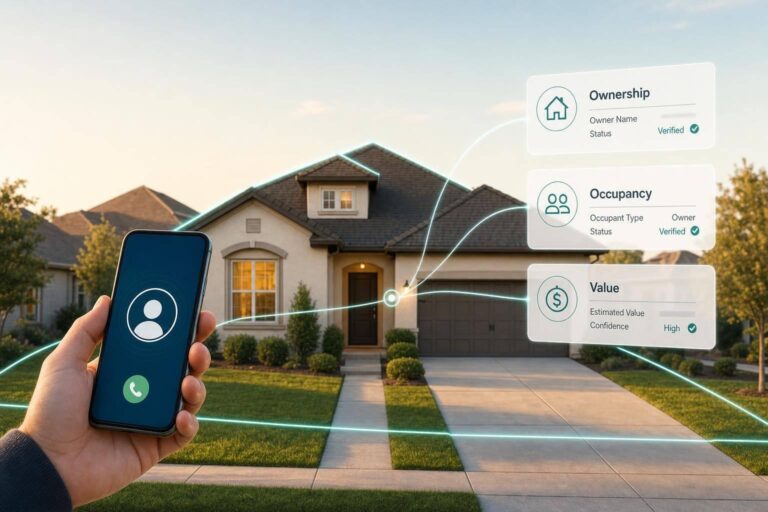
If I match a phone number to a person but can’t tie that person to the right property, I still can’t score the lead, route the record, or decide whether outreach makes sense. In property work, the parcel drives the action.
Here’s the short version:
- Phone-to-person matching tells me who a number likely belongs to.
- A property layer tells me which parcel that person owns, occupies, or is linked to.
- When I connect phone + person + property in one workflow, I can sort for owner-occupancy, absentee status, value, taxes, sale history, and property type.
- That matters for investors, lenders, skip tracers, and home-services teams because the wrong person-to-parcel link can waste calls, mail, and rep time.
- It also helps with list checks like line type, disconnected numbers, USPS-standardized addresses, and Do Not Call scrubbing before outreach.
A contact match alone can look right and still send me to the wrong asset. A property-linked record gives me more than identity cleanup. It gives me a record I can use for qualification, underwriting, and targeting.
| Workflow | Contact match only | Contact match + property layer |
|---|---|---|
| Acquisitions | Knows the person | Knows the person and the likely target parcel |
| Underwriting | Needs extra ownership checks | Includes ownership, occupancy, value, and tax data |
| Skip tracing | Finds a person | Links that person to mailing and situs address context |
| Home services | Broad audience lists | Filters by build year, square footage, occupancy, and type |
In plain terms: a phone number without parcel data is incomplete for property decisions. That’s why linking identity resolution to property data in one call changes how I qualify and act on a lead.
Why adding a property layer changes identity resolution
Adding a property layer changes identity resolution from a simple contact lookup into parcel-level enrichment. The phone match tells you who the person is. Then the workflow adds ownership, occupancy, and asset data tied to property records.
That shift matters. The next step isn’t just knowing who called. It’s knowing which parcel that person controls.
What belongs in the property layer
The property layer is a structured set of parcel-level attributes pulled from U.S. tax assessor records, deed filings, and land records.
A complete property layer includes:
- Parcel ID and APN
- Standardized property address
- Owner of record, including co-owners, trusts, and LLCs
- The owner’s separate mailing address
It also shows occupancy by comparing the owner’s mailing address with the situs address.
On the financial side, the layer includes assessed value, sale history with dates and prices, and property tax status. Physical details include total living area in square feet, lot size in acres, number of bedrooms and bathrooms, and year built.
How phone, person, and property connect in one workflow
First, resolve the phone to a person and confidence score. Next, match that person and related addresses to parcel records to verify ownership. Finally, enrich the matched property and send the record downstream.
This gets much more useful when one contact connects to more than one property.
Michael J. Rivera’s phone resolves to an Atlanta mailing address. The property layer then links him to an owner-occupied home and a non-owner-occupied duplex. That makes the duplex the likely acquisition target.
Contact-only vs. property-linked identity resolution
The gap is easiest to see in qualification, underwriting, skip tracing, and outreach.
| Dimension | Contact-Only Matching | Property-Linked Identity Resolution |
|---|---|---|
| Lead quality | Confirms who the contact is | Verifies owners and relevant property fit |
| Underwriting usefulness | Requires separate collateral and ownership checks | Returns parcel, ownership, value, and taxes in one pass |
| Skip-tracing accuracy | Finds a person but may miss correct mailing address | Connects people to the correct mailing address and parcel |
| Outreach precision | Generic campaigns based on person-level attributes | Aligns messaging to occupancy and asset type |
| Speed | Requires manual or multi-step lookups | Removes manual lookup |
At scale, manual lookup becomes the bottleneck.
sbb-itb-8058745
How a property-linked identity workflow works step by step
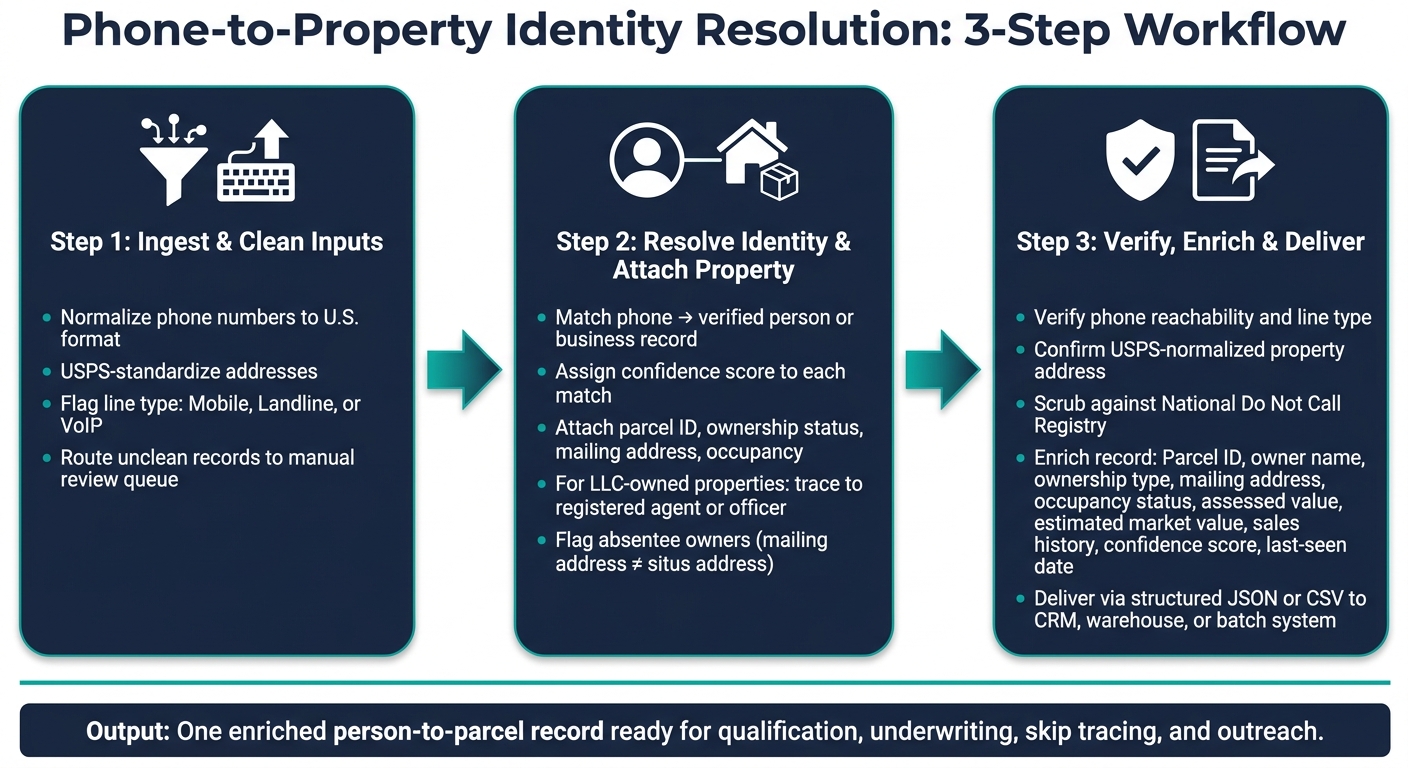
Phone-to-Property Identity Resolution: 3-Step Workflow
This workflow has three moves: clean the inputs, resolve the identity, then attach the parcel.
Step 1: Ingest phones, names, and addresses
Start with the phone number as the workflow’s entry point. That phone-to-person match only matters if it can later connect to a property, so the data needs to be cleaned first.
Normalize phone numbers and USPS-standardize addresses before matching. Also flag whether each number is mobile, landline, or VoIP so outreach teams can sort records in a smarter way. If a record can’t be cleaned or matched, send it to a manual review queue instead of letting it clog the pipeline.
Step 2: Resolve identity and attach property records
Once the inputs are clean, the workflow moves from a simple phone lookup to a parcel-level record.
The system matches the phone number to a verified person or business record built from identity and property records. Each match gets a confidence score based on how strong the phone-to-identity link is. From there, attach the matching parcel and the main ownership signals: parcel ID, ownership status, mailing address, and occupancy.
Give more weight to current, high-confidence owner-occupied matches than to weak historical signals. Mailing address comparisons also help spot absentee owners.
If a property is owned by an LLC, the workflow checks business registration records to find the registered agent or officers, then looks for their personal contact. The point is to get to a person-to-parcel match, not just a contact-only lookup.
Step 3: Verify, enrich, and deliver to downstream systems
Next comes validation, then delivery to downstream systems.
Phone verification checks reachability and line type. Address verification confirms the USPS-normalized form of each property record. Before any outreach record goes out, lists are scrubbed against the National Do Not Call Registry.
The enriched record includes:
- parcel ID
- owner name
- ownership type
- mailing address
- occupancy status
- assessed value in U.S. dollars
- estimated market value
- recent sales history
- confidence score
- last-seen match date
Deliver the data in structured JSON or CSV for CRM, warehouse, or batch delivery. One property identity cuts duplicate records and conflicting ownership views.
That enriched record is what drives qualification, underwriting, skip tracing property owners, and outreach.
Where property-linked identity resolution creates measurable value
Once identity is tied to a parcel, the workflow starts shaping day-to-day decisions.
Lead qualification for investors and acquisition teams
A phone match tells you who the contact is. A property-linked match tells you which asset is in play. That’s the difference that changes how acquisition teams sort leads.
Take a wholesaler. If they resolve a phone number to a person whose mailing address is different from the situs address, that points to an absentee owner. That record should move up the list fast. Compare that with a matched number tied to an owner-occupied property with weaker fit signals. Both records are matches. But only one lines up with the buy box. Without the property layer, both can end up sitting in the same queue.
Confidence scoring makes that sorting tighter. High-confidence owner-occupied matches can go to direct-dial reps. Lower-confidence records can move into automated follow-up instead. That shift helps teams stop wasting senior rep time on leads that don’t deserve it.
The same idea also improves risk checks and outreach precision.
Underwriting, skip tracing, and outreach accuracy
For lenders and skip tracers, the property layer works as a verification layer first. It doesn’t just add data. It checks the story. If a loan applicant claims one address but the parcel record shows something else, that mismatch can point to a problem a contact-only lookup would miss.
Skip tracing gets a lift from mailing address context too. When the property’s situs address and the owner’s mailing address don’t match, that gap confirms the owner is not living at the property and gives you another location to pursue. Tax delinquency flags, lien indicators, and recent deed filings add timing context, which can improve skip tracing and acquisition results. Line type verification matters here as well: VoIP numbers signal higher fraud risk in lending workflows and call for extra scrutiny before outreach.
Home-services targeting by actual property fit
A roofing company that wants pre-1990 homes in the right square-footage range needs a list built around those filters. That means owner-occupied only, single-family homes, set build-year ranges, and confirmed square footage cutoffs. A solar installer can do something similar by filtering for roof size and property age, so the team can spot likely fits before making a single call.
The payoff is simple: a smaller list, but a better one. That tends to improve return on ad spend and cuts down the time agents spend talking to people who were never a fit in the first place.
Across these use cases, the property layer changes both targeting and results.
| Workflow | Key Property Signals Used | Measurable Outcome |
|---|---|---|
| Acquisitions | Absentee status, equity position, tax delinquency | Higher conversion on off-market outreach |
| Risk and Skip Tracing | Mailing vs. situs address, lien status, line type | Reduced fraud exposure; higher right-party contact rates |
| Home Services Targeting | Build year, square footage, property type, owner-occupancy | Improved ROAS; fewer unqualified contacts reached |
Implementing the workflow with BatchData and key takeaways
BatchData capabilities that support this workflow
Once the workflow is mapped out, the next step is putting it into production. BatchData supports phone, person, and property matching with verification, contact enrichment, property enrichment, API access, bulk delivery, accurate datasets, and services for pipeline design and upkeep.
When a phone number enters the pipeline, verification checks whether it’s a mobile, landline, or VoIP number and flags disconnected lines before outreach starts. Contact enrichment then adds phone numbers, email addresses, and alternate addresses for each owner or occupant. Property enrichment adds parcel details like APN, ownership type, occupancy, and value, so you can build a linked person-property record for either real-time lookup or bulk delivery.
If your team uses custom data models or more involved pipeline logic, BatchData also offers services for pipeline design and upkeep. That helps keep the workflow in sync as buy boxes, service territories, or underwriting rules shift over time.
Integration considerations for U.S. teams
Implementation usually works better when person and property data stay separate in structure but linked in practice. Keep them as connected records, and store ownership history in a join table or foreign key. That setup makes the data easier to manage without losing the relationship between a person and an asset.
A few practical details matter here:
- Use U.S. formats for currency, dates, and measurements so your data stays in line with MLS data, appraisals, and contractor estimates.
- Normalize phone numbers to a standard U.S. pattern before sending them to the API to improve match rates.
- Refresh ownership and occupancy data monthly or quarterly for active investor pipelines and loan portfolios.
For contact data, event-based triggers are often the better move. If a call sequence fails or emails bounce, rerun enrichment for that record right away instead of waiting for the next scheduled batch. That keeps high-priority records current when timing matters most.
Conclusion: why the property layer matters
With the pipeline and data model in place, the payoff is faster, more accurate decision-making. Phone-to-person matching tells you who the contact is. The property layer tells you whether the asset fits the use case.
Parcel data, ownership records, occupancy signals, and property characteristics turn raw identity resolution into property intelligence. That changes how teams act on a lead. Investors can screen out the wrong asset class sooner. Lenders can catch address mismatches earlier. Contractors can build smaller, better-targeted lists instead of casting a wide net and hoping for the best.
When one workflow connects phone, person, and property, teams waste fewer contacts, keep data pipelines cleaner, and cut the time between a lead entering the system and a rep knowing whether it’s worth pursuing.
FAQs
How does the property layer improve phone-to-person matching?
A property layer makes phone-to-person matching much more useful because it connects contact data to verified property records. Instead of stopping at contact metadata, it ties a phone number to parcel-level details like the owner’s name, occupancy status, and key property facts.
That extra context helps you check whether the person is the current owner or simply an occupant. It also brings forward signals such as equity, distress, or absentee status, so you can focus on stronger leads and spend less time on dead ends.
What property data is most useful for lead qualification?
For effective lead qualification, go past basic contact info and focus on data that ties a person to a property.
The most useful signals connect the owner, the asset, and the current situation. That includes ownership history, tax and assessment records, equity position, lien or distress status, parcel details, listing signals, permit history, and occupancy status, such as absentee versus owner-occupied.
Why does that matter? Because it helps you confirm who can make the call and shape outreach that fits the property owner’s situation instead of sending the same message to everyone.
How often should property-linked identity data be refreshed?
Ideally, property-linked identity data should be refreshed daily to keep it accurate. Contact data decays by more than 2% per month, so old or static datasets can create serious business risk.
Some teams still work with monthly or quarterly updates. But daily refreshes do a better job of catching changes like ownership transfers, liens, and phone number reassignments. That helps protect lead quality and keeps outreach precise.
Related Blog Posts
- Property Data Validation for Skip Tracing Teams
- “Reverse Phone Lookup vs. Skip Tracing: What’s the Difference (and Why Real Estate Investors Need Both)” – owns “reverse skip trace” conceptually without needing a product name; strong internal-linking bridge to your existing skip-tracing cluster.
- “The Inbound Lead Problem Nobody’s Solving: Why a Phone Number Alone Isn’t Enough” – use-case-led (inbound lead ID), no product-name dependency, very GEO-friendly framing (problem → solution).
- “Reverse Phone & Address Lookup APIs, Compared: Trestle, IDI, LexisNexis, and What’s Missing” – comparison content is the single best format for AI-answer extraction right now; hold the “BatchData” row until pricing is cleared, publish the category comparison now.