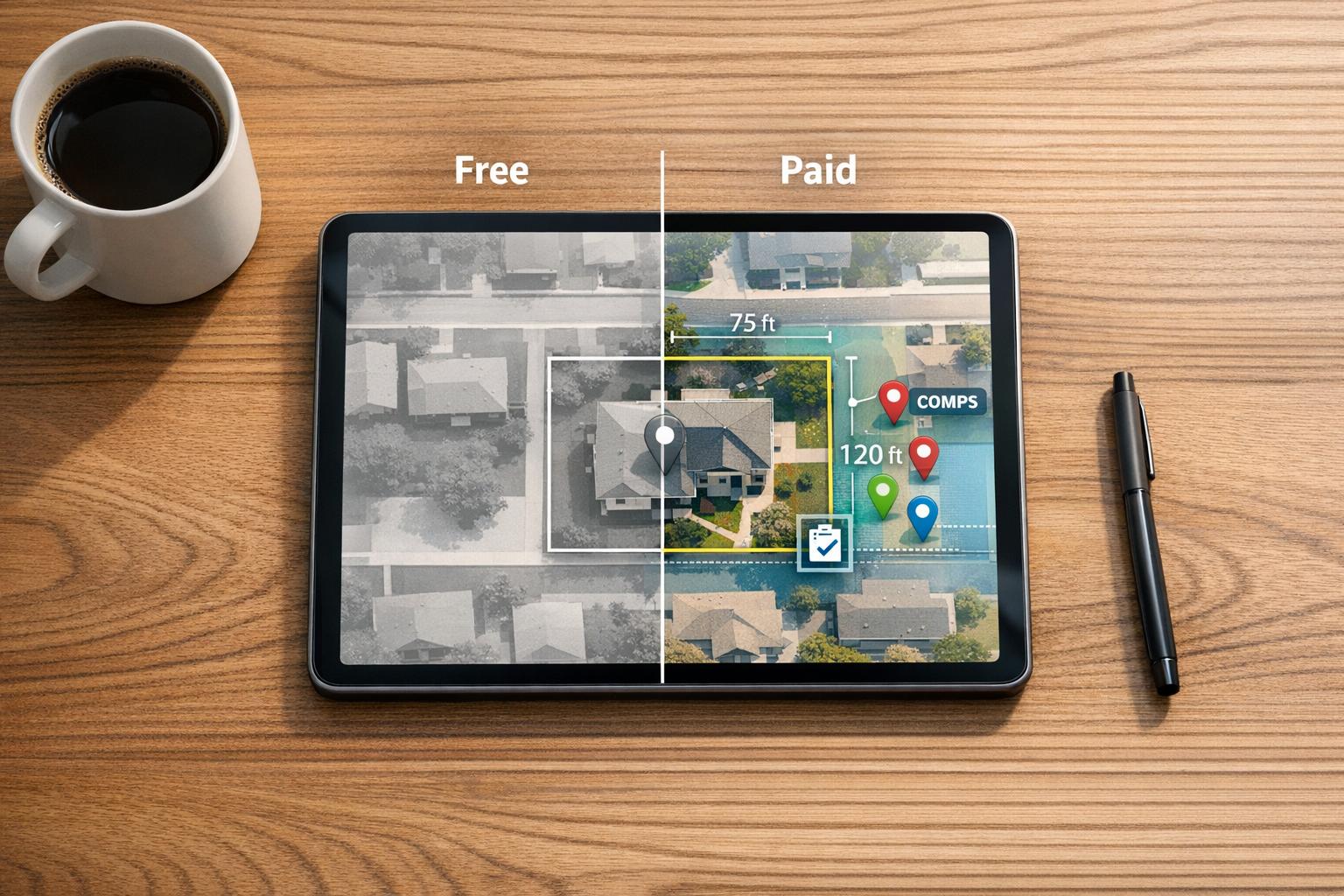





































In 2026, accurate property owner data is critical for real estate professionals, from investors to lenders. With APIs providing up to 95%+ accuracy, choosing the right one depends on speed, data depth, and cost. Here’s a quick breakdown of five leading property data APIs:
- ATTOM: Broad U.S. coverage (158M parcels), monthly updates, and advanced ownership insights. Costs ~$0.10 per API call.
- Mashvisor: Budget-friendly ($0.05/query), metro-focused, but relies on third-party data with occasional accuracy gaps.
- PropertyRadar: Daily updates, strong in the Western U.S., and detailed ownership data. Costs ~$0.08 per record.
- Tracers: Real-time data with behavioral analytics, ideal for skip tracing. Bulk queries cost ~$0.07 per hit but slower for large volumes.
- DataTree: Title plant-backed data with 98.5% accuracy and historical insights. Costs ~$0.12/report but has a steeper learning curve.
Key takeaway: For enterprise-grade accuracy, ATTOM and DataTree shine. Mashvisor suits budget-conscious users, while PropertyRadar and Tracers offer region-specific or real-time advantages. Balance accuracy, update speed, and cost to find the best fit.
1. ATTOM
Data Sources
ATTOM collects owner records directly from county tax assessor and recorder offices, ensuring its data includes ownership, deed, mortgage, and tax records sourced directly from government entities. The platform also compiles data from over 2,000 building departments nationwide, creating a centralized database that merges assessor tax data, legal descriptions, and building permits.
To maintain accuracy, ATTOM uses a 20-step Enterprise Data Management Program (EDMP). According to ATTOM:
"Our rigorous Enterprise Data Management Program (EDMP) involves more than 20 steps that validate, standardize and enhance the real estate data we collect".
This process includes parsing owner names and employing "ATTOM ID" matching to connect records from various counties. These measures ensure the reliability of ATTOM’s extensive property data.
Coverage Scope
ATTOM’s database spans 158 million property parcels across the U.S., covering 99% of the population. It manages over 70 billion rows of data in a 30TB warehouse, including more than 9,000 data fields. Its building permit data is especially comprehensive, covering 94% of the largest U.S. cities, such as New York City, Los Angeles, Chicago, Houston, Miami, and Washington D.C..
Update Frequency
Regular updates are essential for maintaining data accuracy. ATTOM refreshes its building permit data on a monthly basis, ensuring it remains current and reliable. While the platform describes its data as "timely" and "AI-ready", specific update schedules for ownership fields are not outlined.
Owner Data Validation
ATTOM provides detailed ownership data, including vesting information (e.g., Joint Tenants, Community Property), occupancy status, tax mailing addresses, and "Transparent Owner" insights that identify individuals behind LLCs and trusts. The platform standardizes property addresses and integrates data from multiple sources, delivering precise information across over 200 million building permits.
sbb-itb-8058745
2. Mashvisor
Data Sources
Mashvisor gathers property owner information from commercial data providers rather than directly from county offices. This method pulls together property records from various markets, but the accuracy and timeliness of the data heavily rely on the reliability of these third-party sources.
Coverage Scope
The platform includes a range of property types, from residential to commercial properties. It tends to have better coverage in larger metropolitan areas, while data for rural counties may be less comprehensive.
Update Frequency
Owner contact details can become outdated quickly – phone numbers, for example, might be disconnected within six months. While Mashvisor uses automated tools to refresh its data, maintaining up-to-date information remains a challenge. This makes it essential to consider the balance between the platform’s broad data aggregation and the potential limitations in its accuracy over time.
3. PropertyRadar
Data Sources
PropertyRadar stands out by sourcing its data directly from county assessors, recorders, and courts across the U.S., rather than simply reselling bulk files from large aggregators. This approach ensures more accurate and reliable information. The platform also incorporates court-sourced signals for events like divorce, probate, and eviction, making it easier to pinpoint motivated sellers.
"Most competitors simply resell bulk files from big aggregators. We don’t. We combine multiple sources, test against county records and manually backfill gaps." – PropertyRadar
One of its key features is OwnerGraph™, a proprietary system that maps connections between people, properties, and documents over time. This tool is especially helpful in uncovering the true owners behind LLCs or trusts, which often hold property titles. Since 2007, PropertyRadar has been processing public record data and now standardizes information from over 3,000 counties, providing extensive nationwide coverage.
Coverage Scope
PropertyRadar offers coverage for 3,142 counties across the U.S., encompassing residential, multifamily, and commercial properties. It also provides exclusive foreclosure auction tracking in 270 counties, with specialized trustee sale tracking in states like California, Washington, Oregon, Nevada, and Arizona. Users can take advantage of over 250 search filters, covering everything from property characteristics and mortgage details to zoning and legal descriptions.
Update Frequency
The platform updates its data daily using an event-driven streaming system. Through a combination of rules engines, natural language processing, and machine learning, PropertyRadar normalizes data from various jurisdictions. This commitment to fresh and accurate data is a key focus, as CEO Mark Hockridge explains:
"We recognized the frustration of inaccurate data and wasted marketing efforts, and decided to invest in giving investors what they actually need to close more deals: fresh + reliable data." – Mark Hockridge, CEO of PropertyRadar
Owner Data Validation
Daily updates also enhance the platform’s owner data validation process. PropertyRadar continuously cross-checks its data with county records, and when discrepancies arise, a dedicated research team steps in to manually fill those gaps. This hands-on approach ensures a higher level of accuracy than automated systems alone can achieve. Additionally, the platform incorporates data from relatives to provide extra contact options beyond the primary owner.
4. Tracers
Data Sources
Tracers goes beyond the usual scope of traditional APIs by pulling from a wide range of data sources. Instead of relying solely on property records, it combines public records with behavioral analytics to refine owner identification. This includes real-time financial data, mobile activity, and social media information. The platform also incorporates data from mobile network operators, such as call logs, text message details, and GPS location data, offering insights into an individual’s current location. Social media platforms like Facebook, Twitter, and Instagram are also part of the mix, along with proprietary data partnerships. To manage and verify this diverse information, Tracers employs machine learning algorithms to ensure accuracy and reliability.
"By accessing these public records databases in real-time, businesses can gather valuable information to aid in their skip tracing efforts." – Tracers
Owner Data Validation
Accuracy is a priority for Tracers, and it achieves this by cross-referencing data across several categories. By connecting financial transactions with social media activity and mobile device usage, the platform creates detailed and verified owner profiles. Tracers operates within regulatory guidelines like FCRA, GLBA, and CCPA, ensuring compliance. Additionally, data analysts review the collected information to extract practical insights.
Update Frequency
With a focus on real-time data access, Tracers reduces the delay between data collection and its application. This ensures users receive the most current information on relocations or updated contact details. This feature is especially useful for skip tracing and how it works and tracking property owners who have moved, making Tracers a standout tool for delivering timely owner data.
5. DataTree
DataTree stands out by combining accuracy with its unique reliance on title plants, setting it apart from other APIs.
Data Sources
DataTree gathers owner information from title plants maintained by title insurers. These databases track title histories, liens, and ownership chains, making them ideal for underwriting risk and legal checks. This data is further enriched with County Tax Assessor records to provide current ownership details. With access to over 8.5 billion land record images, including deeds and mortgages, DataTree delivers comprehensive documentation to verify ownership and title transfers.
Coverage Scope
DataTree offers complete access to 100% of U.S. housing properties, making it one of the broadest platforms available. Users can refine searches with filters like "Owner Occupied", "Absentee Owner", "Corporate Owned", and "Do Not Mail", ensuring more precise targeting. Additional insights include ethnicity, exemption status, and the total number of properties owned by an individual or entity.
Update Frequency
By leveraging the latest County Tax Assessor data, DataTree ensures users receive the most up-to-date ownership and vesting information. The TotalView Report provides key details such as current ownership, listing status, and foreclosure status, keeping real estate professionals informed with the freshest data directly from county sources.
Historical Depth
DataTree offers deep historical insights through features like the "Legal & Vesting Chain" and "Enhanced Transaction History", which detail prior loans and property transfers. This historical data helps users trace ownership changes over time, making it a valuable tool for title research and due diligence. When combined with its current data, this historical access strengthens DataTree’s comprehensive property datasets.
Owner Data Validation
The inclusion of title plant data ensures a higher level of validation compared to standard public records. Since title plants are specifically designed for legal and risk assessments, the ownership data has already been reviewed by title insurance underwriters. Combined with advanced filters and billions of land record images for cross-referencing, DataTree provides a reliable mechanism for confirming owner accuracy.
Strengths and Weaknesses
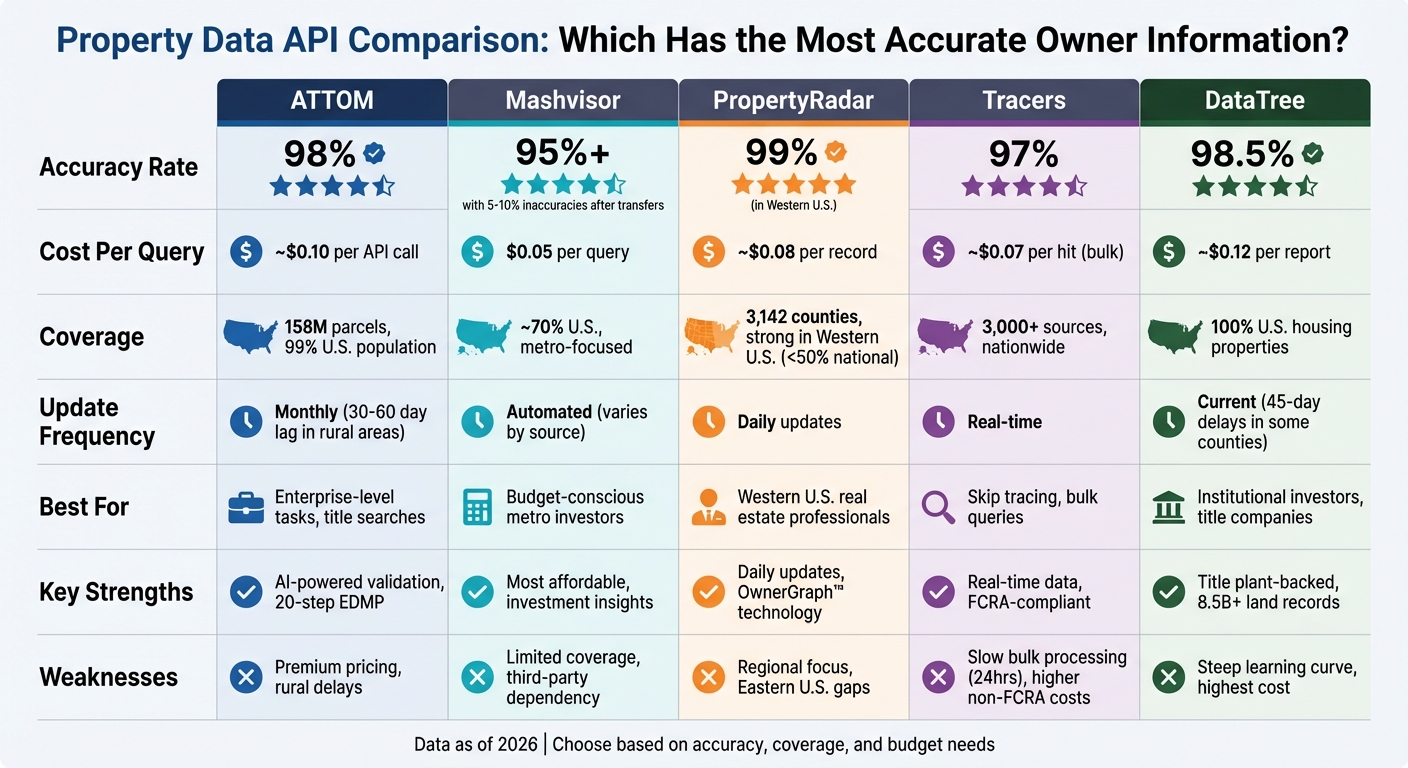
Property Data API Comparison: Accuracy, Coverage, Cost & Update Frequency
Here’s a breakdown of the key strengths and weaknesses of each API, emphasizing performance in speed, cost, and data coverage – essential factors for accurate real estate decisions.
ATTOM
ATTOM boasts an impressive 98% accuracy in matching owner names, thanks to AI-powered validation across 155 million U.S. property records. This makes it a strong choice for enterprise-level tasks like title searches and property enrichment for investor research. However, its premium pricing – starting at $0.10 per API call – might be a drawback for cost-sensitive users. Additionally, updates in rural counties can lag by 30 to 60 days.
Mashvisor
Mashvisor offers investment-focused insights, including owner data with over 95% accuracy, at a budget-friendly rate of $0.05 per query. It also provides details like owner investment history and portfolio size. The downside? It covers only about 70% of the U.S., focusing mainly on metro areas. Its reliance on third-party data can also lead to 5–10% inaccuracies following recent property transfers.
PropertyRadar
PropertyRadar excels in California and the Western U.S., delivering 99% accuracy through direct integrations with county recorders. At $0.08 per record, it’s a solid option for those operating in its core regions. Unfortunately, its limited coverage – less than 50% of the country – and higher error rates in Eastern states due to inconsistent data feeds are notable limitations.
Tracers
Tracers provides FCRA-compliant data with a 97% match accuracy, compiling information from over 3,000 sources. It supports bulk queries at $0.07 per hit, which is useful for larger operations. However, its slower processing time for high-volume queries (up to 24 hours for batch processing) and higher costs for non-FCRA commercial use may deter users needing quick results.
DataTree
DataTree delivers high-grade owner data with 98.5% accuracy, backed by a database of more than 3 billion document images. At approximately $0.12 per detailed report, it’s tailored for institutional use. That said, its steep learning curve for integration and occasional 45-day update delays in certain counties could be hurdles for smaller businesses or those needing rapid deployment.
Each API has its strengths and trade-offs, offering distinct advantages depending on your specific requirements and constraints.
Conclusion
When choosing a property data API, it’s essential to consider factors like accuracy, update frequency, and cost.
For those needing enterprise-grade accuracy (over 95%) and comprehensive historical property records across the U.S., options like ATTOM and DataTree are excellent. These APIs are ideal for lenders, title companies, and institutional investors. However, their premium pricing might not suit smaller businesses or those requiring frequent real-time updates.
If you’re an investor focusing on metropolitan areas and working within a tighter budget, Mashvisor can be a practical choice. It maintains industry-standard accuracy, though its reliance on third-party data may occasionally result in minor inconsistencies.
Look for APIs with RPC rates of 76% or higher and LLC unmasking capabilities to identify true decision-makers. Additionally, evaluate how well the API handles bulk queries, as this can significantly impact efficiency for larger operations. Balancing these factors – accuracy, cost, and update speed – is critical to finding the right fit.
Integrating the right API into your workflow ensures precise, data-driven decisions. Use API calls for enriching CRM systems in real-time or bulk delivery for large-scale analysis. Ultimately, the best API will deliver reliable owner information while aligning with your specific operational needs.
FAQs
How do property data APIs verify who the true owner is behind an LLC or trust?
Property data APIs help uncover the real owners behind LLCs or trusts by cross-referencing reliable sources such as county records, business registries, and public ownership databases. For LLCs, they tap into Secretary of State records and property-related documents. When it comes to trusts, they use verified ownership records and legal paperwork. BatchData takes it a step further by combining public records, utility data, and credit bureau information to deliver precise owner identities and contact details tailored for real estate professionals.
How fresh is owner data, and why are there update delays in some counties?
BatchData updates owner data every day to keep it as current as possible. However, in some counties, there may be delays. This is often because these areas rely on traditional sources, like county records, which can be slow to update or may not reflect the latest information. These factors can affect how quickly new data is accessible.
What should I test in a trial to confirm owner-data accuracy before scaling?
To ensure owner data is accurate during a trial period, focus on these critical areas:
- Ownership details: Compare public records to verify legal names and mailing addresses match up.
- Contact info: Double-check phone numbers and email addresses to confirm they’re accurate and active.
- Address verification: Use tools like USPS validation to make sure addresses are deliverable.
- Data freshness: Ensure the platform provides data that’s either real-time or updated regularly.
These checks help guarantee the reliability of owner data before moving forward with scaling.