


































A false claim about your property's ownership can instantly kill a multi-million dollar deal, a reality that costs U.S. property owners an estimated $1 billion annually in direct and indirect losses. This attack, known as defamation of title (or slander of title), isn't about personal reputation; it’s a direct assault on the financial integrity of your most valuable asset. It deliberately creates a "cloud on title," a legal encumbrance that renders a property unsellable and unfinanceable until resolved, often at great expense.
- The Core Problem: A malicious, false statement about property ownership that causes measurable financial loss.
- The Immediate Impact: Halts sales, blocks financing, and erodes asset value by creating a "clouded title."
- The Legal Burden: You must prove the statement was false, published, made with malice, and caused specific financial damages.
This guide breaks down exactly what defamation of title is, how to prove it, and the data-driven strategies you can use to protect your investments.
What Is Defamation Of Title?
Defamation of title is the knowing publication of a false statement about your legal ownership of a property, causing direct financial harm. It is a calculated act designed to sabotage an asset by casting doubt on the owner's legal right to sell, finance, or possess it.
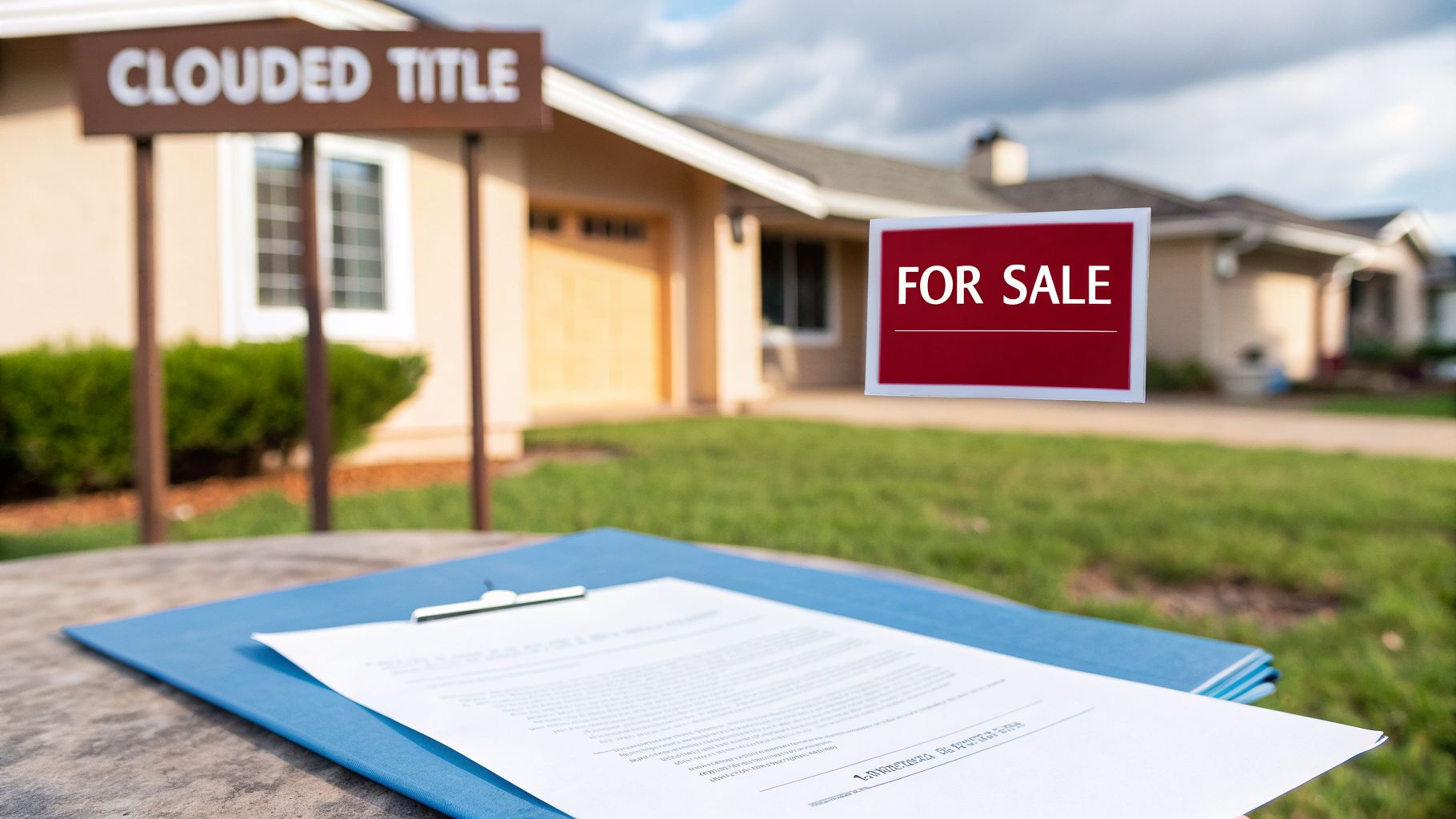
This is distinct from personal defamation. While the general concept of defamation harms a person’s character, slander of title is a direct assault on the property. It creates a "cloud" on the title—a legal term for any claim or encumbrance that makes the title's validity questionable.
The Real-World Impact
A clouded title paralyzes real estate transactions. A disgruntled contractor filing a baseless mechanic's lien or a neighbor falsely recording an easement becomes a public record. Title companies flag these issues, stopping a sale or refinance dead in its tracks. The core danger is its ability to halt commerce, as a property with a clouded title is often unsellable and unfinanceable until the dispute is resolved.
The financial fallout is immediate and measurable:
- Collapsed Sales: A potential buyer will almost certainly walk away once a title search reveals an ownership dispute.
- Blocked Financing: No lender will issue a mortgage or refinance a property with a title that is not clear.
- Eroded Asset Value: The mere hint of a title dispute deters future buyers and lowers a property's market value.
Legal Action And Core Concepts
To win a defamation of title lawsuit, you must prove four key elements: the statement was false, it was "published" to a third party (e.g., filed in public records), it was made with malice, and it caused you "special damages"—a specific, calculable financial loss.
These claims are serious. In the UK, the High Court saw 152 defamation claims in 2020 alone, which includes malicious falsehood cases analogous to slander of title. A West Virginia University Law Review analysis noted a spike in this litigation around mineral rights, where bad-faith claims have led to multi-million dollar verdicts.
How Do You Prove A Defamation Of Title Claim?
To win a defamation of title claim, you must demonstrate a direct line from the defendant's false statement about your property to a tangible financial loss. This requires a disciplined, evidence-backed approach to prove four distinct legal elements.
1. Publication of a False Statement
Publication means the false statement about your title was communicated to a third party. This does not require a media broadcast; in real estate, it's often more formal.
Common forms of publication include:
- Recording a fraudulent document, like a bogus mechanic's lien or a forged deed, with the county recorder’s office.
- Telling a potential buyer or lender about a fabricated claim, thereby killing a deal.
- Filing a wrongful lis pendens, a public notice that a property is in a lawsuit, which halts any sale or refinance.
The key is that the falsehood was communicated to someone other than the owner, setting the damages in motion.
2. Falsity of the Statement
The statement must be demonstrably false. The defendant’s claim must incorrectly challenge your ownership or assert an encumbrance that does not exist. For example, if a contractor files a lien for unpaid work but you possess receipts proving payment in full, the lien is based on a falsehood. You must provide undeniable proof—payment records, a clear title report, signed contracts—showing the claim is factually baseless. A mere disagreement is insufficient.
3. Malice and Intent
Proving malice is often the most difficult element. You must show the defendant acted with ill will or, at minimum, a reckless disregard for the truth. An honest mistake or a good-faith legal dispute generally fails to meet this high standard.
Malice isn't just being wrong; it's about knowing you're wrong or not caring if you are. The defendant must have intended to cause harm or acted so recklessly that harm was a highly probable outcome. The landmark New York Times Co. v. Sullivan (1964) case, while focused on personal defamation, established the "actual malice" standard that influenced property law. Following this precedent, U.S. courts saw a 40% drop in successful defamation lawsuits by 1970, underscoring the necessity for hard facts. More about how famous cases have shaped modern defamation law on BochettoandLentz.com.
4. Special Damages
Finally, you must prove you suffered special damages—specific, quantifiable financial losses directly caused by the false statement. Vague claims like "it hurt my property's value" are insufficient.
Examples of provable special damages include:
- The lost profit from a terminated sale.
- Higher interest rates or fees incurred when a refinance was delayed or denied.
- Attorney's fees and other direct costs paid to clear the cloud on your title.
Without documented financial losses, even the most blatantly false and malicious statement may fail to win a defamation of title lawsuit.
What Are Common Examples Of Title Defamation?
Defamation of title manifests in specific, deliberate actions that derail transactions and cause significant financial harm to property owners. The common thread is a published falsehood, made with malice, that leads to a measurable financial loss.
Fraudulent Mechanic's Lien
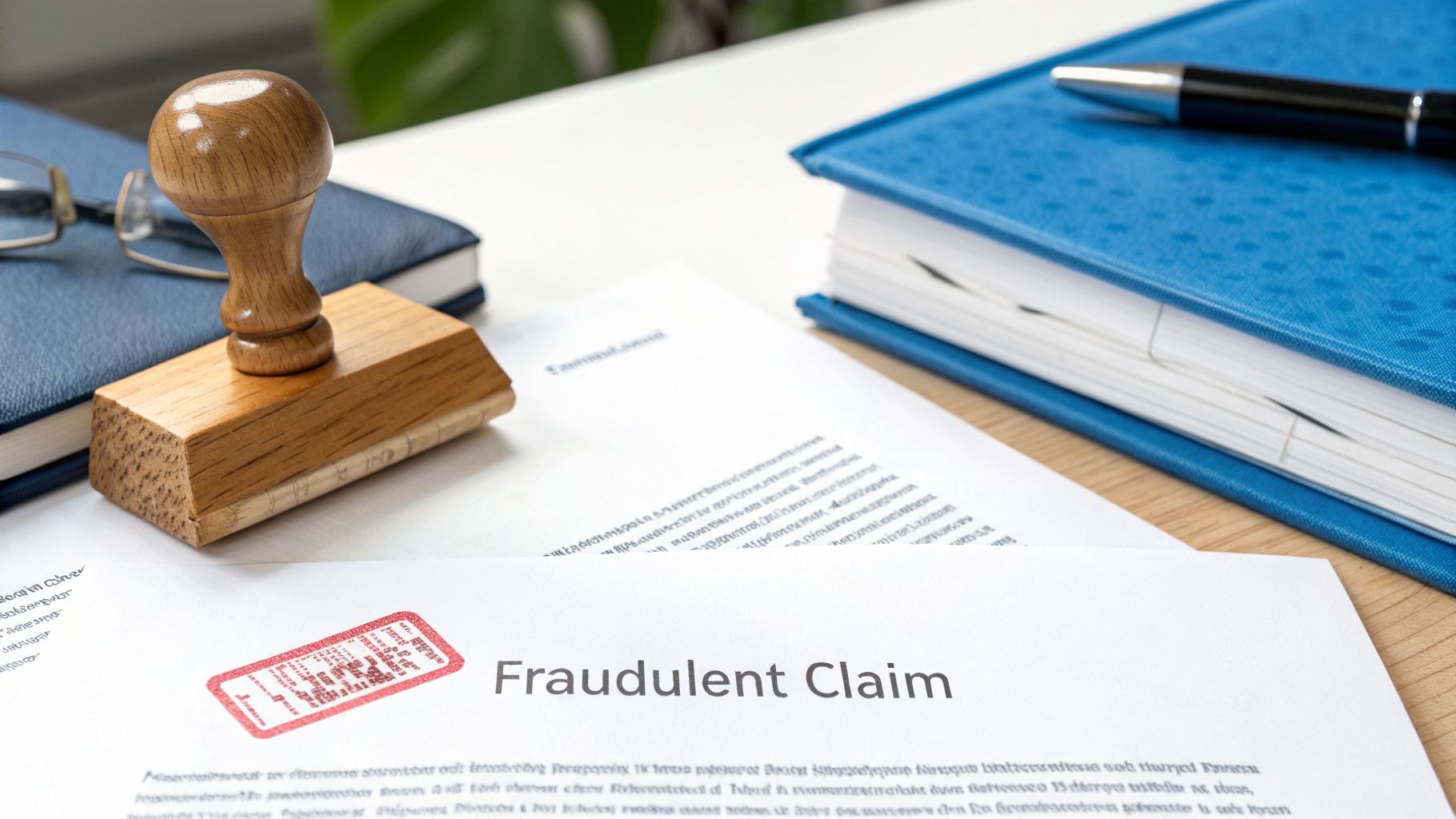
This is a classic scenario where a contractor, in a dispute over payment or work quality, knowingly files a mechanic's lien for an inflated amount or for work never performed.
- Publication: The lien is filed with the county recorder, making it public record.
- Falsity: The owner has receipts and bank statements showing payment, proving the claim is fraudulent.
- Malice: The contractor knows the claim is false but files it as a pressure tactic.
- Damages: The owner's attempt to refinance is blocked by the lien, causing them to miss a lower interest rate and incur legal fees for removal.
Improperly Recorded Easement
An easement grants someone the right to use your land for a specific purpose. If a neighbor records a document claiming an "easement by necessity" for a shortcut across your property without any legal right, they have published a false claim. When you try to sell, a title search uncovers this supposed easement. A prospective buyer, avoiding a potential dispute, backs out of their $400,000 offer, causing a direct, quantifiable financial loss.
Wrongful Foreclosure Proceedings
A simple administrative error can escalate into a nightmare. A lender might accidentally start foreclosure proceedings against a homeowner who is current on their payments, filing a lis pendens—a public notice of a lawsuit involving the property.
A wrongful lis pendens is a potent form of title defamation. It publicly declares a property's ownership is disputed, making it untouchable in the market.
Even if the lender later withdraws the action, the damage is done. The homeowner, who was about to secure a home equity line of credit, has their application denied. The special damages are the lost business opportunity and the legal fees to expunge the lis pendens. For more details, see our guide on the foreclosure lis pendens on a property.
False Claims By A Previous Owner
This often arises from a contentious sale. A disgruntled former owner, claiming they were "defrauded," records an affidavit asserting they are still the rightful owner. This act immediately clouds the new owner's title, creating a legal mess that halts any plans to sell or borrow against the property and incurs thousands in attorney fees to resolve in court.
What Damages And Remedies Are Available?
Winning a defamation of title case is about financial compensation and correcting the public record. A favorable court ruling opens the door to specific financial awards and legal orders designed to make you whole and punish the defendant's malicious actions.

The first step is recovering special damages—your actual, provable losses.
Quantifying The Financial Harm
Unlike personal defamation, where "emotional distress" is subjective, damages in a title case must be concrete and measurable.
You can recover special damages for:
- Lost Profits from a Failed Sale: The profit you would have realized from a sale that fell through due to the false claim.
- Costs to Clear the Title: All reasonable legal fees, court costs, and other expenses incurred to remove the fraudulent claim.
- Increased Financing Costs: The difference in cost if a delayed refinance resulted in a higher interest rate.
Punishing Malicious Conduct
Courts can also award punitive damages. These are not meant to compensate you but to punish the defendant for egregious behavior and deter similar conduct from others.
Punitive damages are a financial penalty reserved for cases where the defendant acted with obvious ill will or a complete disregard for your rights.
While slander of title statistics are rare, recent high-profile U.S. defamation verdicts from 2022-2024 have included awards of $83.3 million and over $10 million. An analysis of mineral rights litigation reveals that 15-20% of title disputes since 2010 involved defamation elements, with settlements averaging $250,000 per case. This highlights the significant financial risk for anyone publishing false property information. Read more on the high stakes in defamation law in this analysis from Knight Columbia.
Correcting The Record: Non-Monetary Remedies
Often, the most critical remedy is a direct court order that fixes the title problem. These equitable remedies are as important as financial awards.
| Remedy Type | Action | Purpose |
|---|---|---|
| Expungement | The court orders the fraudulent document (e.g., a lien) to be legally removed from public records. | This officially removes the cloud on the title, restoring its clear status. |
| Injunction | The court issues an order prohibiting the defendant from repeating or further publishing the false claims. | This provides preventative relief, stopping future harm before it can occur. |
| Quiet Title Action | A lawsuit asking the court to issue a definitive ruling on who owns the property, resolving all competing claims. | This provides a final, binding judgment on ownership, extinguishing other false claims permanently. |
These legal actions restore your property's value and marketability, allowing you to move forward without the false claim hanging over your head.
What Are The Defenses To A Defamation Of Title Claim?
The law provides several robust defenses against a slander of title accusation. Understanding these arguments is crucial for both plaintiffs and defendants, as they reveal the high legal bar required to prove the claim.
The Truth Defense
Truth is the most powerful and absolute defense. If the defendant can prove their statement about the property's title was factually correct, the claim fails. A true statement, regardless of its negative impact on marketability, cannot be legally defamatory. For example, a lender filing a lis pendens for a genuinely delinquent mortgage is making a true statement, even if it kills a pending sale for the homeowner.
Absolute And Qualified Privilege
Some statements are protected by privilege, granting legal immunity even if the statement is false. This protection exists to encourage free speech in specific, important contexts.
| Privilege Type | Scope of Protection | Core Rationale |
|---|---|---|
| Absolute Privilege | A complete shield for statements made during official government proceedings (e.g., court filings, legislative testimony). | Encourages full and open participation in the legal and governmental process without fear of reprisal. |
| Qualified Privilege | A conditional protection for statements made in good faith between parties with a legitimate, shared interest (e.g., a title company and a lender). | Protects necessary business communications. This defense is lost if the plaintiff proves the statement was made with actual malice. |
Lack Of Malice
A core defensive strategy is to proactively demonstrate a lack of malice. The defendant can argue their statement was an honest mistake or based on a good-faith belief in the information they had. For instance, a company filing an incorrect lien due to a clerical error can argue it was an accident, not a malicious act intended to harm the property owner.
The Statute Of Limitations
The statute of limitations is a strict deadline for filing a lawsuit. If a plaintiff waits too long, their claim can be dismissed regardless of its merit. These deadlines vary by state; Oregon has a one-year statute of limitations for slander of title. Crucially, the clock often starts ticking when the special damages (financial harm) actually occurred, not when the false statement was made. The 1983 case Diamond v. Huffman was dismissed solely because the plaintiff filed after the one-year deadline, a stark reminder that in law, timing is everything.
How To Use Data To Prevent Defamation Of Title
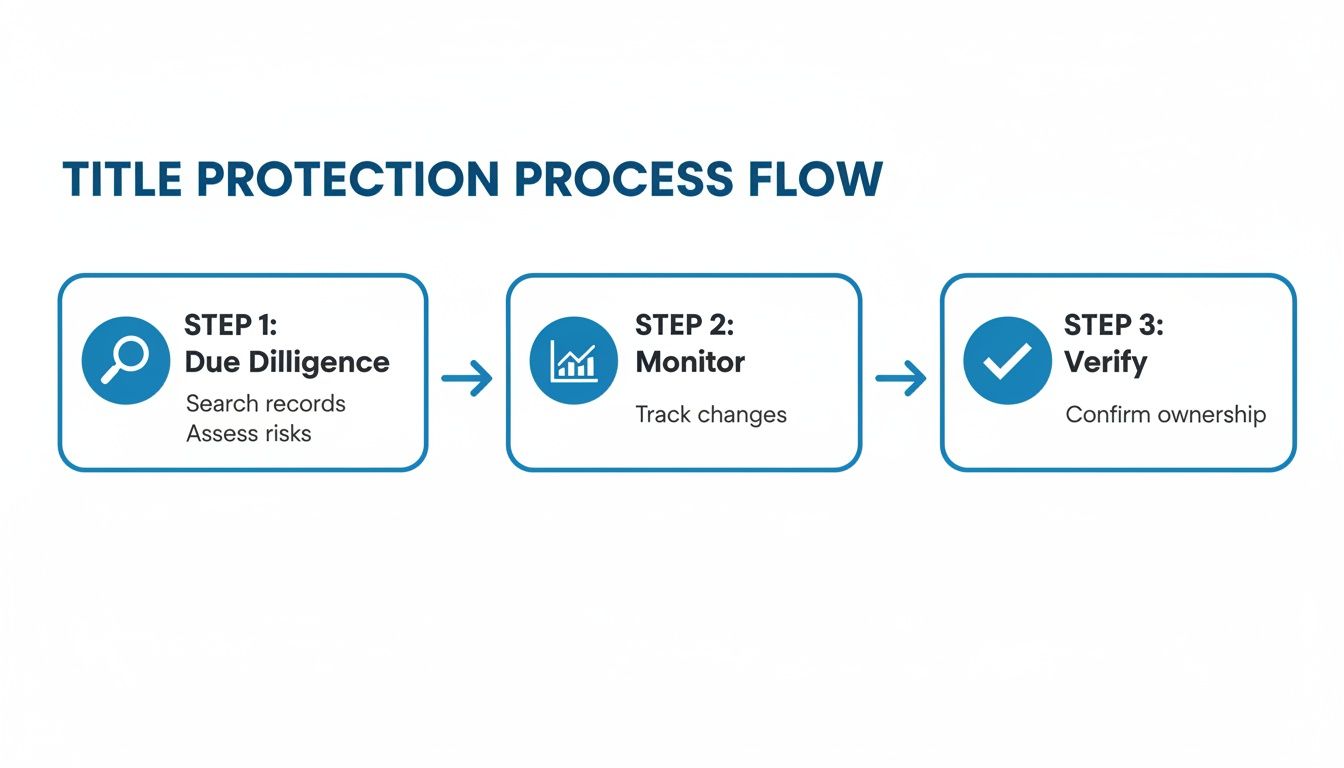
The best defense against defamation of title is a proactive offense. For savvy investors, lenders, and real estate professionals, the strongest shield is built from comprehensive, verified, and near-real-time property data. A platform like BatchData provides an essential risk management playbook to build a defensive perimeter around your assets.
1. Perform Exhaustive Due Diligence
Before acquisition, due diligence is non-negotiable. A deep dive into a property’s history using multi-source data is the only way to spot hidden risks.
A thorough process involves:
- Verifying Ownership History: Cross-reference every deed record and transfer to confirm an unbroken chain of title.
- Identifying All Encumbrances: Pull a complete lien report, including mortgages, judgments, and tax and mechanic's liens.
- Analyzing Associated Documents: Scrutinize every document tied to the parcel, such as permits, easements, and court records.
Use our comprehensive real estate due diligence checklist as a step-by-step framework.
2. Continuously Monitor Portfolios
Closing the deal is not the finish line. A clear title today can be targeted by a fraudulent claim tomorrow. Continuous portfolio monitoring is essential for early threat detection.
Real-time alerts for new filings are your first line of defense. A bogus lien filed on Monday should be on your radar by Tuesday, not discovered six months later during a sale.
Automated systems can provide instant notifications for critical events like:
- New Liens: Alerts for any mechanic's lien, judgment, or other encumbrance recorded against your properties.
- Ownership Changes: Immediate detection of unauthorized deed transfers or other fraudulent filings.
- Pre-Foreclosure Activity: Notification of any lis pendens or notice of default filings.
3. Verify And Investigate With Precision
When an issue arises, quickly verifying or debunking the claim is critical. This requires access to interconnected data points. If a mysterious mechanic’s lien appears, you must be able to instantly pull the property’s full history, find owner contact information, and check records of associated entities.
Understanding specific legal mechanisms, like a Muniment of Title in Texas, is also vital for establishing clear property rights in certain states. A platform like BatchData allows you to cross-reference multiple datasets to untangle title clouds, verify owner identities, and confirm document details, turning a slow, manual process into a fast, data-driven investigation.
Common Questions About Defamation Of Title
Even with a solid understanding, defamation of title remains a complex legal issue. Getting straight answers to specific questions is the best way to understand the risks and protect yourself.
Is Slander Of Title The Same As Slander?
No, they are entirely separate legal claims that protect different interests and have different proof requirements.
| Claim Type | Protects | Requires Proof Of |
|---|---|---|
| Personal Slander | An individual’s personal reputation against false spoken statements. | Harm to character or good name. |
| Slander of Title | The legal ownership or quality of property against false statements. | Specific, measurable financial loss (special damages). |
How Much Does A Defamation Of Title Lawsuit Cost?
There is no single price. Costs vary based on case complexity, jurisdiction, and attorney fees, but these lawsuits are almost never cheap.
Legal costs can easily run from tens of thousands to hundreds of thousands of dollars, covering attorney fees, court costs, expert witnesses, and discovery expenses like depositions. The extensive research required to prove falsity and malice drives up legal bills quickly, making proactive prevention a more cost-effective strategy.
Can You Sue If A Zillow Zestimate Is Inaccurate?
Generally, no. A low Zestimate does not meet the legal standard for a defamation of title claim for two key reasons:
- Opinion vs. Fact: Automated Valuation Models (AVMs) like the Zestimate are legally considered opinions of value, not statements of fact about your legal title. A defamation claim requires a false statement of fact concerning ownership or encumbrances, not a market value estimate.
- Lack of Malice: AVMs are algorithms; there is no "ill will" or provable intent to harm a specific property owner, which is a required element to prove a claim.
While a frustratingly low Zestimate can impact perception, it does not create a cloud on your title or provide grounds for a valid slander of title lawsuit.
With accurate, real-time property data, investors and lenders can proactively monitor their portfolios for the very threats that lead to costly legal battles. BatchData provides the comprehensive property, ownership, and lien data needed to perform exhaustive due diligence and detect fraudulent activity before it causes financial damage. Learn how our platform can become your first line of defense at https://batchdata.io.