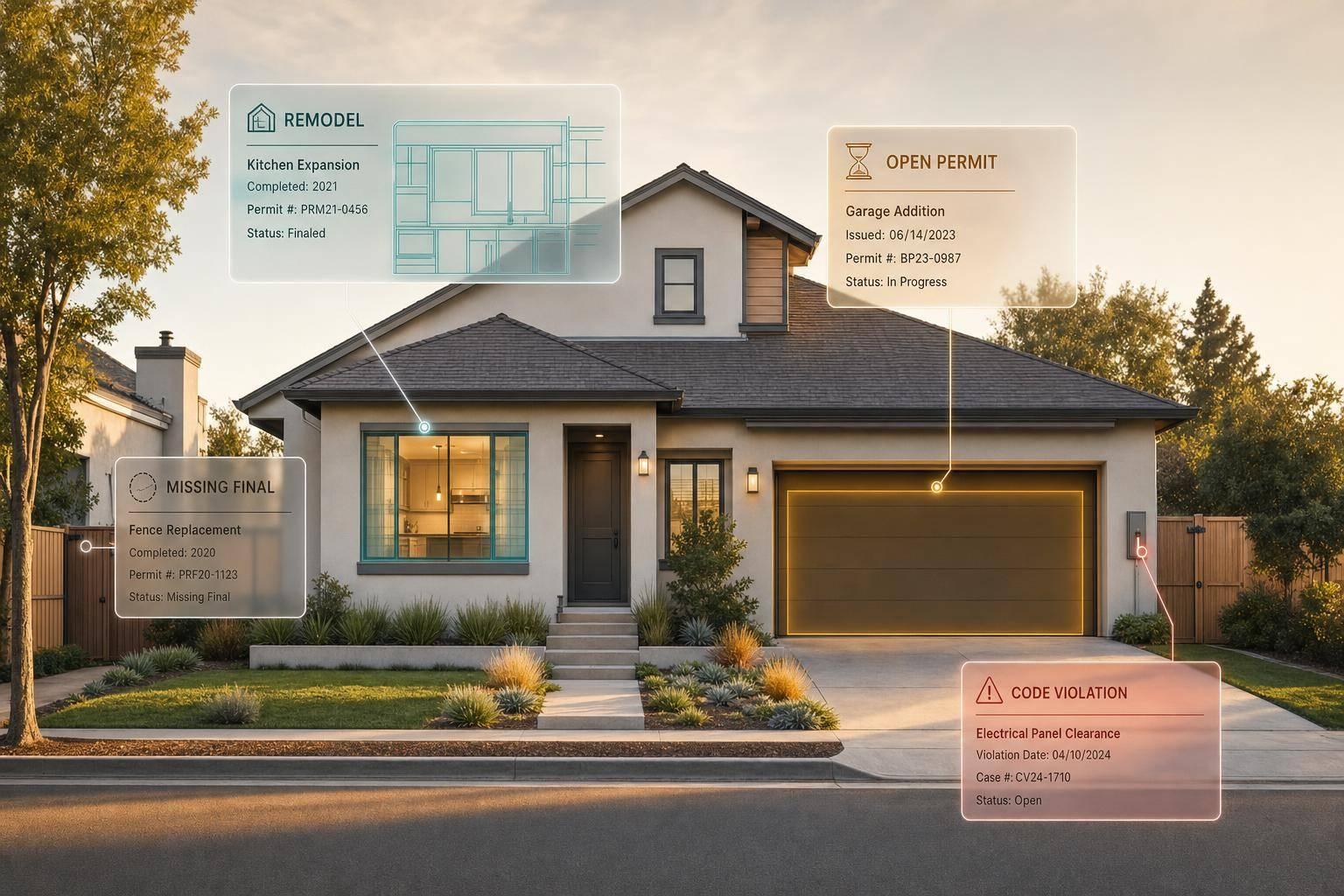
I see four permit signals that matter most: remodel work, open permits, missing final inspections, and code issues like violations or stop-work orders. When those records do not match the property, lenders may pause closing, insurers may review coverage by hand, and investors may add repair time and cost to the deal.
Here’s the short version:
- Remodel history can show that the home changed, even if public property facts did not.
- Open permits can mean work is still unfinished or not closed in the file.
- Missing finals mean there is no record that work passed final inspection.
- Code flags can point to work that needs review or correction.
- A simple review path is: collect records, sort status, check gaps, then decide to proceed, condition, remediate, or escalate.
In plain terms: if the record is incomplete, the property is harder to price, insure, or lend on. Even one unresolved permit can lead to delay, added review, or post-close cost.
This article shows how I would turn permit history into a repeatable risk check for U.S. property review.
Permit Compliance Risk Review: 4-Step Decision Flow for Property Risk
EP 85: Deborah Yelvington | The Permit Problem: Hidden Property Risks That Can Cost Your Family
2. The Four Permit Signals That Affect Property Risk
Not every permit signal carries the same level of risk. But four of them show up again and again in property risk review.
Each one points to a different kind of mismatch between what the record says and what may be true at the property itself.
Remodel activity that changes condition and exposure
Permit history can show additions, remodels, structural changes, and other work that affects a property's size, layout, age, or overall condition.
That matters because this kind of activity can reveal changes that a basic property profile might miss. If the permit record shows a major update, but the recorded square footage or layout hasn't changed, the valuation may be starting from the wrong baseline.
At that point, the gap isn't minor. The record and the property no longer line up.
Open permits and missing finals as signs of unresolved work
An open permit means work is still open in the record. A missing final inspection means there is no final sign-off on file.
In both cases, the work has not been fully verified.
Sometimes that's because the job was never finished. Other times, it's just slow paperwork. Either way, the record remains unverified. And that uncertainty matters in underwriting, coverage, and acquisition pricing because the property's condition has not been fully confirmed.
Code flags, violations, and stop-work orders
Code flags, violations, and stop-work orders are key compliance signals in this group.
They show that a jurisdiction found an issue serious enough to call for review, correction, or a pause in work. That's not the kind of record item lenders, insurers, or investors can brush aside.
These records often call for a full permit-compliance review before the property can be treated as low risk. When they appear, they may point to unresolved compliance issues that need to be cleared before that risk view changes.
That is why enforcement records belong in the same review as permit status.
| Signal | What It Indicates | Why It Triggers Review |
|---|---|---|
| Remodel activity | Physical changes to size, layout, structure, or systems | The record may not reflect the property's current condition |
| Open permit | Work started but not closed out | Work may be unresolved or administratively unfinished |
| Missing final inspection | No final sign-off on completed work | Compliance is unconfirmed and corrections may still be pending |
| Code flag / stop-work order | Enforcement action tied to permit activity | Potential compliance gap or possible unresolved compliance issue |
These signals directly affect lender, insurer, and investor decisions.
3. How Lenders, Insurers, and Investors Use Permit Data
Lenders, insurers, and investors look at the same permit records. But they don't read them the same way.
Lender review: collateral quality, close conditions, and underwriting holds
Lenders check permit records to confirm the property's collateral quality. If they find open permits or missing finals, those issues often turn into close conditions or underwriting holds until the record is cleared.
Insurance review: coverage gaps and loss exposure
Insurers compare permit history with the property's reported condition. If the file shows unpermitted work, or work without final sign-off, that can affect hazard assumptions, replacement cost estimates, and premiums. In some cases, it can also trigger manual review.
Investor review: acquisition pricing, rehab planning, and post-close risk
Investors use permit history to put a price on unresolved work before they buy. It also helps them plan rehab budgets and account for post-close remediation, repair, and timing risk.
These same signals then feed the step-by-step review flow.
4. A Step-by-Step Decision Flow for Property Risk Review
Permit records only lower risk if your team uses them the same way every time. That’s the whole point here: take raw permit history and turn it into a repeatable review flow, whether you’re running it by hand or through an API.
Step 1: Collect and organize permit history
Start with the four permit signals above and use them in the same review sequence each time. Pull the full permit record, including issue dates, work type, status, and final inspection results. Then match each permit to the right parcel with a unique property identifier.
Next, put the data into a standardized format. Status labels should clearly separate open, expired, and finalized permits. Work types should also be grouped by trade, so a reviewer can spot patterns fast, like several open electrical permits tied to one property. BatchData gives access to more than 155 million U.S. property records, with permit data available alongside ownership, mortgage, and transaction history. Once the record is standardized, review it in the same order every time.
Step 2: Check open items, finals, and code exceptions
With the permit history organized, move through the file in a fixed order. Look at remodel activity first. Then check open permits, missing finals, and any code flags, violations, or stop-work orders.
Some gaps are just paperwork issues. Others need deeper review. That distinction matters, especially when a file looks messy at first glance.
Step 3: Proceed, condition, remediate, or escalate
After the review, assign one of four actions.
| Outcome | When to use it |
|---|---|
| Proceed | All permits are finalized, with no open items or code flags |
| Condition | Minor gaps remain and documentation is needed |
| Remediate | Unresolved compliance issues must be corrected before closing |
| Escalate | Complex violations or stop-work orders need deeper review |
Teams can automate the first pass by flagging open or expired permits in the API.
5. Use Permit Compliance Data to Close Property Risk Gaps
Permit compliance data helps teams spot trouble early, before it slows a closing or leaves a coverage gap. Open permits, missing finals, and code flags can point to work that was never finished off or other compliance issues that still need attention.
The main win here is consistency. And that comes from using the same review path every time. Collect the records, organize them, check open items, then decide whether to proceed, add conditions, remediate, or escalate. That kind of repeatable process turns permit history into steady risk decisions across every review.
It works even better when the record is standardized. BatchData delivers permit history with ownership, mortgage, and foreclosure data in one feed. Teams can refresh property risk profiles when new permit filings or code violations show up.
Used this way, permit compliance data cuts down on closing surprises and helps limit coverage gaps.
FAQs
How far back should I review permit history?
There’s no one set lookback period. Review enough property history to cover the parts of its renovation and maintenance cycle that matter.
Current, integrated permit data can surface key risk signals, including open permits, missing final inspections, and code flags. That gives lenders, insurers, and investors a more accurate, up-to-date view of compliance.
Can an open permit delay closing?
Yes. Open permits can delay closing because they may point to work that is still in progress or never fully signed off. They can also hint at compliance issues, like code flags or missing final inspections.
Lenders, insurers, and investors look at permit compliance data as a risk signal. They use it to judge whether a property is likely to meet closing and underwriting requirements before they move ahead.
What should I do if a permit record looks wrong?
If a permit record looks wrong, check it against records from the local municipal building department. BatchData pulls data from multiple independent sources, so some records can show delays or gaps when upstream feeds are late or temporarily down.
These records are for information only. They are not official legal certifications. You’re still responsible for your own compliance and due diligence, especially for regulated uses like lending or insurance underwriting.