Real estate investors often talk about "more leads" as if volume alone solves pipeline problems. In practice, the opposite is often true. More names on a list can mean more wrong numbers, more uninterested owners, more agent frustration, and more budget wasted chasing properties that were never likely to convert.
That’s the core insight behind data stacking: instead of marketing to everyone who might possibly sell, you narrow your list to owners showing multiple signs of motivation.
In a conversation featuring Stephen Hal, an investor with a long background in probate and acquisitions, the message was clear: better filtering leads to better conversations. The real opportunity is not just finding more properties. It’s identifying the smaller set of properties where timing, equity, ownership profile, and distress indicators align.
For investors, operators, and PropTech builders, this has implications far beyond list building. It changes how you think about acquisition efficiency, outbound performance, and even team morale.
Key Takeaways
- List stacking means layering multiple property and owner filters to find records with stronger deal potential.
- Smaller, more targeted lists often outperform massive broad lists because they improve relevance and conversion rates.
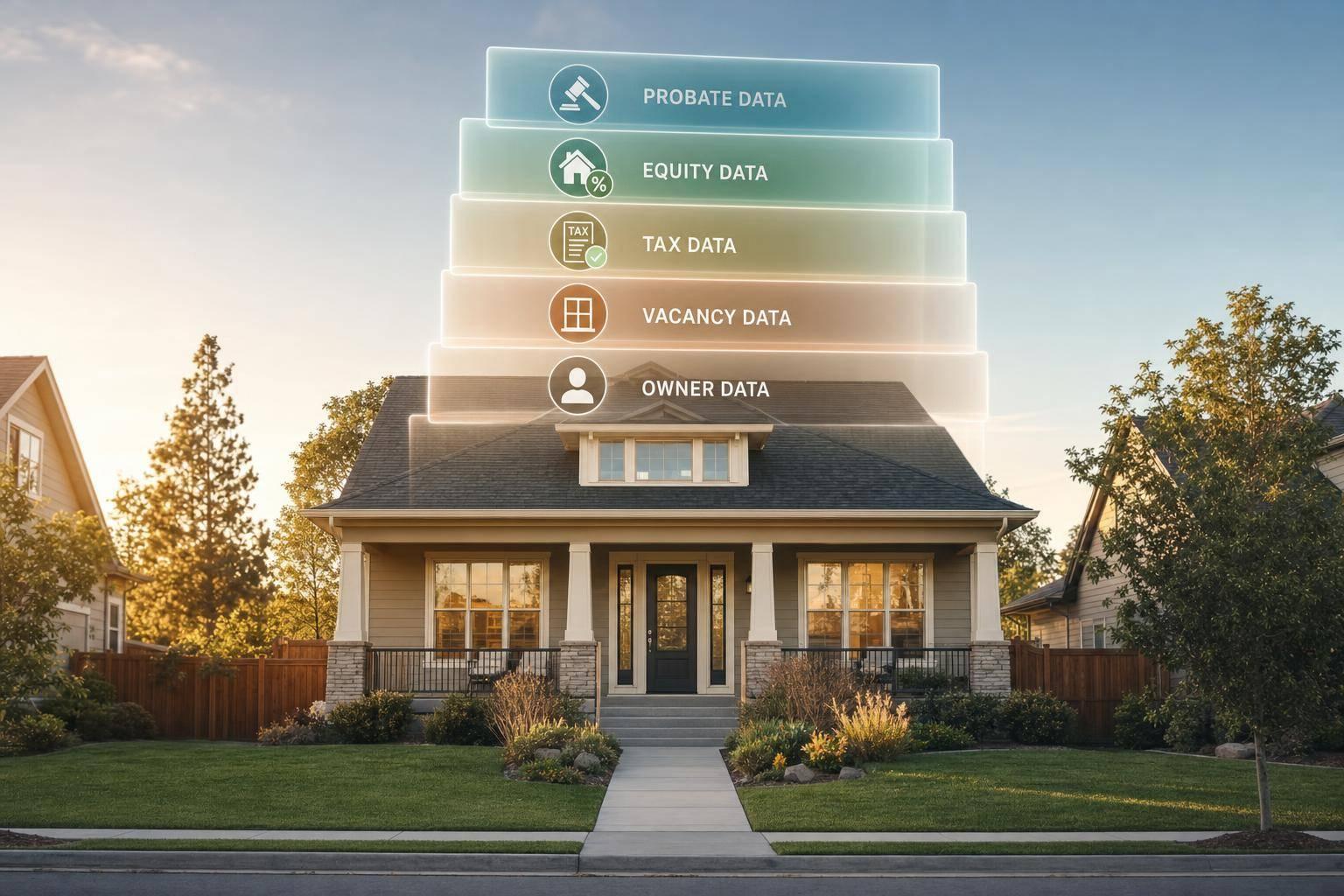
- Motivation signals matter more than list size. Equity, ownership duration, absentee status, tax delinquency, and probate status can work together.
- Niche lead sources like probate can produce larger spreads because many properties are dated, lightly leveraged, or inherited by out-of-area decision-makers.
- Bad data creates operational drag, not just wasted ad spend. It can lower caller confidence and increase team burnout.
- Fresh lists beat stale lists. Rebuilding or refreshing highly filtered audiences on a regular cadence is critical.
- Property condition data can act like a shortcut to driving for dollars, especially when time or field capacity is limited.
- The best workflow is not more tools, but better orchestration: source, filter, verify, and act from one clean process whenever possible.
Why "More Leads" Is Often the Wrong Goal
Many investors start with broad targeting because it feels safer. If you market to 20,000 records, surely some deals will emerge.
Sometimes they do. But broad campaigns usually hide a costly truth: most of those records were never good-fit prospects to begin with.
That creates three predictable problems:
1. Lower marketing efficiency
When a list is too broad, response rates drop and cost per opportunity rises. You spend money contacting owners who have little reason to sell.
2. Lower sales efficiency
Phone teams and acquisition managers spend more time disqualifying than progressing. The pipeline fills with noise.
3. Lower team morale
This was one of the strongest points in the discussion. Repeated rejection from poorly targeted outreach doesn’t just reduce performance metrics. It wears people down. A caller who spends all day reaching disinterested owners becomes less confident, less sharp, and eventually less effective.
In other words, bad targeting is both a data problem and a people problem.
What Data Stacking Actually Means
At a basic level, stacking is the process of applying multiple filters to the same population of properties until a clearer pattern of likelihood emerges.
You might begin with a standard geographic set:
- Single-family homes
- Specific county or ZIP code
- Value range aligned with your buy box
Then you add another layer:
- Owned for at least 7 years
- Minimum equity threshold such as 30% to 40%
Then another:
- Built within a target year range
- Excluding homes that are too new or too obsolete for your strategy
Then another:
- Absentee-owned
- Out-of-state-owned
- In probate
- Tax delinquent
- Vacant
- Long-term landlord ownership
- Senior owner profile
Each additional layer narrows the audience but increases the odds that the remaining owners may have a reason to act.
That is the real value of stacking. It doesn’t just reduce list size. It raises signal density.
From Broad Market to High-Intent Segment
One of the practical examples discussed followed a pattern many investors will recognize.
A market may start with tens of thousands of single-family properties. Once you apply value range, holding period, equity, and year-built criteria, you may reduce that universe to a few thousand. Add absentee ownership or probate, and the list gets much smaller. Add tax delinquency or vacancy, and it can shrink to a highly specific set of records.
This is where many beginners get nervous. A list of 200 or 300 names feels too small compared with a list of 20,000.
But that reaction confuses quantity with quality.
A targeted list of 300 owners with overlapping motivation signals may be far more valuable than a generic list 50 times larger.
For operators, this changes campaign planning. You’re no longer asking:
How many people can we contact?
You’re asking:
How many well-matched owners can we contact with a credible reason to believe they may need a solution?
That’s a much better business question.
Why Probate Keeps Showing Up as a Strong Niche
Probate came up repeatedly in the conversation for good reason. It’s one of the clearest examples of a niche lead source where the ownership situation itself can create motivation.
According to the discussion, probate properties often share several useful characteristics:
- The property may be owned free and clear or with a low loan balance
- The home may be outdated and in need of repairs
- The decision-maker may live out of town or out of state
- The emotional attachment may be lower for the estate representative than for an original owner-occupant
None of that guarantees a sale, and many probate properties will still be listed traditionally or kept in the family. But from a deal-sourcing perspective, probate can produce a subset of records where timing and flexibility are often more favorable than in the general market.
The broader lesson is bigger than probate itself: specialized ownership events often matter more than generic homeowner data.
For data teams and acquisition leaders, this suggests a priority order:
- Identify ownership transitions
- Overlay property distress or deferred maintenance
- Confirm contactability and compliance
- Sequence outreach based on stacked signals
The Hidden Cost of Unfocused Lead Generation
One of the most practical ideas in the discussion was that poor lead quality can poison the whole acquisition process.
If an inside sales team doesn’t trust the list, performance declines before the call even begins. If appointments set from that list are weak, field reps lose trust too. Eventually, every stage of the funnel becomes more expensive because the team is working against the data rather than with it.
This is especially relevant for operations leaders managing:
- Call center productivity
- Right-party contact rates
- Appointment-to-offer conversion
- Rep retention
- Marketing ROI by channel
A weak list doesn’t just reduce top-line opportunity. It introduces friction into every downstream workflow.
That’s why clean, well-filtered data is not merely a sourcing advantage. It is an operational control system.
A Better Framework for Building a Stacked List
If you want to apply the principles from the conversation, a practical workflow looks like this:
Step 1: Start with your buy box
Define the property type, geography, and price or value band that actually fit your acquisition model.
Ask:
- What ZIP codes produce the right deal economics?
- What property type are we built to evaluate quickly?
- What value range aligns with our exit strategy?
Step 2: Add ownership maturity
Longer tenure and meaningful equity often indicate flexibility.
Useful signals include:
- Years since last sale
- Estimated equity range
- Mortgage status if available
Step 3: Add condition or distress clues
These help simulate field-level observations without relying exclusively on windshield time.
Potential signals:
- Assessed building condition
- Vacancy indicators
- Tax delinquency
- Age of property within strategic bounds
Step 4: Add owner motivation layers
This is where list stacking becomes truly powerful.
Examples:
- Probate
- Absentee ownership
- Out-of-state ownership
- Long-term landlord status
- Senior ownership segments
Step 5: Prioritize overlap
Owners appearing across several categories deserve higher attention because they present multiple reasons a sale could happen.
This overlap is often where the best off-market opportunities live.
Why Property Condition Data Matters More Than People Realize
A particularly useful tactic mentioned in the conversation was using county-rated building condition as a shortcut.
Many counties categorize properties using labels such as:
- Excellent
- Average
- Fair
- Poor
- Unsound
Filtering for the lower categories can act as a partial substitute for manual driving for dollars. It’s not perfect, and county-level data quality varies by market. But for teams that can’t physically canvass neighborhoods at scale, condition ratings can quickly narrow the map.
For technical and operations teams, this raises an important point: not all useful lead intelligence comes from flashy alternative datasets. Sometimes the edge comes from simply using ordinary public data more intelligently.
Fresh Data Beats Perfect Data
Another strong operational point from the discussion: a good list degrades over time.
Owners sell. Probate cases resolve. Tax statuses change. Vacancies get filled. Contact records age.
That means even a strong stacked list should not be treated as a one-time asset. It’s more accurate to think of it as a living audience that needs routine refreshes.
A simple discipline can go a long way:
- Rebuild or review target lists weekly
- Compare newly added records versus aged records
- Reconfirm filters by geography and buy box
- Rotate outreach based on the newest stacked opportunities
This matters for both investors and developers. For investors, it preserves campaign quality. For PropTech teams, it highlights a product truth: users don’t just need data access. They need repeatable freshness.
What This Means for Different Real Estate Teams
The ideas in this discussion map well to several business roles.
For acquisition teams and investors
Your edge is not just hustle. It’s specificity. A highly filtered list lets you spend more time in real conversations and less time defending your outreach to unqualified owners.
For sales and operations leaders
Stacked data improves rep efficiency and reduces emotional fatigue. Better inputs usually create better calling behavior, stronger follow-up, and healthier conversion rates.
For technical architects and product teams
The lesson is workflow design. If users must source data in one place, stack it in another, verify contacts in a third, and export manually into a fourth, the system encourages delay and inconsistency. The cleaner the pipeline, the easier it becomes to act on fresh signals.
For compliance-conscious enterprises
More targeted outreach can also support safer operations. A narrower, better-qualified audience means fewer wasted touches and fewer unnecessary contact attempts, which matters when compliance and contact quality are part of the cost equation.
The Strategic Shift: From Lead Generation to Opportunity Engineering
The most valuable idea beneath the conversation is that investors should stop thinking only in terms of "lead gen."
Lead generation is often treated as a top-of-funnel math problem. Opportunity engineering is different. It asks how data can be combined to create high-probability starting points for human conversations.
That shift has several benefits:
- It makes marketing more efficient
- It protects team capacity
- It sharpens your buy box discipline
- It uncovers niche inventory before broader competition sees it
- It turns raw property data into a practical prioritization system
For investors chasing off-market deals, that is a meaningful advantage.
Conclusion
Stacking real estate data is not about making your list look sophisticated. It’s about building a smarter acquisition process.
The discussion with Stephen Hal highlighted a simple but often overlooked truth: you do not need to talk to more people to find better deals. You need to talk to better-fit people.
That means narrowing broad property universes into focused opportunity pools using signals like:
- equity,
- ownership duration,
- absentee or out-of-state status,
- probate,
- tax delinquency,
- vacancy,
- and condition data.
When you do that well, you improve more than response rates. You improve team confidence, reduce waste, and create a repeatable path to higher-quality deal flow.
For modern real estate operators, clean and calibrated data is not just a convenience. It is a competitive weapon.
Source: "The Real Estate Data Strategy That Finds Better Deals Faster" - The Team Lead Talks Podcast, YouTube, Jul 8, 2026 - https://www.youtube.com/watch?v=86wu9mruncw