


































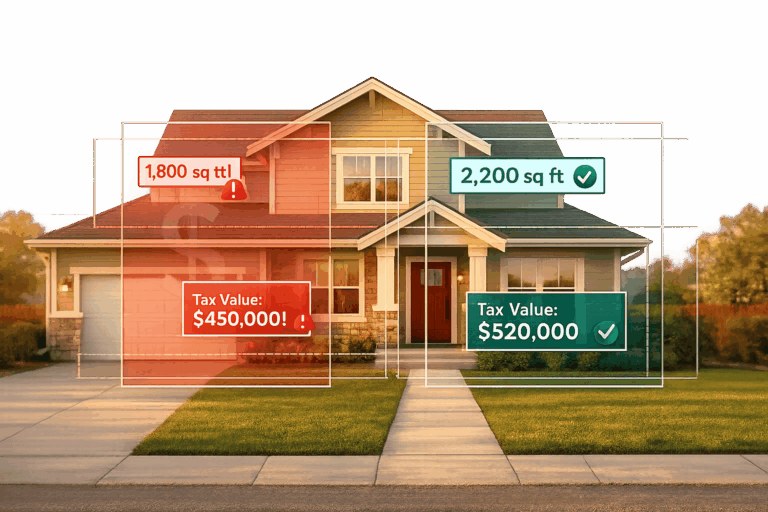
Bad property data can cost you thousands – sometimes even kill a deal. Whether it’s wrong square footage, zoning errors, or inflated valuations, these mistakes lead to overpayments, legal trouble, and wasted time. For example, discrepancies in MLS and county records can result in a $26,000 error on a $300,000 property. Fines for zoning violations can reach $50,000 per infraction, and failed deals can drain your budget due to unrecoverable costs like inspections and legal fees.
Here’s what you need to know:
- Zoning errors can lead to fines, redesigns, or project delays.
- Valuation mistakes drive overpayments or financing gaps that derail deals.
- Operational inefficiencies waste time and strain relationships with lenders and partners.
- BatchData offers tools like real-time APIs and bulk data services to eliminate these costly errors, ensuring accurate property records for better decisions.
Bottom line: Accurate data is the foundation of successful investments. Fixing errors upfront saves money, protects your reputation, and helps avoid risks that can destroy profits.
Identifying Useful and Useless Property Data
sbb-itb-8058745
Types of Property Data Errors That Hurt Investors
Mistakes in property data can derail real estate investments, and issues with zoning and valuation data are among the most damaging. These errors can lead to regulatory headaches, financial losses, and missed opportunities.
Wrong Zoning and Land Use Data
Zoning errors are some of the most costly mistakes in real estate. Regulatory violations caused by incorrect zoning data can result in fines ranging from $10,000 to $50,000 per infraction. The complexity of zoning regulations adds to the problem – one parcel of land might be subject to overlapping rules from the county, city, and even past rezonings. Missing details, like stricter setback requirements or environmental overlays, can drastically reduce the usable area of a property. This often leads to fewer lots being developed than planned, which directly impacts profitability.
If these issues are discovered after a purchase, investors face expensive redesigns and project delays. These delays, combined with fines, can quickly eat into profits. In severe cases, repeated violations may even result in the suspension of business licenses.
"Poor real estate data quality doesn’t just drain your finances. It erodes your credibility and trust in the market." – Snehal Joshi, Business Process Management Lead, Hitech BPO
This quote highlights how zoning errors not only bring financial penalties but also damage an investor’s reputation, further compounding the risks.
Incorrect Property Valuations and Market Data
While zoning mistakes disrupt compliance and planning, valuation errors strike directly at the heart of investment returns. Inaccurate market data and flawed appraisals can lead to overpaying for properties or missing out on lucrative deals. For example, if comparable sales data is incorrect or market trends are misunderstood, the investment margins can shrink to the point where deals fall apart.
Even small errors – like incorrect square footage, bedroom counts, or unrecorded renovations – can undermine both automated valuation models and manual appraisals. This often results in a pro forma that no longer aligns with the original investment plan, leaving investors with properties that fail to meet expected returns.
The Financial Impact of Inaccurate Property Data
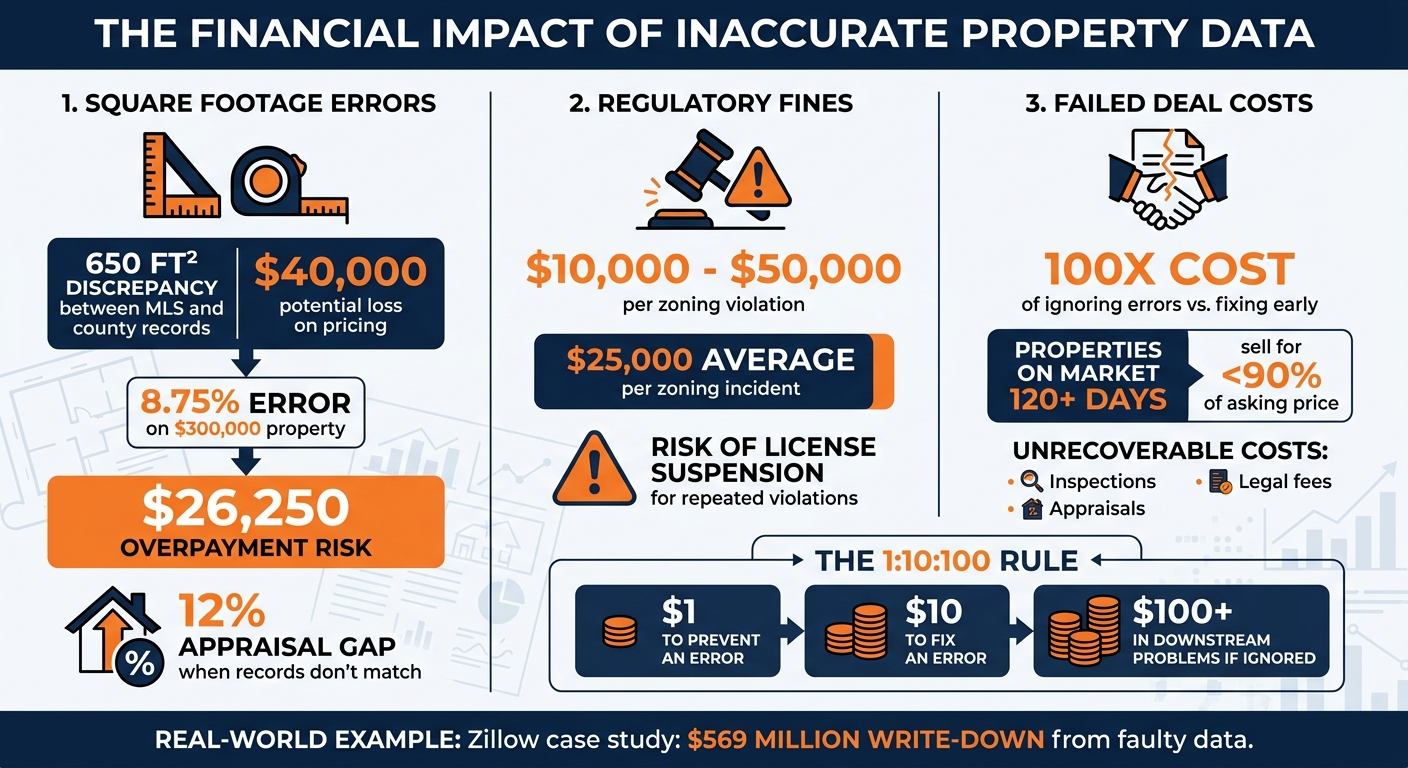
Financial Impact of Inaccurate Property Data on Real Estate Investments
Getting property data right isn’t just about smooth operations – it’s about protecting your profits. When property data is wrong, it can lead to overpayments, legal troubles, and even failed deals, all of which chip away at your bottom line.
Paying Too Much or Too Little for Properties
Imagine this: the MLS lists a property at 1,850 ft², but county records show it’s only 1,200 ft². That 650 ft² difference could cost you around $40,000. If your Maximum Allowable Offer (MAO) is based on the inflated MLS figure, you might overbid. For a $300,000 property, that could mean an error of 8.75% or $26,250.
This issue worsens when appraisers rely on county records, but investors base their offers on MLS data. Such mismatches often lead to appraisals coming in 12% below the purchase price. The result? A financing gap that could derail the deal or force last-minute renegotiations. Even major players like Zillow have felt the sting of bad data – its $569 million write-down stemmed from overestimating home values due to faulty data entry.
And that’s just the beginning. Regulatory risks can make these financial hits even harder to recover from.
Fines and Legal Problems
Bad data doesn’t just mess with pricing – it can land you in legal trouble. Errors in zoning or property records can lead to fines ranging from $10,000 to $50,000 per violation. These penalties pile up quickly, especially when overlooked details like environmental overlays, setback requirements, or outdated land use classifications come into play. In extreme cases, repeated violations could even result in license suspension or revocation, effectively halting your investment operations.
There’s also the risk of ownership disputes or hidden liabilities, such as environmental hazards that were missed due to inaccurate records. These issues can lead to expensive litigation, tying up your capital and delaying other deals.
But the financial pain doesn’t stop there – failed deals bring their own set of losses.
Lost Money from Failed Deals
When deals fall apart because of data mistakes, the costs are often unrecoverable. Inspections, appraisals, title searches, and legal fees all add up, and when a deal collapses, that money is gone. Ignoring data errors can cost up to 100 times more than addressing them early on.
Overpricing is another major issue. Properties that linger on the market for more than 120 days due to bad valuation data typically sell for less than 90% of their original asking price. This creates a double hit: wasted time and reduced sale proceeds. On top of that, if renovation budgets spiral out of control because square footage estimates were wrong, a deal that seemed profitable could quickly turn into a financial headache – or worse, a loss.
How Bad Data Disrupts Operations and Strategy
Bad data doesn’t just create pricing and legal headaches – it can throw a wrench into your operations and long-term plans. Instead of focusing on growth, teams end up stuck fixing errors, while competitors with accurate data gain the upper hand.
Duplicate and Conflicting Records
When MLS and county records don’t match, your team is left guessing which one to trust. This forces them to spend valuable time cross-referencing, slowing down processes and creating inefficiencies that add up over time. These delays don’t just waste hours; they also stop your team from analyzing new opportunities.
The 1:10:100 rule highlights the cost of bad data: preventing an error costs $1, fixing it costs $10, and ignoring it can lead to $100 in downstream problems. If your team is constantly correcting errors, they’re not focusing on building relationships or exploring new strategies. And it’s not just MLS and county records – accurate data is critical across the board.
Errors in Occupancy and Vacancy Data
Once record inconsistencies are fixed, you still need accurate occupancy data to make sound investment decisions. If this data is wrong – say, occupancy rates are reported as higher than they actually are – it can throw off cash flow projections and market analysis. Missteps like these can put your portfolio growth on pause while competitors with better data seize opportunities.
Damaged Relationships with Partners and Lenders
The ripple effects of bad data don’t stop internally. Inaccurate information can strain external relationships with partners and lenders, especially when deals fall apart due to errors. For instance, lenders often base appraisals on county records, not MLS data. If inflated square footage leads to a financing gap, it can force last-minute renegotiations – or worse, kill the deal entirely.
"If the appraiser comes in 12% below your purchase price because they’re working from assessor sqft instead of MLS sqft – that’s a financing gap that kills the deal or forces a price renegotiation at the worst possible time." – DistressIQ
For wholesalers, the stakes are even higher. If a contract’s assigned value is based on an inflated ARV and due diligence reveals discrepancies – like MLS square footage being overstated by 300–800 ft² – it can result in a renegotiated fee or a collapsed deal altogether. Consistent errors like these damage your credibility, making future financing harder to secure and weakening relationships with key partners. In these situations, your reputation becomes your biggest liability.
How BatchData Improves Property Data Accuracy
BatchData directly addresses the challenges of costly data errors by providing tools designed to ensure accurate, reliable property information. By focusing on precision and verification, BatchData helps eliminate mistakes and delivers dependable data exactly when it’s needed. Here’s how their solutions tackle these issues.
Property Data Enrichment and Verification
BatchData enhances outdated or incomplete property records by appending verified details from trusted sources like county assessor databases and MLS listings. This process helps avoid costly errors, such as overpayments or legal penalties. For instance, public records that are outdated by 2–5 years can lead to valuation errors of up to 15%. In one notable case, an investor using BatchData’s verification tools uncovered a recent rezoning from industrial to residential on a commercial property. This discovery saved a $2 million development project and avoided potential fines. With data coverage for over 160 million properties and more than 700 data points per property – including square footage, ownership history, tax assessments, and zoning information – BatchData helps investors steer clear of expensive missteps that could derail their plans.
Real-Time APIs for Property Search
BatchData’s Real-Time APIs provide near-instant access to current property information, with a response time under one second and 99.9% uptime reliability. Accuracy rates reach 98%, ensuring dependable results. These APIs can be integrated directly into applications or dashboards, enabling users to perform immediate property searches on-site. For example, house flippers can confirm a property’s vacancy status in real time, helping them avoid bidding on occupied foreclosures. In one case, a hedge fund used BatchData’s API to identify a recent title lien that hadn’t yet been flagged by other data sources, saving them from a potential $1.5 million loss. By aggregating data from more than 3,000 U.S. county sources daily and cross-verifying it with proprietary algorithms, BatchData ensures users always have access to the most up-to-date information.
Bulk Data Delivery for Large-Scale Operations
For those managing extensive property portfolios, BatchData offers Bulk Data Delivery, capable of processing up to 1 million records overnight in formats like CSV, JSON, or API exports. This solution reduces manual data entry by 90%, minimizing human error and cutting costs to just $0.02 per record. For example, a REIT client processing 50,000 properties each month identified $10 million in undervalued assets thanks to BatchData’s bulk delivery service, which filled gaps in their data. Implementation is quick, typically taking 1–2 days via secure uploads and automated scheduling. One investment fund even automated audits through this service, reducing operational costs by 25% and improving lender negotiations. At just $0.02 per record, the savings add up fast, especially when dealing with tens of thousands of properties.
Steps to Maintain Accurate Property Data
Avoid costly data mistakes by combining smart technology, consistent oversight, and expert assistance. These three steps can help cut data inaccuracies by 70% and protect your investments. By maintaining precise property data, you ensure your decisions are backed by reliable information.
Use real-time verification tools to keep your data current. For example, BatchData’s APIs deliver highly accurate property details – like ownership, zoning, valuations, and lien status – with a 98% accuracy rate. During due diligence, you can instantly verify details such as square footage or legal issues by querying a property’s address, reducing errors from outdated records by as much as 40%. By integrating these tools into your CRM and setting up alerts for discrepancies, you can act quickly. One mid-sized U.S. investor managing 500 units used BatchData’s APIs to avoid overpayments and fines while speeding up deal cycles by 25%.
Conduct regular data audits to catch issues before they escalate. A quarterly audit process can include reviewing your property inventory, pulling updated data from county records or APIs, flagging discrepancies over 10%, and updating high-risk records. This method helps identify 75% of zoning errors before they lead to fines, which average $25,000 per violation. BatchData’s Bulk Data Delivery service can process up to 1 million records overnight for just $0.02 per record, slashing manual data entry by 90% and making large-scale audits manageable. These audits ensure your portfolio remains accurate and up-to-date.
Leverage professional services for tailored solutions to complex challenges. BatchData’s team can develop custom APIs for bulk analysis, enrich datasets with predictive models, and create automated monitoring systems. For investors managing thousands of properties across multiple states, these personalized tools deliver 25–50% better accuracy in specialized markets, such as commercial zoning. One REIT client used BatchData’s services to build a custom portfolio dashboard, uncovering $10 million in undervalued assets by addressing critical data gaps. Start with a needs assessment, run a pilot on 10–20% of your portfolio, and roll out fully with service-level agreements (SLAs). This approach can reduce errors by 15–30%.
Conclusion
Inaccurate property data can have a serious impact on your bottom line. It leads to overpayments, legal penalties, and missed opportunities – potentially draining up to 8.75% of a property’s value. For example, on a $300,000 property, that’s a staggering $26,000 lost. Trusting agent-reported square footage instead of verified county records means relying on unverified marketing data, which can be a costly mistake.
"MLS property data is agent-reported and routinely inaccurate – wrong square footage, phantom bedrooms, inflated values. County assessor records are the legal source of truth." – DistressIQ
BatchData offers a solution to these challenges by delivering reliable property data for over 155 million U.S. properties. Each record includes more than 1,000 verified attributes. Whether you’re using real-time APIs for due diligence or bulk data for large-scale analysis, BatchData ensures that your decisions are based on verified facts, not assumptions. This automation not only reduces underwriting labor costs by over 50% but also helps close financing gaps when appraisals fall short of expectations.
In a global real estate market valued at nearly $700 trillion, where over 90% of investment decisions depend on accurate data, precision is no longer optional – it’s essential. Investors who prioritize data accuracy gain a major edge: they uncover off-market deals before the competition, avoid zoning violations that can cost $25,000 per incident, and build trust with lenders by making informed, reliable decisions.
FAQs
Which property fields should I verify first before making an offer?
Verifying critical property fields such as ownership details, square footage, zoning information, title status, liens, and boundary data is crucial. Mistakes in these areas can lead to inaccurate valuations, legal issues, or even missed opportunities. Double-checking these details ensures better decisions and smoother investment outcomes.
How can I spot zoning problems before they turn into fines or delays?
To steer clear of zoning problems that could result in fines or project delays, it’s crucial to perform detailed due diligence. Leverage tools that bring together zoning information, environmental limitations, and infrastructure plans into a single, easy-to-understand view. Go beyond surface-level zoning checks to identify potential hidden restrictions, such as overlay zones or special conditions. Make it a habit to cross-check zoning details with municipal records frequently to ensure everything is up-to-date and avoid unexpected – and expensive – issues during your development process.
How often should I audit my portfolio data to keep it accurate?
To keep your portfolio data accurate, it’s important to audit it regularly. Experts often recommend reviewing your data on a quarterly or semi-annual basis. This helps identify outdated or incorrect information, such as property records or ownership details.
If your portfolio changes frequently or depends on real-time data, you might need to perform audits more often. Regular checks not only minimize financial and operational risks but also support smarter decision-making.