





































Data pipeline automation isn't mainly a speed play, it's a control problem. The messy part isn't moving data anymore, it's proving that automated movement is trustworthy when the input is wrong, the schema changes, or someone needs to reverse a bad decision. That's why cloud-native pipeline tooling has become the default, with 71.18% of tools now cloud-based and the market projected to rise from $14.76 billion in 2025 to $48.33 billion by 2030 at a 26.8% CAGR (integrate.io).
For real estate teams, that shift matters because the pipeline isn't just feeding dashboards, it's shaping underwriting, portfolio monitoring, and outreach. Automation works when it reduces manual upkeep, enforces quality, and gives you a clean rollback path when a record set is bad. It fails when teams treat orchestration as the finish line.
- Core job: move, transform, and monitor data with minimal human intervention.
- Real payoff: less maintenance drag, faster insight, and fewer broken downstream reports.
- Practical rule: automation should start with trust, not ambition.
The rest of this guide gets specific about what works in production, and what breaks first when the data gets ugly.
What Data Pipeline Automation Does
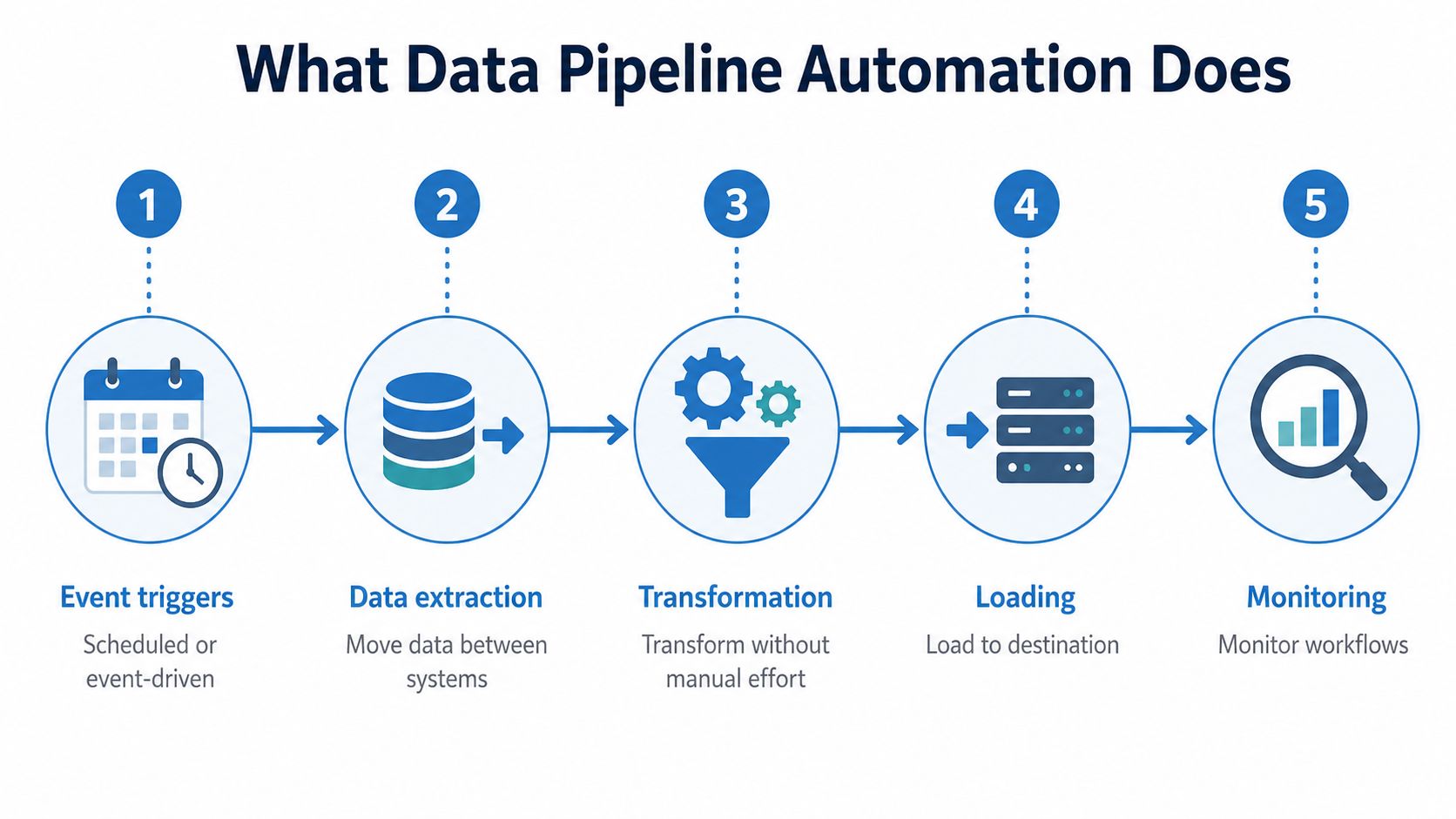
Data pipeline automation is software-driven movement, transformation, and delivery of data with minimal manual intervention. IBM's framing is useful because it strips out the hype and focuses on the core job, coordinating workflows so data moves repeatably from source to destination without someone babysitting every step (IBM).
For teams still living in cron jobs and hand-coded ETL scripts, the shift is easy to see. Pipeline automation used to mean brittle schedules and one-off scripts. Now the center of gravity is cloud-managed orchestration, elastic compute, and readiness for near real-time work. That is why cloud-based tools account for 71.18% of the market in the referenced compilation, and why the category is projected to grow sharply through 2030 (integrate.io).
Batch, micro-batch, and streaming
Batch pipelines collect data on a schedule, usually for reporting, reconciliation, or historical loads. Micro-batch sits in the middle, breaking a day into smaller windows so freshness improves without the operational burden of full streaming. Streaming pipelines process events as they arrive, which matters when stale data creates downstream cost.
A real estate investor does not need streaming for every feed. Nightly rent roll reconciliation, property tax snapshots, and monthly investor reporting usually fit batch because the decision window is wider. Lead routing from a form fill, delinquency alerts, and underwriting checks on a hot deal pipeline can justify streaming or micro-batch because a delayed record can push the wrong action into the next workflow.
The Business Case and Core Architecture
The business case starts with maintenance drag. Data teams lose a large share of their time to retries, schema changes, hand fixes, and one-off recovery work, which is why automation matters in serious data orgs. The payoff is not just lower upkeep. It is fewer interrupts, faster recovery when sources drift, and less time spent reworking the same pipeline after every upstream change.
If you need budget approval, frame it that way. Cut the pitch about “modernization.” Focus on reduced engineering drag, fewer manual interventions, and less time lost every time a source schema changes. In practice, that also means the warehouse can stay current without forcing analysts to wait on someone to babysit loads.
Three layers, three failure domains
The cleanest way to diagnose a stack is to split it into ingestion, transformation, and delivery. Each layer has a different job, different tooling, and different failure modes. That is where teams usually misread the incident.
| Layer | Typical Tools | Latency | Top Failure Mode | Real Estate Consequence |
|---|---|---|---|---|
| Ingestion | APIs, S3 drops, CDC | Batch or near real time | Missing files, broken credentials, late source arrivals | Rent rolls, lender feeds, or lien records arrive late, which delays underwriting and blocks timely portfolio checks |
| Transformation | SQL, dbt, serverless workers | Usually batch or micro-batch | Schema drift, logic bugs, duplicate rows | Occupancy, NOI, or delinquency metrics can be computed off stale or duplicated records, so investment decisions rest on bad inputs |
| Delivery | Snowflake, dashboards, downstream APIs | Depends on SLA | Stale tables, broken refreshes, inconsistent consumer views | Asset managers and acquisition teams see different numbers, which creates avoidable disputes before a deal or reporting cycle closes |
If a warehouse keeps showing bad numbers, the fault might not be transformation. If data never lands, the issue might be source handling. That distinction saves hours during incident response and keeps the team from fixing the wrong layer. It also explains why Snowflake integration patterns for batch delivery matter when the problem is how data moves into the warehouse, not how a dashboard reads it.
Translate the metrics into reality
A business case gets stronger when maintenance cost is tied to team capacity. Automation that cuts repetitive work does more than save effort. It changes what senior engineers can spend time on, and that matters when the pipeline supports property operations, acquisitions, and investor reporting at the same time.
In real estate, that usually means more model refinement, better entity resolution, and fewer fire drills when portfolio data shifts overnight. It also means the team can spend more time deciding which refresh model reduces downstream error cost, instead of spending the morning re-running failed jobs and reconciling hand edits.
Eight Best Practices That Move the Needle

The strongest pipelines combine reliability controls, not one silver bullet. Databricks identifies idempotent writes, embedded data-quality expectations, CI/CD with pre-production testing, and full observability with proactive alerting as high-impact practices, while Pantomath extends the list into anomaly detection, error detection, fault isolation, and traceable alerting. The order matters because the first problem to solve is repeatability, especially in real estate pipelines where the same source file, backfill, or retry can easily create duplicate rows that distort rent rolls, occupancy views, and underwriting inputs. Once writes are safe to run again, the rest of the controls become much easier to trust and debug. For warehouse-side design, the discipline of data warehouse best practices for pipeline teams matters because the warehouse often becomes the control plane for downstream trust.
Prioritize in this order
- Idempotent writes with merge logic in Snowflake or warehouse-native upserts, so retries don't duplicate rows. This matters most in real estate pipelines because duplicate property, lease, or transaction records can change portfolio views and underwriting outputs faster than a failed job ever will.
- Embedded data-quality checks in dbt or Great Expectations, so bad records stop before they spread. A check that blocks null parcel IDs or invalid rent values saves more cleanup time than a downstream reconciliation pass.
- CI/CD with pre-production testing through GitHub Actions or GitLab CI, so broken models never reach production. Treat transformation code like application code, because schema drift and logic regressions are easier to catch before a load hits the warehouse.
- Orchestration with dependency graphs in Airflow, Prefect, or Dagster, so task order is explicit. That gives you a clear map of what can run in parallel and what has to wait on upstream data.
- Declarative scheduling in a workflow engine or cloud scheduler, so you define when to run, not how to hand-hold each step. This keeps the trigger logic simple when different asset classes or reporting cycles need different refresh windows.
- Full observability with logging, lineage, and alerting through tools like Pantomath or OpenTelemetry-style instrumentation. Once a pipeline supports investor reporting, you need a way to trace a bad metric back to the exact load, transformation, or source file that introduced it.
- Contract and unit tests for schemas and transformation logic, so upstream drift gets caught early. These tests are the cheapest way to catch a source adding a field, changing a type, or dropping a column that downstream models depend on.
- Security and compliance controls with role-based access and audit logs, so access and overrides stay reviewable. If someone can patch data manually, the change needs a traceable record or the pipeline stops being trusted infrastructure.
The most common failure these practices prevent is silent corruption. A job can “succeed” while still writing duplicate rows, dropping nulls into required fields, or propagating a stale dimension table. That is why the three highest-value checks after every run stay simple, primary-key uniqueness, null checks on required columns, and row-count comparison against yesterday's output (dev.to).
Practical rule: if you can only automate three validations, make them uniqueness, nullability, and row counts.
Orchestration Stacks and a Working Implementation Pattern
Orchestration is really a trust layer, not just a scheduler. Airflow still shows up in a lot of mature environments because it can handle tangled dependency graphs, but Prefect and Dagster are often easier for smaller teams that want Python-native flows and clearer data modeling. Kubernetes operators and serverless workers still make sense in narrower setups, especially when the team already runs inside those runtimes and does not want another platform to babysit.
The stack choice comes down to who owns the failure at 2 a.m. If the team already ships containerized workloads, Kubernetes operators can fit cleanly into the existing ops model. If the priority is readable flows, fewer moving parts, and faster iteration, Prefect usually wins that argument. Dagster tends to fit teams that want stronger software-style data asset modeling, which is a different trade-off from wiring tasks together. For a more grounded comparison of orchestration patterns and control surfaces, see the Prefect and Dagster comparison resource and weigh it against your own maintenance load.
| Stack | Best Fit | Learning Curve | Ideal Team Size |
|---|---|---|---|
| Airflow | Complex dependency graphs and legacy-heavy environments | Moderate to steep | Medium to large |
| Prefect | Python-first teams that want simpler orchestration | Moderate | Small to medium |
| Dagster | Teams that want strong software-style data asset modeling | Moderate | Small to medium |
| Kubernetes operators | Platform teams already standardizing on Kubernetes | Steep | Medium to large |
| Serverless workers | Lightweight event-driven jobs and narrow task scopes | Low to moderate | Small |
A useful reference for small teams thinking about automation patterns is automation tips for real estate teams, especially if the workflow sits closer to operations than to a large central data platform.
A workable implementation pattern starts with one clear rule. Treat raw data as replayable, classify failures before retrying, and keep the handoff to storage simple enough that an operator can reason about it without reading five logs. BatchData can sit at the front of that flow when you need property data access and bulk delivery.
The point of the code is not elegance. It separates transient failures from permanent ones, keeps secrets in environment variables, and avoids wasting retries on a bad request that will never succeed. In practice, you would land the raw file first, then run a transformation step after the object is in S3 or staged for Snowflake bulk loading.
That order matters because it keeps the raw input intact for replay and audit. If a downstream model changes, you can rerun from the same landing file instead of calling the source again and hoping the response still matches yesterday’s run. That is the part most orchestration diagrams skip, and it is where trust usually breaks.
A Real Estate Pipeline From Ingestion to Alert
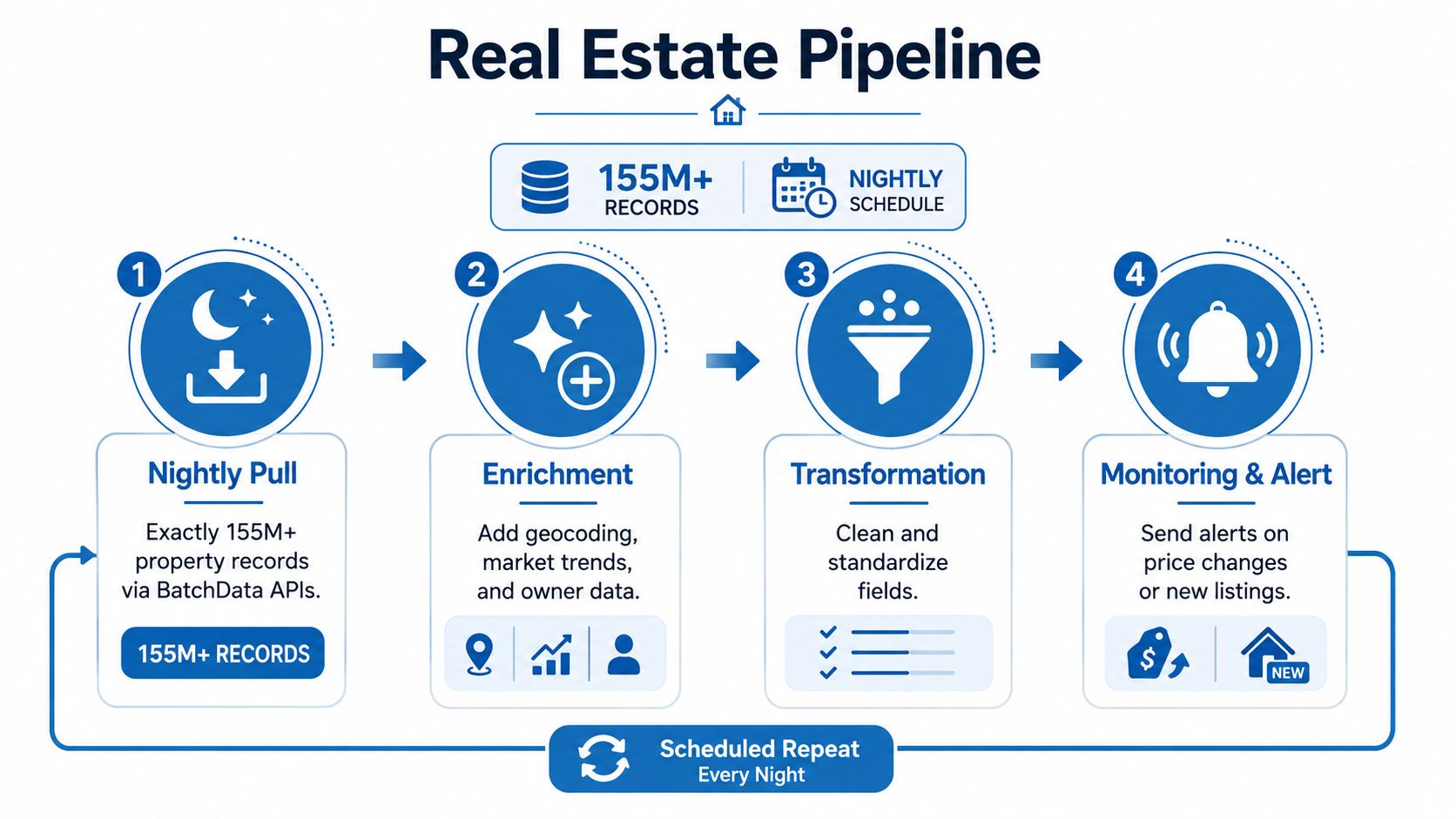
A useful real estate pipeline starts with one nightly pull and ends with one alert a human can act on. For investors, lenders, and underwriting teams, the flow is straightforward, pull property records, enrich them, load them into the warehouse, run a model, and alert only when the signal crosses a meaningful threshold. The part that usually gets ignored is the trust model behind that flow, who can override a result, which records stay replayable, and how much freshness the business needs before the next decision.
The first step is ingestion. BatchData can provide property data for this kind of workflow, helping teams refresh portfolio data and monitor changes across a wide footprint. That matters when you are tracking ownership changes, lien risk, or equity movement, because missed or stale records can affect underwriting and portfolio monitoring.
From there, the pipeline enriches the records with skip-traced owner contacts, lands the result in S3, and bulk loads it into Snowflake. A dbt model then flags records where estimated equity crosses your internal threshold. That is the point where raw property data becomes a decision surface, and where stale inputs start costing real money if the monitoring logic is too slow.
The alert should page an analyst only when the anomaly score exceeds a calibrated baseline, not every time a field wobbles.
The quality checks still matter after every run, but they should be tied to portfolio monitoring outcomes instead of copied as a generic checklist. Primary-key uniqueness protects you from double-counting a property across the book. Null checks on required fields keep the monitoring layer from dropping owners, addresses, or valuation inputs. Row-count comparison against yesterday’s output catches an upstream feed that suddenly goes thin, which is often the first sign that a source changed format or a pull failed partway through. That is a practical control loop, not a theoretical one, and it is the difference between a clean alert feed and a false sense of coverage (dev.to).
For teams watching how software changes property workflows, technology shaping property market is a useful lens on why these automated loops are becoming normal instead of novel. This pipeline turns a nightly file drop into an operational signal, not just another table.
Governance, Overrides, and the Trust Gap in Automated Pipelines
The hard problem is authority, not automation. Once a pipeline starts correcting records, replaying files, or firing alerts, the team has to define who can override it, how that override is recorded, and how the original raw data stays replayable. Generic orchestration coverage usually stops before that question, which is exactly where the risk starts showing up in production (surnex.io).
For real estate pipelines, the safe pattern is decision support first, autonomy later. A lien alert on a rental acquisition, a stale valuation on a refinance package, or a missing owner record in a portfolio feed should be reviewed before the system is trusted to act on its own. That lines up with how risk teams work, because they want reviewability before they want speed.
Controls that matter
- Versioned business rules so a change to an underwriting threshold can be traced back to the exact rule set that produced it.
- Replayable raw data so a bad owner match, a broken comp feed, or a flawed delinquency flag can be rebuilt from source.
- Role-based override policies so only senior underwriters can suppress a lien-alert flag, while junior analysts can only request review.
- Audit trails that show who changed a rent-roll exception, when it happened, and why the override was approved.
- Rollback paths that let the team reverse a bad suppression or restore a prior alert state without reconstructing the whole workflow by hand.
A control is only useful if it maps to a real decision. Versioning helps when an acquisition team changes a vacancy threshold and later needs to explain why a property dropped out of the watchlist. Replayable raw data matters when a lender asks why a tax record disappeared from a nightly feed and the only safe answer is to rerun from the original input. Role-based overrides matter because not every analyst should be able to silence a default notice on a high-risk asset. Audit trails matter when ownership or compliance asks who approved the exception and whether the right reviewer signed off. Rollback paths matter when a false positive has already reached the portfolio dashboard and needs to be corrected without breaking downstream reports.
The operational reality is messier than a neat definition of automation. You still need a named reviewer for sensitive changes, and you still need to know how far an automated correction traveled before it was caught. If a stale valuation was pushed into a lender packet, the team needs to trace the path, fix the source, and document the override before the same mistake spreads into another report.
If you can’t reverse it safely, you probably shouldn’t let it auto-correct in the first place.
The trust gap shows up quickly in real estate workflows. A bad owner match, a stale valuation, or a false anomaly should not trigger a downstream action just because the scheduler ran on time. The pipeline needs a governance layer that can say yes, no, or stop and explain itself.
Troubleshooting and Performance Tuning Playbook
Most production failures are predictable if you know where to look. Schema drift, broken retries, bad backfills, and pipelines that fall behind load usually show up in the same few places. Treat each problem as a symptom, a cause, and a fix path, not as a mystery.
If dbt starts failing after a source change, the symptom is usually a model error or a missing column. The cause is upstream schema drift. The fix is to add schema tests at ingestion, use defensive SQL with explicit casts, and check column presence before transformation. The debugging flow in cloud data pipeline debugging guidance is a useful reference when the failure spans more than one stage.
If Snowflake shows duplicate rows after a retry, the root issue is usually that the load path is not safe to run twice. That often comes from append-only logic without a merge key. Use MERGE statements keyed on the primary identifier, or stage into a deduplicated temp table before load. That keeps retries from creating copies.
If a backfill rewrites history and dashboards start disagreeing, the problem is replay scope. Freeze consumer-facing aggregates during replay, isolate the affected partitions, and publish a completion marker only after validation passes. Teams that skip that control end up explaining why yesterday’s numbers changed twice.
Choose the first lever based on the symptom
Start with the failure mode, then move down to the cheapest fix that addresses it.
- Missing or renamed fields. Check schema drift first, then validate upstream contracts before touching downstream models.
- Duplicate records after retries. Check the load path and dedup logic first, then confirm the retry window is not reprocessing the same batch.
- Numbers change after backfills. Freeze aggregates, compare replay scope to the original run, and confirm the handoff marker only fires after validation.
- Jobs are slow or missed SLAs. Check warehouse contention, job concurrency, and scan volume before rewriting models.
- Freshness is fine but the cost is too high. Revisit batch, hybrid, or streaming based on the error cost of stale data, not on preference.
A useful rule of thumb is simple. If the symptom is correctness, inspect schema, replay, and retry behavior first. If the symptom is throughput, inspect compute contention, scan volume, and scheduling overlap first.
Performance levers that actually help
- Warehouse sizing should match workload shape, not ego. A steady ingestion job and a spiky enrichment run do not need the same setup.
- Concurrency limits stop too many jobs from fighting over compute.
- Batch, hybrid, or streaming should follow SLA, not fashion.
- Observability on each stage keeps you from guessing which hop slowed down.
- Partition pruning still matters, but only after the model and query paths are stable.
A streaming pipeline is worth the complexity when freshness cost is high and event loss is unacceptable. Batch still wins when consistency, observability, and cheaper operations matter more than immediacy. Hybrid designs fit the middle ground, especially when you need both history and urgency in the same workflow.
A 90-Day Roadmap and Answers to the Questions Readers Ask Next
A sane rollout starts with control points, not tools. Weeks 1 to 2, map every pipeline, count maintenance hours, and identify the jobs that fail most often. Weeks 3 to 6, add idempotency and the three quality checks so reruns do not rewrite trusted numbers. Weeks 7 to 10, introduce orchestration and CI/CD around the handoffs that cause breaks. Weeks 11 to 13, add governance and observability so overrides, lineage, and freshness checks are visible instead of buried in Slack threads.
A good rollout also makes raw data replayable before it makes dashboards pretty. If you cannot re-run a feed from the original landing zone and prove which version fed underwriting or portfolio monitoring, the automation is too fragile to trust.
| Validated benchmark | What it means in practice |
|---|---|
| Shorter maintenance burden | Start with the pipelines that consume the most manual ops time, because those are the ones automation can relieve fastest. |
| Controlled reruns | Keep raw data and replay paths intact so backfills do not overwrite the evidence trail. |
| Faster handoffs with checks | Move orchestration after the quality gates are clear, so speed does not come at the cost of trust. |
FAQ
- How fast does ROI show up? The practical answer is that payback usually shows up after the first high-friction workflows are automated, especially the ones that keep breaking or need constant manual repair. Start with the feed that creates the most rework, not the one that looks easiest.
- Should underwriting use batch or streaming? Use the freshness model that minimizes downstream error cost. If stale records can change a decision, batch-only is usually too slow. If the team mainly needs repeatable reporting and clean auditability, batch often carries less operational risk.
- What about compliance posture? Build access control, lineage, and override logging into the pipeline so regulated data flows stay reviewable. The trust gap closes when someone can see who changed what, why it changed, and whether the raw record is still available for replay.
- How do I evaluate a vendor? Ask whether it supports bulk delivery, replayable raw data, observability, and a clean path from manual review to controlled automation. Then ask a sharper question for real estate portfolios, what freshness SLA do you guarantee for the properties that drive underwriting and portfolio monitoring, and what happens when that SLA slips?
If you want to reduce manual pipeline maintenance and get cleaner property data into Snowflake, BatchData offers 155M+ U.S. property records, enrichment, skip tracing, Smart Property Search, and bulk delivery built for this kind of workflow. Visit BatchData to see how it fits your ingestion, enrichment, and monitoring stack.