Real estate investing has always had a storytelling problem.
Too many market decisions still begin with anecdotes: This city feels hot. That suburb is growing. Everyone I know is buying there. The trouble is that intuition alone does not scale, and it rarely helps operators compare one opportunity against another with confidence.
In the podcast discussion "How to Use AI and Data to Find Winning Real Estate Markets", investor and technologist Neil Bawa makes a strong case for a more rigorous approach: use data to rank markets, use AI to accelerate analysis, and use both to improve - not replace - human judgment.
For real estate operators, PropTech builders, and data-minded investors, the conversation offers a useful framework. The real value is not just in Bawa’s market opinions. It is in the operating model behind them: collect the right signals, quantify them consistently, and let AI help surface what humans might miss.
Key Takeaways
- Market selection should be comparative, not anecdotal. It is not enough to ask whether a city is "good." Ask which market is better, by how much, and based on which signals.
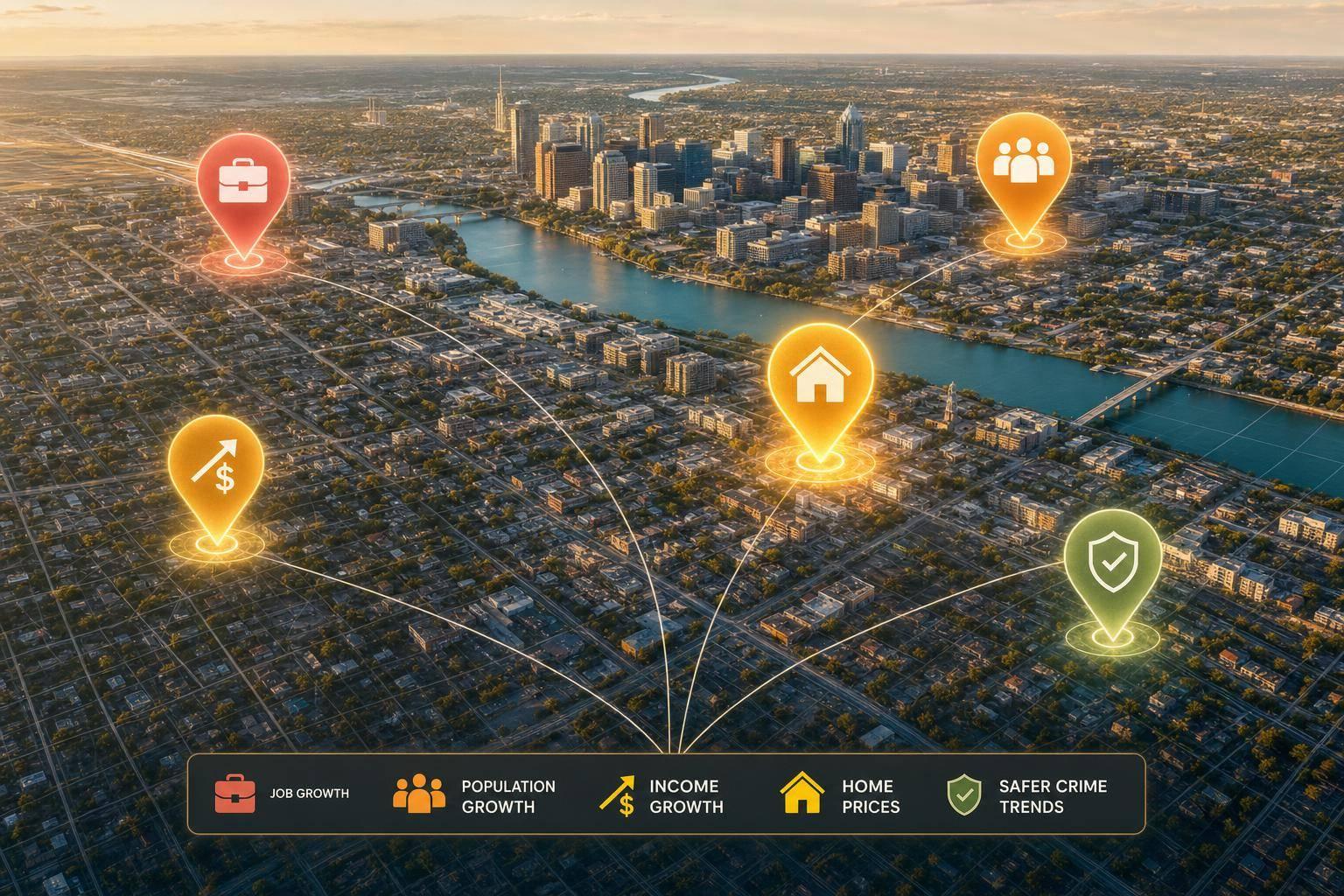
- Five indicators stood out in the discussion: job growth, income growth, population growth, home price growth, and crime reduction.
- Thresholds matter as much as trends. Bawa argues that modest growth is not the same as market-moving growth; for example, stronger rent acceleration tends to require population growth above roughly 1%.
- AI is most useful as a force multiplier. It can summarize meetings, process T12s, review rent comps, and flag anomalies faster than teams working manually.
- Accuracy still requires oversight. AI can make math mistakes or misread context, so the best use case is assisted analysis - not blind automation.
- Single-family and multifamily are reacting differently to rates. Multifamily repriced downward as rates rose, while single-family was buffered by the mortgage "lock-in" effect.
- 2026, as discussed in the video, looks more transitional than explosive. The conversation points to mild rate relief, better rent conditions, and relatively flat home price growth.
- Distress creates opportunity - but selectively. The most attractive deals may come from isolated pain points, not broad market dislocation.
- For operators, process discipline matters. AI adoption worked in Bawa’s company because it was embedded into accountability and workflow design.
- Action item: Build a repeatable market scorecard before expanding into a new metro. If your team cannot define its inputs, AI will only help you move faster in the wrong direction.
Why Real Estate Needs a More Quantitative Playbook
One of the most practical ideas from the conversation is also the simplest: real estate should be evaluated with the same comparative clarity investors use in public markets.
If two people debate Apple versus Google, there are decades of data available to compare appreciation, volatility, and performance. Real estate markets deserve the same treatment. Instead of saying "Idaho Falls sounds promising" or "Grand Rapids seems strong", a better question is:
- Which market has stronger job growth?
- Which one has more durable population inflows?
- Which one is seeing income gains that can support rent growth?
- Which one is improving on livability and safety metrics?
That shift matters for three reasons:
1. It reduces narrative bias
Real estate is full of compelling stories. A new employer enters town. A downtown gets revitalized. A neighborhood becomes trendy. Those stories may be true, but they do not automatically make a market investable.
Data helps separate signal from excitement.
2. It improves repeatability
If you are a solo investor, a standardized framework makes your buying decisions more disciplined. If you are running acquisitions across multiple metros, it becomes essential. Teams need a common way to evaluate markets without reinventing the wheel each time.
3. It creates a foundation for automation
You cannot build useful AI workflows on top of vague opinions. AI becomes more valuable when your inputs are structured, your logic is documented, and your team agrees on what good looks like.
That is especially relevant for technical teams building internal tools or investor products. Garbage in, garbage out still applies - just faster.
The Five Market Signals That Matter Most
According to the discussion, Bawa’s group found strong correlation between real estate profits and five primary indicators:
1. Job growth
This is arguably the anchor metric. More jobs typically mean more household formation, more demand for rentals, and stronger buyer activity.
But job growth is not binary. A market with 1% job growth is not the same as one growing at 4% or 5%. The latter may generate much stronger pricing pressure in both rents and home values.
2. Income growth
Population inflow is helpful, but income growth tells you whether demand is becoming more solvent. Rising wages support higher rents and improve housing affordability at the margin.
For operators, this is the difference between growth that looks exciting in headlines and growth that can actually sustain collections.
3. Population growth
Population growth remains one of the clearest demand-side signals in housing. More residents usually mean more pressure on existing supply, especially in markets where new construction lags.
The important nuance raised in the conversation: the amount of growth matters. A slowly growing metro may not create enough demand shock to materially change rent growth.
4. Home price growth
This one can be misunderstood. Home price growth is useful as a trend signal, but by itself it can become a rearview metric. Fast appreciation can indicate demand strength - or it can indicate overheating.
That is why it works better in combination with the other variables.
5. Crime reduction
This is the least discussed factor in most investor conversations, which is exactly why it is valuable. Improving safety can change the trajectory of submarkets long before broad investor consensus catches up.
For acquisition teams, this is where public data can uncover early neighborhood shifts that simple comps may not explain yet.
The Hidden Insight: It’s Not Just the Factors, It’s the Thresholds
The most useful analytical point in the episode is that directional growth alone is not enough.
Many cities have some population growth, some income growth, and some job creation. That does not mean they will all produce the same rent growth or appreciation. What matters is whether those indicators reach levels that create real market pressure.
This is where many spreadsheets fail. They track variables, but they do not define the tipping points.
For example, the discussion suggests:
- Population growth above roughly 1% annualized may be needed for stronger rent gains
- Job growth around 3% can be meaningful
- 4% is unusually strong
- 5% is exceptional and rare
Whether those exact thresholds hold across all cycles is debatable. But the framework is valuable: investors should look for inflection points, not just positive direction.
For data teams, this opens the door to a more mature market-ranking model:
- Normalize each metric
- Assign weights based on historical relevance
- Identify minimum thresholds
- Flag outliers and contradictions
- Re-rank quarterly as conditions change
That is a much more robust operating system than a static market list shared in a slide deck once per year.
Where AI Actually Fits in a Real Estate Workflow
A lot of real estate AI talk is still vague. This discussion was more useful because it focused on workflows, not hype.
Bawa described an "AI-first" operating style where employees regularly use AI tools to assist with internal analysis. The examples matter because they are practical and repeatable.
AI use case: turning meeting transcripts into investor reports
One workflow described in the conversation takes recordings of property management meetings, transcribes them, feeds them into a structured prompt, and generates a polished investor update for human review.
The business benefit is obvious:
- Less manual note-taking
- Faster reporting cycles
- More consistent communication
- Lower admin burden on operations teams
For a strategic operator, this is not about novelty. It is about reclaiming time from repetitive work.
AI use case: rent comps
Rent comp analysis is tedious, number-heavy, and easy to perform inconsistently across assets. AI can help compile, compare, and summarize large comp sets quickly.
For acquisitions and asset management teams, that means faster underwriting and quicker decision support.
AI use case: T12 review and anomaly detection
This may be the strongest example in the conversation. When reviewing trailing 12-month operating statements, AI can scan line items and identify patterns that deserve attention.
That does not mean the model is always right. But it can highlight:
- unusual expense spikes
- inconsistent trends
- outlier categories
- possible reporting issues
- patterns that may suggest mismanagement or even fraud risk
This is especially important for enterprise users and risk teams. AI’s value is not just in producing answers. It is in surfacing what deserves investigation.
The Right Way to Think About AI Accuracy
The host raised the obvious concern: AI can hallucinate and is not always dependable with numbers.
That skepticism is healthy.
The balanced takeaway from the conversation is this: AI does not need to be perfect to be useful. It needs to produce enough signal to improve human review.
In real estate, that means AI works best when it is used to:
- summarize
- compare
- prioritize
- flag anomalies
- draft internal outputs
It works worst when teams expect it to operate as an unverified decision-maker.
For technical architects, this is the implementation lesson: build AI into a controlled pipeline with validation steps, not as a standalone oracle.
A strong workflow usually looks like:
- Ingest structured and unstructured data
- Use AI to generate first-pass analysis
- Route outputs through human review
- Capture corrections
- Improve prompts and process over time
That is how you get operational leverage without creating compliance or underwriting risk.
Why Process Discipline Matters More Than AI Access
One of the more underappreciated points in the discussion is that AI adoption did not happen by accident. It happened because the company had a management system that could absorb change.
Bawa referenced using a structured operating framework with quarterly goals and accountability. That matters because many firms buy AI tools but never operationalize them.
The real obstacle is rarely the model. It is the lack of:
- clear ownership
- workflow documentation
- adoption targets
- feedback loops
- incentives for experimentation
In other words, AI maturity is an operating challenge before it becomes a technical one.
For PropTech companies and real estate teams, that distinction is critical. A modern data stack only creates value if it actually changes how work gets done.
2026 Outlook: A More Balanced Market, Not a Boom
The episode also spent time on forward-looking market views. Since this was discussed as an outlook rather than a certainty, it is best interpreted as directional analysis.
Interest rates
The expectation in the conversation was for modest rate reductions rather than dramatic cuts. Mortgage rates, in that view, would remain elevated by historical standards but ease somewhat through 2026.
Home prices
The estimate shared was relatively muted home price growth, roughly in the low single digits. The reasoning: wage growth may modestly outpace home price growth, improving affordability slightly.
Rent growth
The discussion suggested rents could recover after a flat or near-flat period. That would be significant for owners whose operating margins were pressured by inflation without corresponding rent increases.
Occupancy
There was also an expectation that rental market softness could begin to reverse, though not all markets will recover at the same speed.
Taken together, this is not a thesis for easy money. It is a thesis for careful market selection in a more nuanced environment.
The Mortgage Lock-In Effect Explains a Lot of the Housing Puzzle
One of the most useful macro explanations in the episode concerns the single-family housing market.
Historically, higher interest rates tend to pressure home prices downward. But in the recent cycle, single-family housing did not follow that script as cleanly as expected.
Why?
Because millions of homeowners refinanced into unusually low mortgage rates during the zero-rate era. Once rates rose sharply, many owners became economically "stuck." Selling a home with a 3% mortgage and buying another with a 6% or 7% mortgage made little sense.
That created the so-called lock-in effect:
- fewer homeowners listed properties
- inventory stayed constrained
- supply shortages helped support prices
This is a useful reminder that housing markets are not driven by rates alone. They are driven by rates interacting with behavior.
For operators, that means pricing forecasts should account for inventory psychology, not just Fed headlines.
Multifamily, Office, and Distress: Where Opportunity May Actually Exist
The discussion made an important distinction across asset classes.
Multifamily: repriced, but not broadly broken
Unlike single-family, multifamily responded more directly to higher rates. Valuations fell in many areas, with some markets seeing significant declines.
That does not automatically mean blanket opportunity. The more interesting angle is selective distress, particularly in areas with refinancing pressure or lender fatigue.
For acquisitions teams, this points to a tactical strategy:
- monitor loan maturities
- track submarkets with oversupply pressure
- identify sponsors facing equity gaps
- watch for lender flexibility or recapitalization events
In other words, good multifamily deals may come from capital structure problems, not just operational upside.
Office: ugly sentiment, but maybe closer to a floor
Office remains the most controversial sector. Bawa’s view in the conversation was not that office is healthy, but that it may be closer to a bottom than many assume.
That thesis rests on two conditions:
- return-to-office trends gradually improve utilization
- little to no new office construction limits future oversupply
The caution here is obvious: office is highly market-specific. AI-heavy and high-wage employment hubs may recover differently than secondary markets with weak demand.
For most readers, the lesson is not "buy office." It is that distressed sentiment alone should not be confused with permanent impairment.
Senior housing: a demographic tailwind worth watching
The discussion briefly highlighted senior housing as a potentially attractive niche. The reason is straightforward: aging demographics create structural demand over time.
For investors and operators, this is a classic example of where macro demand may support long-term opportunity - but execution risk remains high.
The video did not go deeply into underwriting details here, so any investment conclusion would be speculative. Still, as a market-screening concept, it is worth attention.
The Bigger Housing Problem: Affordability Is Becoming Structural
Perhaps the most important long-term takeaway from the conversation is not about AI at all. It is about affordability.
The guest pointed to two alarming trends discussed in the episode:
- first-time buyers represented a much smaller share of home purchases
- the average age of a first-time buyer has risen significantly
Even without debating exact causes, the implication is clear: entry into homeownership is getting harder.
That has major downstream effects:
- renters stay renters longer
- starter-home inventory remains constrained
- institutional ownership becomes more controversial
- housing inequality compounds across generations
For anyone building products in real estate data, this is more than a macro talking point. It affects customer demand, lead quality, market expansion strategy, and risk models.
If affordability stays strained for years, demand for smarter targeting, ownership intelligence, rental analytics, and compliance-safe outreach will only increase.
What This Means for Data-Driven Real Estate Teams
The strongest insight from this discussion is not that AI will pick winning cities automatically. It is that better systems beat stronger opinions.
For modern real estate businesses, that means:
If you are a technical architect
Build workflows that unify market data, property data, and analysis layers into one repeatable stack. Your advantage comes from reducing manual stitching and increasing decision speed without sacrificing data integrity.
If you are an operations leader
Use AI to cut waste in reporting, underwriting review, comp analysis, and internal communications. The win is not "using AI." The win is eliminating hours of low-value work while improving consistency.
If you are a deal-focused investor
Stop relying only on broad market narratives. The best opportunities often come from submarket divergence, distress pockets, and early trend shifts that become visible in data before they become obvious in conversation.
A Practical Framework for Applying the Video’s Lessons
If you want to put these ideas to work, start with a simple operating model.
1. Build a market scorecard
Track a fixed set of metrics across your target metros:
- job growth
- income growth
- population growth
- rent growth
- home price trends
- crime trends
- vacancy or occupancy trends
2. Define thresholds
Do not just note whether a metric is positive. Define what level of growth is meaningful enough to affect demand.
3. Add an anomaly layer
Use AI to summarize what changed since the previous quarter and flag contradictions in the data.
4. Validate with field intelligence
This was one of the key concerns raised in the panel discussion after the interview: numbers should narrow the field, but local context still matters. Data can tell you where to look. It cannot fully replace local inspections, operator interviews, or on-the-ground diligence.
5. Re-rank continuously
Markets are not static. A good model is not a one-time exercise; it is a living system.
Final Thoughts
The real estate firms that gain an edge over the next few years will not be the ones making the loudest claims about AI. They will be the ones quietly building better decision systems.
This interview reinforces a practical truth: data helps you ask better market questions, and AI helps you answer them faster. But neither removes the need for judgment.
For investors, operators, and PropTech teams, the opportunity is not to replace experience. It is to make experience more scalable, more measurable, and less dependent on guesswork.
In a market defined by affordability pressure, uneven recovery, and rising competition for good opportunities, that kind of edge matters.
Source: "Investing In Real Estate With AI Science" - Money Tree Investing Podcast, YouTube, Jul 8, 2026 - https://www.youtube.com/watch?v=0Kg8I7dZMiE