Choosing between BatchData and CoreLogic depends on your business needs. BatchData excels in real-time access, enriched contact data, and flexible pricing, making it ideal for lead generation and marketing. CoreLogic, with decades of historical property records and compliance tools, is better suited for institutional applications like mortgage lending and insurance underwriting.
Key Takeaways:
- BatchData: Focuses on speed, enriched contact data, and ease of integration. Offers pay-as-you-go pricing starting at $1,000/month.
- CoreLogic: Offers extensive historical data and institutional-grade compliance features. Requires custom pricing and long-term contracts.
- BatchData supports real-time APIs and bulk delivery via platforms like Snowflake and AWS S3. CoreLogic provides custom API solutions and bulk data options.
Quick Comparison:
| Feature | BatchData | CoreLogic |
|---|---|---|
| Focus | Lead generation, skip tracing | Mortgage, insurance, compliance |
| Data Points | 1,000+ per property | 200+ per property |
| API | Real-time, developer-friendly | Custom enterprise solutions |
| Pricing | Starts at $1,000/month | Custom, consultation required |
| Compliance Tools | DNC scrubbing, litigator tags | Regulatory compliance focus |
BatchData is ideal for businesses needing fast, actionable data. CoreLogic is better for organizations requiring deep historical records and institutional-grade tools.
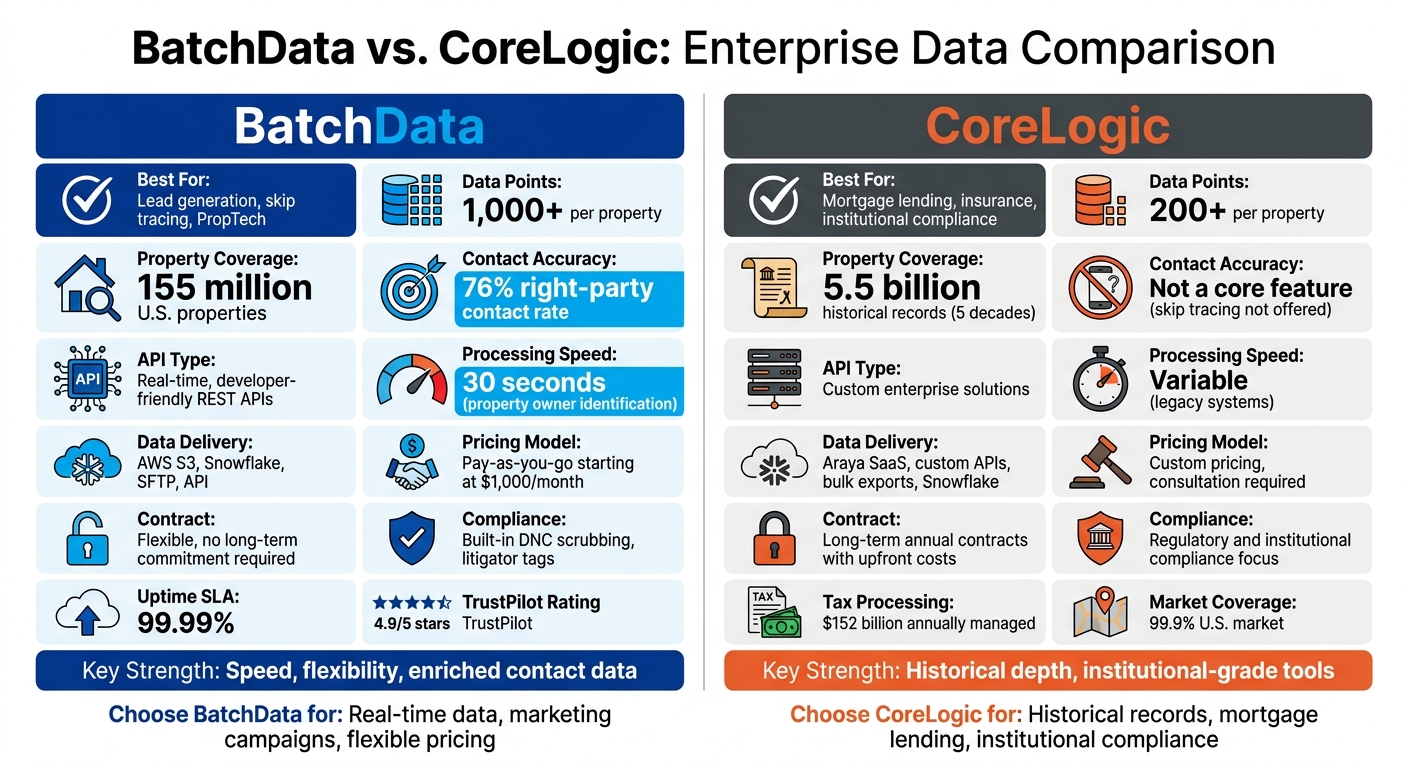
BatchData vs CoreLogic: Enterprise Data Platform Comparison Chart
BatchData Overview
BatchData is a platform tailored for businesses that need large-scale, real-time access to property intelligence and contact data. It covers over 155 million U.S. properties – representing 99% of the population – and offers more than 1,000 data points per property through a developer-friendly API. With its RESTful JSON endpoints, integration is streamlined, allowing users to access property details, ownership records, and verified contact information in just minutes.
BatchData Core Features
BatchData ensures uninterrupted data access by pulling information from over 3,200 sources, making it resilient to local outages. Key features include:
- Property Data Enrichment: Access over 700 attributes per property.
- Skip Tracing: Achieves a 76% accuracy rate for right-party contact, nearly tripling the industry average.
- Advanced Verification: Validates phone numbers and addresses in real time.
- Compliance Tools: Automatically scrubs data against Federal DNC lists and known litigators.
The platform caters to various delivery needs. Besides its API, users can also receive bulk datasets through AWS S3, Snowflake Data Sharing, or SFTP. With a 99.99% uptime SLA and sub-second response times, BatchData is well-suited for high-frequency tasks like instant property valuations.
BatchData Pricing Structure
BatchData operates on a tiered subscription model for property data and skip tracing. Pricing for property data starts at $1,000 per month for 100,000 records (Growth plan), scales to $2,500 per month for 300,000 records (Professional), and goes up to $5,000 per month for 750,000 records (Scale). Skip tracing plans range from $2,000 per month for 100,000 records to $20,000 per month for 3,000,000 records.
All plans include API access and core data points, with higher tiers offering extras like bulk lookups and dedicated support. Optional add-ons include:
- MLS data: $600/month
- Demographics: $400/month
- Contact data: $5,000/month
For businesses with specific needs, custom enterprise solutions provide tailored pricing, SLAs, and dedicated account management.
BatchData Applications
BatchData serves a variety of industries. Real estate investors use it to identify off-market opportunities by analyzing property characteristics. Marketing teams rely on its verified contact lists for targeted campaigns. The platform also supports mortgage underwriting, insurance risk evaluation, and investment analysis with daily property and financial updates [8, 11].
One standout example is Crexi, a commercial real estate marketplace, which reduced its entity resolution time from 30 minutes to just 30 seconds after integrating BatchData’s property owner identification API [6, 9]. Additionally, USPS-compliant geocoding and address normalization make it a valuable tool for government agencies needing accurate location data for planning and due diligence.
The next section will explore CoreLogic’s services to provide a direct comparison of features.
CoreLogic Overview
CoreLogic is a powerhouse in property data and regulatory compliance, offering a vast repository of 5.5 billion U.S. property records spanning five decades. With 99.9% U.S. market coverage, it provides crucial insights for industries like mortgage lending, insurance, and government operations, ensuring informed decision-making across the board [13, 14]. Its capabilities include in-depth risk analysis, an advanced tax processing system, and a wide array of datasets tailored to industry needs.
The platform facilitates the management of approximately $152 billion in combined tax payments annually, serving 80% of escrowed homeowners in the U.S. This cements CoreLogic’s role as a cornerstone for financial institutions. Its data supports a broad spectrum of sectors, from telecommunications to retail, all of which rely on verified property intelligence for compliance, underwriting, and strategic planning [13, 14].
CoreLogic Core Features
CoreLogic delivers a suite of tools designed to provide unparalleled property intelligence. Each property record includes 200+ fields detailing ownership, tax data, land use, building specs, and more. Its Total Home ValueX (THVx) tool offers property valuations for nearly all U.S. properties, streamlining mortgage underwriting and appraisal processes [13, 16, 17].
The platform also integrates natural hazard modeling with property data, enabling users to assess risks like flooding and wildfires [13, 14]. Its Araya SaaS platform uses AI to process data for around 5 million housing professionals, including regulators and attorneys, while the MCP Server ensures secure, real-time access to verified property data for AI models [14, 15].
A significant milestone was the September 2023 migration to GKE, boosting operational efficiency by 30% and cutting Cloud Foundry costs. This upgrade allows CoreLogic to handle tens of thousands of requests per second and manage tens of terabytes of data.
"CoreLogic is a leading provider of global property information, analytics, and data-enabled solutions, and runs over 25,000 business-critical application instances on Google Cloud." – Shalva Kakauridze, Sr. Director, Cloud Platforms, CoreLogic
CoreLogic offers flexible data delivery options, including the Araya SaaS platform, custom REST APIs, bulk data exports (CSV/S3), and integrations with platforms like Snowflake, Google Cloud, and Databricks. Importantly, 99.5% of property-related records are sourced directly, ensuring high data integrity. Beyond the U.S., CoreLogic also tracks 2.2 billion energy efficiency records in the U.K. and processes 1 million monthly updates for Australian properties.
CoreLogic Pricing Structure
CoreLogic operates on a customized pricing model, requiring direct consultation with its sales team. Pricing depends on factors like the delivery method – whether through Araya, APIs, bulk exports, or third-party marketplaces – and the specific needs of the client. This tailored approach enables volume-based licensing, service level agreements, and bespoke data integration solutions. Sales inquiries are handled Monday through Friday [14, 16, 19].
CoreLogic Applications
CoreLogic serves industries where precision and compliance are non-negotiable. Mortgage lenders use it as a "single source of truth" for property records, underwriting, and loan servicing. Insurance companies leverage its hazard risk analytics to evaluate disaster exposure and streamline restoration efforts. Government agencies rely on its verified data for urban planning and regulatory compliance.
The platform’s Matrix listing management system supports over 1.2 million real estate professionals across North America. Financial institutions benefit from tools like Total Home Value AVM and Climate Risk Analytics, which provide accurate collateral valuations and risk assessments. Telecommunications and retail sectors use the data to analyze demographics and property locations for infrastructure and site planning.
"CoreLogic’s investment in Araya reflects its vision to make an impact, delivering the critical property, portfolio and market insights that empower professionals to make confident, informed decisions in the $40+ trillion U.S. housing industry." – Devi Mateti, President of Enterprise Digital Solutions, CoreLogic
CoreLogic’s data offerings also include 10 million property listings with over 600 variables per listing, enabling detailed market and portfolio analysis. Additionally, the platform tracks 25 years of U.S. home price history and home equity trends dating back to 2009, offering valuable insights for investment strategies.
The next section will explore how CoreLogic’s features measure up against BatchData.
BatchData vs. CoreLogic: Feature Comparison
Features and Capabilities Comparison
BatchData focuses on speed, easy integration, and detailed property intelligence, offering over 1,000 data points for 155 million properties. CoreLogic, on the other hand, emphasizes institutional-grade data, extensive historical records, and compliance-driven risk analysis.
When it comes to contact enrichment, the two platforms take very different approaches. BatchData boasts a 76% right-party contact rate, significantly exceeding the industry average. This is achieved through data aggregation from over 3,200 sources and user feedback from 20,000 users. CoreLogic does not prioritize skip tracing as a core feature, instead focusing on areas like property valuations, tax processing, and hazard risk modeling.
Data delivery methods also differ. BatchData supports real-time APIs and bulk delivery via platforms like S3 and Snowflake, while CoreLogic provides custom API solutions tailored for enterprise-level data requests. However, CoreLogic does not heavily detail its delivery methods. Below is a table summarizing these key differences:
| Feature | BatchData | CoreLogic |
|---|---|---|
| Property Coverage | 155 million properties | Extensive historical property records |
| Data Points per Property | Over 1,000 data points | Key property attributes |
| Contact Enrichment | 76% right-party contact rate; includes mobile, landline, email; built-in DNC/TCPA compliance | Skip tracing is not a core offering |
| API Access | Real-time APIs; up to 100 properties per request | Custom API solutions |
| Bulk Data Delivery | Available via S3, Snowflake, and flat files | Provides bulk data delivery options |
| Verification Tools | Phone validation, DNC/TCPA tools, and reachability scoring | Standard verification processes |
| Permit & Improvement Data | Detailed permit insights (solar, pool, roof, HVAC) with contractor information | Property improvement data available |
| Pricing Model | Pay-as-you-go, credit-based | Custom enterprise pricing |
Platform Strengths and Weaknesses
When assessing these platforms, BatchData stands out for its speed and precision, making it a strong choice for outbound marketing and real estate lead generation. Its detailed permit data and built-in compliance tools help reduce risks related to TCPA violations, which can result in penalties ranging from $500 to $1,500 per call. However, one limitation is that the underlying data, despite fast API responses, may be 30 to 90 days old.
CoreLogic shines in providing robust data solutions tailored for institutional use cases like mortgage lending and insurance underwriting. Its offerings include extensive historical records and a strong focus on regulatory compliance. However, CoreLogic’s custom pricing model and enterprise-focused approach may be less accessible for smaller businesses.
| Criteria | BatchData | CoreLogic |
|---|---|---|
| Best For | Outbound marketing, skip tracing, and permit-based targeting | Institutional applications such as mortgage lending and insurance underwriting |
| Data Freshness | Updated periodically via national aggregators | Includes extensive historical records |
| Ease of Purchase | Transparent pay-as-you-go model without long-term contracts | Custom pricing requiring direct consultation |
| Integration Complexity | Developer-friendly APIs with integrations (e.g., Zapier, Make.com) | Designed for robust enterprise integrations |
| Scalability | Capable of handling millions of records via a bulk infrastructure | Engineered for high-volume enterprise requests |
| Compliance Focus | Incorporates DNC/TCPA compliance checks | Emphasizes regulatory and institutional compliance |
| Historical Data Depth | Provides current property and permit data | Offers extensive historical property information |
How to Choose Between BatchData and CoreLogic
What to Consider When Deciding
Start by looking at contractual flexibility. CoreLogic typically requires long-term contracts with substantial upfront commitments, while BatchData offers a more accessible entry point, including free trials and lower initial costs. Matt Shephard, Chief Revenue Officer at BatchData, highlights this difference:
"Prior to BatchData, most data companies required a substantial, upfront investment and a contract for a duration longer than a year."
Next, think about integration and delivery. BatchData stands out with real-time APIs that cut processing time from 30 minutes to just 30 seconds. It also supports bulk data delivery through platforms like Snowflake and AWS S3.
If your focus is outreach, BatchData’s enriched contact information – including mobile numbers, landlines, email addresses, and built-in DNC/litigator scrubbing – can increase reach by 76% across a database of 350 million phone numbers. On the other hand, CoreLogic caters more to institutional property research than data enrichment for outreach. For teams concerned with compliance, BatchData’s built-in DNC and litigator tags help maintain regulatory adherence.
Data freshness is another critical factor. Ivo Draginov, President of BatchData, underscores its importance:
"Data freshness means daily updates and real-time checks for content accuracy. It is what separates productive deal-making from wasted effort."
BatchData prioritizes real-time updates and rigorous validation processes, including USPS address standardization (CASS certification). In contrast, CoreLogic focuses on maintaining extensive historical records. Your choice ultimately depends on whether you need up-to-date, actionable data or a robust archive for historical analysis.
With these factors in mind, let’s break down the platforms by key business criteria.
Platform Comparison by Business Criteria
The table below highlights how BatchData and CoreLogic align with different business needs:
| Business Criteria | BatchData | CoreLogic |
|---|---|---|
| Speed/Latency | High (Real-time APIs, 30-second processing) | Variable (Older storage systems impact speed) |
| Cost Structure | Flexible; pay-as-you-go starting at $1,000/month | High upfront costs; long-term annual contracts |
| Compliance | Integrated DNC & Litigator scrubbing | Standard enterprise compliance |
| Scalability | High (Cloud-native: Snowflake, S3) | High (Enterprise-grade bulk delivery) |
| Data Depth | Property + Deep Contact Enrichment (1,000+ data points) | Property, Tax, and Legal focus with extensive historical records |
| Best For | PropTech companies, skip tracing, lead generation | Mortgage professionals, lenders, institutional users |
Choose BatchData if you’re focused on lead generation, skip tracing, or building PropTech applications that require fast APIs and enriched homeowner contact data. Opt for CoreLogic if you’re a mortgage professional or lender in need of institutional-grade property research, AVM reports, and valuation tracking. BatchData’s 4.9/5 rating on TrustPilot and its recognition as a leader in the G2 Property Intelligence Grid underscore its strengths for businesses prioritizing speed and actionable data.
This comparison highlights how each platform caters to distinct real estate data needs, allowing you to make an informed choice based on your priorities.
Conclusion
BatchData and CoreLogic serve very different audiences, each catering to specific needs in the real estate data market. BatchData emphasizes speed, adaptability, and advanced contact enrichment, offering daily updates with extensive property and contact information. These updates are accessible via real estate APIs, ensuring smooth and fast integration for users looking for real-time solutions.
BatchData’s pay-as-you-go pricing model and API-driven setup are ideal for PropTech startups and individual investors who need flexible, scalable tools for lead generation. On the other hand, CoreLogic primarily serves institutional clients like mortgage lenders, insurance companies, and large financial firms. However, CoreLogic often requires long-term contracts, significant upfront costs, and relies on older delivery methods. These differences make BatchData a better fit for businesses seeking efficiency and modern integration options.
For those aiming to predict market trends, BatchData’s AI-powered BatchRank tool is a game-changer. It identifies nearly 64% of properties likely to sell with an impressive 63% accuracy, cutting prospecting time by up to 80%. Meanwhile, CoreLogic remains a go-to choice for institutions needing in-depth property research and valuation.
BatchData also shines with its developer-first approach. With public documentation, SDKs, and dedicated onboarding support, developers can start retrieving property records in under five minutes – something legacy systems often struggle to match. This ease of use highlights BatchData’s commitment to providing modern, agile tools for the real estate industry.
As over 90% of real estate decisions now rely on data, choosing the right platform can significantly impact your efficiency and ROI. BatchData’s 4.9-star TrustPilot rating and recognition as a leader in the G2 Property Intelligence Grid further reinforce its position as a top choice for businesses that value speed, flexibility, and real-time insights.
FAQs
How fresh is BatchData’s property and contact data?
BatchData keeps its property and contact data up to date, with the most recent updates completed in January and February 2026. This ensures you have access to the latest information, helping your business make accurate and timely decisions.
What do I need to integrate BatchData’s API into my app?
To get started with BatchData’s API, you’ll need a few essentials: API credentials, access to the developer portal, and the documentation provided by BatchData. First, log in or create an account to generate your API keys and review the technical details. Before diving into live data, test your integration in a sandbox environment to work out any issues. Keep an eye on your API usage to maintain optimal performance. BatchData also provides onboarding support and step-by-step guides to help make the integration process as smooth as possible.
How do BatchData credits and add-ons affect monthly cost?
BatchData’s pricing can vary depending on your usage and the features you choose. The base plans kick off at $1,000 per month, which includes access to 100,000 records. However, additional features like MLS listings (priced at $600 per month) or permits (which cost $1,250 per month) can quickly add to your monthly expenses. To keep your costs under control, it’s important to assess your specific needs and only opt for the features that align with your goals.