



Finding an accurate address is not guesswork; it is a data-driven process of piecing together information from public records, digital footprints, and specialized property data to pinpoint one verifiable location. Over 8% of the U.S. population moves annually, making address discovery a critical skill for professionals who need to maintain contact, assess risk, or close deals. With the right strategy, a single data point like a name or phone number can be transformed into a confirmed, deliverable address.
- Core Takeaway: Successful address discovery relies on a systematic workflow: Start with a known data point, use specialized tools to cross-reference multiple sources, and end with a verified result.
- Key Methods: The most effective methods are reverse lookups for contact info, public records searches for property owners, and automated skip tracing for hard-to-find individuals.
- Critical Factor: Data quality is paramount. Using unverified or outdated addresses leads directly to wasted resources and missed opportunities.
This guide provides the systematic approach professionals use to navigate data, find accurate addresses, and ensure compliance.
What Are The Most Effective Methods for Finding an Address?
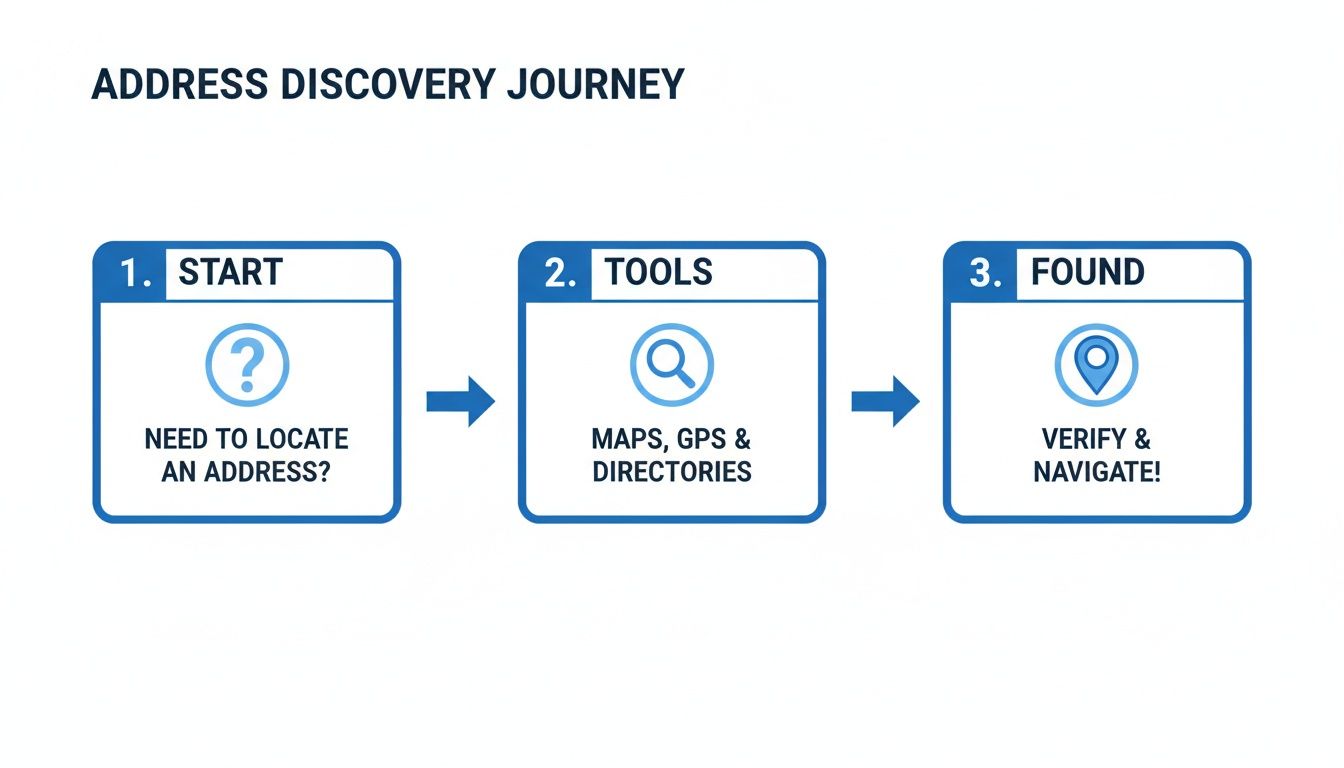
The most effective method for finding an address is determined entirely by the information you start with, as there is no single tool that works for every scenario. The core principle is matching your starting data point—be it a name, phone number, or old address—to the correct toolset to avoid wasting time on ineffective searches. This structured approach ensures a higher probability of success from the outset.
Address Search Methods by Starting Data
| Starting Information | Primary Method | Key Tools & Data Sources | Best For |
|---|---|---|---|
| Full Name + Location | Public Records Search | County Tax Assessor, Court Records, White Pages | Finding property owners, legal research |
| Phone Number or Email | Reverse Lookup / Skip Tracing | Specialized data providers (e.g., BatchData) | Quickly finding current contact info for outreach |
| Old/Previous Address | Property History Search | Deed Records, Title Reports, NCOA Databases | Tracking an individual's movement over time |
| Company Name | Corporate Records Search | Secretary of State Websites, Business Databases | Locating business owners or registered agents |
Why Data Quality Is Paramount
Finding an address is insufficient; the address must be accurate and deliverable. Data decays rapidly—with nearly 10% of U.S. households moving annually, fresh information is non-negotiable. Using unverified or obsolete addresses leads directly to wasted marketing budgets on returned mail, failed service of legal documents, and lost business opportunities.
The real cost of bad data is measured in missed opportunities. An incorrect address means a lost deal, a failed connection with a borrower, or a marketing message that never arrives.
For professionals, this reality mandates the use of validated data. Services that provide confidence scores, CASS certification for mailability, and daily record updates are essential for operating at scale. This focus on data integrity is the primary distinction between amateur searches and professional, results-driven workflows. To understand how this data impacts broader market trends, you can explore how property data is shaping national real estate conditions in our latest report.
How Do Professionals Systematically Locate People with Public Data?
Professionals systematically locate people by moving beyond simple web searches and using a methodical workflow to triangulate information from multiple structured public databases. The objective is not to find a single perfect data point, but to build a compelling case for a high-probability current address by cross-referencing information. This approach ensures data is both accurate and compliant, separating expert-level work from amateur attempts.
Start with Property Ownership Records
County tax assessor records are the single source of truth for property-related searches. These public databases tie individuals directly to physical properties and are typically accessible via county websites.
- The Mailing Address: The assessor's record includes the address where the tax bill is sent. For absentee owners, this is almost always their primary residence, not the property's address. It is one of the most reliable data points for finding where someone actually lives.
- Ownership History: Deed records allow you to follow the chain of title, uncovering previous addresses. This is crucial for tracking an individual's movements and building a complete profile.
Layer in Legal and Business Filings
Life events and business activities create a public paper trail that is rich with address information. An address listed on a legal document is a powerful find because it is typically verified at a specific point in time.
A professional builds a "data portfolio" for each subject. Every new address found in one database becomes a key to unlock information in the next, creating a web of interconnected data points that lead to a confirmed location.
- Court Records: Lawsuits, divorces, or even traffic tickets require a current address for legal service. These records are often searchable by name through county courthouse portals.
- State Business Filings: If a person owns an LLC or corporation, they have filed paperwork with the Secretary of State that includes the business address and the registered agent's address—often the owner’s home.
- Professional Licensing Boards: Licensed professionals like doctors or real estate agents must maintain a current address on file with their state board, and this data is public.
The Modern Toolkit: From Manual Lookups to APIs
The practice of using public records for tracking dates back to the U.S. Census Bureau's release of anonymized microdata in 1960. Today, technology has scaled that concept exponentially. With U.S. mobility rates around 8.4% annually as of 2023, modern proptech platforms like BatchData are essential, offering instant access to over 155 million property records with deep ownership history.
Instead of manually scraping dozens of disparate county and state websites, data aggregation platforms connect the dots behind the scenes. To see how this data is shaping market decisions, review our latest Investor Pulse reports.
What Is Skip Tracing and How Does It Work?
Skip tracing is a systematic, data-driven discipline for locating people who are hard to find, used when public records searches are insufficient. Modern skip tracing services automate this discovery process by merging public data with massive, non-public datasets—such as credit bureau headers and utility records—to identify a person’s current location with a high degree of probability. What was once manual detective work is now a high-speed, scalable process that can return a ranked list of potential new addresses in minutes.
The Data Engine Behind Skip Tracing
Skip tracing operates on data aggregation and analysis, finding the digital and financial breadcrumbs individuals leave behind. It taps into national-level data sources that are inaccessible to the general public.
- Credit Bureau Headers: This non-financial data from credit reports includes names, aliases, DOB, and a history of associated addresses, making it one of the most effective sources for tracking movement.
- Utility Records: Each time a person sets up electricity, gas, or internet, they create a time-stamped record of residency, which is accessible to compliant data providers.
- Phone Carrier Data: Mobile and landline records are another powerful tool for linking individuals to specific service addresses.
- Change of Address Databases: Private databases meticulously track moves beyond the official USPS National Change of Address (NCOA) system.
- Delivery Service Records: Data from private shipping companies provides fresh address updates that other sources often miss.
Manual vs. Automated Skip Tracing
While manual tracing is possible, automated platforms provide superior efficiency and accuracy, primarily due to their access to non-public data.
| Feature | Manual Skip Tracing | Automated Skip Tracing Platform |
|---|---|---|
| Data Sources | Publicly available records only (county websites, social media) | Public records plus credit headers, utility data, phone records |
| Speed | Hours or days per search | Seconds or minutes per search; thousands in a bulk file |
| Accuracy | Highly variable; depends on skill and luck | High, with data-driven confidence scores and verification |
| Cost | "Free" in dollars, but extremely high in labor costs | Low per-search cost, often pennies per record in bulk |
| Scalability | Not scalable; feasible only for one-off searches | Highly scalable via API or bulk file processing |
Advanced platforms like BatchData assign a confidence score, using proprietary algorithms to weigh the recency and reliability of each data point and identify the most likely current address. For any business that requires reliable and efficient people-finding, automated skip tracing is the industry standard.
How Can Address Searches Be Scaled for Large Volumes?
Address searches are scaled for large volumes using Application Programming Interfaces (APIs) and bulk processing, which replace slow, manual labor with high-speed, automated data retrieval. This technology allows businesses to integrate address discovery directly into their operational logic, enabling real-time data delivery without human intervention. Instead of finding one address at a time, these tools can enrich thousands or millions of records simultaneously.
Bulk Address Enrichment Workflow
Bulk processing is the workhorse for any large-scale data project. The workflow is direct: upload a file with existing information, and the system returns an enriched file with missing addresses and other verified contact details filled in.
- Upload: Submit a CSV or Excel file containing names, old addresses, or phone numbers.
- Process: The platform's engine matches each record against its database to pinpoint the most probable current addresses.
- Download: Within minutes or hours, download the enriched file, now containing verified mailing addresses, phone numbers, and emails, often with confidence scores indicating data accuracy.
With a fresh address list, you can streamline communications with Mail Merge in Google Docs to execute personalized outreach campaigns at scale.
The Strategic Value of Scalable Address Data
Automating the process of finding addresses for people transforms the task from a simple chore into a strategic asset, enabling data-driven decisions and new business opportunities.
- High-Intent Targeting: A real estate investor can upload a list of properties with high equity to get owner contact information, then launch a direct mail campaign targeting only the most motivated sellers.
- Risk Modeling: A lender can run its loan portfolio through the system to update borrower addresses, which is crucial for compliance and loan servicing.
- Market Analysis: An insurer can analyze address data in a specific region to better assess risk exposure from local factors.
The core shift is from finding an address to actively using that address data. Automation frees up personnel to focus on high-value strategy—analyzing campaign results, negotiating deals, or refining underwriting models—instead of data collection. This evolution mirrors historical leaps, like Herman Hollerith's tabulating machine for the 1890 U.S. Census, which reduced processing time by 67%. Today, platforms like BatchData are the modern successor, using AI-driven APIs to deliver 155 million+ U.S. property records and verified contacts.
What Are the Legal and Ethical Rules for Finding Addresses?
The ability to find an address for nearly anyone comes with significant legal and ethical responsibilities governed by a strict set of regulations. While the data itself is not illegal, how you use it is what determines compliance. Your intended purpose dictates which laws apply, and this must be determined before a search is initiated to avoid severe penalties.
Purpose Dictates the Rules
Your intended use case determines which laws apply. Using an address for a direct mail campaign is governed by different rules than using it to underwrite a loan.
- Fair Credit Reporting Act (FCRA): This law regulates data used for decisions about credit, insurance, employment, or housing eligibility. For these purposes, you MUST use data from a certified Consumer Reporting Agency (CRA).
- Gramm-Leach-Bliley Act (GLBA): This law applies to financial institutions and governs how they handle nonpublic personal information (NPI), including address data.
- Driver's Privacy Protection Act (DPPA): This federal law restricts access to and use of personal information from state motor vehicle records.
The biggest mistake is assuming all data is the same. Using a non-FCRA compliant data source for an FCRA-regulated purpose, such as tenant screening, is a direct violation.
Marketing vs. Eligibility Decisions
Understanding the line between marketing and making eligibility decisions is critical for compliance.
| Use Case Category | Examples | Governing Principles | Allowed Data Sources |
|---|---|---|---|
| Marketing & Outreach | Direct mail, sales prospecting, reconnecting with past clients | CAN-SPAM, TCPA (for phones), general consumer privacy | Public records, commercial data aggregators (e.g., BatchData), compliant skip tracing |
| Eligibility Decisions | Tenant screening, loan underwriting, employment background checks | FCRA, GLBA, DPPA | Only from a Consumer Reporting Agency (CRA) and with permissible purpose |
| Legal & Collections | Serving legal documents, debt recovery, fraud investigation | FDCPA, state-specific service of process rules | Public records, compliant skip tracing, court-ordered data access |
Before finding addresses for people, you must define your exact purpose. For most business uses like real estate investment targeting or B2B sales prospecting, commercial data platforms are the correct and compliant choice.
How Do You Validate Data for Maximum Reachability?
Obtaining an address is only the first step; verifying that it is correct and deliverable is where the real value is created. With nearly 10% of U.S. households moving annually, address data becomes stale quickly. Verification is a fundamental part of any professional workflow to avoid wasted marketing spend, returned mail, and missed opportunities. The industry benchmark is USPS CASS certification, which standardizes addresses and adds ZIP+4 codes, followed by a check against the National Change of Address (NCOA) system to identify recent moves.
Why Data Decay Is Your Biggest Enemy
Bad data is a silent killer for your dataset, leading to flawed business intelligence. A 2018 analysis in the International Journal of Epidemiology found that failing to update residential addresses in health studies led to an 11% overestimation of tracked person-years, introducing a massive bias that skewed research outcomes. This demonstrates the critical importance of current addresses in any field. For professionals relying on platforms like BatchData, this risk is actively managed with enterprise-grade solutions that deliver daily-updated owner contact information.
Moving Beyond Basic Verification
Modern data platforms provide more than just USPS checks; their primary value is in proprietary algorithms that generate confidence scores for each address and contact point. This score is calculated by cross-referencing dozens of sources—utility records, credit headers, deed transfers—to gauge how many recent, reliable signals point to the same location.
The goal is to shift from asking, "Is this address real?" to "How certain are we that this person is at this address right now?" A high confidence score means multiple, recent data points confirm the location, providing the assurance needed to invest in a direct mail campaign or legal notification. This level of detail is also essential for building accurate property valuation models, a topic covered in our guide on how geospatial analysis enhances automated valuation models.
What are the most common questions about finding addresses?
Common questions about finding addresses revolve around cost, legality, and accuracy. Here are direct answers to what professionals encounter daily.
How Much Does Finding an Address Cost?
The cost ranges from free (for time-intensive manual searches) to a few cents per record for automated services. Manual public record searches are free in terms of dollars but cost significant time. Professional skip tracing services that access premium data sources typically run between $0.05 to $0.25 per record for bulk lists. The true cost calculation should factor in the return on investment; paying a small fee for a verified, deliverable address is almost always more profitable than wasting marketing spend on free, unverified data that bounces.
Is It Legal to Look Up Someone's Address?
Yes, it is legal to look up an address using publicly available information. The legality hinges on how you use the address. Strict laws like the Fair Credit Reporting Act (FCRA) govern its use for eligibility decisions (e.g., credit, housing, employment), which requires data from an FCRA-compliant Consumer Reporting Agency. Using an address for a marketing mailer is different from using it to screen a tenant; the purpose dictates the rules and the required data source.
What Is the Most Accurate Method?
The most accurate method is professional-grade skip tracing that triangulates data from multiple sources. No single source is ever 100% correct. True accuracy is achieved by platforms that cross-reference public records, credit bureau headers, and utility data, then assign a confidence score. This multi-source validation is superior to relying on a single source like tax records, especially considering that nearly 10% of the U.S. population moves annually. An address confirmed by several independent, recent sources is the gold standard for accuracy.
Ready to move beyond unreliable data? BatchData provides the verified owner contacts and property data you need to power your business decisions with confidence. Access over 155 million records through our powerful APIs or bulk processing.