
An Automated Valuation Model (AVM) is an algorithm that uses massive datasets to calculate a property's estimated market value in seconds, a process that takes a human appraiser days.
This is not a simple online calculator; it's a sophisticated statistical engine that mimics the logic of a market analysis at an industrial scale. AVMs are now a fundamental tool for mortgage lenders, investors, and proptech platforms that require speed and efficiency. They provide an instant, data-driven snapshot of a property's worth.
Article Takeaways:
- Function: An AVM uses public records, property characteristics, and market trends to estimate value.
- Accuracy: It's a statistical estimate, not a formal appraisal. Its accuracy depends on data quality and property uniqueness.
- Users: Lenders, investors, iBuyers, and insurance carriers rely on AVMs for speed and scale.
- Limitations: AVMs are blind to property condition, recent renovations, and unique features.
This guide breaks down exactly how AVMs work, who uses them, and what separates a reliable model from a useless one.
What is an AVM in Real Estate?
An Automated Valuation Model (AVM) is a software program that estimates a property's likely market value without a physical inspection by a human. It achieves this by analyzing millions of data points, cross-referencing public records, comparable sales, and market trends to produce a valuation almost instantly.
Where a human appraiser manually selects a handful of comparable properties ("comps"), an AVM algorithmically sifts through thousands, identifying patterns that predict a property's current worth.
Core Components of an AVM
The model's output is only as good as its inputs and its analytical engine. A robust AVM relies on three core components working in tandem.
| Component | Description | Example |
|---|---|---|
| Data Inputs | Raw information the algorithm analyzes. The quality and breadth of this data directly impact accuracy. | Public records (deeds, tax assessments), property characteristics (sq. ft., beds/baths), recent comparable sales, local market trends. |
| Statistical Model | The algorithm that processes the data. It identifies patterns and relationships between property features and sale prices. | Hedonic models, repeat-sales indices, machine learning algorithms. |
| Valuation Output | The final product generated by the model. A professional-grade AVM provides more than just a single number. | A specific value estimate, a value range (e.g., $480k - $520k), and a confidence score indicating reliability. |
A high-performing AVM is built on a foundation of high-quality, frequently updated data and is powered by an adaptive algorithm.
Key Data Inputs
The principle of "garbage in, garbage out" is absolute here. An AVM's accuracy is entirely dependent on the quality and freshness of its data sources.
- Public Records: This is the bedrock data, pulling from official sources like tax assessments, deed records, and transaction histories.
- Property Characteristics: These are the physical details, including square footage, the number of bedrooms and bathrooms, lot size, and the year built.
- Comparable Sales: The model analyzes recent sales of similar properties in the immediate vicinity to benchmark what buyers are actually paying.
- Market Trends: The AVM factors in broader economic signals like price appreciation rates, current listing prices, and average days on market.
The AVM Output
When the model completes its analysis, it produces more than just a single dollar amount. A professional-grade AVM report delivers several critical data points:
- The Valuation: The model’s single best estimate of the property's current market value.
- A Value Range: An upper and lower price boundary, showing the likely spectrum where the true market value falls.
- A Confidence Score: A crucial metric indicating the model's certainty about its own estimate. A higher score means the underlying data was strong and the valuation is more likely to be reliable.
AVMs have fundamentally changed how real estate professionals operate by providing instant property valuations. In major U.S. markets, these tools process countless property attributes to generate estimates that slash analysis timelines from days to seconds. For more on this, the National Association of REALTORS® offers additional insights on real estate forecasting and trends.
How does an AVM calculate property value?
An AVM calculates property value using statistical algorithms to analyze vast datasets and predict a probable sale price. It functions like a digital detective, weighing hundreds of property- and market-related clues simultaneously to solve for value.
The two most common statistical engines are hedonic models and repeat-sales indices.
- A hedonic model works by assigning a specific dollar value to individual property features. For example, the model learns that within a specific zip code, a renovated kitchen adds approximately $25,000 to a home's value, while an extra bathroom adds $15,000. The algorithm sums the value of all features—positive and negative—to arrive at a total estimate.
- A repeat-sales index ignores individual features and instead tracks the price appreciation of the exact same property over time. By analyzing how a specific home’s value increased between sales, it builds a highly reliable index of local market trends.
The most accurate AVMs blend both methodologies for a more complete and defensible valuation.
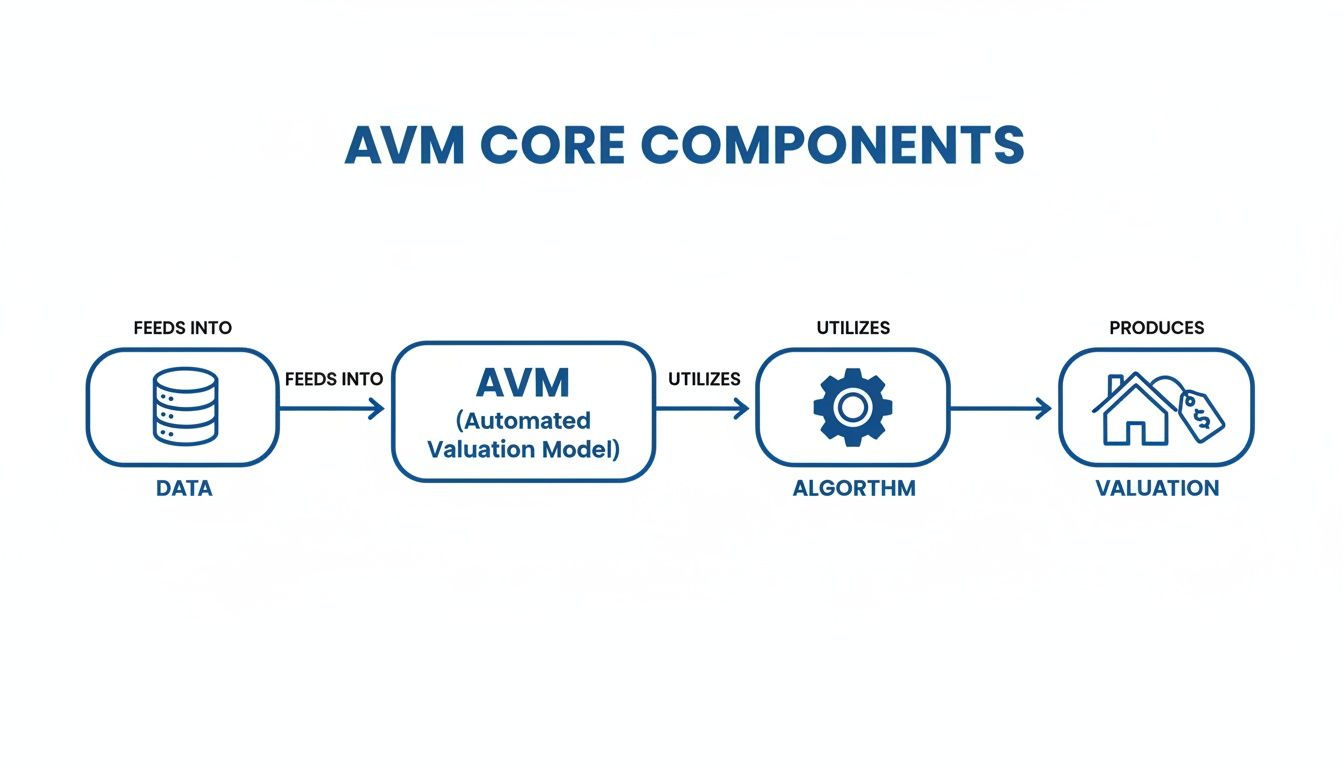
This process demonstrates that a high-quality valuation is impossible without starting with deep, comprehensive data and processing it through a robust algorithm.
Beyond the Basics: The Data That Matters
The true power of a modern AVM lies in the depth of its data. Basics like square footage and bed/bath counts are table stakes. Top-tier models incorporate a much wider array of data points that reveal a property's true story:
- Permit Data: A permit pulled for major electrical work is a clear signal of a recent upgrade, prompting a positive value adjustment.
- Lien Information: An outstanding mechanic's lien or tax lien directly impacts a property's marketability, and a good AVM accounts for it.
- Pre-Foreclosure Activity: Properties entering pre-foreclosure often indicate localized distress that can depress nearby values.
This granular data separates a mediocre AVM from a great one. The technology is also advancing rapidly. By 2026, experts predict AVMs will use generative AI to analyze property photos and factor in real-time economic signals to predict future values, not just current ones. You can get more insights on AI's role in property valuation over at ThePaintedHinge.com.
The Confidence Score Explained
The most important data point after the valuation itself is the confidence score. This is the AVM’s measure of its own certainty and a critical indicator of the valuation's reliability.
A confidence score is typically based on a statistical metric called the Forecast Standard Deviation (FSD). For example, an FSD of 0.07 (or 7%) translates to a 93% confidence score. This means there is a 68% probability that the AVM's value is within +/- 7% of the property's actual sale price.
A low confidence score is not a sign of a "bad" AVM. It is an honest signal that the property is difficult to value algorithmically, perhaps because it is a unique custom home, data for the area is sparse, or the local market is too volatile. This score tells you when to trust the number and when to conduct further due diligence.
How accurate is an AVM compared to a traditional appraisal?
AVM accuracy is variable and depends entirely on data quality and the type of property being valued. It is a statistical estimate, not a professional opinion of value backed by a physical inspection like a traditional appraisal.
An AVM has never been inside a house. It cannot see a new kitchen remodel, smell a musty basement, or notice a leaky roof. These are its inherent limitations.

An AVM provides speed and scale; an appraisal delivers boots-on-the-ground verification and legal weight.
Measuring AVM Accuracy
AVM accuracy is measured using the median absolute error rate, which quantifies the typical percentage difference between the AVM's estimate and the property's actual sale price. A top-tier AVM in a major market may achieve a 5% median error rate, which is considered highly accurate.
This accuracy fluctuates based on two key factors:
- Market Stability: In stable, predictable markets with consistent sales, AVMs perform exceptionally well. In volatile markets, their reliance on past sales data means they are always playing catch-up.
- Property Homogeneity: AVMs are highly accurate in suburban subdivisions where houses are similar. They struggle significantly with unique custom homes, rural properties, or any property that breaks the standard mold.
AVM Blind Spots and Limitations
The greatest weakness of an AVM is that it only knows what exists in a data field.
- Property Condition: The algorithm assumes "average condition" and has no way of knowing if a home is pristine or a tear-down.
- Recent Renovations: An $80,000 kitchen remodel is invisible to the AVM until a new permit or tax assessment enters public records, a process that can take months.
- Unique Features: An AVM cannot properly value intangible or non-standard features like a panoramic city view, a new accessory dwelling unit (ADU), or high-end custom finishes.
AVM vs. BPO vs. Full Appraisal
Each valuation method serves a different purpose, with trade-offs in cost, speed, and legal authority. The avm real estate meaning becomes clearer when compared to its alternatives.
| Valuation Method | Typical Cost | Turnaround Time | Primary Use Case | Legal Standing |
|---|---|---|---|---|
| AVM | $1 - $20 | Seconds | Portfolio monitoring, marketing, initial underwriting | None; statistical estimate |
| BPO | $50 - $200 | 2-5 Days | Foreclosures, HELOCs, short sales | Opinion of value, not an appraisal |
| Full Appraisal | $400 - $1,000+ | 1-2 Weeks | Mortgage origination, legal disputes | Legally recognized opinion of value |
An AVM is not a replacement for an appraisal. It is a powerful companion tool that provides lenders, investors, and proptech platforms with an instant, data-driven starting point for valuation, enabling faster, more informed decisions at scale.
Who uses AVMs in real estate?
AVMs are a core operational tool used across the property ecosystem by professionals who need instant, scalable property intelligence. From managing billion-dollar mortgage portfolios to making individual investment decisions, AVMs provide the speed and efficiency that traditional methods cannot match.
These models have become essential because they answer the critical question—what is this property probably worth?—in seconds, allowing businesses to operate at a previously unimaginable scale.
Mortgage Lenders and Servicers
Risk management is the primary concern for mortgage professionals. Lenders use AVMs at several key points in the loan lifecycle.
- Initial Underwriting: Before ordering a full appraisal, lenders run an AVM as an initial collateral check to validate the loan-to-value (LTV) ratio and flag potential issues early.
- Portfolio Monitoring: Lenders and servicers use AVMs to run batch valuations on their entire loan portfolios to monitor collateral risk, identify opportunities for home equity lines of credit (HELOCs), and maintain regulatory compliance.
- Appraisal Waivers: For certain low-risk loans meeting specific criteria, a reliable AVM is a key component that allows lenders to waive the full appraisal requirement, saving significant time and money for both lender and borrower.
Real Estate Investors and iBuyers
Speed is the primary competitive advantage for investors and iBuyers. AVMs provide the velocity needed to act on opportunities before the competition.
An iBuyer making hundreds of offers per week cannot obtain a full appraisal on each property. AVMs are the engine powering the "instant offer" model, providing the initial valuation that determines if an offer is even feasible.
Investors use AVM services to run entire lists of potential deals, filtering for undervalued assets in minutes. This allows them to focus their due diligence only on properties that meet their financial criteria, dramatically accelerating their acquisition pipeline.
Proptech Platforms and Insurance Carriers
The technology powering major real estate websites and calculating insurance premiums often relies on an AVM.
- Proptech and Real Estate Portals: The home value estimate on consumer real estate websites is the output of an AVM, used to engage users and provide a baseline understanding of a home's worth.
- Insurance Companies: Insurers use AVMs to estimate a property's replacement cost when writing a homeowner's policy. An accurate valuation is crucial for managing risk and pricing policies correctly, ensuring the property is neither over-insured nor under-insured.
The core avm real estate meaning for all these users is the same: it’s a tool for instant, scalable valuation intelligence that drives critical business functions.
How do you choose the right AVM provider?
Choosing an AVM provider is about selecting a data partner, not just finding the cheapest option. The quality of their data, the scope of their coverage, and the performance of their technology directly impact the reliability of your valuations.
Not all AVMs are created equal. The right choice depends entirely on your specific business objective.

A cheap AVM that consistently misses the mark is a liability. Your evaluation must focus on non-negotiable criteria that separate commodity providers from true data partners.
Data Depth and Coverage
The single most important factor is the data feeding the model. An AVM is only as good as the raw information it can access.
- Geographic Coverage: Does the provider have comprehensive data in your target markets? National coverage can hide significant weaknesses in specific rural or non-judicial counties.
- Data Freshness: How often is the data updated? In a fast-moving market, weekly updates are insufficient. Look for providers that offer daily updates from public records, MLS feeds, and other crucial sources.
- Attribute Richness: Does the provider offer granular details beyond the basics? Access to data like permit filings, pre-foreclosure activity, and lien records enables a far more nuanced and accurate valuation.
Performance and Integration
An excellent AVM is useless if it cannot be accessed efficiently. For any business integrating AVMs into its workflow, the provider's technical performance is as critical as its data quality.
The best AVM is part of a larger data ecosystem. It should not be a standalone tool but an integrated component that provides a holistic property view, combining the valuation with equity data, ownership history, and mortgage details.
A slow, poorly documented API creates bottlenecks and increases development costs. Look for providers like BatchData that offer low-latency APIs, clear documentation, and dedicated support to ensure a smooth integration.
Beyond the Valuation Number
A top-tier provider delivers more than just a number; it provides the context needed to understand and trust that number.
- Confidence Scores: The AVM must provide a confidence score or Forecast Standard Deviation (FSD). This metric signals the provider's certainty about its own valuation and is a critical tool for assessing risk.
- Access to Comparables: The provider should allow you to see the comparable properties the AVM used in its analysis. This transparency is key to validating the estimate.
- Historical Data: Access to historical AVM values allows you to track market trends and build more sophisticated internal predictive models.
Choosing the right provider means looking past the price tag to the underlying data infrastructure, technical performance, and contextual tools that will empower your business.
What are the most frequently asked questions about AVMs?
Here are direct answers to the most common questions about Automated Valuation Models.
Can an AVM replace a formal appraisal?
No. For most mortgage originations, an AVM cannot replace a formal appraisal. An appraisal is a legally recognized opinion of value from a licensed professional who physically inspects the property. AVMs are data-driven estimates used for initial valuations, portfolio monitoring, and risk assessment. They are, however, used in some appraisal waiver programs for loan types like home equity lines of credit (HELOCs).
Why do different websites show different AVM values?
This is due to proprietary algorithms and different data sources. Each AVM provider uses its own "secret sauce"—a unique statistical model and a distinct blend of data. One model may weigh recent sales more heavily, while another might prioritize tax assessments. Data freshness is another key factor; a platform updating its data daily will have a more current valuation than one updating weekly or monthly.
How can I improve an AVM's accuracy for my property?
You can influence the data the AVM analyzes. For homeowners, this means "claiming" your property on major real estate portals to correct basic facts like bedroom count, bathroom count, or square footage. The most impactful action is to correct factual errors directly with your county assessor's office. As this corrected data enters the public record, it will improve the accuracy of nearly every AVM that values your property.
Are AVMs reliable in a fast-changing market?
They can struggle. AVMs that rely heavily on historical sales data will lag behind rapid price swings, as a six-month-old comp is irrelevant when prices are rising 5% per quarter. However, modern AVMs are adapting by incorporating leading indicators:
- Listing Data: Analyzing current asking prices and price cuts.
- Days on Market: Monitoring how quickly properties are selling.
- Pending Sales: Using properties under contract as a forward-looking indicator of market direction.
These advanced machine learning models can adapt to market shifts in near real-time, making them far more reliable than older versions. Always check the AVM's confidence score to gauge its reliability in any market.
Ready to power your decisions with the most accurate and up-to-date property data? BatchData provides an enterprise-grade AVM and a complete real estate data ecosystem through a low-latency, developer-friendly API. Explore our solutions at https://batchdata.io.