



Due diligence automation isn't a document search problem, it's a data orchestration problem. When AI-driven review can cut document review time by up to 70% and compress mid-market diligence from 6–8 weeks to 10–14 days (ElsaI), the primary advantage isn't speed alone, it's the ability to standardize how evidence gets collected, checked, and turned into decisions.
For real estate teams, that changes the game. Instead of re-reading the same leases, tax records, liens, permits, and ownership files by hand, a proper automation stack pulls signals from source systems, normalizes them, extracts what matters, and leaves humans to judge the exceptions. That shift matters most where volume is high, records are fragmented, and timing affects underwriting, servicing, and portfolio risk.
- Core purpose: turn scattered property and contract data into a repeatable diligence workflow.
- Best use cases: acquisitions, underwriting, lease review, compliance, and portfolio monitoring.
- Main payoff: faster decisions with better auditability, not just fewer hours spent reading.
- Common mistake: buying a search tool and calling it automation.
If you want the strategic distinction between due diligence and adjacent review work, the practical framing on do diligence versus due diligence is useful because the wording often hides the workflow difference. The rest of this article is about building the actual system, not the buzzword.
What Is Due Diligence Automation Really
Due diligence automation is a workflow system that collects evidence, checks it against rules, and surfaces exceptions for human review. It is not just faster document lookup, and it is definitely not a prettier folder structure. In practice, it replaces manual craftsmanship with an assembly line for research, where each stage does one job reliably and the next stage depends on clean inputs.
The business problem it solves
Traditional diligence burns time on repetitive reading, copying, tagging, and cross-checking. That work is also easy to get wrong when the team is moving across leases, title materials, corporate records, and public filings at once. Automation exists to remove the lowest-value labor first, so the people making the deal decision can focus on what materially changes price, risk, or structure.
A real platform does three things at once. It integrates data, applies repeatable rules, and produces decision-ready outputs. A basic search tool can help someone find a file. A true automation stack can tell you what the file means in context, what's missing, and what needs escalation.
Practical rule: if the system can't explain where each fact came from, it's not ready for regulated diligence.
Manual review versus automated review
Manual diligence is like hand-sorting every parcel in a warehouse. It works at small volume, but it breaks when the deal flow grows or when the same question has to be answered across many assets. Automation is the conveyor belt, the scanner, and the quality check station working together.
| Approach | What it does | Where it fails |
|---|---|---|
| Manual review | Human analysts read and interpret everything | Slow, inconsistent, hard to audit |
| Search tools | Help users locate documents or records | Don't standardize decisions |
| Due diligence automation | Ingests data, extracts signals, flags exceptions | Requires clean architecture and governance |
That difference matters in real estate because the workflow isn't just one review. It's acquisition screening, asset monitoring, lease abstraction, servicing checks, and event-driven rechecks after the deal closes. Without automation, every one of those steps becomes a new manual project.
How Do Automation Architectures Work
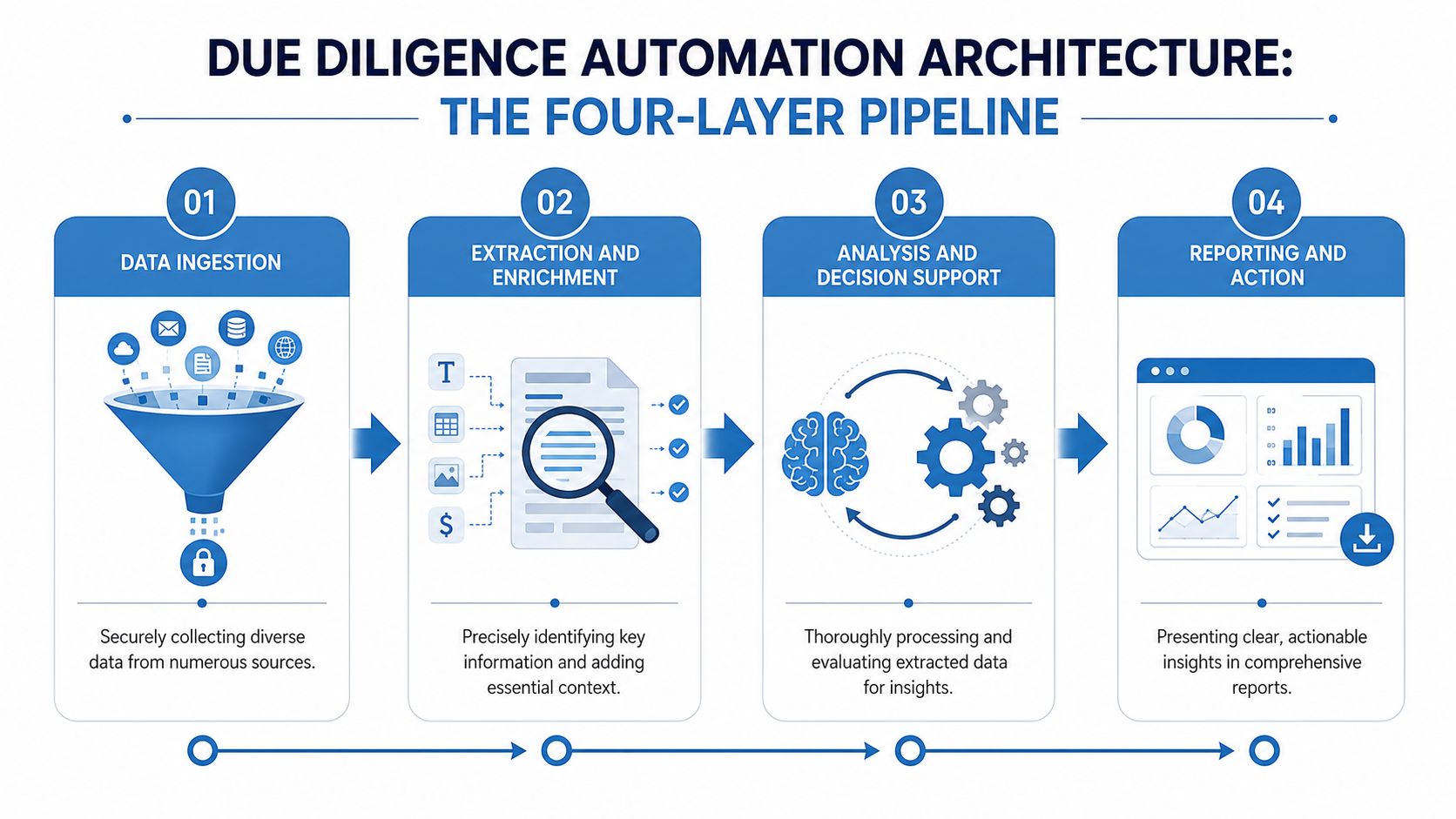
A defensible due diligence automation stack works as a four-layer pipeline. The sequence is data ingestion, extraction and enrichment, analysis and synthesis, then output with verification. That structure isn't cosmetic, it's what makes the result reproducible instead of ad hoc, especially when the workflow needs to handle public records, internal files, and regulated decisions.
Layer 1 and layer 2 do the hard cleanup
Data ingestion is where the system collects records from public databases, internal repositories, and vendor feeds. The point here is not volume for its own sake. The point is to bring every source into a consistent structure before downstream models touch it, because normalization at intake drives OCR and NLP quality later. If the intake layer is sloppy, the rest of the stack inherits errors and generates more manual rework.
Extraction and enrichment turns raw files into usable facts. OCR converts scans into searchable text, then NLP or LLMs identify clause types, dates, parties, obligations, termination triggers, and anomalies. That's where the system starts to separate routine items from exceptions.
For teams comparing technical options, exploring web data extraction APIs is a helpful lens because the practical question is often how to retrieve structured data reliably, not whether the source is public.
Layer 3 and layer 4 create decision control
Analysis and synthesis is where the system scores risk, compares sources, and applies rules. A well-designed system queries sources programmatically, including SEC EDGAR, PACER, and property databases, so the workflow can be repeated and audited instead of rebuilt from scratch each time (Parallel AI). That same architecture is what keeps the process from becoming a pile of disconnected exports.
Output and verification closes the loop. Teams should not accept a summary unless it shows the underlying evidence, the rule applied, and the reviewer who signed off. That is how the system stays useful in regulated environments and how it survives an internal audit.
What Are the Core Benefits and ROI
The ROI is strongest when automation cuts review time, keeps findings consistent, and lets teams handle more assets without adding the same amount of headcount. The most visible KPI is Time-to-Decision, followed by Cost-per-Asset-Reviewed and Risk Identification Rate. In a steady deal flow, even modest reductions in analyst effort change how many opportunities get screened seriously instead of being dropped because the pipeline moves too slowly.
The numbers that matter
As noted earlier, AI-driven platforms can cut document review time significantly, which shortens mid-market transaction reviews and reduces the lag between intake and decision. For contracts, cycle times can also drop sharply, which changes how quickly teams can commit capital, respond to counterparties, and move on to the next deal.
The business case usually shows up in three places:
- Lower manual workload: fewer hours spent reading repeatable documents.
- Faster execution: less time waiting on first-pass review and red-flag triage.
- Better consistency: the same criteria get applied every time instead of varying by analyst.
Why this matters in operations
The hidden ROI is often capacity. When a diligence team spends less time on first-pass work, it can spend more time on exceptions, negotiations, and post-close follow-up. That matters in real estate, where one asset can carry multiple layers of lease, title, zoning, and servicing complexity.
ROI also shows up after close. The same data pipeline that supports acquisition review can feed portfolio monitoring, so teams can watch covenant changes, expiring insurance, lease anomalies, and servicing exceptions without rebuilding reports from scratch each month. That reduces rework, but it also creates cleaner handoffs between asset management, compliance, and finance.
For operators who care about workflow efficiency outside core diligence, how letting agents save time and money offers a useful parallel because the same principle applies, remove repetitive review, and the team gets more room for judgment work.
Faster review is only valuable if the output can be trusted. If the model cannot show its evidence trail, the cycle time win gets erased in rework.
How Is Automation Applied in Real Estate Workflows
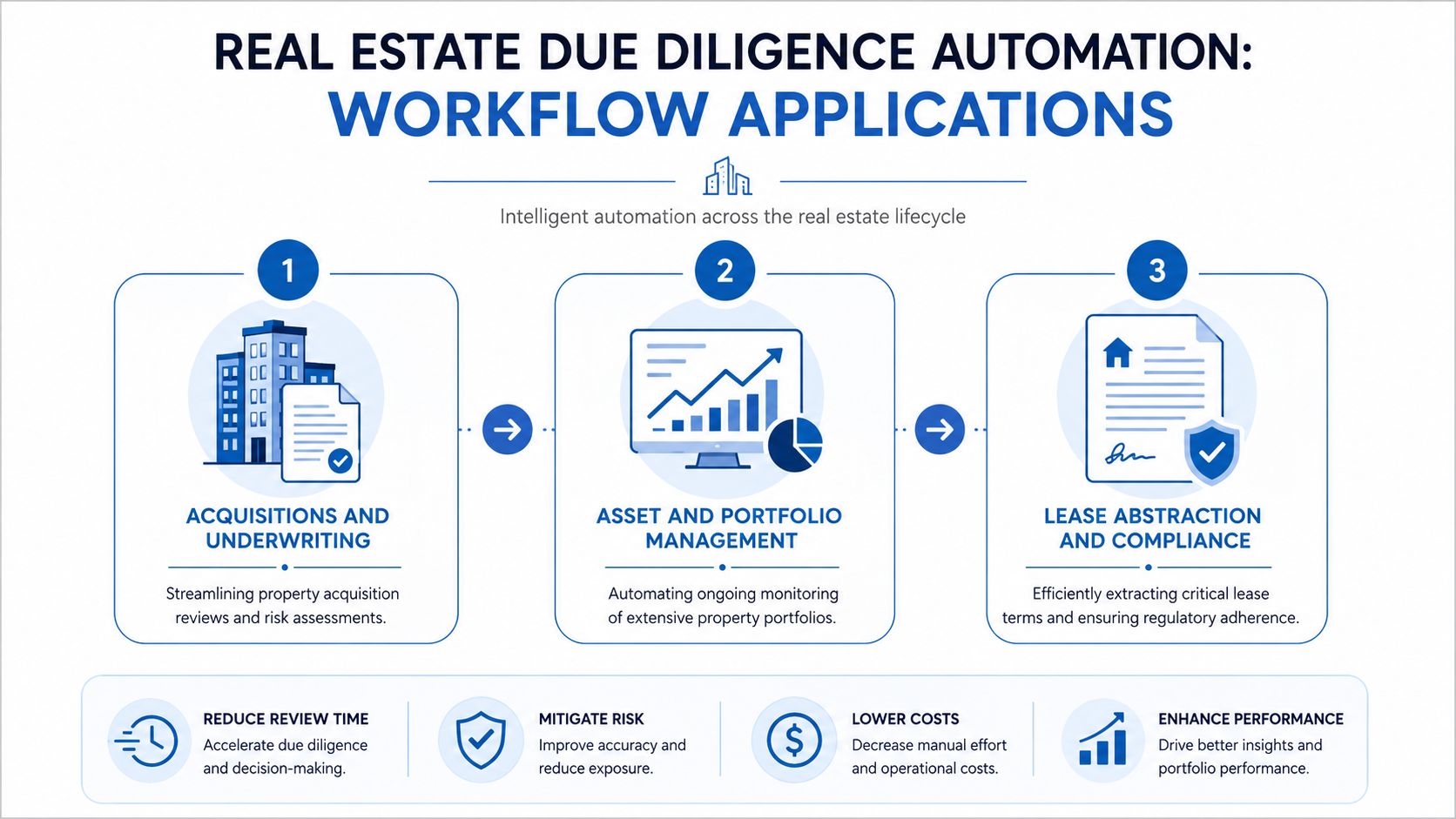
In real estate, due diligence automation is most valuable when it spans the whole asset lifecycle, not just acquisition. The strongest systems help teams at underwriting, keep watch after close, and feed compliance checks during lending or servicing. That makes the workflow continuous instead of point-in-time.
Acquisitions and underwriting
Acquisition teams use automation to assemble property facts faster than a human can chase them across systems. That usually means ownership history, tax records, liens, permits, listings, and valuation signals in one working view. The point isn't to replace underwriting judgment. It's to make the first pass fast enough that good deals don't die in the queue.
A practical workflow looks like this:
- Pull the property record and related ownership data.
- Check liens, mortgage activity, and pre-foreclosure signals.
- Enrich the file with contact and valuation fields.
- Push exceptions to an analyst for review.
That sequence is especially useful when the team needs to evaluate many assets quickly. A manual process can miss small but material inconsistencies, while an automated one can flag them before they become expensive surprises.
Portfolio monitoring and servicing
The bigger change is what happens after close. A key application of due diligence automation is shifting from one-time reviews to continuous monitoring of signals like property usage, news, and market data, then turning those signals into auditable decisions for portfolio management (Sirion). That matters because risk doesn't stop at acquisition.
For portfolio teams, this can mean tracking new liens, zoning changes, owner changes, or distress indicators on a recurring basis. It also means creating alerts that are reviewable, not just noisy. If every event triggers a summary but nothing is tied to an action path, the system becomes another dashboard nobody trusts.
Lease abstraction and compliance
Lease-heavy portfolios benefit from the same pattern. Automation can extract dates, renewal terms, escalation clauses, and obligations, then route edge cases to a human reviewer. That helps legal and asset management teams focus on clauses that affect cash flow or compliance, not on retyping obvious facts.
The key is discipline. Real estate automation works when the system handles the repeatable record pulls and first-pass extractions, while humans handle negotiation, context, and decisions that depend on local market or relationship nuance.
What Are the Key Compliance and Risk Factors
The main risk in automation is not that it thinks too much, it's that teams trust it too much. AI is useful because it can process thousands of data points simultaneously, surface risk early, apply compliance criteria consistently, and generate the audit trails regulated teams need (Grata). The same system can also create false confidence if no one owns verification.
Human review still has to be built in
A healthy system uses human-in-the-loop review gates at the points where context matters most. Strategic fit, cross-jurisdiction interpretation, and relationship-sensitive negotiation still need people, because automation can't reliably replace judgment in those areas. That's not a weakness. It's the boundary that keeps the workflow defensible.
The safest pattern is simple:
- Verify sources at intake: don't let dirty data enter the pipeline.
- Separate extraction from judgment: facts first, decisions second.
- Escalate exceptions: route ambiguous items to a specialist.
- Document every step: keep a traceable record of what changed and why.
If the output can't be audited, the workflow isn't mature enough for regulated use.
Privacy and vendor controls matter
Real estate data often includes ownership contacts, financial signals, and property-level risk indicators, so privacy and vendor governance need to be part of the design from day one. A practical reference for that side of the stack is BatchData's real estate data privacy and vendor compliance guide, especially if you're connecting multiple systems and third-party feeds.
The biggest mistake is treating compliance as a final checkbox. By the time the review lands, the architecture is already set. If the ingest layer, storage model, and review permissions weren't designed for auditability, fixing that later is painful and expensive.
How Do You Select the Right Solution
The build-versus-buy decision comes down to control, speed, and maintenance burden. If you need deep customization and have strong in-house data engineering, building can make sense. If you need reliable coverage, documented APIs, and faster rollout, buying is usually the smarter path. The wrong choice is pretending a search vendor, a data warehouse, and a few scripts add up to a platform.
The clearest decision framework is a side-by-side comparison.
| Factor | Buying a Vendor Solution, for example using a BatchData API | Building an In-House Solution |
|---|---|---|
| Data coverage | Access to large, maintained real estate datasets, including 155M+ property records and verified attributes | Must be sourced, normalized, and maintained internally |
| Implementation speed | Faster to deploy because the data layer already exists | Slower, because ingestion and mapping must be built first |
| Maintenance | Vendor handles updates, coverage changes, and API reliability | Internal team owns uptime, schema drift, and source changes |
| Specialization | Often domain-specific, which helps with property workflows | Can be tailored, but only if the team knows the domain well |
| Security and governance | Depends on vendor controls and documentation | Full control, but also full responsibility |
| Total effort | Lower engineering lift, easier to pilot | Higher upfront cost and long-term overhead |
What to check before you buy
Look at source quality first, not UI polish. Ask whether the system can support your actual workflow, whether the API documentation is usable, and whether the vendor serves the property data objects you need for underwriting or monitoring. If the platform can't support repeatable queries, it's not automation, it's a manual process with a login.
The real estate workflow automation API comparison is worth reviewing when you're comparing vendors because the best option is the one that fits your operational model, not the one with the loudest sales pitch.
When in-house makes sense
Build internally when your logic is highly proprietary, your volumes justify the engineering investment, and you already have people who can maintain the pipeline. That said, internal teams routinely underestimate source maintenance, data quality work, and support load. Those costs don't show up in the first demo, but they show up fast after launch.
What Does a Successful Implementation Roadmap Look Like
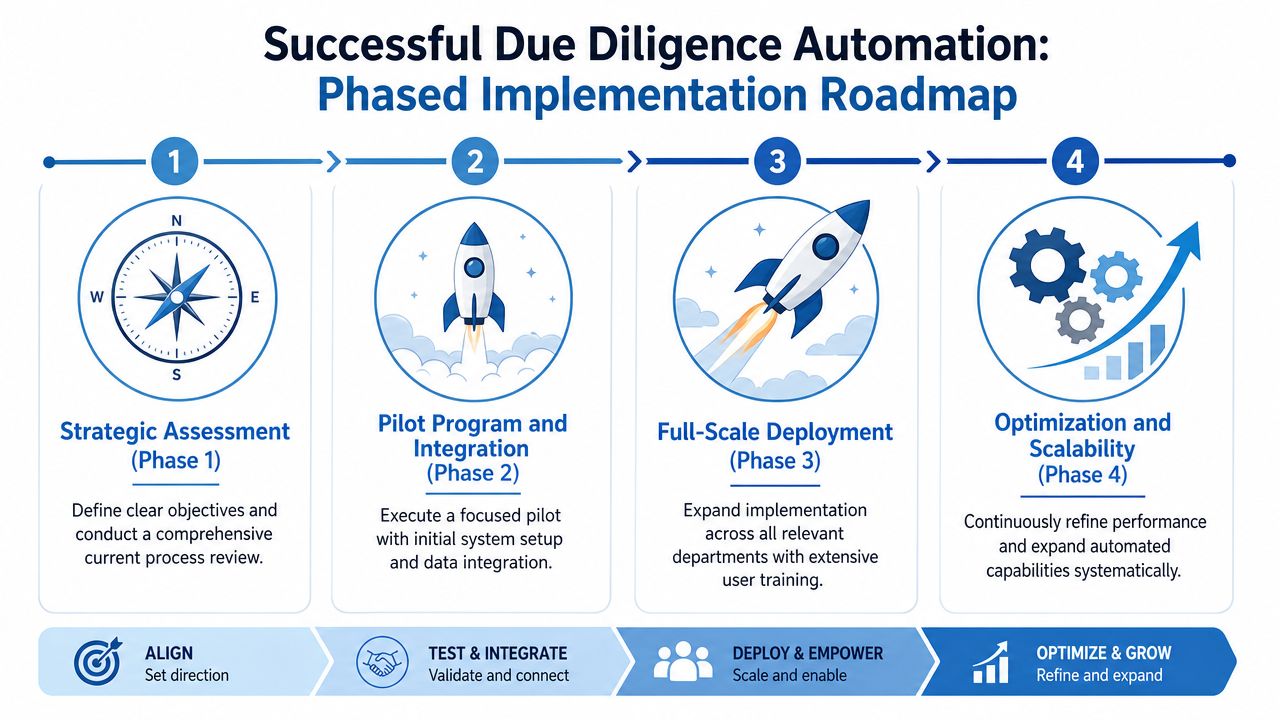
A successful rollout starts small, proves value on repetitive work, then expands into higher-stakes workflows. The goal is to avoid a big-bang launch that tries to automate everything at once. Teams that win here treat implementation like a product rollout, with scope control, validation, and iteration.
Phase 1 to phase 2 set the foundation
Start with strategic assessment. Define the exact workflow you want to automate, the documents or data sources involved, and the success metrics you'll use. Pick one repetitive, high-volume task first, because early wins matter more than broad ambition.
Then run a pilot program on a representative dataset. Test whether the system can ingest cleanly, extract correctly, and route exceptions the way your team expects. This is the stage where bad source assumptions get exposed before they become company-wide problems.
Phase 3 to phase 4 turn the pilot into a system
Once the pilot is stable, move into integration and development. Connect APIs, map fields, establish review gates, and document the logic for exceptions. This is also where you make sure the workflow fits the way analysts, legal teams, or portfolio managers work, instead of forcing them into a brittle interface.
After that comes scale and optimize. Roll the workflow into other assets, teams, or geographies, then refine the rules based on feedback. The objective is not to automate more for its own sake. It's to automate the parts of diligence that are repeatable, measurable, and easy to verify.
A few practical habits keep the rollout on track:
- Start with high-volume tasks: first-pass review is easier to standardize than negotiation.
- Keep a human review lane: exceptions need a named owner.
- Track auditability from day one: the system should explain every result.
- Expand only after validation: scale follows confidence, not the other way around.
If you're ready to connect property data, monitoring, and workflow automation into one diligence stack, BatchData is a practical place to start because it gives teams programmatic access to real estate records they can feed into underwriting, review, and monitoring workflows.