



A real estate analyst's primary job is financial modeling and underwriting to determine whether a property investment is viable. In the U.S., compensation commonly lands in the high-five-figure to low-six-figure range, with Indeed reporting about $87,139 per year and Glion citing roughly $98,000 annually.
The term "analyst" often brings reporting to mind. That's not the job. A strong real estate analyst builds the financial case for or against a deal, pressure-tests assumptions, and gives decision-makers a clean view of return, risk, and execution issues before capital goes out the door.
Here's the practical version:
- Core function: underwrite deals, not just summarize data
- Daily work: models, comps, assumptions, diligence, and investment memos
- What matters most: Excel, DCF logic, debt and equity modeling, and market judgment
- Where roles differ: brokerage, development, and finance use the same title but need different outputs
- Career reality: some jobs are highly analytical and paid accordingly, while some junior roles are closer to data coordination
If you're hiring, the title alone won't attract the right person. If you're applying, the title alone won't tell you what the job really is.
SEO Title: Real Estate Analyst Job Description Guide for Hiring and Careers
Meta Description: Learn what a real estate analyst does, the core skills required, salary expectations, KPIs, and how to write a strong job description.
Meta Keywords: real estate analyst job description, real estate analyst salary, real estate underwriting, real estate financial modeling, real estate analyst skills, real estate analyst interview, acquisitions analyst, property market research
What Does a Real Estate Analyst Actually Do
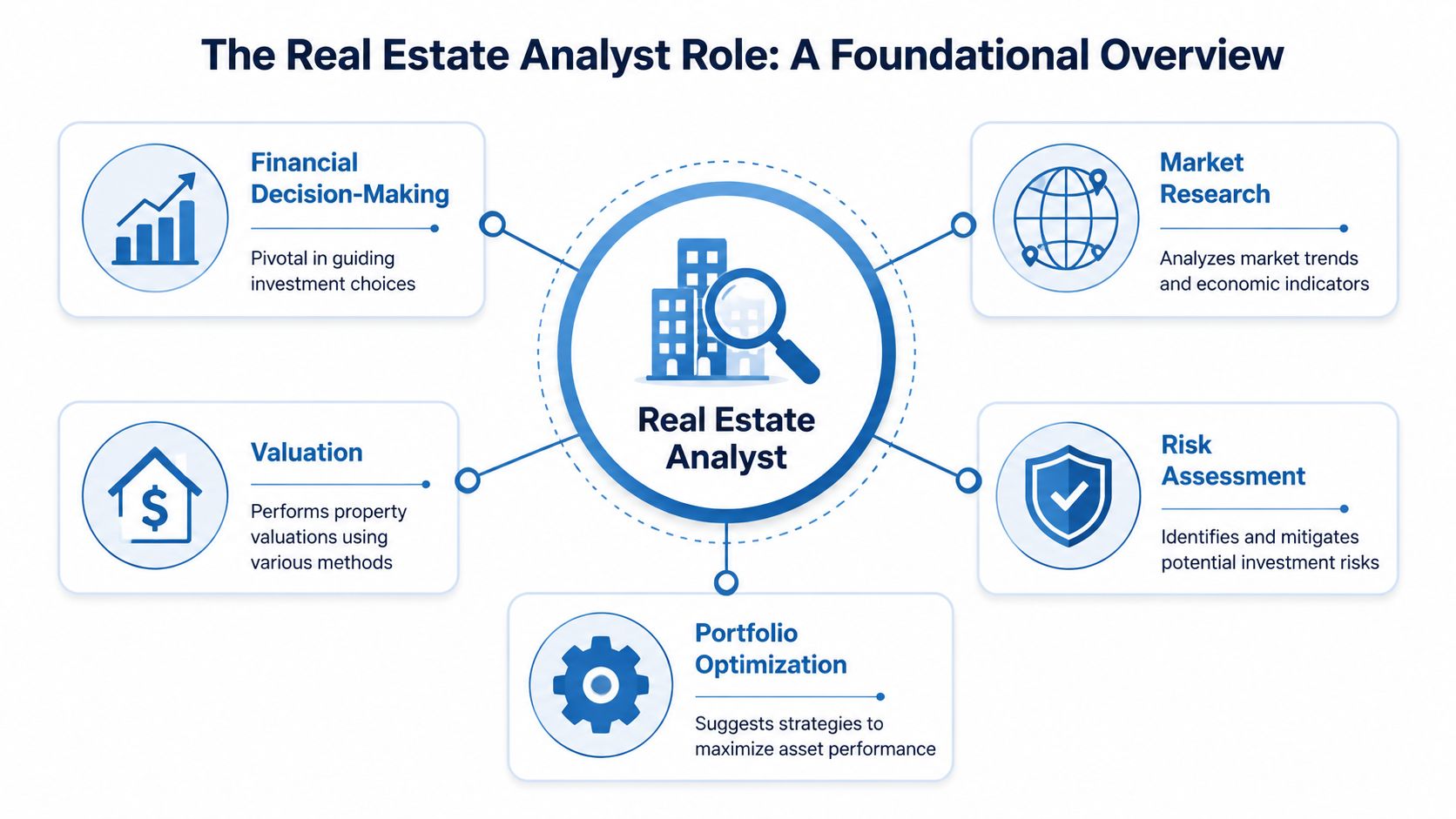
A real estate analyst de-risks capital allocation. That's the cleanest definition.
The role is primarily a financial modeling and underwriting job. One employer-side description says analysts prepare complex models for project and portfolio performance, evaluate exit strategies, update models with actual cost data, and underwrite rents, interest rates, budgets, and operating expenses. That same description also includes market research, rental-rate analysis, and due diligence support, which is why the role sits between investment judgment and market intelligence, not simple reporting (financial analyst job description).
The real output is a decision
A weak analyst hands over spreadsheets. A strong analyst answers the question behind the spreadsheet: Should we pursue this deal, and under what assumptions?
That usually means translating messy inputs into a recommendation:
- Revenue assumptions: rent levels, lease-up pace, reimbursement structure, downtime, concessions
- Cost assumptions: operating expenses, taxes, insurance, repairs, capex, development budget items
- Capital assumptions: debt terms, equity structure, refinance options, exit pricing logic
- Risk flags: title issues, permit uncertainty, market softness, tenant rollover, cost volatility
Practical rule: If the model doesn't change the decision, the analyst hasn't finished the job.
What the day actually looks like
The day-to-day work is less glamorous than the title sounds. It often starts with incomplete information and tight deadlines.
A real analyst's workflow typically includes:
- Collecting raw inputs from brokers, owners, public records, rent rolls, operating statements, and internal deal notes
- Cleaning and normalizing data so the model isn't built on inconsistent assumptions
- Running valuation and underwriting through DCF, debt, and equity structures
- Checking market reality against comps, supply, demand, and submarket context
- Writing the investment narrative so the deal team can act on the findings
This is why analysts spend so much time on both numbers and context. Financial logic without market grounding creates false precision. Market color without a disciplined model creates opinion masquerading as analysis.
Reporting versus underwriting
Many job descriptions often become sloppy at this stage.
Reporting tells you what happened. Underwriting tells you what could happen if assumptions hold, and what breaks if they don't. That difference matters in acquisitions, development, lending, and portfolio management.
For firms focused on acquisitions, the analyst often becomes the first serious filter in the process. Before a senior person commits time, the analyst has already framed the downside, tested the return profile, and done the first pass on vetting investment properties.
If you're training a new hire, that's the standard to set early. Don't ask them to “run numbers.” Ask them to produce an investable view.
What Core Skills and Tools Define a Top Analyst
A top analyst combines financial acumen, technical execution, and market intelligence. Miss one, and the work falls apart.
The technical bar is not optional. Employers expect advanced Excel and modeling capability, including building or reviewing DCF, debt, and equity models, performing due diligence, and verifying underwriting line items. That matters because model integrity and clear presentation directly reduce pricing and execution risk (real estate analyst job description expectations).
A modern workflow also depends on faster data access and cleaner records.
Financial skills that actually matter
Most hiring managers say they want “strong financial modeling.” That's too vague. Be specific.
The analyst should be comfortable with:
| Skill area | What it means in practice | Why it matters |
|---|---|---|
| DCF modeling | Projecting income, expenses, capex, financing, and exit value | Converts assumptions into an investment case |
| Debt and equity modeling | Testing leverage, refinance logic, promote structures, and capital stack effects | Shows who gets paid, when, and under what scenarios |
| Sensitivity analysis | Stress-testing rents, rates, expenses, and exit assumptions | Prevents overconfidence in a single base case |
| Underwriting review | Checking formulas, line items, and source support | Stops preventable pricing mistakes |
A lot of candidates can build a model from a template. Fewer can explain why one assumption matters more than another. That gap is usually the difference between a spreadsheet operator and a deal analyst.
Technical stack and data tools
Excel still does the heavy lifting. In many shops, ARGUS matters too, especially for stabilized commercial assets. But the bigger shift is upstream. Analysts now spend less time hunting for scattered records and more time validating them.
Useful tools usually fall into four buckets:
- Spreadsheet and modeling tools: Excel, shared model libraries, scenario tabs, version control
- Property and owner data tools: tax records, deed history, mortgage detail, lien status, permit history, ownership chains
- Market research tools: comps databases, listing feeds, rent and sale tracking, mapping
- Presentation tools: investment memos, map exhibits, diligence summaries, IC materials
For teams evaluating modern data sources, this overview of top real estate analysis platforms is a helpful comparison point.
One example is BatchData's investment analysis tools overview, which covers property records, ownership, valuations, and related datasets analysts often use during sourcing, underwriting, and diligence. The point isn't that one tool replaces analysis. It's that better input quality improves model reliability.
Good underwriting can survive imperfect data. Great underwriting starts by fixing the data problem early.
Market intelligence is where judgment shows up
Many junior analysts over-focus on formulas and under-focus on market structure. That's a mistake.
You need to know how to answer questions like:
- Is this rent assumption supported by recent comparable deals?
- Are concessions distorting face rents?
- Is supply coming online that changes lease-up timing?
- Are operating costs understated relative to the asset's age and condition?
- Does the exit assumption make sense for this buyer pool?
This is also where communication matters. Senior people don't need every tab explained. They need to know what changed, what drives the return, and what could go wrong.
A quick walkthrough helps illustrate what strong technical communication looks like in practice.
How Is an Analyst's Performance Measured
An analyst's performance should be measured by decision quality, speed, and reliability. “Works hard” is not a KPI.
The cleanest mistake managers make is evaluating analysts only on output volume. That rewards motion, not judgment. The better approach is to score the role based on whether the analyst improves deal screening, underwriting accuracy, and team trust.
The KPIs that matter
| KPI | What to look for | Why it matters |
|---|---|---|
| Model accuracy | How closely assumptions and projected performance align with later operating reality | Shows whether underwriting is grounded or optimistic |
| Diligence turnaround | How quickly the analyst can take a new opportunity from raw package to decision-ready memo | Affects deal flow and response time |
| Data integrity | Error rate in models, comp sets, source inputs, and reporting files | Prevents bad approvals and rework |
| Recommendation quality | Whether the analyst identifies the real drivers of risk and return | Separates useful analysis from mechanical output |
| Cross-functional usefulness | Whether acquisitions, asset management, development, or lenders can act on the work | Measures practical business value |
A strong analyst isn't just fast. They're fast without breaking trust.
What managers should review
Managers should look at the work after the model leaves the analyst's desk.
Questions worth asking include:
- Were assumptions traceable? Can someone identify where the rent, expense, and capex inputs came from?
- Did the memo surface the actual risks? Or did the analyst bury them in notes?
- Was scenario analysis useful? Not fifteen tabs of noise. Actual downside cases.
- Did the analyst update the model when facts changed? That discipline matters more than the initial draft.
If you're formalizing performance feedback, this guide to performance review self-assessments is useful because it shows how to frame outcomes, not just tasks.
What analysts should track for promotion
Promotion usually goes to the analyst who becomes dependable under pressure. That's a mix of technical accuracy and business judgment.
A practical personal scorecard often includes:
- Turnaround discipline: how quickly you can produce a clean first pass
- Revision control: whether your model stays organized as assumptions evolve
- Issue spotting: whether you catch weak rent comps, missing costs, or shaky exit logic before someone else does
- Benchmarking habit: whether you compare live deals against market and portfolio context
Analysts who want to improve this side of the job should study frameworks for property performance benchmarking, because benchmarking forces you to compare assumptions against something real instead of relying on intuition.
The analyst who gets promoted isn't usually the one with the flashiest model. It's the one whose work other people stop double-checking.
What Is the Typical Salary and Career Path
The salary question has a short answer. Real estate analyst pay varies widely because the title covers very different jobs.
Indeed reports an average U.S. real estate analyst salary of about $87,139 per year, while Glion cites roughly $98,000 annually. For broader outlook, Indeed points to U.S. Bureau of Labor Statistics data showing 5% growth from 2022 to 2032 for related property appraiser and assessor roles, which is faster than average for all occupations (salary and outlook context).
Salary depends on the actual job, not the title
Some roles under the analyst label are primarily financial. Others are closer to research support, reporting, or data administration.
Glassdoor's job-description guidance notes that a real estate license may be required by some employers but not universally, and cites a current junior analyst listing paying $20 to $25 per hour with associate-level education required. That's a useful reminder that the title spans everything from entry-level data work to advanced finance roles (real estate analyst hiring realities).
Real Estate Analyst Salary by Experience Level 2026 Estimates
| Level | Years of Experience | Typical Salary Range |
|---|---|---|
| Junior or entry-level analyst | Early career | $20 to $25 per hour for some data-focused roles |
| Analyst | Varies by market and specialization | Around $87,139 per year on average |
| Experienced analyst | Varies by market and specialization | Roughly $98,000 annually in one cited estimate |
This table isn't a universal ladder. It shows the spread in the market using the limited verified compensation data available.
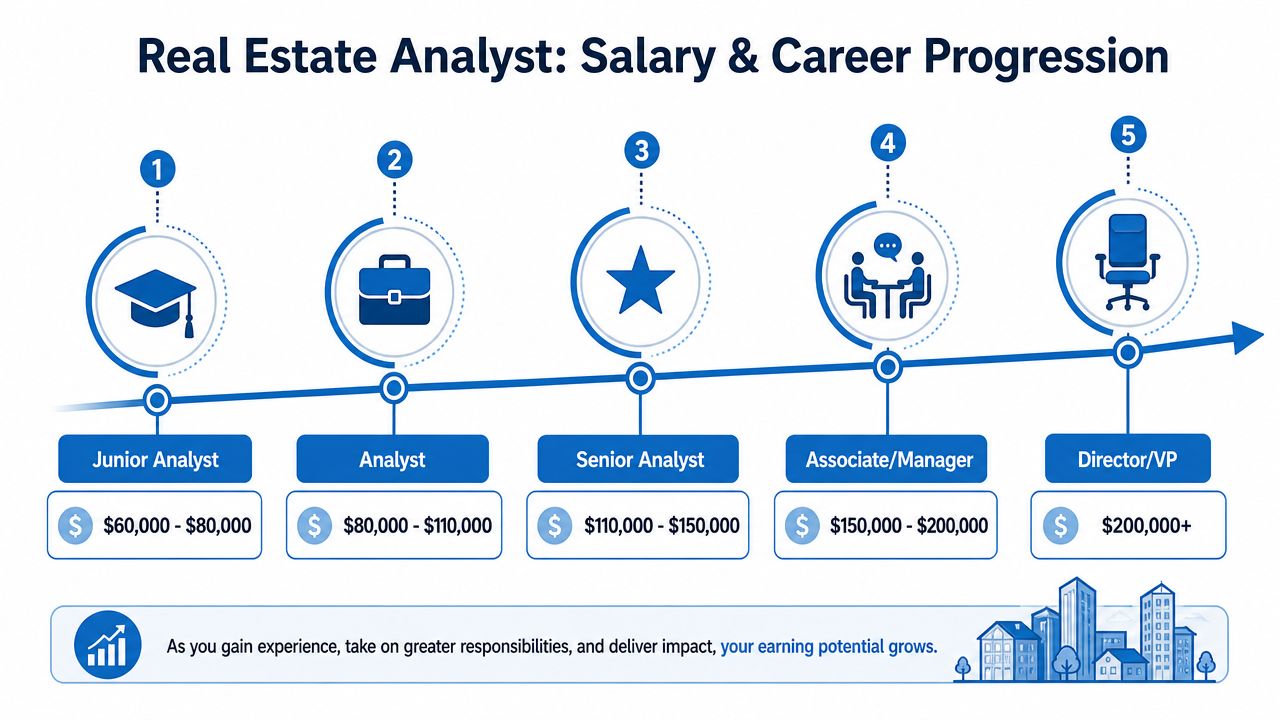
The real career ladder
In practice, the role usually progresses through responsibility, not just tenure.
| Stage | Main responsibility | What changes |
|---|---|---|
| Junior analyst | Data gathering, comp support, first-pass underwriting | Learns process discipline |
| Analyst | Owns full models and supports memos | Becomes accountable for assumptions |
| Senior analyst | Reviews others' work and drives deeper scenario analysis | Adds judgment and consistency |
| Associate or manager | Runs workstreams, interacts with counterparties, shapes recommendations | Moves from execution to deal ownership |
| Director or VP track | Sets strategy, pricing posture, and capital allocation priorities | Owns decisions, not just analysis |
Career progression happens when you stop being the person who “updates the model” and become the person who can defend the investment thesis.
Brokerage, development, and finance all offer different versions of that path. Brokerage-side analysts often move toward production support or deal execution. Development analysts grow into project underwriting, budgeting, and capitalization work. Finance and acquisitions analysts tend to move toward investment committee exposure and capital deployment roles.
How Do You Write a Job Description That Attracts Top Talent
A strong real estate analyst job description starts with what the person will decide, not a pile of generic requirements.
The role is typically built around two pillars: financial modeling and market research. Analysts evaluate cash flow, ROI, rent and sales comparables, and property valuation, then turn those inputs into recommendations for acquisition, development, or sale decisions. That also means stress-testing assumptions and running sensitivity analysis, not just reporting historical numbers (real estate analyst role overview).

What weak job descriptions get wrong
Most weak postings fail in three places:
- They confuse tasks with outcomes. “Maintain spreadsheets” won't attract strong underwriters.
- They hide the asset type and business model. Multifamily acquisitions, development, debt, and brokerage all need different analysts.
- They lump must-haves and nice-to-haves together. That scares off good candidates and attracts résumé inflation.
If you want better applicants, be direct about the work.
A practical template you can use
Role summary
We're hiring a Real Estate Analyst to support underwriting, market analysis, and investment decision-making across our pipeline. This person will build and maintain financial models, analyze rent and sales comparables, support due diligence, and translate findings into clear recommendations for acquisition, development, leasing, or disposition decisions.
Why this works: It defines the business purpose of the role immediately.
Key responsibilities
- Build and update acquisition, development, or portfolio cash flow models
- Underwrite rents, operating expenses, capital costs, debt assumptions, and exit scenarios
- Conduct market research using sales comps, rent comps, public records, and third-party datasets
- Support due diligence by validating operating data, ownership information, budgets, and property assumptions
- Prepare investment memos, summary dashboards, and decision materials for internal review
- Track assumption changes and update models as new information becomes available
Why this works: Every line describes action tied to a decision.
How to separate must-haves from preferences
Use this format instead of one bloated qualification list.
| Category | Include | Leave as preferred |
|---|---|---|
| Must-have | Excel modeling, underwriting logic, ability to analyze comps, attention to detail | Do not dilute this list |
| Preferred | ARGUS exposure, GIS familiarity, asset-class specialization, real estate license where relevant | Useful but role-dependent |
| Context-specific | Development budgeting, lender modeling, brokerage support, portfolio reporting | Add only if the team actually needs it |
Required qualifications
- Strong Excel and financial modeling skills
- Ability to analyze cash flow, valuation, and return assumptions
- Comfort working with imperfect datasets and reconciling inconsistencies
- Clear written and verbal communication
- Degree in finance, real estate, economics, or a related field if your firm requires it
Preferred qualifications
- Experience with ARGUS or institutional underwriting templates
- Exposure to acquisitions, asset management, development, or brokerage workflows
- Real estate license if the role includes brokerage-side responsibilities
Hire for judgment and discipline first. Software familiarity is easier to teach than skepticism.
Tailor the job description by business line
Don't post one generic template for every team.
- Brokerage analyst: emphasize comps, OM support, pipeline tracking, market packages, and transaction support
- Development analyst: emphasize budgets, schedules, sources and uses, draw logic, and entitlement-related diligence
- Acquisitions or finance analyst: emphasize DCF, debt and equity modeling, sensitivity work, and investment committee materials
That's how you write a real estate analyst job description that attracts the right candidate instead of the broadest pool.
How Can Candidates Ace the Interview and Land the Job
Candidates win these interviews by proving they can think like an owner, not just build a spreadsheet.
A lot of applicants overprepare for terminology and underprepare for judgment. Interviewers want to know whether you can take an incomplete deal package, organize the facts, and tell them what matters.
What interviewers are really testing
Most interviews evaluate four things:
Technical fluency
Can you build or audit a model without creating errors you can't explain?Commercial judgment
Do you understand what drives value and risk for the asset type?Communication
Can you summarize your conclusion without wandering through every tab?Role fit
Are you interviewing for brokerage support, development analysis, or investment underwriting? Those are not interchangeable.
Candidates also need to ask direct questions about role structure. A license isn't universally required, especially in finance or development, while some brokerage-side jobs may prefer one. Compensation can also vary sharply, from $20 to $25 per hour for data-focused junior roles to six-figure analytical positions, so you need clarity before you accept the title at face value.
Questions you should expect
| Interview question | What a good answer shows |
|---|---|
| Walk me through how you'd underwrite this deal | Structured thinking and prioritization |
| What assumptions would you stress-test first | Understanding of sensitivity and downside |
| How do you verify comp quality | Discipline around data integrity |
| Tell me about a time your analysis changed a recommendation | Evidence of judgment, not just execution |
| Why this sector or asset type | Genuine interest and market awareness |
How to handle the modeling test
Many otherwise good candidates fail for this reason. They rush.
A better approach:
- Start with structure: build clean inputs, assumptions, outputs, and checks
- Label everything: if someone else opens the file, they should follow your logic quickly
- Keep formulas simple: complexity doesn't impress anyone if it reduces auditability
- Check circular logic and broken links: avoid preventable errors
- Write a short conclusion: don't let the spreadsheet speak for itself
If you can't explain your model in plain English, you don't understand it well enough yet.
For candidates exploring role formats, including distributed opportunities, this roundup of remote real estate analyst jobs is useful because it shows how employers package the title across different workflows.
Resume bullets that translate well
Strong bullets focus on analysis plus decision impact.
Better phrasing looks like this:
- Built underwriting models for acquisition opportunities using rent, expense, and valuation assumptions
- Analyzed sales and rent comparables to support pricing recommendations
- Reviewed source documents and reconciled operating assumptions for diligence packages
- Prepared investment summaries and presented key risks and return drivers to decision-makers
Avoid generic bullets like “responsible for financial analysis” or “worked on real estate projects.” Those say almost nothing.
Conclusion The Modern Analyst's Edge
The modern real estate analyst is not a back-office note taker. The role is part underwriter, model builder, market interpreter, and risk filter.
That matters because firms don't make money from having more data. They make money from using the right data to make better decisions, faster. An analyst who can organize messy inputs, test assumptions objectively, and communicate a recommendation clearly gives the team a real edge.
For hiring managers, the takeaway is simple. Write a job description around actual decisions, actual tools, and the actual business line. Don't post a generic analyst role and hope the market sorts it out.
For candidates, the lesson is just as direct. Learn to model. Learn to verify. Learn to explain. The people who advance in this field aren't the ones who memorize the most formulas. They're the ones who can tell a principal, lender, or development lead what's true, what's uncertain, and what deserves a hard no.
That's the standard. And it's why the title still matters.
If your team needs cleaner property, ownership, valuation, and market data for underwriting or diligence, take a look at BatchData. It's a practical option for analysts and operators who need property records and related datasets in a format they find useful.