



Remote real estate analyst roles exist, but they're still a niche. Indeed shows 628 open “Remote Real Estate Data Analyst” jobs, while Glassdoor shows 36 remote “Real Estate Analyst” roles, which tells you the opportunity is real but competitive (Indeed job search data).
If you want one of these jobs, generic advice won't help. Hiring managers don't need another resume that says “strong analytical skills.” They need proof that you can clean messy data, build a model that holds up, explain the output in plain English, and do all of that without someone standing over your shoulder.
Here's the practical version of the market:
| Area | What matters |
|---|---|
| Role reality | Most remote analysts do research, underwriting support, portfolio tracking, and reporting. |
| Hiring bar | Accuracy, documentation, and clear communication matter as much as raw modeling skill. |
| How to stand out | Build a portfolio with real property analysis projects, not just a skills list. |
| Where candidates fail | They apply to vague “real estate” roles that are actually admin or coordinator jobs. |
Remote work made the role more accessible. It didn't make hiring easier.
What Does a Remote Real Estate Analyst Actually Do
A remote real estate analyst turns property, lease, market, and financial data into decisions. That usually means underwriting deals, checking assumptions, preparing reports, validating inputs, and helping operators or investors see risk before it becomes expensive.
The biggest misconception is that remote means lighter work. It usually means the opposite. In-office analysts can clarify a missing assumption by walking to someone's desk. Remote analysts need to catch the issue early, document it clearly, and move the work forward through tools like WebEx, Microsoft Teams, and email. Job listings also show the market has adapted to distributed teams, with some employers wanting 7 or more years of commercial credit analysis and underwriting experience, while others accept 2 years of professional experience in place of a master's degree (remote real estate analyst hiring patterns).
What the job looks like day to day
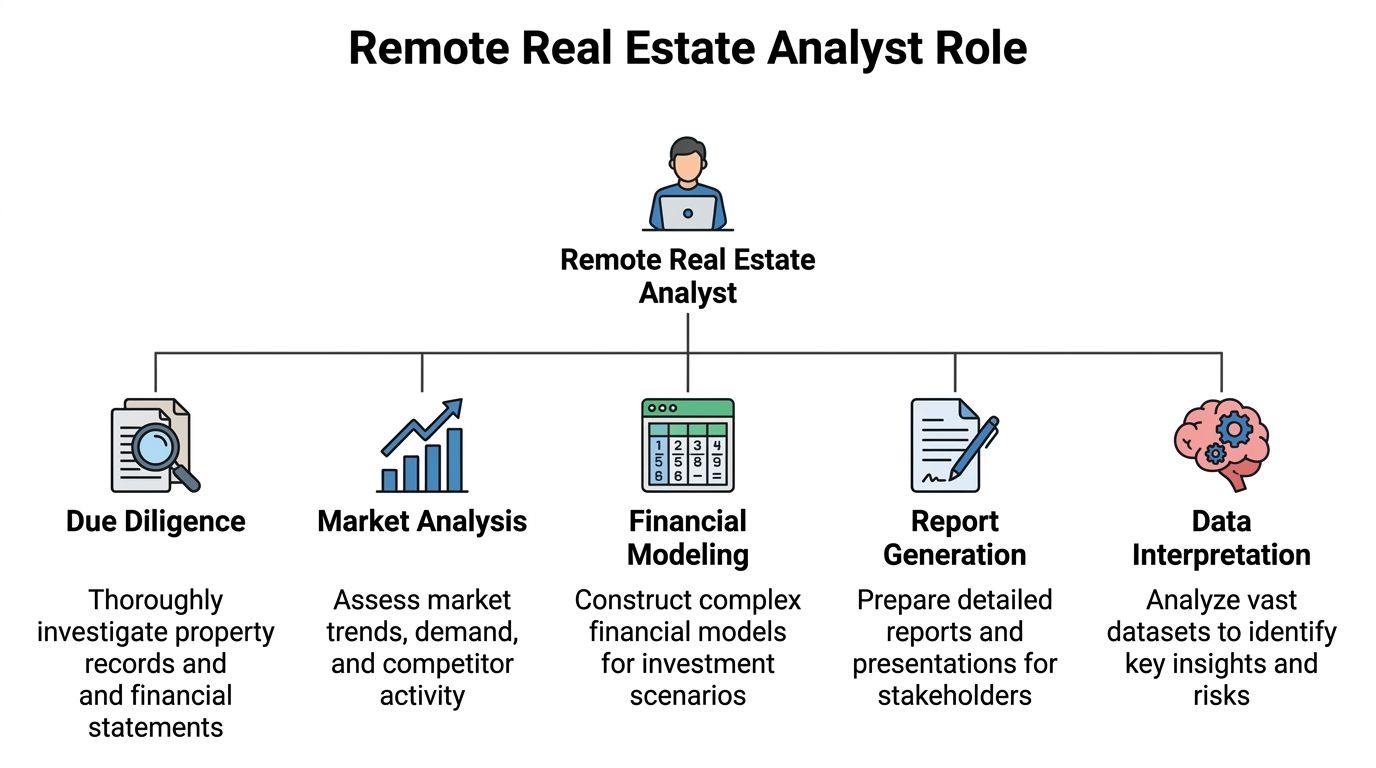
A solid remote analyst usually owns some mix of these responsibilities:
- Due diligence support. Reviewing property records, rent rolls, operating statements, debt terms, and market comps.
- Financial modeling. Building and maintaining models for acquisitions, dispositions, refinancing, or portfolio reviews.
- Market analysis. Comparing submarkets, tracking demand signals, and testing whether a deal's assumptions make sense.
- Reporting. Turning model output into memos, dashboards, and executive summaries that busy stakeholders can effectively use.
- Data quality control. Finding broken formulas, stale records, inconsistent field definitions, and missing assumptions before they reach leadership.
What changes when the role is remote
Remote analysts need a sharper operating system than in-office analysts.
Practical rule: If someone can't understand your assumptions from your file, notes, and message, your analysis isn't finished.
Three habits matter more in remote work than candidates expect:
Documentation
Every model needs clean tabs, labeled assumptions, version control, and notes that explain why a number changed.Asynchronous communication
You need to write short updates that answer the next question before someone asks it.Independent judgment
Managers hire remote analysts because the work can be done digitally. They still expect you to know when to escalate a bad input, a weak comp set, or a timing risk.
If you're still deciding whether this path fits, a broader guide to remote jobs in demand helps put analyst roles in context. The key distinction is that real estate analysis is less about availability and more about trust. If your work is sloppy, remote settings expose it fast.
What Are the Must-Have Skills for Remote Analysts
Hiring managers sort remote analyst candidates into two buckets fast. Can this person produce reliable analysis, and can they prove it with work samples?
For remote real estate analyst roles, skill lists matter less than demonstrated output. A resume that says Excel, SQL, market research, and underwriting gets you a glance. A portfolio that shows a clean rent comp model, a documented market screen, and a short memo explaining the recommendation gets you an interview.
Table stakes skills
These are the baseline skills I expect before I spend time on a case study.
| Skill | What hiring managers mean | What good looks like |
|---|---|---|
| Excel | More than formatting and basic formulas | Clean models, lookup logic, error checks, scenario tabs |
| Research | Pulling and validating market inputs | You can defend why a comp belongs in the set |
| Financial modeling | Building decision-ready analysis | Assumptions are separate from calculations |
| Databases | Comfort with structured data | You can work across exports, schemas, and field definitions |
| Writing | Explaining analysis clearly | Your memo is concise, specific, and easy to skim |
Use a focused guide to essential technical skills to spot gaps, then close those gaps with project work. Do not turn that checklist into resume filler. Hiring teams want proof.
Differentiator skills
Here, candidates separate themselves.
The best remote analysts build files another analyst can pick up in ten minutes. Tabs are labeled clearly. Assumptions are easy to trace. Checks catch broken logic before a manager finds it. That level of discipline saves time for the whole team, and teams remember who creates that kind of reliability.
Data fluency matters too. Remote analyst work rarely arrives in one neat spreadsheet. You may start with county records, exported CSVs, broker comps, and internal deal notes that conflict with each other. Strong candidates know how to clean those inputs, reconcile discrepancies, and document which source they trusted and why.
Then there is communication. A remote analyst who writes a sharp five-sentence update is more useful than one who sends a dense paragraph and a workbook with no context. Senior people skim. If your summary does not state the conclusion, key assumptions, and main risk, your analysis loses value.
Strong candidates show the process behind the output, not just the output itself.
Skills that raise your value
Higher-paying remote analyst roles usually ask for stronger judgment in one of three areas:
- More complex asset or portfolio analysis
- Better underwriting judgment under incomplete information
- Better systems thinking around data, reporting, and repeatable workflows
The third category is where many applicants fall short. They can build a model once. They cannot build a repeatable workflow that another person can run next week.
That is why portfolio projects matter so much. If you want to stand out, build one project using modern property data tools and show the full chain of work. Pull a targeted property set, clean the fields, rank opportunities, write a short investment memo, and package the file so another analyst could review it without your help. This overview of real estate data analytics workflows is useful because it connects raw property data to analyst tasks you can turn into a portfolio piece.
Here is the standard I use. “Excel proficiency” gets you past a keyword screen. Being able to audit a model, resolve conflicting property inputs, and explain the decision in three clear bullets gets you hired.
How to Build Your Remote-Ready Portfolio and Resume
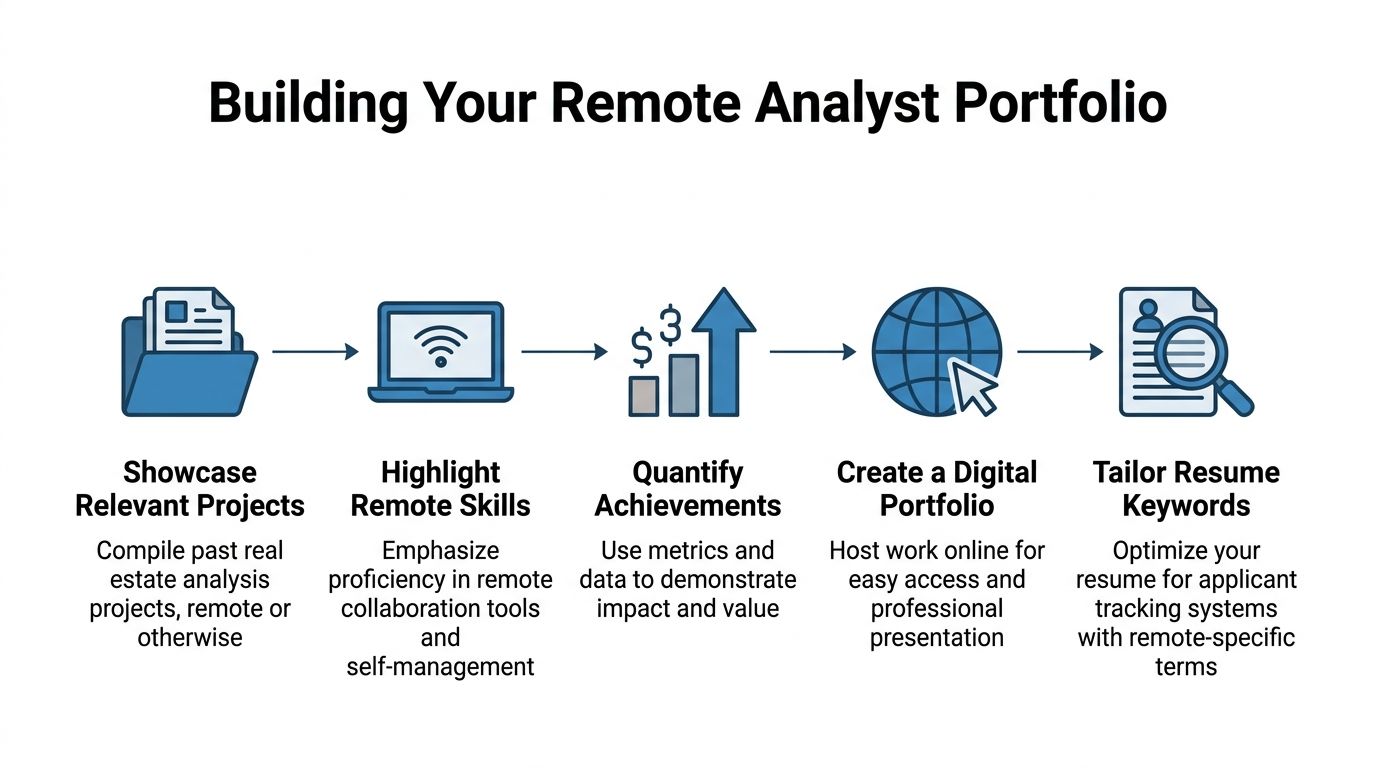
A portfolio beats a claim. If you say you can analyze real estate data, underwrite opportunities, and communicate findings remotely, show it in files, writeups, and project outputs.
Most applicants miss the mark by sending a resume full of tool names and generic bullets. Hiring managers want evidence that you can produce reliable work with structure and discipline. Analyst career guidance makes that standard clear. Strong analysts are judged on attention to detail, reliability with deadlines, proactive automation or process improvement, and quantifiable outputs like transaction volume, year-over-year growth, and deliverable quality. The right benchmark is to treat every report like a controlled production artifact, not an ad hoc spreadsheet (analyst workflow guidance).
Build projects that look like actual analyst work
Your portfolio shouldn't feel academic. It should resemble the output of a junior or mid-level analyst.
Good project formats include:
Market screening project
Rank zip codes in one metro for a specific strategy such as small multifamily acquisition, fix-and-flip, or absentee-owner outreach.Deal memo project
Underwrite a property, summarize assumptions, list risks, and present an investment view in a short memo.Portfolio monitoring project
Track a set of properties monthly and show changes in listing status, ownership signals, or risk flags.Data cleanup project
Take messy source files and standardize fields, reconcile duplicates, and document your assumptions.
One practical option is using property datasets and workflow tools that mirror real analyst environments. For example, real estate investment analysis tools can help you frame projects around underwriting, market research, and portfolio review instead of random spreadsheet exercises.
What a strong portfolio project includes
A good project has five parts:
A clear question
Example: Which submarkets appear most attractive for small multifamily acquisition based on property characteristics, owner signals, and recent activity?A defined dataset
State what fields you used, how you filtered records, and where your assumptions came from.A repeatable method
Show your cleaning steps, logic, formulas, and checks. If someone can't follow your process, the project is weaker than you think.An executive output
Create a one-page memo, slide, or dashboard. Senior people won't dig through a workbook to find your conclusion.A risk section
Every real estate analysis has caveats. Include data gaps, assumption limits, and what needs human verification.
The portfolio item that gets attention isn't the prettiest one. It's the one that shows judgment, controls, and a useful recommendation.
How to write the resume bullets
Don't list responsibilities. Write proof.
Weak bullet:
- Responsible for analyzing property data and creating reports
Better bullet:
- Built a repeatable property screening model that standardized source fields, flagged exceptions, and produced investment summaries for target submarkets
Weak bullet:
- Used Excel and real estate tools to evaluate deals
Better bullet:
- Underwrote residential and multifamily opportunities using structured assumptions, comp selection logic, and sensitivity analysis, then summarized findings in executive-ready memos
What to publish
You don't need a fancy website. You need accessible proof.
Use a simple structure:
| Asset | Purpose |
|---|---|
| PDF memo | Shows business judgment |
| Spreadsheet or notebook | Shows technical process |
| Short README | Explains assumptions and workflow |
| LinkedIn project entry | Makes the work easy to find |
A remote-ready candidate looks organized before the interview starts. Your portfolio should do that work for you.
Where to Find High-Quality Remote Analyst Openings
A broad job-board search can produce dozens of “remote real estate analyst” results, but title volume is a weak filter. Many of those postings are really transaction coordination, sales support, or admin work with a finance label attached. Good candidates waste weeks applying to the wrong jobs because they screen by title instead of deliverables.
Start with employer type. That tells you more about the work than the title does.
| Employer type | Typical work | Upside | Trade-off |
|---|---|---|---|
| REITs and large operators | Reporting, portfolio analysis, lease and asset tracking | Structured training, defined process | Slower change, narrower role scope |
| Private equity and investment shops | Underwriting, diligence, acquisition support | High-signal deal exposure | Faster pace, less hand-holding |
| Brokerage and advisory firms | Market research, comps, client reporting | Variety of assignments | Deadline swings and presentation pressure |
| Proptech companies | Data analysis, product-facing research, market intelligence | Modern tools, remote-native habits | Role definitions can be less traditional |
I usually tell candidates to search for work product, not job titles. “Analyst” is too loose. “Own weekly portfolio reporting,” “build acquisition models,” and “reconcile property datasets across systems” are much better signals.
How to screen postings fast
Read the responsibilities section like a hiring manager reading a sample memo. Look for concrete outputs, systems, and decision support.
Prioritize listings that mention:
- Portfolio or lease analysis
- Recurring reporting
- Financial modeling
- Due diligence
- Data reconciliation
- Specific systems, datasets, or SQL/Excel workflows
Be careful with postings built around phrases like “support the team,” “assist agents,” or “real estate experience preferred” without naming the analysis itself. If the company cannot say what data you will handle, what reports you will produce, or what decisions your work informs, the role is usually too vague.
One fast test works well. Ask: what will this person deliver by day 30? If the posting does not answer that, keep digging or move on.
Search strategy that gets better results
Use narrower search strings tied to actual analyst tasks:
- real estate analyst remote underwriting
- remote portfolio analyst lease analysis
- remote acquisitions analyst property data
- real estate data analyst remote financial modeling
Then stop relying on keyword feeds alone. Build a target list of firms and check career pages directly. Include owners, lenders, brokerages, valuation firms, and proptech companies. Remote analyst hiring is often inconsistent across boards, and some of the better roles get posted on a company site first.
This is also where your portfolio changes the search process. If you built a clean project using parcel, ownership, or market data in BatchData and turned it into a short investment memo or dashboard, you can target proptech and data-heavy real estate teams with a much stronger message. Instead of saying you have analytical skills, you can show a hiring manager the exact type of remote work they need done. Candidates pursuing those roles should also review this guide to proptech interviews and databases, because many of these teams care as much about data judgment as classic underwriting.
For candidates interested in startup environments, this piece on actionable strategies for remote work is useful because startup hiring often happens outside the most obvious search paths. In proptech, that matters. Titles get messy, but the actual work can be highly analytical.
How to Pass the Remote Interview and Case Study
Remote interviews reward preparation that's visible. The hiring team can't see how you carry yourself in an office, so they judge your setup, your clarity, and your discipline through a screen.
That starts before the first question. Your camera angle, audio quality, screen-sharing readiness, and file organization all send signals. A strong analyst doesn't fumble for a workbook or explain that a formula broke “for some reason.”

How to handle the live interview
Most interviewers are trying to answer three questions:
- Can this person think clearly with incomplete information?
- Can this person communicate analysis without rambling?
- Can this person operate independently in a remote workflow?
Your answers should reflect that.
Use short structures:
- Situation
- Your method
- The output
- The risk or limitation
- What you improved
That format works especially well for questions about ambiguity, deadlines, data errors, and cross-functional work.
If the role touches APIs, structured datasets, or proptech tooling, this guide to proptech interviews and databases is worth reviewing. It helps candidates speak more precisely about the technical layer behind analyst work instead of staying stuck at the spreadsheet surface.
How to approach the case study
Treat the case as a simulation of your working style, not just a technical exam.
A good approach looks like this:
Clarify the ask early
Confirm what decision the model is supposed to support.State assumptions explicitly
Don't bury them in formulas. Put them where a reviewer can find them fast.Build for readability
Separate inputs, calculations, and outputs. Label tabs and use consistent logic.Stress-test the key variables
Show what changes the recommendation, not just the base case.Write a short conclusion
Summarize what you recommend, why, and what still needs verification.
A messy but technically correct model can lose to a cleaner model with better judgment and communication.
A useful prep resource sits below. Watch it the same way a hiring manager watches your case. Focus on how the candidate explains choices, not just how they build the file.
What candidates get wrong
They overbuild. They don't explain assumptions. They submit a workbook with no narrative. Or they answer every question as if they're trying to prove intelligence instead of reliability.
Remote analyst hiring favors candidates who make the reviewer's job easy. That's the standard.
What to Expect for Salary and How to Negotiate
Remote real estate analyst pay is real, but it isn't uniform. It moves with asset complexity, employer type, modeling depth, and how much independent judgment the role requires.
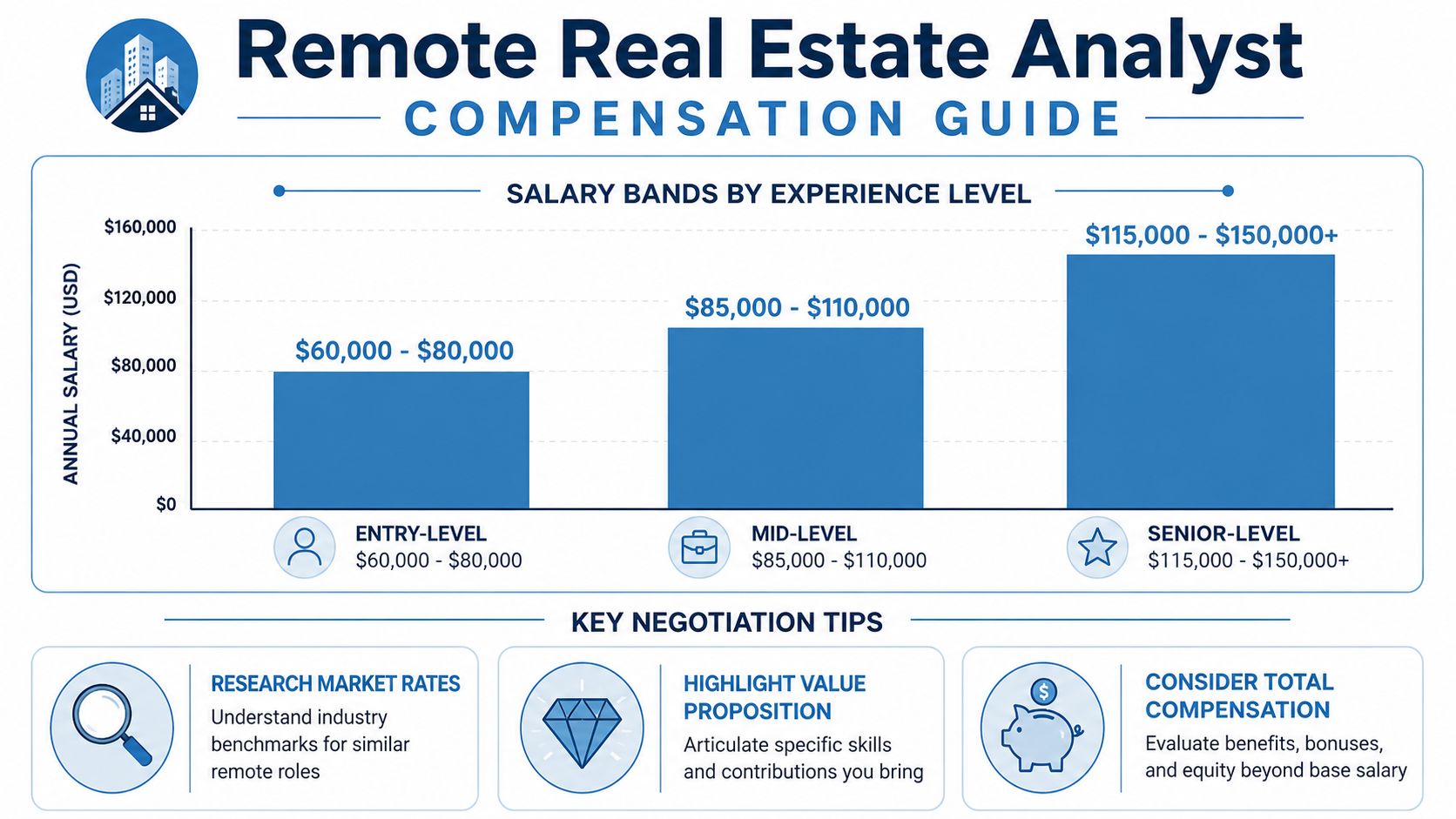
The cleanest benchmark in the verified data is range, not a single “market rate.” Public listings show one remote role at $52,885.70 to $63,690.30 per year and another fully remote analyst role at $60,000 to $80,000 annually. A broader advertised remote range reaches $37K to $167K. Separate salary data also shows averages among top employers ranging from about $63,997 to $80,862, which reinforces the point that pay changes materially with employer and scope.
How to read the range correctly
Don't anchor on the highest number you see online. Ask what the company is buying.
| Pay driver | Usually means |
|---|---|
| Entry-level range | Research-heavy work, cleaner datasets, more supervision |
| Mid-range roles | Independent modeling, recurring reporting, cross-team communication |
| Higher-end roles | Complex underwriting, portfolio judgment, stronger systems ownership |
If your background is lighter, negotiate from demonstrated capability. If your background is deeper, negotiate from replacement cost. In plain terms, show that hiring you reduces manager review time, improves data reliability, and increases confidence in the output.
What to say in negotiation
A good salary conversation sounds like this:
Reference scope, not entitlement
Tie your ask to the level of analysis, autonomy, and reporting ownership expected in the role.Use your portfolio as evidence
Point to projects that show disciplined modeling, documented assumptions, and executive-ready outputs.Negotiate total package if base is tight
Remote roles may have flexibility around equipment, learning budget, or schedule structure even when base pay is constrained.
Your leverage is strongest when you can show how you work, not when you argue abstract market averages.
One more rule. Don't negotiate like a generic remote candidate. Negotiate like an analyst. Be specific, document your reasoning, and connect your request to the value you can produce.
If you're serious about landing remote real estate analyst roles, build your portfolio around real property data and repeatable analysis workflows. BatchData gives teams access to large-scale U.S. property records, ownership, valuation, mortgage, lien, listing, and permit data through APIs and bulk delivery, which makes it a practical option for building analyst-style projects that look closer to actual hiring-team use cases than a generic spreadsheet exercise.