






































A county code is a unique 5-digit numeric ID for every U.S. county, acting as the universal key for all property data. Think of it as a Social Security Number for a geographic jurisdiction, designed by the federal government to standardize location information across thousands of disconnected databases. Its sole purpose is to eliminate the ambiguity from inconsistent place names, ensuring a property record in Texas isn't confused with one in Florida.
For real estate investors, lenders, and proptech platforms, this code is the non-negotiable foundation for accurately pinpointing properties, analyzing market trends, and managing risk. Without it, unifying data is a manual, error-prone nightmare.
- Core Takeaways:
- The Standard: The 5-digit FIPS (Federal Information Processing Series) code is the universal identifier.
- Structure: It combines a 2-digit state code and a 3-digit county code (e.g., 06037 for Los Angeles, CA).
- Function: It acts as a "primary key" to link tax, deed, mortgage, and zoning data into a single, unified property profile.
- Critical Difference: FIPS codes define stable government jurisdictions, unlike ZIP codes which define fluid mail routes.
This guide breaks down exactly how this simple number structures the entire real estate data ecosystem.
How Are County Codes Structured?
A FIPS county code is a 5-digit number architected for nationwide data integrity and interoperability. The structure is not random; it is a logical system designed to give every county-level jurisdiction in the U.S. a unique, machine-readable identifier, solving the problem of ambiguous or duplicate place names.
The first two digits identify the state, and the next three pinpoint the specific county within that state. For example, the FIPS code 06037 breaks down cleanly: ‘06’ is the code for California, and ‘037’ is the specific code for Los Angeles County. This systematic approach is the foundation of any reliable, large-scale data work in real estate.
FIPS Code Structure Breakdown
This table shows how the standard 5-digit FIPS county code is structured. The combination of a state and county identifier creates a unique code that ensures data consistency nationwide.
| Component | Digit Length | Description | Example (Los Angeles County, CA) |
|---|---|---|---|
| State Identifier | 2 Digits | The FIPS code for the specific U.S. state. | 06 (California) |
| County Identifier | 3 Digits | The FIPS code for the specific county within that state. | 037 (Los Angeles County) |
| Full FIPS Code | 5 Digits | The combined, unique code for the county jurisdiction. | 06037 |
This structure prevents data collisions. There are 31 "Washington" counties in the U.S., but Washington County, Florida (12133) is structurally distinct from Washington County, Oregon (41067). This precision is a level that other identifiers, like ZIP codes, cannot provide.
While a county code defines a government jurisdiction, the Assessor’s Parcel Number (APN) identifies an individual land parcel within that county.

Why Are County Codes Critical for Real Estate Analysis?
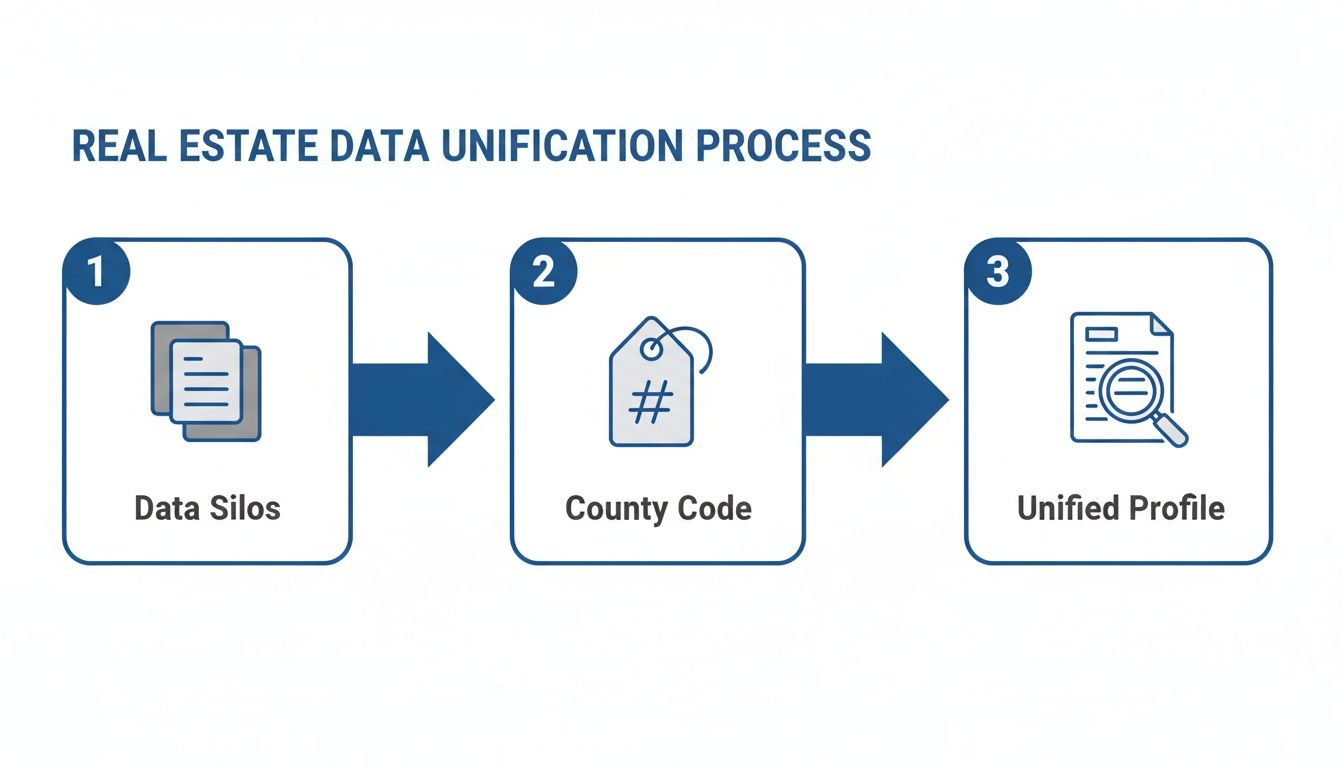
County codes are the secret ingredient that turns mountains of raw, disconnected property data into strategic, actionable intelligence. They act as the primary key that connects otherwise separate datasets, allowing you to merge a property’s tax records, deed history, zoning files, and permit filings into a single, unified profile.
For a mortgage lender, county codes enable precise tracking of pre-foreclosure filings, flagging risk in specific jurisdictions. For an investor, they allow for laser-focused targeting of high-growth counties ripe for acquisition. Without this standardized key, real estate operations at scale grind to a halt.
FIPS vs. Other Geographic Identifiers
Confusing county codes with ZIP codes is a critical error in data analysis. They serve entirely different functions and have vastly different levels of reliability.
For a deeper dive, check out our guide on the differences between county maps and ZIP codes.
| Identifier | Purpose | Stability | Primary Use Case in Real Estate |
|---|---|---|---|
| FIPS County Code | Defines a stable government & legal jurisdiction. | Very High. Boundary changes are rare and tracked. | Legal records, tax assessment, risk modeling. |
| ZIP Code | Defines a mail delivery route for the USPS. | Low. Routes change frequently for efficiency. | Direct mail marketing, logistics. |
| Assessor's Parcel Number (APN) | Identifies a specific, individual parcel of land. | High. Tied to the physical land parcel. | Pinpointing a single property's history. |
The Power of Data Unification
The true power of county codes is their ability to create a single source of truth from dozens of disparate data sources.
- For Market Analysis: An investor can analyze home price appreciation across every county in a state, pinpointing undervalued markets right next to overheated ones.
- For Due Diligence: A land buyer can instantly pull all relevant documents tied to a specific county—a critical step for understanding local zoning rules and legal access.
- For Risk Management: A national lender can aggregate loan-to-value ratios by county to spot the early warning signs of market distress.
This granular analysis is impossible with ZIP codes, which often cross county lines and do not align with the legal and taxing boundaries that govern real estate.
The Economic Impact of Standardized Data
The FIPS system, standardizing data across 3,144 U.S. county-level jurisdictions, has massive economic implications. An estimated 72% of U.S. GDP—over $21 trillion in 2023—is directly tied to real estate activity organized and analyzed by county.
For investors, this concentration of value is staggering: the top 10 U.S. counties by property equity now hold $2.1 trillion, a 45% increase since 2010. This is the high-value intelligence that fuels powerful tools like BatchData. In a market where county-level data can predict up to 75% of value shifts, working with standardized identifiers isn't an advantage—it's essential.
How Do You Find a Property's County Code?
The correct method for finding a county code depends entirely on scale. For a single property, a manual search is sufficient. For processing thousands of records, an automated, programmatic solution is the only viable option.
Manual vs. Automated Lookup
Manual lookups are free and effective for homeowners or small-scale investors who need a quick answer.
- U.S. Census Bureau: Provides a geocoding tool to find FIPS codes from an address.
- FFIEC Geocoding System: A tool used by federal financial institutions that provides state, county, and census tract codes for any street address.
For professionals, the only practical solution is a geocoding API. These services automatically convert a street address into its geographic coordinates and associated data, including the correct FIPS county code. This is the engine running behind every modern real estate platform. A geocoding API doesn't just find the code; it standardizes it, ensuring every address is matched to the correct 5-digit FIPS format.
To see this in action, check our guide on how to find the county for any address.
The Platform Solution
For true scalability, a dedicated data platform is the most robust solution. These platforms handle the entire workflow automatically: ingesting raw data, cleaning it, normalizing identifiers, and enriching it with hundreds of additional data points.
Platforms like BatchData automate this process end-to-end. When you access a property record, the correct, standardized county code is already validated and integrated. This eliminates countless hours of manual lookups and painful data-cleansing projects, freeing your team to focus on analysis and execution.
What Are Common Data Pitfalls with County Codes?
The smallest errors in county information can poison an entire dataset, leading to flawed analysis and bad investments. These are not minor hiccups; they are foundational problems that derail strategies.
A common issue is inconsistent naming conventions. A lookup fails because one dataset uses "St. Lucie County" while another has "Saint Lucie County." That simple discrepancy means records for the same location will never match. A single transposed digit in a FIPS code—'06037' becoming '06073'—can instantly misclassify a property from Los Angeles County to San Diego County, destroying the integrity of any market analysis.
Deceptive Jurisdictional Errors
A more subtle pitfall is jurisdictional confusion with independent cities. States like Virginia have dozens of cities that function as county-equivalents with their own unique FIPS codes but are often mistaken for being part of an adjacent county.
For example, the City of Richmond, VA (FIPS 51760) is separate from Henrico County, VA (FIPS 51087). Confusing them leads to wildly inaccurate demographic, tax, and property value assessments.
Another critical mistake is relying on outdated data. County boundaries and codes change. In 2013, Shannon County, SD (FIPS 46113) was renamed and recoded to Oglala Lakota County (FIPS 46102). An old dataset will contain non-existent geographic codes, leaving huge holes in your analysis.
Why DIY Data Normalization Fails
Attempting to clean and normalize county data in-house is a massive drain on time and resources that rarely succeeds at scale. It requires constant monitoring of government sources, building complex validation rules, and manually fixing an endless stream of exceptions.
| Challenge | DIY Data Cleansing Approach | Professional Data Provider Solution |
|---|---|---|
| Inconsistent Naming | Manual find-and-replace; time-consuming and error-prone. | Automated normalization using proprietary alias libraries. |
| Outdated FIPS Codes | Relies on periodic, often infrequent, manual updates. | Daily monitoring of government sources for code changes. |
| Jurisdictional Errors | Requires deep, state-specific geographic knowledge to prevent. | Pre-validated datasets with correct county-equivalent assignments. |
| Data Entry Typos | Extremely difficult to catch without cross-referencing multiple sources. | Automated validation against master property and geospatial records. |
A dedicated service like BatchData handles the grueling task of data normalization for you. It delivers a clean, reliable, and up-to-date dataset, freeing your team from the data integrity headaches that plague real estate operations.
Frequently Asked Questions (FAQ)
Here are direct answers to the most common questions about county codes in real estate data.
What is the difference between a county code and a ZIP code?
A county code defines a permanent legal and tax jurisdiction, while a ZIP code defines a fluid mail delivery route. County codes (FIPS) are essential for any analysis tied to legal records, taxes, or risk because their boundaries are stable and official. ZIP codes are managed by the USPS for logistical efficiency and their boundaries change frequently, often crossing county lines, making them unreliable for serious property analysis.
Are FIPS codes the only type of county code?
No, but they are the only ones that matter for national-scale data analysis. Some local municipalities use their own proprietary codes, but these create isolated data silos that are incompatible with national datasets. The FIPS code, harmonized with ANSI standards, is the undisputed universal standard for data interoperability among proptech platforms, financial institutions, and government agencies.
How does BatchData ensure its county codes are accurate?
We treat county code accuracy as the bedrock of our platform through a continuous, multi-layered validation system.
- Source Triangulation: We cross-reference data from multiple authoritative sources, including federal, state, and county-level government records, to validate every code.
- Daily Updates: Our systems scan for jurisdictional changes (like renames or recoding) daily, ensuring our database reflects these updates almost immediately.
- Algorithmic Standardization: Our proprietary algorithms automatically detect and correct common errors like typos ("St." vs. "Saint") and format inconsistencies, cleansing and normalizing the data at a scale impossible to achieve manually.
This relentless focus on validation delivers clean, standardized county codes baked into every property record, eliminating the data integrity issues that plague most real estate operations.
Stop wrestling with messy data and start making decisions with confidence. BatchData provides the clean, accurate, and standardized property data you need to scale your operations. Explore our platform today.