SEO Title: Real Estate Due Diligence Checklist: 10 Critical Items
Meta Description: Our 10-point real estate due diligence checklist covers title, liens, taxes, and zoning. Get the institutional-grade framework for de-risking any property.
Meta Keywords: real estate due diligence checklist, property due diligence, commercial real estate due diligence, due diligence checklist real estate, property investment checklist
Overlooking one item in due diligence turns a promising real estate investment into a financial catastrophe, a risk highlighted by data showing **11% of real estate transactions are terminated due to inspection issues alone**. A flawed process costs more than the deal; it erodes capital, wastes time, and creates unforeseen legal liabilities. The difference between a profitable acquisition and a portfolio-sinking mistake is the rigor of your investigation.
This comprehensive **real estate due diligence checklist** provides a systematic, 10-point framework to de-risk any acquisition, from residential flips to commercial portfolios. It delivers an institutional-grade analysis for protecting your investment by detailing the exact documents, data points, and red flags you must scrutinize.
| Core Due Diligence Pillar | Key Objective |
|---|---|
| **Legal & Title Verification** | Ensuring clear ownership and identifying hidden claims. |
| **Financial Scrutiny** | Analyzing existing debts, tax status, and operational costs. |
| **Physical & Environmental** | Assessing structural integrity and potential hazards. |
| **Regulatory & Zoning** | Verifying legal use, permits, and restrictions. |
This guide provides the actionable steps needed to verify every critical aspect of a property, ensuring you identify and mitigate risks *before* closing, not after.
## What is the first step in a property title check?
**Verifying a property’s title** is the bedrock of any real estate due diligence checklist. This step confirms the seller's legal authority to transfer ownership and uncovers any competing claims, liens, or encumbrances that could jeopardize the transaction. A "_clear title_" means the property is free from defects that could challenge the buyer's ownership rights.
The process involves a detailed examination of public records to trace the property's "chain of title." Any breaks in this chain, unresolved liens, outstanding property taxes, or boundary disputes create a "cloud" on the title, rendering it unmarketable until resolved.

### Actionable Title Verification
* **Order a Title Search Early**: Engage a title company to run a preliminary title report as soon as a property is under contract. This provides a formal record of all recorded documents affecting the property.
* **Cross-Reference Ownership Data**: Use real estate data platforms to instantly access ownership records. Compare this with public county assessor data to identify discrepancies in names, addresses, or legal descriptions.
* **Analyze Transfer History**: Scrutinize the chain of title for unusual patterns. Rapid, successive sales ("flipping") in a short period can indicate distressed activity that warrants deeper investigation.
* **Verify Entity Ownership**: If the property is owned by an LLC or corporation, confirm the entity is in good standing with the state and the person signing is an authorized agent.
Meticulously validating ownership prevents future legal battles and financial losses. Learn more about navigating the [5 common issues in title verification](https://batchdata.io/blog/5-common-issues-in-title-verification) that can derail a deal.
## Why is a lien and encumbrance search critical?
**A comprehensive search for financial claims** against the property is essential for uncovering liens, judgments, and other encumbrances. These financial obligations are tied to the real estate, and identifying them is necessary for understanding the property's true cost and avoiding unexpected liabilities.
An "_encumbrance_" is any claim or liability attached to a property that may diminish its value or limit its use but does not necessarily prevent the transfer of title. These range from mortgage liens to mechanic's liens filed by unpaid contractors. Without a thorough search, a buyer could inherit these debts.

### Actionable Lien and Encumbrance Search
* **Run Concurrent Searches**: Conduct lien searches simultaneously across federal, state, and county databases. A property might be clear at the county level but have a significant federal tax lien attached.
* **Obtain Official Payoff Letters**: Do not rely on verbal estimates. Request formal payoff letters from all identified lienholders to confirm the exact amounts required to clear the encumbrances.
* **Review UCC Filings**: Check for Uniform Commercial Code (UCC) filings, which can reveal liens against personal property (like commercial equipment) that are included in the sale and could be repossessed.
* **Monitor for New Filings**: Continuously monitor the property for newly filed liens between the initial search and the closing date. A last-minute mechanic's lien can derail the entire transaction.
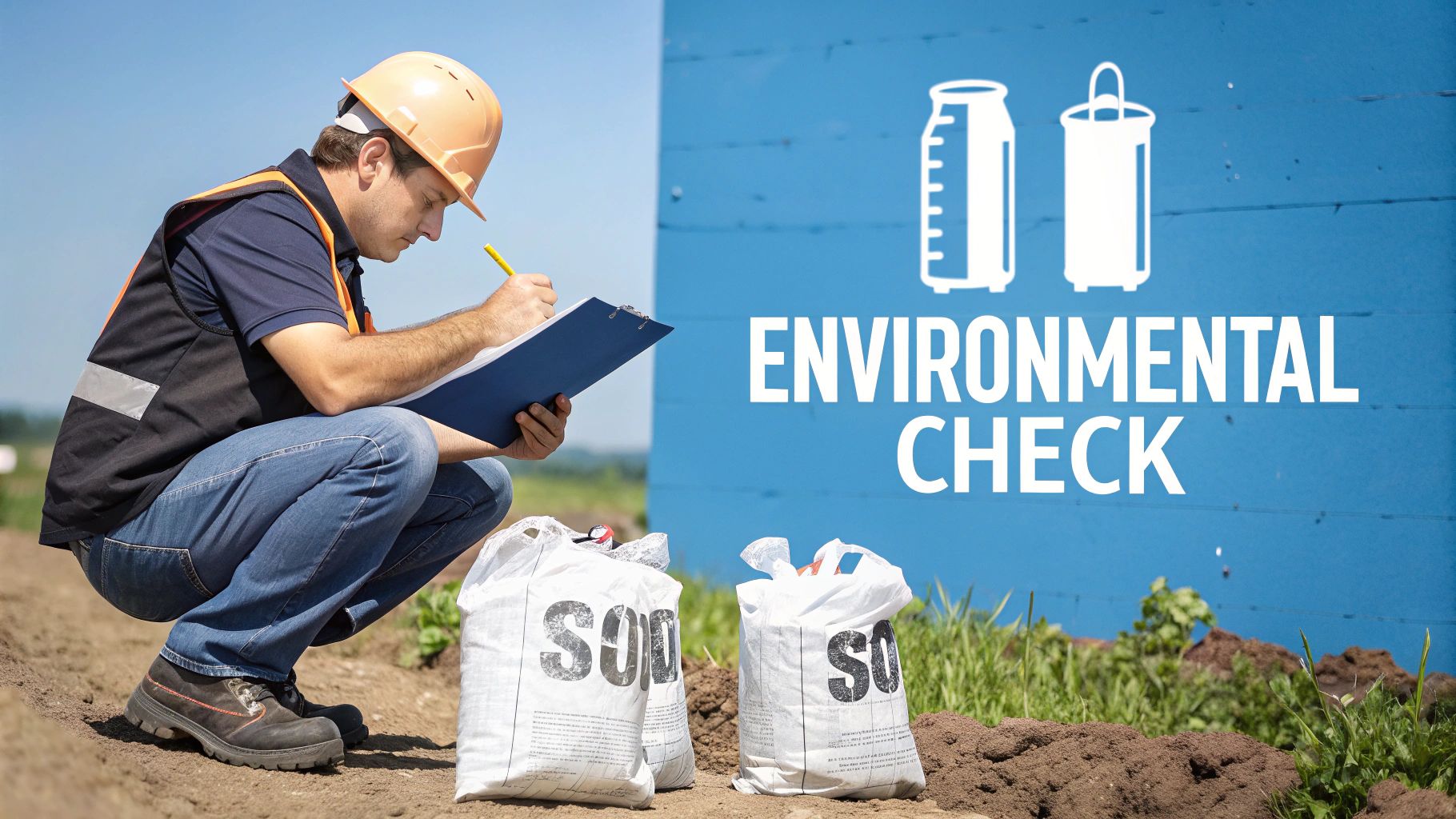
## What does a Phase I Environmental Assessment identify?
**A Phase I Environmental Site Assessment (ESA)** identifies potential environmental contamination liabilities. This non-intrusive process combines with a general property condition inspection to uncover hidden issues, from structural defects to hazardous materials. Identifying these problems early is essential for calculating remediation costs and understanding liability exposure.
The Phase I ESA involves reviewing historical records, government databases, and conducting a site visit to identify "_recognized environmental conditions_" (RECs). Discovery of potential contamination, such as an old underground storage tank, gives the buyer critical leverage to renegotiate, demand cleanup, or walk away from a potentially catastrophic investment.
### Actionable Environmental & Condition Assessment
* **Engage a Professional Early**: Commission a Phase I ESA from a qualified environmental firm as soon as a property is under contract, especially for commercial, industrial, or older properties.
* **Budget for Phase II**: If the Phase I report identifies RECs, be prepared for a Phase II assessment, which involves invasive soil and groundwater sampling to confirm the presence and extent of contamination.
* **Verify Permit and Violation History**: Use data platforms to cross-reference a property’s environmental history with local permit and violation records. This can uncover past issues or undisclosed contamination sources.
<iframe width="560" height="315" src="https://www.youtube.com/embed/adS7aSjSvTc" frameborder="0" allow="accelerometer; autoplay; clipboard-write; encrypted-media; gyroscope; picture-in-picture" allowfullscreen></iframe>
## How does a title insurance commitment protect a buyer?
**A title insurance commitment** provides a formal promise from a title insurance company to issue a policy, contingent upon resolving specific requirements and clearing listed exceptions. It serves as the final checkpoint for securing a buyer’s ownership rights against future claims.
The commitment details the scope of coverage, identifies who is insured, and lists all exceptions that will *not* be covered by the final policy. These exceptions can range from standard utility easements to significant defects like unreleased liens. Reviewing and negotiating these items is a non-negotiable step to protect the investment and satisfy lender requirements.
### Actionable Title Insurance Verification
* **Review All Schedules**: Meticulously review Schedule A for accuracy of names and legal descriptions, and scrutinize Schedule B for requirements and exceptions that must be addressed.
* **Negotiate Exception Removal**: Do not accept all exceptions as-is. Many standard exceptions, such as unrecorded mechanics' liens, can be removed with proper documentation like an owner's affidavit or a recent property survey.
* **Confirm Lender Requirements**: Lenders have specific title insurance requirements, often mandating a separate lender's policy and certain endorsements. Verify these needs upfront.
* **Consider Extended Coverage**: For investment properties, especially those with a history of foreclosure, an extended coverage policy provides protection against risks not covered by a standard policy, such as survey errors or unrecorded easements. The process can be streamlined using a First American approved RON platform for efficient closings.
## What is the purpose of analyzing a seller's mortgage?
**A deep dive into all current mortgages, loans, and other financial encumbrances** is required to understand the seller's debt structure. This analysis ensures the buyer knows exact payoff amounts, prepayment penalties, and other clauses that could impact the transaction's financial viability.
Failing to scrutinize these documents can lead to costly surprises. A buyer might assume a loan can be paid off at closing, only to discover a substantial prepayment penalty that was not factored into the budget. This analysis confirms the exact funds needed to clear all liens, preventing closing delays.
### Actionable Financial Analysis
* **Request Payoff Letters Early**: Immediately request official payoff and estoppel letters from all lenders and lienholders. These documents provide the exact amount required to satisfy the debt.
* **Verify Payoffs Directly**: Always verify loan payoff amounts directly with the mortgage servicer or lender, not just the seller, to avoid discrepancies.
* **Scrutinize Loan Documents**: Carefully review all loan agreements for prepayment penalties, defeasance clauses, or recapture provisions which can add significant costs.
* **Confirm Loan Assumability**: Check for a "due-on-sale" clause, which requires the loan to be paid off upon sale. If the loan is potentially assumable, investigate the lender's specific conditions.
## How are property tax obligations verified?
**Scrutinizing property taxes** means understanding the property's assessed value, identifying potential delinquencies, and uncovering hidden costs like special assessments. Accurate tax verification ensures that financial projections are sound and prevents buyers from inheriting costly liabilities.
Failing to verify tax obligations can lead to significant financial strain. An investor might budget based on the current owner's tax bill, only to face a much higher amount after a reassessment triggered by the sale. Undisclosed tax liens can jeopardize ownership and require immediate, unplanned capital outlay to clear the title.
### Actionable Tax Verification
* **Obtain Official Tax Records**: Pull current and historical tax statements directly from the county assessor or tax collector's website to confirm assessed value and payment history.
* **Check for Delinquencies**: Verify that there are no outstanding tax balances or liens. If back taxes are owed, request a formal payoff letter from the taxing authority.
* **Identify Special Assessments**: Investigate whether the property is part of a special assessment district for infrastructure improvements (e.g., sewers, roads), which can add multi-year costs.
* **Analyze Appeal Potential**: Compare the property's assessed value against recent sales data. A significant discrepancy may present a strong case for a tax appeal, but be mindful of strict deadlines.
A [real estate tax calculator](https://batchdata.io/blog/real-estate-tax-calculator) can help forecast these critical holding costs more accurately.
## What is the risk of incorrect property zoning?
**Incorrect zoning can render an asset unusable for its intended financial purpose.** Confirming a property's zoning classification is a critical checkpoint that dictates what can legally be built and operated on the site. Overlooking these rules leads to costly redesigns or legal battles.
Zoning laws regulate building height, density, setbacks, and permitted activities. A property might also have a "_non-conforming use_" status, meaning its current use was permitted before zoning laws changed but may not be allowed to be rebuilt or expanded under current regulations. This verification step protects investors from purchasing land that is fundamentally unsuitable for their project.

### Actionable Zoning Verification
* **Obtain a Zoning Verification Letter**: Request an official letter from the local municipal planning or zoning department. This document provides a definitive statement of the property’s zoning classification.
* **Review Comprehensive Land Use Maps**: Analyze the municipality’s future land use maps. These documents can reveal long-term plans for the area that may signal future zoning changes.
* **Identify Variances and Overlays**: Look for any special permits, variances, or overlay districts (e.g., historic, conservation) that impose additional restrictions on the property.
* **Confirm HOA and Deed Restrictions**: Review Homeowner Association (HOA) covenants and deed restrictions, as they can impose stricter limitations on property use than the local government.
A dedicated [property zoning checker](https://batchdata.io/blog/property-zoning-checker) can streamline this research.
## How is property insurability assessed during due diligence?
**Assessing insurability verifies that an asset can be protected against loss and provides a clear picture of ongoing insurance costs.** An uninsurable property or one with prohibitively high premiums can derail an acquisition.
The process involves obtaining preliminary quotes and scrutinizing underwriting requirements. Factors like the property's age, location (e.g., flood zones), claims history, and condition of major systems (roof, plumbing, electrical) are all assessed. Discovering that a property is uninsurable late in the game can lead to costly closing delays.
### Actionable Insurance Verification
* **Secure Preliminary Quotes Early**: Engage an insurance broker to obtain multiple quotes as soon as the property is under contract to estimate annual premiums and identify underwriting hurdles.
* **Review the Property's Claims History**: Request a CLUE (Comprehensive Loss Underwriting Exchange) report, which details insurance claims filed in the past seven years that impact premiums.
* **Assess Major System Conditions**: Pay close attention to the age and condition of the roof, HVAC, electrical, and plumbing systems, as outdated systems can trigger surcharges or coverage denials.
* **Verify Specialized Coverage Needs**: If the property is in a designated flood, wildfire, or earthquake zone, confirm the availability and cost of specialized policies.
## What municipal records should be checked?
**Checking a property's permit history and code violation records is essential.** This step ensures all structures were built with the required permits and are free from outstanding code violations. Uncovering unpermitted work or existing citations prevents inheriting fines, mandated repairs, or demolition orders.
A property’s compliance history provides a clear window into its physical and legal integrity. For instance, a finished basement completed without electrical and plumbing permits represents a significant liability. Outstanding code violations can become liens against the property, which must be paid before a clear title can be transferred.
### Actionable Compliance Verification
* **Request a Comprehensive Permit History**: Contact the local municipal building department to obtain a full record of all permits issued for the property address.
* **Cross-Reference Permits with Improvements**: Compare the official permit history against the property's actual features. A new deck or bathroom without a corresponding permit is a major red flag.
* **Search Code Enforcement Databases**: Check the municipality’s code enforcement website for any open or recent citations linked to the property, revealing ongoing maintenance or safety issues.
* **Verify Certificate of Occupancy**: Ensure the property’s current Certificate of Occupancy (CO) matches your intended use, especially when converting a single-family home to a rental.
## Why is reviewing HOA documents so important?
**Reviewing HOA documents is critical because they dictate property use, outline financial obligations, and impose restrictions that impact value.** These documents reveal the community's financial health and operational stability, protecting you from future liabilities and unexpected costs.
This process involves analyzing Covenants, Conditions & Restrictions (CC&Rs), bylaws, and financial statements. These records can uncover a history of steep special assessments, rules prohibiting certain activities, or ongoing litigation. For an investor, a CC&R that forbids short-term rentals could invalidate their business model for a property.
### Actionable HOA and Covenant Review
* **Obtain a Complete Document Package**: Request all governing documents from the seller or HOA, including CC&Rs, bylaws, the two most recent annual budgets, and recent board meeting minutes.
* **Analyze Financial Health**: Scrutinize the HOA's budget, balance sheet, and reserve study. A poorly funded reserve for future capital expenditures is a major red flag for upcoming special assessments.
* **Identify Use Restrictions**: Read the CC&Rs for restrictions that conflict with your plans, such as clauses related to renting, home businesses, pets, or architectural modifications.
* **Investigate Pending Litigation**: Ask the HOA management company about any current or pending litigation involving the association, which can drain financial reserves.
* **Verify Fees in Writing**: Get a written statement detailing all current dues, pending assessments, and any transfer fees required at closing.
## What is the best way to compare due diligence tasks?
A comparison table is the most effective way to evaluate the complexity, resource needs, and outcomes of each due diligence step, allowing you to prioritize efforts based on the property type and transaction goals.
| Item | Complexity 🔄 | Resource Needs ⚡ | Expected Outcomes 📊 |
|---|---|---|---|
| Property Title Verification | Moderate | Title company, public records | Clear ownership, defects flagged |
| Lien & Encumbrance Search | High | Court, tax, UCC databases | All liens identified; priority & payoff amounts |
| Condition & Phase I ESA | High | Environmental consultant, budget | REC identification; remediation risk estimates |
| Title Insurance Commitment | Moderate | Title insurer, survey, legal review | Coverage scope & exceptions identified |
| Financial Obligation Analysis | Moderate–High | Loan docs, servicer contact | Payoff amounts, penalties, assumability status |
| Property Tax Verification | Low–Moderate | County assessor/tax roll data | Current taxes, delinquencies, appeal opportunities |
| Zoning Compliance Check | High | Planning dept records, zoning maps | Permitted uses, variance/restriction needs |
| Insurance Underwriting Review | Moderate | Insurance brokers, CLUE reports | Insurability, premium estimates, exclusions |
| Permit & Code Violation Search | Moderate–High | Municipal permit/code databases | Open violations, unpermitted work, remediation needs |
| HOA & Covenant Review | Moderate | HOA docs, financials, CC&Rs | Fees, restrictions, reserve health, enforcement risk |
## From Checklist to Competitive Edge: Operationalizing Due Diligence
Completing a real estate due diligence checklist is not a passive, box-ticking exercise; it is an active strategy for risk mitigation and value creation. The difference between amateur and professional investors lies in operationalizing this process, transforming raw data into decisive action. A sophisticated investor uses findings to renegotiate terms, forecast capital expenditures, or walk away from a deal that, on the surface, appeared flawless.
### Key Takeaways: From Theory to Action
Mastering due diligence requires a shift in perspective. It is not about avoiding all risk but about understanding, quantifying, and strategically managing it.
* **Proactive Verification Over Reactive Correction**: Use advanced data platforms to pre-screen properties for red flags like liens or zoning issues. This allows you to focus deep-dive efforts on opportunities with the highest probability of success.
* **Integration is Power**: True insights emerge from the intersection of data. For example, a recent building permit (from municipal records) for an addition not reflected in the property tax assessment (from county records) signals a future tax hike.
* **Speed as a Strategic Advantage**: In a competitive market, the speed and accuracy of your due diligence are often deciding factors. Verifying title, liens, and permits in minutes—not days—allows you to make confident offers while others are still waiting for paperwork.
### Turning Your Checklist into a System
The most successful investors have a system built around their checklist. This involves standardizing the process, assigning clear responsibilities, and defining action plans. To ensure meticulous management from due diligence through closing, leverage a robust [real estate transaction coordinator checklist](https://tabtablabs.com/blog/real-estate-transaction-coordinator-checklist) to complement your investigative efforts. This ensures that once diligence is complete, the execution of the closing is just as flawless.
A world-class real estate due diligence checklist is your shield against catastrophic losses and your key to unlocking hidden value. By embracing a systematic, data-driven approach, you transform a procedural necessity into your most powerful competitive advantage.
---
Ready to replace manual research with automated intelligence? **BatchData** provides instant access to the nationwide property data you need to execute your real estate due diligence checklist with unparalleled speed and accuracy. Stop chasing documents and start closing better deals by visiting [BatchData](https://batchdata.io) to see how our platform can revolutionize your investment strategy.
Article created using Outrank