

































Data dictionaries are the backbone of consistency in real estate data, solving the chaos caused by fragmented systems and inconsistent terminology across MLSs, brokerages, and platforms. They standardize how data is labeled, organized, and shared, ensuring clarity and accuracy for everyone, from agents to developers.
Key points:
- What it is: A structured guide defining data fields, categories, and values (e.g., "ListPrice" instead of "AskingPrice").
- Why it matters: Reduces errors, simplifies integration, and cuts costs for tech development.
- The RESO Data Dictionary: A standard used by 800+ organizations, covering 1,700+ fields and 3,100+ lookups.
- Benefits: Better data accuracy, easier tech integrations, and smarter decision-making for brokers, agents, and investors.
Without standardization, real estate data remains fragmented, creating inefficiencies and inflating costs. Tools like the RESO Data Dictionary are essential for aligning the industry and enabling seamless data sharing across platforms.

RESO Data Dictionary Impact: Key Statistics for Real Estate Standardization
Driving Technology Faster Using the Data Dictionary – RESO 2022 Spring
The Problem: Fragmented Data in Real Estate
The move from printed MLS books to digital platforms revolutionized the real estate industry, but it also created a patchwork of incompatible systems. Each organization developed its own unique field names, data formats, and structures, leaving the industry fragmented and disjointed. Instead of a seamless network, it became a maze of disconnected silos, creating widespread challenges for MLS data, developers, and real estate professionals.
Inconsistent Data Across MLSs
The inconsistencies in MLS data go far beyond minor naming differences. For example, one MLS might use a "Yes/No" field like HorseYN to indicate equestrian amenities, another might rely on a feature lookup list called HorseAmenities, and some even use both. This lack of standardization forces developers to implement custom logic for aggregating data across markets. While the RESO Data Dictionary was designed to bring order – defining over 1,700 fields and 3,100 lookups – many systems still haven’t adopted it, leaving the problem unresolved.
"Thousands of REALTOR® associations and MLSs adopted unique technology systems to serve their local markets. These systems often could not communicate with each other." – RESO
Impact on Developers and Businesses
These data inconsistencies don’t just create technical headaches – they slow innovation and inflate costs. Every MLS integration requires custom mapping, making it expensive and time-consuming to scale technology solutions. This creates a "lock-in" effect, where businesses become reliant on specific technology providers with proprietary data models that are difficult to migrate or integrate elsewhere. The financial impact is staggering: organizations lose an average of $12.9 million annually due to poor data quality. Much of this loss comes from the challenges of dealing with inconsistent data structures.
Operational Problems for Real Estate Professionals
For brokers, agents, and investors, fragmented data leads to daily frustrations. Data silos cause operational inefficiencies, with data scientists spending 80% of their time cleaning data instead of analyzing it. Errors like incorrect property addresses or faulty financial calculations are all too common, stemming directly from incompatible data formats. Even worse, valuable insights often remain locked away in unused data because the effort to extract and standardize it is too overwhelming. A universal, standardized data dictionary could eliminate these inefficiencies, making operations smoother and unlocking the full potential of real estate data.
What Data Dictionaries Standardize
Data dictionaries bring uniformity to real estate data by organizing it into a hierarchy of Resources, Fields, and Lookups. Think of it as a universal guidebook: Resources represent categories like Property, Member, Office, and Media. Within these, Fields capture specific details – such as ListPrice, StandardStatus, BedroomsTotal, or Community Features. Meanwhile, Lookups provide standardized options for fields. For example, instead of allowing free-form text for the "Fencing" field, options like "Vinyl", "Wood", or "Chain Link" are pre-defined.
Standardizing Key Real Estate Data Fields
By adhering to this structure, the dictionary ensures clarity in individual data points, reducing confusion. The RESO Data Dictionary includes an extensive array of standardized fields and lookups, covering nearly every aspect of real estate transactions. This system eliminates inconsistencies by aligning everyone to the same terminology. For instance, instead of one MLS using HorseYN and another using HorseAmenities, the dictionary establishes one consistent standard.
This uniformity is crucial because it breaks the reliance on proprietary data models. As a result, technology vendors can seamlessly integrate property data across thousands of tools, reports, and websites without needing custom solutions for each market.
"The RESO Data Dictionary is the real estate industry’s universal language for data. It allows a wide range of systems to talk to each other in a seamless manner." – RESO Staff
Industry-Wide Adoption of Standards
The Real Estate Standards Organization (RESO) plays a key role in advancing these standards across the industry. The current version, Data Dictionary 2.0, forms the basis for RESO certification tests, which serve as a "seal of approval" for data partners. By August 2023, over 60% of MLSs had committed to replacing the outdated RETS (Real Estate Transaction Standard) with the modern RESO Web API. This transition from fragmented, proprietary systems to open standards enhances competition, expands product options, and improves data consistency – making decision-making smoother and more efficient. Such widespread adoption also ensures the framework can adapt to local market requirements.
Flexibility for Local Market Needs
While standardization ensures consistency, it doesn’t overlook the unique needs of local markets. Data dictionaries are designed to be flexible through extensibility and omissibility. Extensibility allows providers to create custom resources, fields, or lookups to address specific local needs – such as zoning laws or unique property features – while still staying compliant. Omissibility, on the other hand, lets organizations exclude irrelevant fields, tailoring the data to their operations.
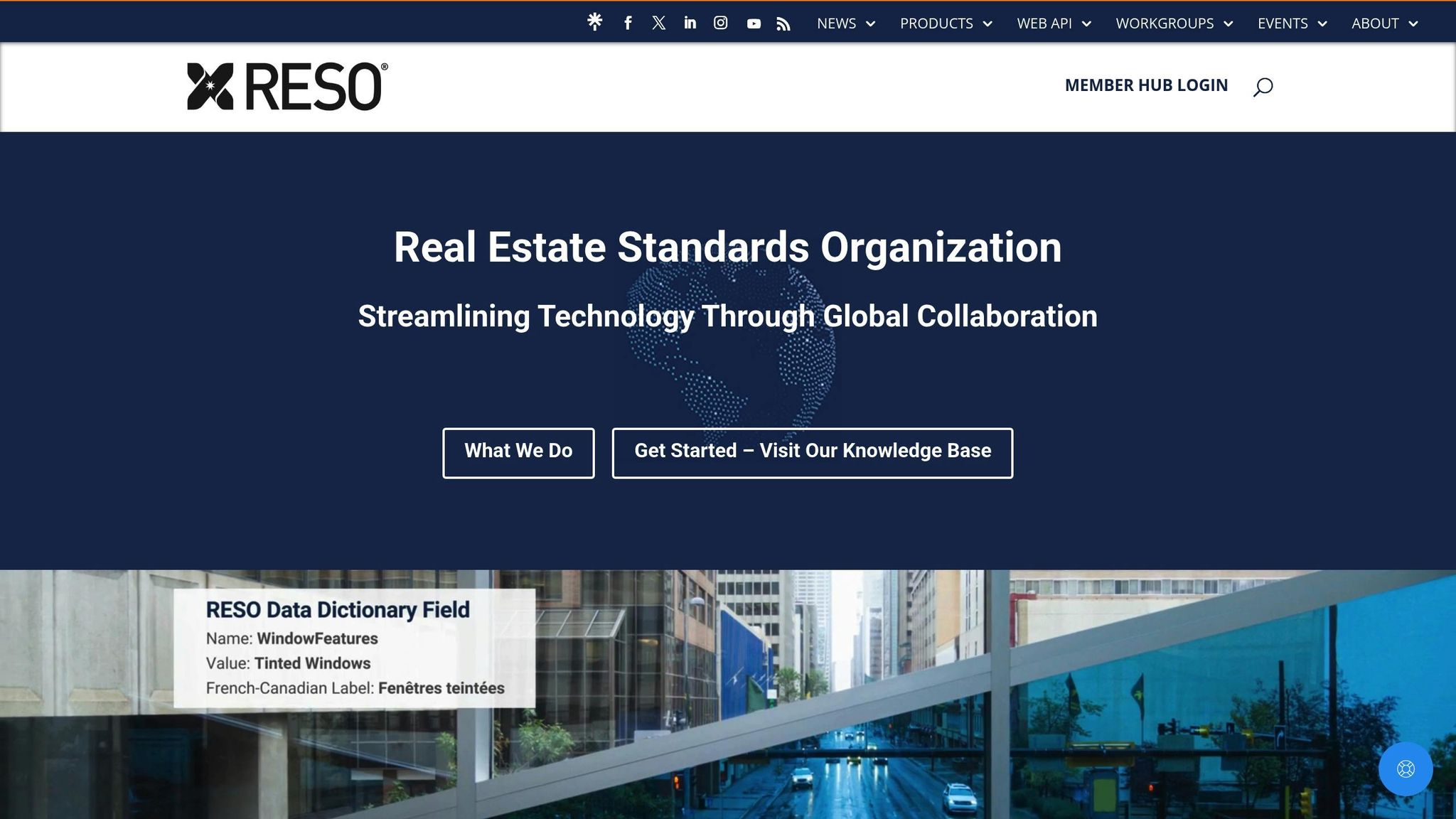
The dictionary even supports multi-language metadata, like French-Canadian translations, to accommodate international markets.
"Local market distinctions are preserved without sacrificing standardization." – RESO Staff
Benefits of Data Dictionaries in Real Estate
Standardized data doesn’t just tackle fragmentation – it also unlocks operational and analytical advantages across the real estate industry. Thanks to RESO’s collaborative effort involving over 800 member organizations, a comprehensive set of standardized fields and lookups benefits everyone, from individual agents to large-scale technology platforms.
Better Data Accuracy and Consistency
Data dictionaries help maintain accuracy by embedding standardized validation rules that enforce specific criteria – like acceptable value ranges and format requirements – during data entry. This ensures that poor data input doesn’t lead to unreliable outputs, which could otherwise undermine analytics or market reports. When all systems use the same definitions for fields like ListPrice or StandardStatus, property information remains consistent as it moves from MLSs to consumer-facing websites.
This unified approach ensures that a property listed with "Vinyl" fencing in one system will appear consistently across all connected platforms.
"A data dictionary serves as a single source of truth for all your business rules. This approach aids in curtailing inefficiencies, enhancing data quality and data integrity."
– Pradeep Sharma, Developer Relations, RudderStack
Easier Technology Integration
Standardization simplifies technology integration, cutting down on both timelines and costs. Technology providers can connect property data across thousands of tools without needing to create custom solutions for every market. By shifting from proprietary models to open standards, vendor lock-in is reduced, and innovative products can be onboarded more quickly.
The RESO Web API certification process further ensures that data partners meet consistent quality benchmarks, boosting confidence in integrations.
"The time and cost needed to create or onboard innovative products can be greatly reduced."
– RESO Staff
This efficiency also enhances real-time decision-making capabilities, which are crucial in a fast-paced industry.
Better Decision-Making and Analytics
With improved data accuracy and streamlined integration, standardized data elevates analytics to a new level. Clean, structured data enables real estate professionals to analyze markets more effectively and assess risks with greater precision. Standardized terms allow for accurate comparisons across datasets, while uniform data supports reliable predictive analytics. For example, investors can confidently compare similar assets, knowing that standardized definitions – like those for PoolFeatures – are applied consistently across listings.
Data lineage tracking, which shows where data originates and how it evolves, further builds trust in financial forecasts and strategic planning. This clarity also helps firms spot potential regulatory issues, improving risk management. Al McElmon, Senior Leader of Software & Data Engineering at CoreLogic, highlights the importance of uniformity:
"The more succinct and the more uniform that we can be across the industry, I think the better results you’re going to end up coming up with out of all this".
With access to current, standardized data, analysts can make real-time decisions without waiting for manual reconciliation between systems. In fast-moving markets, this speed can make all the difference in determining profitability.
sbb-itb-8058745
Case Studies: How Data Dictionaries Work in Practice
Standardized data has reshaped operations across the real estate industry, driving efficiency, reducing costs, and boosting returns on investment.
Streamlining Operations for Brokerages
Brokerages that adopt RESO-certified data standards have tackled inefficiencies caused by incompatible systems. This standardization ensures that property information flows seamlessly across MLSs, CRMs, and consumer-facing websites. Once listing data is entered, it stays consistent throughout the sales pipeline – from MLS entry to public display.
Switching from proprietary data models to open standards has slashed onboarding costs for new tools and eliminated the constraints of vendor lock-in. With the introduction of Data Dictionary 2.0, the industry has achieved a major step forward in data consistency. This ensures that fields and pick lists are uniformly defined across platforms. These improvements not only streamline operations but also create a solid foundation for future technological advancements.
Technology Advances Through Standardization
The adoption of standardized data dictionaries has allowed technology vendors to create products that function effortlessly across MLSs without needing custom integrations. This has cut development time and costs, accelerating innovation.
Developers gain confidence knowing that RESO-certified partners adhere to consistent quality standards. Meanwhile, the dictionary’s flexibility supports custom fields tailored to specific market needs while maintaining compatibility across systems. Beyond operational efficiency, the financial benefits for investors are equally impressive.
Increasing ROI for Investors
Real estate investors have seen notable financial returns by leveraging standardized data for smarter decision-making. For example, data standardization has reduced search times by up to 60% and rework by 50%, with some investors reporting a 750% ROI in the first year and a payback period of just 1.4 months.
In April 2025, Utopi Ltd, a technology firm, helped a client save $155,000 during the sale of a student accommodation asset. A consultant’s report had flagged the building’s heating system as “poor,” jeopardizing the deal. However, Utopi exported and analyzed two seasons of detailed heating data, revealing that the system efficiently adjusted temperatures in unoccupied rooms. This analysis avoided unnecessary upgrades and allowed the sale to proceed smoothly.
In another example, a hardware store franchise used standardized location data via ArcGIS Business Analyst tools to pinpoint a prime site in a crowded suburban market. By overlaying consumer spending data for home improvement with traffic patterns and competitor locations, the investor quickly identified a high-potential neighborhood. This led to a strategic site selection that optimized supply chain access and customer reach.
"Data isn’t just about tracking what’s happening – it’s about creating opportunities, safeguarding investments, and future-proofing assets."
– Ben Roberts, CMO and Co-Founder, Utopi Ltd
These examples highlight the power of standardized data. It enables investors to identify risks like stranded assets due to non-compliance with environmental or regulatory standards and take proactive steps to preserve marketability. Additionally, it ensures accurate property comparisons, helping avoid costly valuation errors.
BatchData‘s Role in Real Estate Data Solutions

Expanding on the importance of standardization, BatchData takes these principles to the next level by enhancing the quality of real estate data. The platform provides clean, standardized, and enriched data that seamlessly integrates into various workflows, enabling smarter decisions. With access to over 1,000 data points on more than 150 million U.S. properties, BatchData ensures the consistency that real estate professionals depend on.
Property and Contact Data Enrichment
BatchData enriches datasets sourced from top-tier providers, aligning with the Property and Member Resource structures outlined in the RESO Data Dictionary. By standardizing property and contact data with consistent fields and lookup values, BatchData ensures accuracy and reliability.
What sets BatchData apart is its use of real-time feedback from over 20,000 users. This ongoing feedback loop helps identify and correct inconsistencies quickly, much like the validation rules and format criteria used in data dictionaries. The result? Enhanced property and contact data that improves outreach efforts, ensures more accurate property comparisons, and minimizes costly valuation errors.
Developer-Friendly APIs for Seamless Integration
BatchData’s APIs are designed to simplify application development by providing standardized real estate data in an easy-to-use format. These APIs eliminate the need for extensive custom integration work, offering developers a streamlined way to work with interoperable data.
With structured data formats, developers can reduce both time and costs during the development process. The APIs offer access to tools like property search, phone verification, address validation, and bulk data delivery. This flexibility makes scaling applications easier as business needs evolve, delivering the same benefits that technology providers experience when adopting RESO-certified standards.
Scalable Data Solutions for Every Need
BatchData goes beyond standard offerings with bulk data delivery, skip tracing, and tailored services such as custom datasets and data pipelines. Its Pay-As-You-Go pricing model gives businesses the flexibility to access data as needed, while enterprise-level custom solutions are designed to handle more complex integration requirements.
Just as data dictionaries offer extensibility, BatchData provides customizable options for both nationwide data analysis and localized outreach. Whether the goal is to analyze property data on a national scale or enrich contact information for targeted campaigns, BatchData delivers adaptable solutions that meet diverse operational demands.
Conclusion: Why Data Dictionaries Matter in Real Estate
Key Takeaways
Standardization has reshaped how real estate data is managed, and data dictionaries are at the heart of this transformation. By turning disconnected, inconsistent data into a unified framework, tools like the RESO Data Dictionary have become essential. They ensure data accuracy and consistency across platforms, from MLS systems to consumer websites, while cutting down inefficiencies and integration costs.
For brokers, agents, developers, and investors, the benefits are clear: more reliable data, easier integrations, and better-informed decisions. By keeping property information aligned, data dictionaries eliminate the need for manual reconciliation. With over 800 organizations contributing to and refining these standards annually, the industry continues to evolve and improve.
The Future of Data Standardization
The push for standardization is gaining momentum, with the RESO Data Dictionary expanding its reach into international markets as the industry moves beyond outdated systems. Professionals who adopt these standards today are positioning themselves for success in the years ahead. Whether it’s through obtaining RESO certification, engaging in governance workgroups, or implementing standardized APIs, embracing data dictionaries is a step toward shaping the future of real estate.
These tools not only address current challenges but also pave the way for innovation. The result? A more competitive marketplace with a wider array of products, reduced development costs, and a solid foundation for advancing real estate technology. By adopting these standards, you’re not just solving today’s problems – you’re setting the stage to lead the industry into a smarter, more connected future.
FAQs
How do data dictionaries enhance real estate data accuracy?
A data dictionary acts as a go-to guide for defining key terms and formats in real estate data, such as “square footage,” “ownership type,” or “contact phone.” By standardizing these definitions and formats, it ensures that everyone – whether developers, brokers, or data providers – speaks the same "language." This consistency helps avoid misunderstandings, reduces errors in entries, and improves the quality of data before it even reaches a database.
When combined with automated validation tools, a data dictionary can enforce these rules in real time. For instance, it can catch duplicate property listings, standardize address formats, and confirm that critical fields like square footage or property addresses are filled out. The result? Cleaner, more reliable datasets that enable accurate analysis and quicker decision-making. Platforms like BatchData incorporate these principles into their property search APIs and data services, helping real estate professionals access precise and actionable information every time.
How does the RESO Data Dictionary improve real estate data standardization?
The RESO Data Dictionary serves as the real estate industry’s go-to reference for defining data fields, types, and values. It simplifies communication by standardizing terms – like using "squareFootage" instead of inconsistent labels such as "sq ft" – which eliminates confusion when sharing data among MLSs, brokers, and tech platforms. This standardization not only streamlines communication but also minimizes errors during data integration.
Managed by the Real Estate Standards Organization (RESO), the dictionary is frequently updated to reflect evolving market trends and regulations. Using these standards improves data accuracy, accelerates integration processes, and ensures consistent decision-making across the real estate landscape. By aligning its services with RESO standards, BatchData guarantees the data it delivers adheres to these essential industry guidelines.
Why is standardizing data essential for real estate technology systems?
Data standardization plays a key role in connecting real estate technology systems, allowing them to work together effortlessly. When platforms like MLSs, CRMs, and analytics tools use consistent field names, formats, and data types, they can share information without hiccups or the need for complicated adjustments. This consistency enables smoother real-time updates, automated workflows, and compliance checks, all while cutting down on tedious manual tasks.
It also boosts accuracy by making validation and cleaning processes more effective. For example, when details like addresses, square footage, or contact information follow a uniform format, automated tools can easily spot duplicates, verify data, and uphold industry standards. This level of reliability speeds up integration and ensures data functions consistently across all real estate tech platforms.